📋 Quick Summary
In this article:
1. Inflation Reduces Purchasing Power
2. Grocery Bills Can Rise
3. Housing Costs Can Put Pressure on Budgets
4. Transportation Costs Can Increase
5. Utilities and Household Services Become More Expensive
6. Inflation Can Make Saving More Difficult
7. Inflation Affects Emergency Funds
8. Cash Loses Purchasing Power During Inflation
9. Savings Account Interest Rates Matter
10. Inflation Changes Borrowing Costs
11. Credit Card Debt Becomes More Important
💡 Key Insight
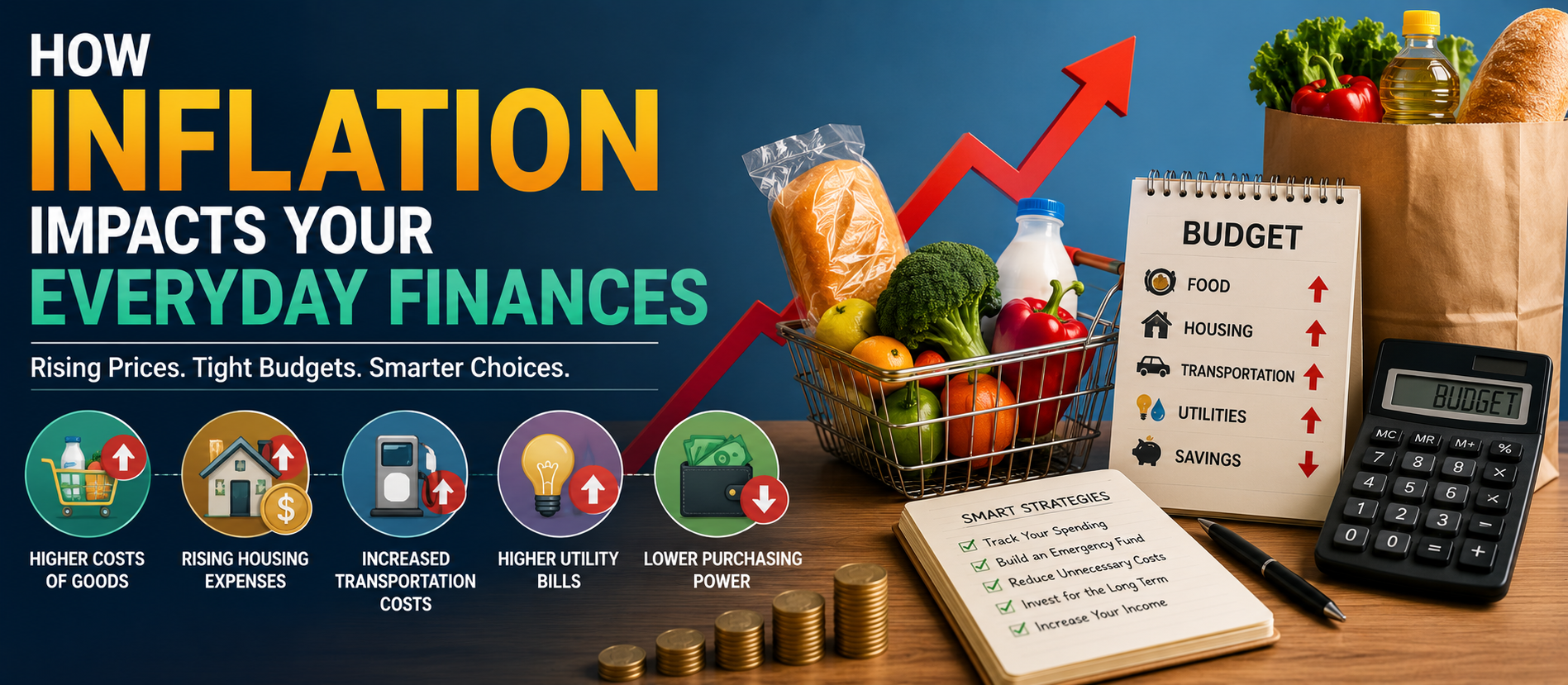
How inflation impacts your everyday finances is a question that matters whenever the cost of groceries, housing, transportation, utilities, insurance, services, and other essentials changes faster than household income. Inflation can gradually reduce purchasing power, change spending habits, affect savings goals, increase borrowing costs, and make long-term financial planning more difficult.
Inflation does not mean that every price rises at the same speed. It refers to a broad increase in the general price level of goods and services over time. The Federal Reserve explains that inflation is measured using price indexes that track groups of goods and services, including the Personal Consumption Expenditures price index and the Consumer Price Index. citeturn0search5turn0search7
Current U.S. household data show why the subject remains important. In the Federal Reserve's 2025 household survey, 58% of adults said changes in prices compared with the previous year had made their financial situation worse. The same survey found that 35% of adults reported higher monthly spending, compared with 32% reporting higher monthly income. citeturn0search0
The Federal Reserve's July 2026 Monetary Policy Report also noted that inflation had risen during 2026, with the PCE price index up 4.1% over the 12 months ending in May and core PCE up 3.4%. citeturn0search1turn0search2 These figures illustrate why households need a flexible approach to budgeting, saving, borrowing, and investing.
This guide explains the practical effects of inflation on everyday money decisions and provides strategies for protecting purchasing power without relying on unrealistic promises or one-size-fits-all financial rules.
This WordPress-ready HTML article is prepared for Digiifrog (www.digiifrog.com).
What Is Inflation?
Inflation is a sustained increase in the overall price level of goods and services. When inflation occurs, the same amount of money generally buys fewer goods and services than it did previously.
For example, if a household spends $100 on a particular basket of goods today and the same basket costs $105 later, the household needs 5% more money to purchase the same basket, assuming the basket itself has not changed.
Inflation is different from a temporary increase in one product's price. A single expensive item does not necessarily indicate broad inflation. Economists examine price changes across many categories to understand the overall trend.
1. Inflation Reduces Purchasing Power
The most direct effect of inflation is reduced purchasing power. If income remains unchanged while prices rise, a household's money covers fewer expenses.
This can happen even when the household does not feel that anything dramatic has changed. A small increase in groceries, fuel, utilities, subscriptions, insurance, and household services can add up over an entire year.
The practical response is to compare spending with income regularly instead of assuming that an old budget will remain accurate indefinitely.
2. Grocery Bills Can Rise
Food is one of the categories households notice quickly because groceries are purchased frequently. When food prices rise, consumers may change brands, reduce quantities, shop at different stores, or substitute less expensive products.
According to the Federal Reserve's 2025 household survey, 62% of adults said they had switched to cheaper products in response to higher prices, while 60% said they used less of or stopped using a product. citeturn0search0
A practical inflation strategy is to separate essential food spending from discretionary food spending. Comparing unit prices, planning meals, reducing waste, and choosing flexible substitutes can help control the impact without requiring extreme cuts.
3. Housing Costs Can Put Pressure on Budgets
Housing is often one of the largest household expenses. Inflation can affect rent, maintenance, utilities, insurance, property taxes, repairs, and other housing-related costs.
Renters may experience higher housing costs when market rents increase or when leases renew at higher rates. Homeowners may be less exposed to rent increases if they have a fixed-rate mortgage, but they still face changes in insurance, property taxes, utilities, maintenance, and repair costs.
The effect therefore depends heavily on the household's housing arrangement and location.
4. Transportation Costs Can Increase
Transportation is another area where inflation can affect everyday budgets. Fuel, vehicle prices, repairs, tires, insurance, public transportation, and maintenance can all change over time.
When transportation costs rise, households may respond by combining trips, using public transportation, carpooling, choosing more fuel-efficient vehicles, or postponing vehicle purchases.
Businesses can also pass transportation costs into the prices of goods and services, creating indirect effects beyond the household's own fuel bill.
5. Utilities and Household Services Become More Expensive
Electricity, heating, cooling, internet, repairs, cleaning, childcare, and other services can become more expensive when labor, energy, materials, or operating costs increase.
Because many of these expenses are recurring, even moderate price increases can materially affect annual spending. Reviewing recurring bills and eliminating unused services can create room in the budget without reducing essential consumption.
6. Inflation Can Make Saving More Difficult
If everyday expenses rise faster than income, households may have less money available for savings. The Federal Reserve reported that 41% of adults in its 2025 survey said they reduced savings in response to higher prices. citeturn0search0
Reduced saving can become a long-term problem because emergency funds, retirement contributions, education savings, and other goals depend on consistent contributions.
Instead of abandoning savings completely, households can review the amount, frequency, and priority of contributions. Even when the contribution amount changes temporarily, maintaining a savings habit can be valuable.
7. Inflation Affects Emergency Funds
An emergency fund is designed to cover unexpected expenses such as medical bills, repairs, job interruptions, or urgent travel. Inflation changes how much money a household may need to cover those expenses.
An emergency fund based on old spending levels may become less adequate as essential costs increase. Review the fund periodically against current monthly expenses rather than relying on an outdated target.
8. Cash Loses Purchasing Power During Inflation
Keeping money in cash provides liquidity and stability, but cash that earns little or no interest can lose purchasing power when inflation is higher than the return on the money.
This does not mean every dollar should be invested. Emergency savings and short-term spending money often need safety and liquidity. The important distinction is between money needed soon and money intended for long-term goals.
9. Savings Account Interest Rates Matter
Interest earned on savings can partially offset inflation. When interest rates rise, some deposit accounts may offer higher yields, although the rate available depends on the institution and account type.
Compare the actual annual percentage yield, fees, withdrawal rules, account protections, and access requirements instead of choosing an account based only on an advertised headline rate.
10. Inflation Changes Borrowing Costs
Inflation can influence monetary policy and broader interest rates. When inflation remains elevated, central banks may use tighter monetary policy to reduce demand and bring price growth down.
Higher interest rates can make credit cards, personal loans, auto loans, mortgages, and business borrowing more expensive. The Federal Reserve's July 2026 report described elevated inflation and noted that household consumption had slowed. citeturn0search1turn0search2
For consumers, this makes interest rates an important part of everyday financial planning.
11. Credit Card Debt Becomes More Important
Credit card balances can become especially expensive when interest rates are high. Carrying a balance from month to month can cause interest charges to consume money that could otherwise support savings or essential spending.
When possible, prioritize high-interest debt while maintaining enough cash for essential emergencies. Avoid taking on new revolving debt simply to maintain a lifestyle that has become unaffordable because of inflation.
12. Inflation Affects Major Purchases
Consumers may change the timing of major purchases when they expect prices to rise. The Federal Reserve's 2025 household survey found that 18% of adults said they had made a major purchase earlier than planned because they expected prices to increase. citeturn0search0
However, buying early is not automatically a smart financial decision. A purchase should still be evaluated based on need, financing cost, maintenance, useful life, and available cash.
13. Inflation Can Change Spending Habits
Inflation often encourages households to become more deliberate about spending. Common responses include switching brands, reducing consumption, delaying purchases, searching for discounts, and changing service providers.
The goal should not be to cut everything. A sustainable budget distinguishes between needs, priorities, and optional spending so that changes can be targeted where they have the least impact on quality of life.
14. Income May Not Rise at the Same Speed
A household can experience financial pressure even when income increases if expenses rise faster. This is why the difference between nominal income growth and real purchasing power matters.
If wages rise 4% while a household's relevant expenses rise 6%, the household may feel financially worse off despite receiving a raise.
Workers can respond by improving skills, negotiating compensation where appropriate, developing additional income sources, or changing jobs when economically sensible. However, income strategies should be balanced against job stability, time, taxes, and personal circumstances.
15. Inflation and Retirement Planning
Inflation is especially important for long-term retirement planning because retirement may last decades. A fixed amount of money can purchase substantially less in the future if prices continue to rise.
Retirement planning therefore needs assumptions about future spending, inflation, investment returns, taxes, healthcare, housing, and longevity. Using only today's expenses without considering future purchasing power can lead to unrealistic estimates.
16. Inflation Affects Investment Decisions
Inflation can influence stocks, bonds, real estate, commodities, cash, and other assets differently. Some investments may perform well during particular inflation environments, while others may face pressure from higher interest rates or weaker economic growth.
A diversified portfolio should be built around the investor's time horizon, risk tolerance, goals, and need for liquidity rather than a simple assumption that one asset will always beat inflation.
17. Real vs. Nominal Financial Returns
Nominal return is the stated return before adjusting for inflation. Real return considers the change in purchasing power.
For example, an investment that earns 7% while inflation is 3% has a rough inflation-adjusted return of about 4% before taxes and other costs. The exact real return is calculated more precisely using the relationship between the nominal return and inflation rate.
This distinction helps investors understand whether their money is actually gaining purchasing power.
18. Inflation and Everyday Budgeting
A budget should be a living document rather than a fixed spreadsheet that is never updated. During inflationary periods, review major spending categories at least periodically.
- Track essential monthly expenses.
- Compare current spending with the previous year.
- Separate fixed costs from flexible costs.
- Review recurring subscriptions and services.
- Adjust savings targets when necessary.
- Prioritize high-interest debt.
- Keep emergency savings accessible.
- Review insurance and major household costs.
19. How to Protect Your Purchasing Power
There is no single strategy that eliminates inflation risk. A practical approach combines expense management, appropriate cash reserves, productive use of savings, diversified long-term investments, and income planning.
Consumers should also avoid panic buying, excessive borrowing, speculative investments, or financial decisions based only on headlines about inflation.
20. Inflation and Financial Stress
Inflation is not only a mathematical issue. Higher prices can create financial stress when households struggle to cover bills or unexpected expenses. The Federal Reserve's 2025 household report found that many adults experienced major unexpected expenses, while those struggling with bills commonly responded by cutting other expenses or paying bills late. citeturn0search3
A realistic financial plan should therefore include flexibility. A budget that leaves no room for unexpected price increases can become difficult to maintain.
21. Build an Inflation-Resistant Household Budget
Start with essential expenses such as housing, food, utilities, transportation, insurance, healthcare, and minimum debt payments. Then identify discretionary expenses and long-term financial goals.
Next, create a small buffer for price changes. This does not need to be large. Even a modest margin can prevent a small increase in groceries or utilities from immediately becoming a debt problem.
Review the budget whenever a major recurring cost changes rather than waiting for an annual review.
22. SEO, AEO, GEO and AI Search for Personal Finance Content
SEO can help financial websites reach people searching for inflation, budgeting, saving money, purchasing power, household expenses, and financial planning.
AEO focuses on answering direct questions such as “How does inflation affect my budget?”, “Why does inflation reduce purchasing power?”, and “How can I protect my savings from inflation?”
GEO and AI Search optimization benefit from clear definitions, concise answers, trustworthy sources, practical examples, structured headings, and current data. Financial content should clearly distinguish general education from individualized financial advice.
For local businesses, location-specific content can explain how inflation affects household expenses, housing costs, wages, transportation, or services in a particular city or region.
23. Practical Inflation Checklist
- Review your monthly spending.
- Identify categories with the fastest increases.
- Compare income growth with expense growth.
- Protect an emergency cash reserve.
- Review savings account yields.
- Pay attention to high-interest debt.
- Reassess major purchases before borrowing.
- Review long-term investment diversification.
- Update retirement spending assumptions.
- Avoid panic-driven financial decisions.
Frequently Asked Questions About Inflation and Everyday Finances
How does inflation affect everyday finances?
Inflation can make everyday goods and services more expensive, reducing purchasing power and potentially leaving households with less money available for savings, debt repayment, and discretionary spending.
Why does inflation reduce purchasing power?
When the general price level rises, the same amount of money buys fewer goods and services. The effect is most noticeable when income does not increase as quickly as relevant household expenses.
How can I protect my budget from inflation?
Track spending, prioritize essential costs, maintain an emergency fund, review recurring expenses, manage high-interest debt, and adjust savings and investment plans according to your goals and risk tolerance.
Does inflation affect savings?
Yes. If the return earned on savings is below the inflation rate, the money may lose purchasing power over time. However, cash and savings remain important for emergencies and short-term needs.
Does inflation affect investment returns?
Yes. Inflation can influence asset prices, interest rates, company costs, bond values, real estate income, and consumer demand. Investors should evaluate both nominal and inflation-adjusted returns.
Should I buy things early because of inflation?
Not automatically. Buying early may make sense for a necessary purchase when a price increase is highly likely, but unnecessary purchases or expensive borrowing can create greater financial costs than waiting.
Conclusion
Inflation impacts everyday finances by changing what money can buy, how much households spend, how much they can save, and how expensive borrowing becomes. Its effects can appear in groceries, housing, transportation, utilities, insurance, services, credit cards, savings accounts, investments, and retirement planning.
The most effective response is not to predict every future price. Instead, build financial flexibility. Track spending, protect emergency savings, manage expensive debt, review recurring costs, maintain appropriate long-term investments, and update financial goals as household circumstances change.
Current Federal Reserve household data show that price changes continue to influence consumer behavior, with many adults reporting spending adjustments and reduced savings. citeturn0search0 That makes flexible budgeting especially valuable when prices or income are changing.
For businesses, financial publishers, real estate companies, and service providers seeking modern websites, content marketing, automated lead generation, SEO, AEO, GEO, and AI Search optimization, Digiifrog can help. Visit www.digiifrog.com.
Quick Answer: How Does Inflation Impact Your Everyday Finances?
Inflation reduces purchasing power by making goods and services more expensive. It can increase household spending, reduce savings capacity, raise borrowing costs, change investment returns, and make long-term goals such as buying a home or funding retirement more difficult to plan. The best response is to monitor expenses, maintain financial reserves, manage debt carefully, and regularly update your financial plan.
Important Note
Inflation rates, interest rates, prices, wages, and financial conditions change over time and differ by country, region, household, and spending pattern. This article is educational content, not individualized financial, investment, tax, or legal advice. Use current data and qualified professional advice when making significant financial decisions.
Ready to Grow?
Talk to us about a strategy tailored to your brand — we will help you stand out in search, AI discovery and social.
Comments (0)
Log in to leave a comment.