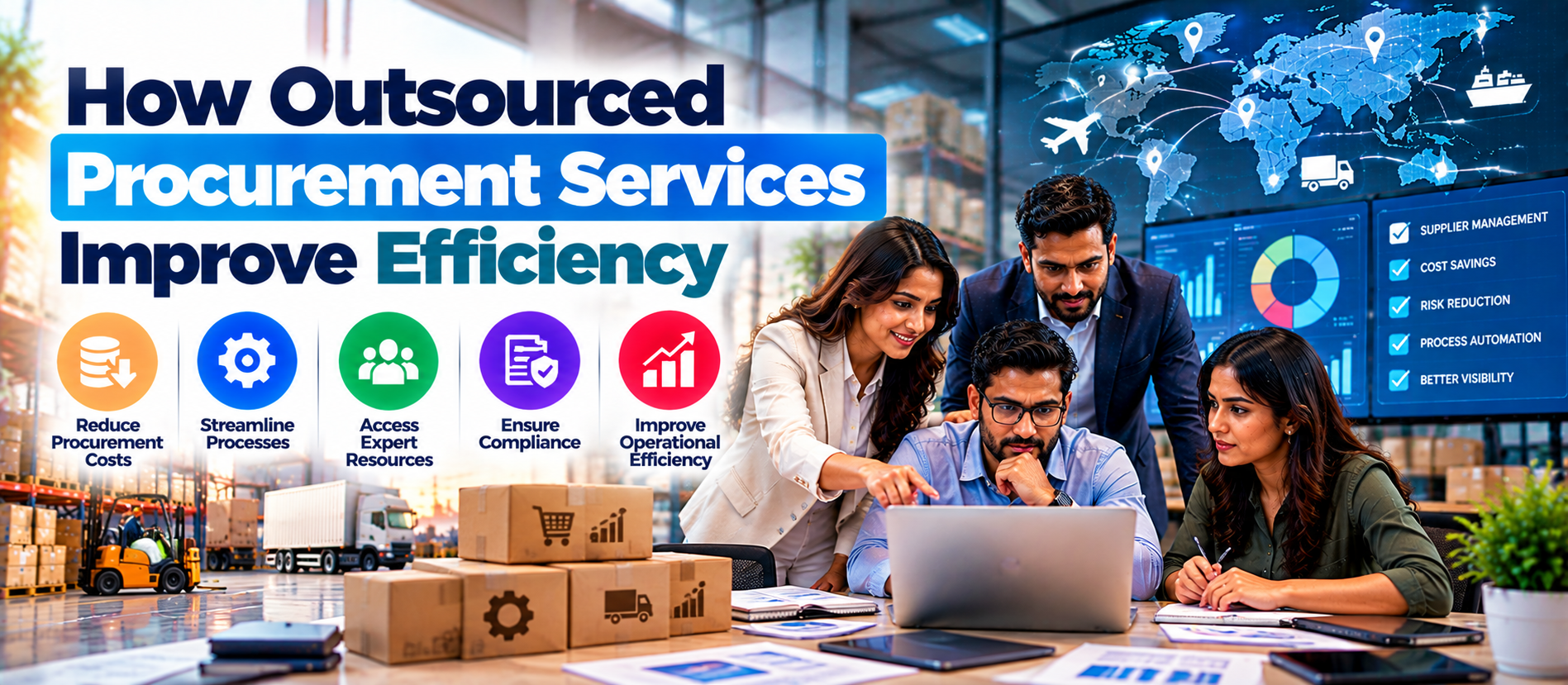
📋 Quick Summary
In this article:
What Are Outsourced Procurement Services?
Why Procurement Efficiency Matters
1. Access to Specialized Procurement Expertise
2. Reduce Procurement Processing Time
3. Improve Strategic Sourcing
4. Lower Procurement Costs
5. Improve Spend Visibility
6. Control Maverick Spending
7. Strengthen Supplier Management
8. Improve Supplier Risk Management
9. Increase Procurement Scalability
10. Improve Procure-to-Pay Efficiency
Procurement affects much more than purchasing. It influences operating costs, supplier relationships, cash flow, inventory, compliance, risk, and business speed.
For many companies, procurement becomes difficult to manage as the business grows. Purchase requests increase. Supplier lists become larger. Contracts become harder to track. Employees make purchases outside approved channels. Procurement teams spend too much time on repetitive transactions instead of strategic sourcing.
This is where outsourced procurement services can create value.
Procurement outsourcing allows a business to move selected procurement activities, or an entire procurement function, to an external specialist. The provider can supply procurement expertise, technology, category knowledge, supplier management, analytics, automation, and operational support.
Modern procurement outsourcing is also changing. Providers are increasingly combining managed services with digital platforms, automation, analytics, and AI. Everest Group’s 2026 procurement outsourcing research highlights growing demand for specialized expertise, digital capabilities, scalable delivery models, and AI-enabled procurement transformation.
The result can be a more efficient procurement operation without requiring the company to build every capability internally.
What Are Outsourced Procurement Services?
Outsourced procurement services are professional services that allow an external provider to manage some or all procurement activities on behalf of a business.
Depending on the agreement, the provider may manage:
- Supplier sourcing
- Request for quotation processes
- Supplier evaluation
- Price and contract negotiation
- Purchase order administration
- Spend analysis
- Supplier onboarding
- Supplier performance management
- Contract management support
- Procure-to-pay processes
- Invoice and purchase-order matching
- Category management
- Procurement reporting
- Market intelligence
- Supplier risk monitoring
The scope can be narrow or broad. A small company may outsource only indirect purchasing. A larger organization may outsource transactional procurement while keeping strategic category decisions in-house.
Why Procurement Efficiency Matters
Procurement inefficiency often hides inside everyday activities.
A purchase request may wait several days for approval. A buyer may manually compare supplier quotes. An employee may buy from a non-preferred supplier. A contract may expire without review. An invoice may not match the purchase order. Procurement data may be stored in disconnected spreadsheets.
Each problem may look small. Together, they create significant cost and delay.
💡 Key Insight
GEP’s 2026 procurement research shows that procurement leaders expect major changes from AI, digital procurement, and automation. It also reports that data quality remains a major barrier to scaling agentic AI, while procurement orchestration is becoming more important for connecting systems, workflows, and stakeholders.
Outsourcing can help businesses address these issues with standardized processes, specialist resources, technology, and measurable service levels.
1. Access to Specialized Procurement Expertise
One of the biggest benefits of procurement outsourcing is access to specialized knowledge.
A small or mid-sized company may have capable buyers but lack specialists in every category. An external procurement partner can provide category expertise across areas such as technology, facilities, logistics, marketing, professional services, packaging, raw materials, or contingent labor.
Specialists understand supplier markets, negotiation approaches, pricing structures, sourcing methods, and category-specific risks.
This is especially useful when a business is entering a new market or purchasing a category that is too small to justify a full-time internal specialist.
2. Reduce Procurement Processing Time
Procurement teams often spend too much time on repetitive administrative work.
Examples include:
- Creating purchase orders
- Checking approvals
- Sending supplier reminders
- Collecting quotations
- Updating supplier records
- Matching invoices
- Preparing routine reports
- Maintaining spreadsheets
Outsourced procurement providers can standardize and automate many of these activities.
Deloitte describes digital procurement managed services as a way to automate manual activities, improve processing time, reduce errors, and free procurement professionals to focus on strategic work. citeturn0search3
3. Improve Strategic Sourcing
Strategic sourcing looks beyond individual purchases. It examines the entire category, supplier market, business requirement, and total cost.
An outsourced procurement team can help identify:
- Alternative suppliers
- Competitive sourcing opportunities
- Volume consolidation opportunities
- Contract renegotiation opportunities
- Specification changes
- Supplier performance gaps
- Potential supply risks
This turns procurement from a reactive purchasing function into a proactive business capability.
External providers can also bring sourcing benchmarks and experience from similar categories, helping internal teams make better-informed decisions.
4. Lower Procurement Costs
Cost reduction is an important reason businesses outsource procurement, but the benefit should not be measured only through negotiated price reductions.
Outsourcing can reduce cost through:
- Better supplier negotiations
- Supplier consolidation
- Competitive bidding
- Spend visibility
- Reduced maverick spending
- Lower transaction costs
- Better contract compliance
- Automation of repetitive work
- Reduced internal procurement overhead
McKinsey notes that procurement outsourcing can provide access to scale, expertise, demand aggregation, and lower-cost transaction processing. It also emphasizes that the business case depends on clear value drivers, appropriate scope, and well-designed incentives.
5. Improve Spend Visibility
You cannot optimize spending that you cannot see.
Many organizations have fragmented procurement data. Purchases may be distributed across departments, suppliers, business units, locations, cards, and different systems.
An outsourced procurement provider can help classify and analyze spend to identify:
- Top suppliers
- High-spend categories
- Duplicate suppliers
- Non-contract purchases
- Off-contract spending
- Price differences
- Unused contracts
- Consolidation opportunities
Better visibility creates a stronger foundation for sourcing decisions.
6. Control Maverick Spending
Maverick spending occurs when employees purchase outside approved suppliers, contracts, or procurement processes.
It can happen because the approved process is slow, employees do not know which supplier to use, or purchasing controls are difficult to follow.
Outsourced procurement teams can combine approved supplier catalogs, procurement workflows, approval rules, contract visibility, and monitoring to improve compliance.
McKinsey identifies maverick spending and procurement value leakage as important areas where better controls, visibility, and automated matching can preserve procurement value.
7. Strengthen Supplier Management
Supplier management is more than negotiating price.
Businesses also need to monitor quality, delivery, responsiveness, capacity, financial health, compliance, and risk.
Outsourced procurement services can establish supplier scorecards and regular performance reviews.
Typical supplier KPIs include:
- On-time delivery
- Quality performance
- Contract compliance
- Response time
- Cost performance
- Issue resolution time
- Service-level achievement
This creates a consistent supplier-management process instead of relying on individual buyer relationships.
8. Improve Supplier Risk Management
Supply disruption can affect production, customer delivery, revenue, and reputation.
Modern procurement therefore needs to consider risk alongside cost.
Gartner’s 2026 procurement guidance places supplier risk management at a much higher priority because businesses operate in a volatile environment influenced by AI, economic uncertainty, and geopolitics.
An outsourced procurement provider can help monitor supplier risk across areas such as:
- Financial stability
- Geographic exposure
- Single-source dependency
- Capacity constraints
- Compliance
- Cybersecurity where relevant
- Geopolitical exposure
- Operational disruption
For critical categories, providers can also help identify alternative suppliers and develop contingency plans.
9. Increase Procurement Scalability
Procurement workload can change quickly.
A business may enter a new market, launch a product, acquire another company, open new facilities, or experience rapid growth.
Hiring and training an internal procurement team for every change is slow.
Outsourced procurement provides a more flexible model. The business can increase or reduce support based on volume, categories, geography, or business requirements.
Everest Group’s 2026 research highlights modular and flexible procurement outsourcing models as providers expand their services to support different transformation and operating needs.
10. Improve Procure-to-Pay Efficiency
Procurement efficiency does not end when a supplier is selected. The business also needs an efficient procure-to-pay process.
A streamlined process can connect:
- Purchase request
- Approval
- Purchase order
- Supplier confirmation
- Goods or service receipt
- Invoice
- Three-way matching
- Payment
- Reporting
Automation can reduce manual handoffs and help identify exceptions.
This improves speed and reduces the risk of paying incorrect invoices or purchasing outside approved agreements.
11. Use Procurement Automation
Technology is a major part of modern procurement outsourcing.
Automation can support:
- Purchase requisition routing
- Purchase order creation
- Approval workflows
- Supplier onboarding
- Invoice matching
- Contract alerts
- Supplier reminders
- Spend classification
- Reporting
- Exception management
GEP’s 2026 research shows that procurement outsourcing is increasingly combining automation with agentic AI. Automation handles predictable tasks, while newer AI capabilities can assess context, identify risks, and trigger actions within defined limits.
12. Apply AI to Procurement Workflows
AI is changing procurement from a reporting function into a more intelligent decision-support function.
Potential AI use cases include:
- Spend classification
- Supplier risk analysis
- Contract analysis
- Demand forecasting
- Market intelligence
- Quote comparison
- Purchase recommendations
- Supplier performance analysis
- Invoice anomaly detection
- Procurement knowledge assistants
McKinsey describes agentic AI as a major shift in procurement because AI can potentially move beyond analysis into multi-step execution, while human teams remain responsible for strategic decisions and governance.
13. Improve Procurement Data Quality
Procurement technology depends on good data.
Common problems include duplicate supplier records, inconsistent category names, outdated contracts, missing purchase-order information, incorrect prices, and incomplete supplier profiles.
An outsourced provider can help standardize procurement data and establish data-quality processes.
Clean data improves spend analysis, supplier comparison, reporting, automation, and AI performance.
14. Improve Contract Compliance
A negotiated contract creates value only when employees and suppliers actually follow it.
Procurement providers can monitor:
- Contract expiration dates
- Agreed pricing
- Volume commitments
- Service levels
- Renewal terms
- Supplier obligations
- Payment terms
Contract analytics can also help identify opportunities for renegotiation and detect potential value leakage.
15. Reduce Procurement Errors
Manual procurement processes create opportunities for errors.
An employee may enter the wrong quantity. A buyer may use an outdated price. An invoice may be paid without the correct approval. A supplier record may contain incorrect information.
Standardized workflows and automated validation can reduce these problems.
Deloitte reports that digital procurement managed services can use automation and intelligent document processing to reduce manual processing and improve accuracy.
16. Free Internal Teams for Strategic Work
Internal procurement professionals should spend more time on high-value activities.
These can include:
- Category strategy
- Supplier innovation
- Business stakeholder engagement
- Negotiation
- Risk management
- Strategic sourcing
- Demand management
- Long-term supplier development
When routine tasks are outsourced, internal employees can focus on decisions that require business knowledge and judgment.
17. Improve Internal Stakeholder Experience
Procurement can become unpopular when employees view it as slow or complicated.
A better procurement service should make buying easier while maintaining appropriate controls.
Useful improvements include:
- Simple purchase request forms
- Pre-approved catalogs
- Clear supplier choices
- Fast approval workflows
- Self-service procurement
- Transparent order status
- Easy support channels
GEP’s 2026 research identifies stakeholder experience as one of the areas procurement transformation can improve alongside productivity, savings, and decision-making.
18. Gain Access to Procurement Technology Without Building Everything Internally
Advanced procurement technology can require significant investment, implementation effort, integration work, and specialist skills.
Outsourcing can allow businesses to access established platforms and procurement capabilities without building the entire infrastructure internally.
This can be particularly useful for organizations that need better procurement capabilities but do not have the resources to build a large technology and analytics team.
19. Improve Procurement Reporting and Analytics
Procurement reports should support decisions, not simply describe past activity.
Useful dashboards can show:
- Total spend
- Spend by category
- Spend by supplier
- Contract coverage
- Maverick spending
- Sourcing savings
- Supplier performance
- Purchase-order cycle time
- Invoice exceptions
- Risk exposure
With better analytics, management can identify where procurement performance is improving and where intervention is needed.
20. Support Better Category Management
Category management organizes procurement around groups of similar products or services.
For each category, the team can examine demand, market conditions, suppliers, pricing, specifications, risk, and business requirements.
Outsourced category specialists can bring expertise to categories where the internal team lacks depth.
This approach is especially valuable for high-spend or high-risk categories.
21. Improve Procurement Negotiations
Experienced procurement professionals understand how to prepare for negotiations.
Preparation can include:
- Spend analysis
- Supplier benchmarking
- Market research
- Alternative supplier identification
- Volume analysis
- Total-cost analysis
- Contract review
- Negotiation objectives
Better preparation can improve commercial outcomes while protecting supplier relationships.
22. Procurement Outsourcing vs In-House Procurement
| Factor Outsourced ProcurementIn-House Procurement | ||
| Expertise | Access to external specialists | Built internally |
| Scalability | Flexible based on scope | Requires internal capacity |
| Technology | Provider may supply platforms and tools | Company funds and manages technology |
| Control | Shared according to contract | Direct internal control |
| Best fit | Businesses needing flexible capability | Organizations with mature internal teams |
The choice is not always either/or. A hybrid procurement model can keep strategic decisions in-house while outsourcing transactional purchasing, selected categories, analytics, or supplier administration.
23. How to Choose an Outsourced Procurement Provider
Choosing the right provider is critical. Businesses should evaluate more than price.
- Category expertise: Does the provider understand your major spend categories?
- Industry knowledge: Can it work within your regulatory and operational environment?
- Technology: What procurement platforms, analytics, automation, and AI capabilities are available?
- Supplier network: Can the provider identify credible suppliers?
- Geographic coverage: Does it support your locations and markets?
- Data security: How will procurement and supplier data be protected?
- Governance: Who owns decisions, approvals, and escalations?
- KPIs: How will efficiency and savings be measured?
- Pricing: Is the commercial model transparent?
- Transition: What is the implementation and knowledge-transfer plan?
24. Define Procurement Outsourcing KPIs
| Objective Example KPI | |
| Speed | Purchase request cycle time |
| Cost | Procurement savings or cost avoidance |
| Compliance | Preferred-supplier spend percentage |
| Supplier quality | Supplier defect or service issue rate |
| Delivery | On-time supplier delivery |
| Automation | Percentage of transactions processed automatically |
| Data | Spend classification accuracy |
| Experience | Internal stakeholder satisfaction |
Do not measure the provider only on negotiated savings. Efficiency, compliance, risk, service quality, and stakeholder experience should also be considered.
25. Build Strong Governance
Outsourcing does not mean giving away responsibility.
The business should define clear governance rules. These should cover approval authority, supplier selection, contract ownership, data access, savings validation, escalation, performance reviews, and strategic decisions.
A monthly or quarterly governance meeting can review performance, risks, savings, service issues, and improvement opportunities.
26. Use a Phased Procurement Outsourcing Model
Businesses do not need to outsource everything on day one.
A phased approach can start with a specific category or process.
Phase 1: Spend analysis and process assessment.
Phase 2: Outsource selected transactional or indirect procurement activities.
Phase 3: Add strategic sourcing and category management.
Phase 4: Integrate automation, analytics, and AI.
Phase 5: Expand based on measured results.
This approach reduces implementation risk and makes it easier to demonstrate value.
27. Common Mistakes in Procurement Outsourcing
- Outsourcing without clear objectives: Define the expected business outcome first.
- Choosing the cheapest provider: Capability and governance matter.
- Ignoring data quality: Poor data reduces the value of analytics and AI.
- Outsourcing strategic decisions blindly: Keep critical business judgment where it belongs.
- Using weak KPIs: Measure savings, efficiency, risk, compliance, and service.
- Skipping stakeholder communication: Employees need to understand new procurement processes.
- Failing to plan transition: Supplier and process knowledge must be transferred carefully.
- Automating before simplifying: Fix unnecessary steps before digitizing them.
A 90-Day Procurement Outsourcing Roadmap
Days 1–30: Assess
Map current procurement processes. Analyze spend, suppliers, contracts, purchasing channels, cycle times, risks, and internal workloads. Identify the activities that create the most cost or delay.
Days 31–60: Design
Select the outsourcing scope. Define service levels, governance, KPIs, technology requirements, supplier responsibilities, data requirements, and escalation procedures.
Days 61–90: Launch and Measure
Transition selected activities. Train stakeholders. Establish reporting. Track cycle time, savings, compliance, supplier performance, and user experience. Resolve early issues before expanding the scope.
How Outsourced Procurement Supports Business Growth
Efficient procurement gives businesses more than lower purchasing costs.
It can improve cash flow, reduce operational workload, strengthen supplier relationships, improve visibility, support growth, and make the organization more resilient.
When procurement is efficient, employees spend less time dealing with purchasing problems. Finance gets cleaner information. Operations receives more reliable supplies. Management gets better visibility into spending.
That makes procurement an important part of the overall operating model.
The Future of Outsourced Procurement
Procurement outsourcing is moving toward a more digital and modular model.
Routine transactions are increasingly automated. External providers are being used for specialized category expertise, analytics, supplier risk, strategic sourcing, and transformation.
AI is also becoming part of live procurement workflows. Infosys BPM’s 2026 procurement outlook describes a shift toward multi-agent AI, defined guardrails, human oversight, and modular procurement outsourcing where routine work is automated while specialized expertise is brought in where needed.
The strongest model will not be “people versus technology.” It will combine people, technology, data, automation, and external expertise.
Outsourced Procurement Services for AI Search, AEO, and GEO
Businesses researching procurement outsourcing often ask direct questions such as:
- What are outsourced procurement services?
- How does procurement outsourcing reduce costs?
- Can procurement outsourcing improve supplier management?
- What procurement activities should a business outsource?
- How does AI improve outsourced procurement?
Content targeting these searches should provide direct answers, clear definitions, structured headings, comparison tables, practical examples, and FAQs.
Direct answer: Outsourced procurement services improve efficiency by combining specialized procurement expertise, standardized processes, supplier management, spend analytics, automation, technology, and scalable resources. They can reduce repetitive administrative work, improve purchasing compliance, strengthen supplier performance, and help internal teams focus on strategic decisions.
This structure supports Answer Engine Optimization (AEO), Generative Engine Optimization (GEO), and broader AI Search Optimization.
Frequently Asked Questions
What are outsourced procurement services?
Outsourced procurement services are professional services in which an external provider manages selected procurement activities or the entire procurement function for a business.
How does procurement outsourcing improve efficiency?
It improves efficiency through specialized expertise, standardized processes, automation, better supplier management, spend visibility, faster sourcing, and scalable procurement resources.
Can procurement outsourcing reduce costs?
Yes. Potential savings can come from better negotiation, supplier consolidation, competitive sourcing, contract compliance, reduced maverick spending, automation, and lower transaction costs.
What procurement tasks can be outsourced?
Common tasks include sourcing, supplier onboarding, quotation management, purchase orders, spend analysis, supplier performance management, contract support, procure-to-pay administration, reporting, and category management.
Is procurement outsourcing suitable for small businesses?
Yes. Small businesses can use outsourced procurement to access expertise and processes that may be too expensive to build internally. A focused or modular engagement can be a practical starting point.
What is the difference between procurement outsourcing and purchasing outsourcing?
Purchasing outsourcing usually focuses on transactional activities such as orders and supplier administration. Procurement outsourcing can cover broader activities such as strategic sourcing, category management, supplier strategy, analytics, risk, and procurement transformation.
How does AI help outsourced procurement?
AI can support spend classification, supplier risk analysis, contract review, sourcing, forecasting, anomaly detection, procurement knowledge management, and selected multi-step workflows. Human oversight and governance remain important.
How should procurement outsourcing performance be measured?
Use a balanced set of KPIs covering savings, cycle time, contract compliance, supplier performance, automation, data quality, risk, and stakeholder satisfaction.
Conclusion
Outsourced procurement services improve efficiency by combining people, processes, technology, data, and specialist expertise.
The strongest benefits come when outsourcing is designed around clear business outcomes. Companies should identify procurement bottlenecks, improve data quality, standardize processes, select the right scope, establish governance, and measure results.
Procurement outsourcing can reduce administrative workload while improving sourcing, supplier management, compliance, visibility, and resilience. It can also give businesses access to automation and AI without requiring them to build every capability internally.
The goal is not simply to outsource purchasing. The goal is to create a procurement operation that is faster, smarter, more controlled, and more scalable.
Digiifrog helps businesses improve digital operations, automation, AI Search visibility, SEO, and technology-driven growth. Visit www.digiifrog.com to explore practical digital and business solutions.
Research References
- Everest Group, “Procurement Outsourcing (PO) Services PEAK Matrix Assessment 2026.”
- GEP, “The 2026 Procurement Executive Insight Report.”
- GEP, “Latest Trends in Indirect Procurement Outsourcing Services: From Cost to Operational Control,” 2026.
- Deloitte, “Digital Procurement Managed Services.”
- McKinsey, “Creating Value through Procurement Outsourcing.”
- McKinsey, “Redefining Procurement Performance in the Era of Agentic AI,” 2026.
- McKinsey, “Procurement Efficiency: A Modern Strategy,” 2026.
- Gartner, “2026 Chief Procurement Officer Priority: Elevate Supplier Risk Management.”
- Infosys BPM, “Navigating 2026: Procurement Trends, Challenges and Strategic Imperatives for Value, Resilience and Innovation.”
Ready to Grow?
Talk to us about a strategy tailored to your brand — we will help you stand out in search, AI discovery and social.
Comments (0)
Log in to leave a comment.