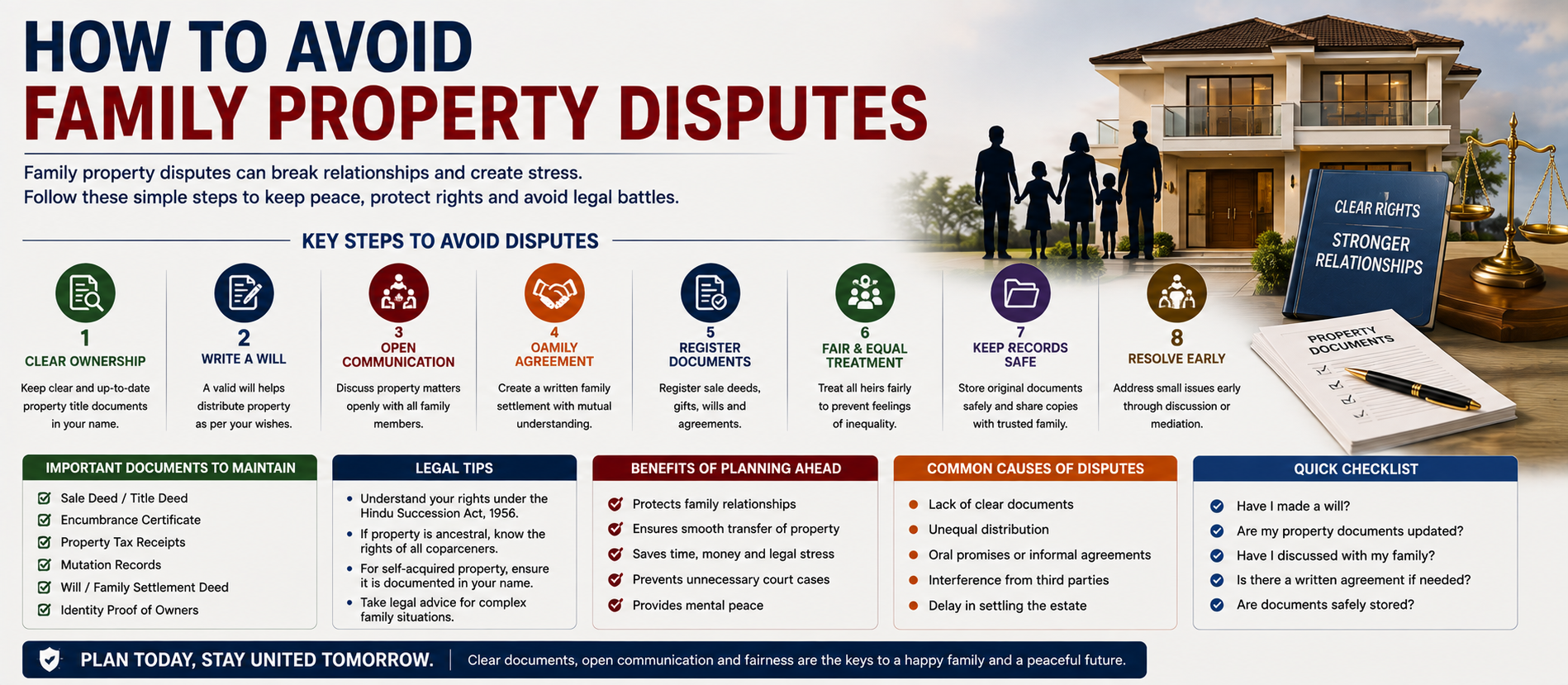
📋 Quick Summary
In this article:
Why Do Family Property Disputes Happen?
Step 1: Identify the Exact Type of Property
Self-Acquired Property
Ancestral or Coparcenary Property
Step 2: Keep Ownership Documents Complete and Organized
Important Documents May Include:
Step 3: Do Not Rely Only on Oral Promises
Step 4: Prepare a Clear and Valid Will Where Appropriate
A Good Will Should Clearly Address:
Step 5: Understand the Difference Between a Will and a Present Transfer
Step 6: Use a Properly Drafted Family Settlement When the Family Has Reached Agreement
⚠ Watch Out
Focus Keyword: How to Avoid Family Property Disputes
Family property can represent years of hard work, savings and emotional attachment. Unfortunately, it can also become a major source of conflict. Disputes may begin after the death of a family member, during a proposed sale, when siblings disagree about inheritance, or when ownership records are unclear.
Most family property disputes do not begin in a courtroom. They often begin much earlier with poor communication, unclear ownership, missing documents, informal promises or different expectations.
The good news is that many disputes can be reduced or avoided through planning. Clear documents, honest communication and timely legal advice can protect both property and family relationships.
This India-focused guide explains how to avoid family property disputes using simple and practical steps. It covers ownership records, wills, succession, partition, family settlements, nomination, documentation, mediation and common mistakes.
Digiifrog creates clear, structured and search-friendly legal and business content using SEO, AEO, GEO and AI Search Optimization.
Why Do Family Property Disputes Happen?
Property disputes usually arise because family members do not have the same understanding of ownership or inheritance.
Common causes include:
- No clear will or succession plan.
- Unclear title documents.
- Property purchased in one person's name but paid for by another.
- Oral promises that were never properly documented.
- Confusion between self-acquired and joint or ancestral property.
- Unequal expectations among children or other relatives.
- Informal family arrangements.
- Old revenue or municipal records that do not match current ownership.
- Unauthorized transfers or disputed signatures.
- Delay in updating records after death or transfer.
The best prevention strategy is simple: do not leave important ownership questions unanswered.
Step 1: Identify the Exact Type of Property
Before planning a transfer or division, understand what type of property is involved.
Self-Acquired Property
Self-acquired property generally refers to property acquired by a person through their own resources or through a legally recognized mode of acquisition. The owner's rights to deal with the property may depend on the applicable law, the source of title and the specific facts.
Ancestral or Coparcenary Property
Some Hindu family property questions may involve coparcenary rights and Section 6 of the Hindu Succession Act, 1956. The legal character of property can be complex and should not be assumed merely because a property has been owned by the family for many years.
Jointly Owned Property
A property may be owned jointly by spouses, siblings, parents and children or other persons. The ownership share should be clear in the title and supporting documents.
Important: Do not use labels such as “ancestral,” “family property” or “joint property” without checking the actual title history. A wrong assumption can create a serious dispute later.
Step 2: Keep Ownership Documents Complete and Organized
One of the best ways to avoid a family property dispute is to maintain complete records.
Important Documents May Include:
- Registered sale deed or title deed.
- Gift deed, settlement deed or partition deed.
- Previous title documents.
- Mutation and revenue records where applicable.
- Property tax receipts.
- Approved building plans where relevant.
- Possession records.
- Loan and mortgage documents.
- Encumbrance records where applicable.
- Will or succession-related documents.
- Family settlement or partition records.
Store original documents safely. Keep scanned copies in a secure location. Let trusted family members know where essential documents are kept.
Step 3: Do Not Rely Only on Oral Promises
A parent may tell one child, “This house will be yours.” Another child may hear a different promise. Years later, these statements can become the foundation of a dispute.
Oral discussions can be misunderstood. Memories can also change over time.
💡 Key Insight
If a property decision is important, consider recording it through the legally appropriate document.
Depending on the facts, this may involve:
- A will.
- A gift deed.
- A settlement deed.
- A partition deed.
- A family arrangement or settlement.
The correct document depends on the property, the family structure, applicable personal law and the intended result.
Step 4: Prepare a Clear and Valid Will Where Appropriate
A clear will can reduce uncertainty about how a person's property should be distributed after death.
Under Indian succession law, the applicable rules depend on the person's personal law, the nature of the property and whether the person dies with or without a valid testament. The Hindu Succession Act, 1956, for example, contains provisions relating to intestate succession and testamentary succession for persons to whom the Act applies.
A Good Will Should Clearly Address:
- The identity of the person making the will.
- The property covered by the will.
- The intended beneficiaries.
- The intended distribution.
- The appointment of an executor, where appropriate.
- The required execution and witnessing formalities.
Do not use vague language such as “my family will divide everything fairly.” Specificity can prevent later arguments.
A will should also be reviewed after major life events such as marriage, divorce, birth, death, purchase or sale of significant property, or major changes in family relationships.
Step 5: Understand the Difference Between a Will and a Present Transfer
A will generally speaks after the death of the person making it. A gift or other present transfer can have immediate legal consequences.
Before choosing a document, ask:
- Do I want ownership to change now or after my death?
- Do I need to retain possession or control during my lifetime?
- Are there tax, registration or stamp-duty consequences?
- Does the property have any mortgage or legal restriction?
- Will the proposed transfer affect another person's legal rights?
Do not sign a transfer document simply because it seems easier than preparing a proper succession plan.
Step 6: Use a Properly Drafted Family Settlement When the Family Has Reached Agreement
Sometimes family members agree to divide assets voluntarily. A well-drafted family settlement can reduce the risk of future conflict.
The Supreme Court and other courts have considered family arrangements in many property disputes. The legal effect of a written arrangement can depend on whether the document merely records an earlier arrangement or itself creates, declares or changes rights in immovable property. A document that itself effects partition may attract registration requirements.
A Family Settlement Should Ideally Clarify:
- Who the parties are.
- Which properties are covered.
- Each person's agreed share or entitlement.
- Who will receive physical possession.
- Whether any payment is required to equalize the arrangement.
- Who will bear taxes, maintenance and registration costs.
- Whether other family claims are being settled.
- How disputes will be handled in the future.
Because the legal consequences of family settlements can vary, professional drafting is strongly recommended.
Step 7: Register Documents When Registration Is Legally Required
Many disputes arise because a family relies on an informal paper that does not have the legal effect everyone expected.
The Registration Act and related property laws specify documents that require registration. For example, documents that themselves create or declare rights in immovable property can require registration depending on their nature and legal effect.
Do not assume that calling a document a “memorandum” or “family agreement” automatically removes registration requirements. Courts examine the substance of the document.
Step 8: Clearly Record Each Person's Share in Joint Property
Joint ownership can work well when expectations are clear.
Problems often arise when a property is purchased jointly but the documents do not explain the intended shares or financial contributions.
Where appropriate, record:
- The names of all owners.
- The ownership share of each person.
- Who paid the purchase price.
- Who is responsible for loan repayment.
- Who may occupy the property.
- How expenses will be shared.
- What happens if one owner wants to sell.
A written co-ownership arrangement can be useful in appropriate cases.
Step 9: Update Records After Every Major Property Event
Buying, selling, inheriting or receiving property is not always the final administrative step.
After a transfer or death, relevant records may need updating with the appropriate authorities.
Depending on the property and location, this may include:
- Revenue records.
- Municipal records.
- Property tax records.
- Housing society records.
- Utility records.
- Loan records.
However, mutation or a tax entry should not automatically be treated as conclusive proof of title. The legal effect of a particular record depends on the applicable law and facts.
Step 10: Talk to Family Members Before a Crisis Happens
Many inheritance disputes are emotional before they become legal.
A parent may believe that every child understands the intended distribution. The children may have completely different expectations.
Where practical, discuss major property decisions openly.
A Useful Family Discussion Can Cover:
- Which assets exist.
- Who currently owns them.
- Whether any loans or liabilities exist.
- Whether a will or settlement has been prepared.
- How the owner intends to distribute property.
- Whether one family member has special housing or care needs.
- Who will manage documents after death or incapacity.
Clear communication does not replace legal documentation, but it can prevent surprises.
Step 11: Do Not Treat Nomination as a Complete Estate Plan
Many people believe that naming a nominee automatically settles ownership of the underlying asset after death. That assumption can be risky.
The legal effect of a nomination can differ depending on the type of asset and the governing law or rules. Nomination and beneficial succession are not always the same issue.
For this reason, coordinate nominations with your wider succession plan and obtain professional advice where significant assets are involved.
Step 12: Avoid Secret Transfers and Last-Minute Changes
Secret property transfers can damage trust and create allegations of fraud, coercion or undue influence.
If an elderly or vulnerable person is making a major property decision, extra care should be taken to ensure that the decision is voluntary, informed and properly documented.
Consider independent legal advice and proper execution procedures where appropriate.
Step 13: Keep Financial Contributions Documented
A common family dispute sounds like this:
“I paid for the house, even though it was registered in someone else's name.”
Or:
“I paid for construction and repairs, so I deserve a larger share.”
Family members should keep records of major financial contributions, loans and reimbursements.
Useful Records Include:
- Bank transfer records.
- Loan documents.
- Construction contracts.
- Receipts.
- Written acknowledgements of family loans.
- Records of major renovation expenses.
Clear records may not resolve every legal issue, but they can reduce factual disagreement.
Step 14: Do Not Delay Partition When a Family Wants Separate Ownership
Sometimes a family continues joint ownership for decades even though each branch effectively treats part of the property as its own.
This arrangement can work temporarily. Over time, however, the number of heirs may increase and the property may become more difficult to manage.
If family members genuinely want separate ownership, consider a properly structured partition or settlement rather than relying indefinitely on informal possession.
Where a written document itself effects division of property, registration and other legal requirements may apply.
Step 15: Consider Mediation Before Going to Court
Not every family disagreement needs to become a long property lawsuit.
Mediation can help family members discuss:
- Division of property.
- Buyout arrangements.
- Shared use of a family home.
- Distribution of sale proceeds.
- Responsibility for maintenance.
- Settlement of long-standing family claims.
Mediation may be especially useful where preserving family relationships is important. A final settlement should still be documented in the legally appropriate form.
Step 16: Get a Title Review Before Selling or Dividing Property
Before a sale, gift, settlement or partition, review the title history.
Questions to check include:
- Who is the current legal owner?
- How did that person acquire the property?
- Are all relevant transfer documents available?
- Is there a mortgage, charge or other encumbrance?
- Are there pending disputes or notices?
- Are government and local records consistent with the title documents?
- Does any person have a legal claim that must be considered?
A title review can identify problems before a transaction creates a larger dispute.
Common Mistakes That Lead to Family Property Disputes
1. Assuming Everyone Knows the Plan
Never assume that an informal family understanding will be remembered the same way by every person.
2. Using Generic Documents
A property document should match the property and legal objective. Copying an internet template without professional review can create problems.
3. Leaving Old Documents Uncorrected
Name changes, ownership changes and incorrect property descriptions should be addressed properly.
4. Ignoring Daughters or Other Legal Heirs
Succession rights depend on the applicable law. Personal assumptions about who “should” inherit can conflict with legal rights.
5. Confusing Possession with Ownership
Living in a property or paying maintenance does not automatically settle the legal question of title.
6. Ignoring Registration Requirements
A document may not have the legal effect the family expects if required formalities are not followed.
7. Waiting Until After a Death
Once a property owner dies, the available planning options and legal questions may change significantly.
A Practical Family Property Planning Checklist
- Create a complete list of all properties.
- Collect title and ownership documents.
- Identify whether each property is self-acquired, jointly owned or subject to another legal character.
- Check whether ownership records are current.
- Record major loans and financial contributions.
- Review existing wills and succession documents.
- Update nominations where appropriate.
- Discuss the broad plan with relevant family members when practical.
- Use a properly drafted will, gift, settlement or partition arrangement as appropriate.
- Complete registration and other formalities where legally required.
- Update relevant records after the transaction.
- Review the plan after major life events.
Special Care for Elderly Property Owners
Property decisions involving elderly family members should be handled carefully and respectfully.
Do not pressure an elderly person to sign documents they do not understand. Ensure that the person understands the transaction and is making the decision voluntarily.
Depending on the circumstances, it may be sensible to obtain:
- Independent legal advice.
- Clear explanation of the transaction.
- Proper witnesses.
- Reliable documentation of execution.
- Independent confirmation where appropriate.
These steps can help reduce later allegations that a document was signed under pressure or without understanding.
How to Handle an Existing Family Property Dispute
If a dispute has already started, do not destroy documents or transfer assets secretly.
Instead:
- Collect all relevant documents.
- Prepare a factual timeline.
- Identify every person claiming an interest.
- Check the title history.
- Consider negotiation or mediation.
- Obtain advice from a qualified property lawyer.
- Avoid signing any settlement you do not understand.
Early settlement can sometimes save time, money and family relationships. However, every settlement should be reviewed carefully before signing.
SEO, AEO, GEO and AI Search Optimization for Property Legal Content
People increasingly ask direct questions through search engines and AI systems, such as:
- How can I avoid a family property dispute?
- How should parents divide property among children?
- Is a will enough to prevent property disputes?
- Do family property settlements need registration?
- What documents prove property ownership?
SEO helps useful content appear in traditional search results.
AEO focuses on giving direct answers to real questions.
GEO helps organize information for generative search experiences.
AI Search Optimization uses clear language, logical headings, concise answers and well-structured information.
For legal content, readability is essential. Clear explanations help readers understand the topic while reducing the risk of confusing complex legal concepts.
How Digiifrog Supports Modern Legal Content
Digiifrog creates structured, readable and search-focused digital content for modern audiences.
- SEO Content Strategy
- AEO and Answer-Focused Content
- GEO and Generative Search Optimization
- AI Search Optimization
- Legal and Business Content Development
- Digital Branding Strategy
Frequently Asked Questions
What is the best way to avoid family property disputes?
The best approach is early planning. Keep ownership documents clear, use legally appropriate succession or transfer documents, communicate important decisions and complete required formalities.
Can a will prevent all family property disputes?
A clear and properly executed will can reduce uncertainty, but it cannot guarantee that no one will challenge or dispute an estate. Good documentation and legally appropriate execution can reduce risk.
Should a family property settlement be in writing?
A written settlement can reduce future disagreement. However, the legal requirements, including possible registration and stamp-duty implications, depend on the nature and legal effect of the arrangement.
Does mutation prove complete ownership?
Not necessarily. The legal significance of mutation and revenue records can differ from proof of title. Title should be examined through the relevant ownership documents and applicable law.
Should parents discuss their property plans with children?
There is no universal rule, but open communication can reduce surprises and misunderstandings. Important decisions should also be properly documented.
What if siblings cannot agree on property division?
They may consider negotiation, mediation or professional legal advice. If no agreement is possible, formal legal remedies may be available depending on the facts and applicable law.
When should I review my will or property plan?
Review it after major life changes, significant property purchases or sales, marriage, divorce, birth, death or other events that could affect the intended distribution.
Conclusion
Knowing how to avoid family property disputes is not only about protecting land, homes or money. It is also about protecting family relationships.
The strongest prevention strategy is early action. Understand who owns the property. Keep documents organized. Do not rely only on oral promises. Use a clear will or another legally appropriate document. Record family settlements properly. Complete registration and other formalities where required. Communicate before a crisis begins.
Property law and succession rights can depend on personal law, the source and character of the property, location, documents and individual facts. What works for one family may not work for another.
Plan early. Document clearly. Communicate honestly. Get professional advice before signing important property documents.
Legal Disclaimer: This article is for general educational and informational purposes only. It is not legal advice. Property rights, succession, registration, taxation and family settlement issues depend on individual facts, applicable personal law, State-specific rules and current legal requirements. Consult a qualified property or succession lawyer before making or signing an important property decision.
Digiifrog
Website: www.digiifrog.com
Ready to Grow?
Talk to us about a strategy tailored to your brand — we will help you stand out in search, AI discovery and social.


Comments (0)
Log in to leave a comment.