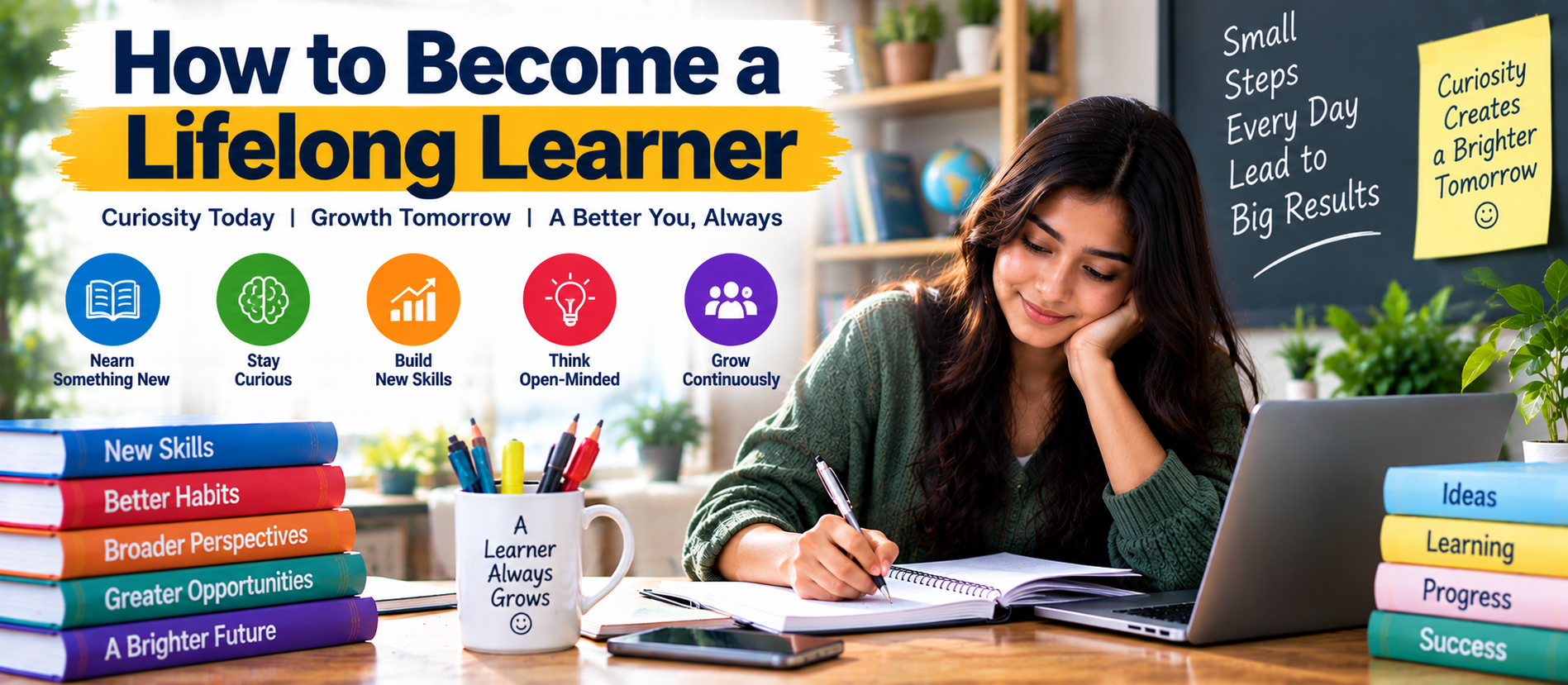
📋 Quick Summary
In this article:
1. Develop a Learning Mindset
2. Stay Curious
3. Choose Clear Learning Goals
4. Start Small
5. Create a Daily Learning Habit
6. Read Regularly
8. Practice What You Learn
9. Use Active Recall
10. Use Spaced Learning
12. Learn From Other People
Quick Answer: To become a lifelong learner, build a habit of learning small amounts regularly. Stay curious, choose clear learning goals, read widely, practice new skills, use reliable digital resources, learn from mistakes, reflect on your progress, and apply what you learn. Lifelong learning is not about collecting certificates or studying all the time. It is about staying open to new knowledge and improving throughout life.
The world changes quickly. New technologies appear. Jobs evolve. Industries adopt new tools. Information becomes easier to access. Skills that were valuable a few years ago may need to be updated. In this environment, learning cannot stop when formal education ends.
Lifelong learning offers a practical response to change. It helps people stay curious, adapt to new situations, develop useful skills, and understand the world more deeply. It can support careers, hobbies, relationships, creativity, and personal confidence.
Becoming a lifelong learner does not require an expensive course or a complicated routine. It starts with a mindset and develops through simple habits. This guide explains how to build that mindset and turn learning into a sustainable part of everyday life.
What Is Lifelong Learning?
Lifelong learning means continuing to learn throughout different stages of life. Learning can happen through formal education, online courses, books, practical experience, conversations, workshops, projects, travel, hobbies, and self-study.
A lifelong learner may study a professional skill, learn a language, understand personal finance, explore history, improve communication, learn photography, or simply investigate a question out of curiosity.
Why Lifelong Learning Matters
Lifelong learning can help people adapt to changing personal and professional environments. It can also make everyday life more interesting because learning creates opportunities to explore new ideas.
For professionals, continuous learning can help maintain relevant skills. For students, it can build independent learning habits. For entrepreneurs, it can support better decisions. For older adults, learning can provide intellectual stimulation and new interests.
Learning does not have to be connected to employment. People can learn simply because a subject is useful, meaningful, or enjoyable.
1. Develop a Learning Mindset
The first step is to believe that learning can continue at any age. You do not need to know everything before starting something new.
A learning mindset treats mistakes as information. Instead of thinking, “I am not good at this,” ask, “What do I need to understand or practice?” This makes difficult subjects more approachable.
2. Stay Curious
Curiosity is one of the strongest drivers of lifelong learning. Pay attention to questions that appear during everyday life.
When you hear an unfamiliar term, look it up. When you see an interesting process, ask how it works. When someone explains a different viewpoint, ask why they think that way.
Keep a simple list of questions and topics you want to explore. This list can become a personal learning roadmap.
3. Choose Clear Learning Goals
“I want to learn more” is a useful intention, but it is too broad for a practical plan. Turn it into a specific goal.
Instead of “learn digital marketing,” try “understand the basics of SEO and create a simple content plan.” Instead of “learn photography,” try “learn exposure, composition, and basic photo editing.”
Clear goals make it easier to choose resources and measure progress.
4. Start Small
Many people fail to build learning habits because they start with unrealistic plans. They decide to study for several hours every day and stop after a short period.
Start with a manageable routine. Even 20 to 30 focused minutes can become useful when repeated consistently.
5. Create a Daily Learning Habit
Attach learning to an existing part of your day. You might read after breakfast, listen to an educational podcast while traveling, practice a skill in the evening, or review notes before bed.
A fixed trigger makes a habit easier to remember.
Consistency matters more than intensity. Regular small sessions can create stronger long-term habits than occasional study marathons.
6. Read Regularly
Reading is one of the simplest ways to keep learning. Books, articles, reports, manuals, essays, and well-edited educational resources can expose you to new ideas.
Read both inside and outside your main area of interest. Professional reading can improve career knowledge. Reading history, science, literature, psychology, or culture can broaden your perspective.
You do not need to finish every book you start. If a resource is not useful or appropriate for your goal, choose another one.
8. Practice What You Learn
Knowledge becomes more useful when you apply it. If you are learning coding, build something. If you are learning writing, write. If you are learning a language, speak and write regularly. If you are learning finance, practice with realistic examples.
Projects turn passive knowledge into active skill. Start small and increase complexity as your confidence grows.
9. Use Active Recall
Active recall means trying to remember information without immediately looking at the answer. It is useful for many types of learning.
💡 Key Insight
After reading a chapter, close the book and explain the main points. Write down what you remember. Answer questions from memory. Then check the source and correct your gaps.
This process helps you discover what you actually know.
10. Use Spaced Learning
Do not study a topic once and assume you will remember it forever. Review important information over time.
You can revisit notes after a day, several days, a week, and later again. The exact schedule can vary. The important principle is to return to useful information instead of relying on one study session.
12. Learn From Other People
Conversation is a powerful learning method. Discuss ideas with classmates, colleagues, friends, mentors, or professional communities.
Explaining an idea to someone else can reveal gaps in your own understanding. Listening to different perspectives can also challenge assumptions and create new questions.
13. Teach What You Know
Teaching is an effective way to strengthen understanding. You do not need to be a professional teacher.
Explain a topic to a friend. Write a short guide. Create a presentation. Answer a question in a study group.
When you teach, you must organize information clearly. That process can expose areas that need more study.
14. Keep a Learning Journal
A learning journal helps you track ideas, questions, and progress. After a learning session, write three simple things:
- What did I learn?
- What was difficult?
- What will I practice or explore next?
Over time, the journal becomes a useful record of your development.
15. Turn Mistakes Into Learning Opportunities
Mistakes are unavoidable when learning difficult skills. The important question is what you do after making one.
Identify the reason for the mistake. Was the concept unclear? Did you misunderstand the instructions? Did you rush? Did you lack practice?
Once you identify the cause, choose a specific correction. This turns failure into feedback.
19. Ask Better Questions
Good questions improve learning. Instead of asking only “What is this?” also ask:
- Why does it work this way?
- How is it different from another approach?
- Where can I use it?
- What are its limitations?
- What evidence supports it?
- What would change my conclusion?
These questions encourage deeper thinking.
20. Develop Critical Thinking
Lifelong learning is not about accepting every piece of information. It is also about evaluating information.
Check who created a claim, what evidence supports it, whether the source is current, and whether other reliable sources agree.
This is especially important online, where information can spread quickly without sufficient context or verification.
21. Learn Digital Skills
Digital skills are increasingly useful across education, work, communication, and everyday life. Depending on your needs, consider learning online research, spreadsheets, presentations, cybersecurity basics, digital communication, data analysis, content creation, or AI literacy.
Choose skills that match your goals rather than trying to master every new tool.
22. Use AI as a Learning Assistant
AI tools can support lifelong learning by explaining difficult ideas, generating practice questions, suggesting examples, helping organize study plans, and offering alternative explanations.
However, AI output can contain errors. Use reliable sources to verify important information, especially in areas where accuracy matters.
AI is most useful when it helps you think, practice, compare, and explore. It should not replace your own reasoning.
28. Make Learning Fit Your Life
A lifelong learning routine should be flexible. Some weeks may allow several hours of study. Other weeks may allow only short sessions.
Do not abandon the habit because your schedule changes. Reduce the learning load temporarily and return to a larger routine when time becomes available.
29. Review Your Progress
Every few weeks or months, review what you have learned.
Ask yourself:
- What skills have improved?
- What can I now do that I could not do before?
- Which methods helped most?
- What am I still struggling with?
- What should I learn next?
Progress becomes easier to see when you compare your current abilities with your earlier abilities.
30. Create a Personal Learning System
A personal learning system brings your habits together. It can include a reading list, course list, project list, note-taking method, learning calendar, and progress review.
Keep it simple. A notebook or basic digital document may be enough. The purpose is to reduce friction and make learning easier to continue.
Frequently Asked Questions
What does it mean to be a lifelong learner?
A lifelong learner continues developing knowledge and skills throughout life. Learning can happen through formal education, self-study, work, hobbies, conversations, projects, and practical experience.
How can I become a lifelong learner?
Start with one clear learning goal. Create a small daily or weekly learning habit. Read, practice, ask questions, use reliable resources, apply what you learn, and review your progress.
Do I need to take courses to become a lifelong learner?
No. Courses are only one learning method. Books, projects, mentors, practical experience, workshops, conversations, and self-study can also support lifelong learning.
How much time should I spend learning every day?
There is no universal amount. Choose a routine that fits your life. Consistency is more important than a large number of hours.
Can lifelong learning help my career?
Continuous learning can help you maintain and develop relevant skills. The specific value depends on your profession, goals, industry, and the skills you choose to develop.
Can I learn effectively without formal education?
Yes. Self-directed learning can be effective when you use reliable resources, practice actively, seek feedback, and measure your progress.
How can AI help lifelong learners?
AI can explain concepts, create practice exercises, organize learning tasks, and provide alternative examples. Important information should be checked against reliable sources.
Key Takeaways
- Lifelong learning means continuing to learn throughout life.
- Start with curiosity and a clear goal.
- Build small and sustainable learning habits.
- Read regularly and use reliable resources.
- Practice skills instead of only consuming information.
- Use active recall and spaced review.
- Learn from teachers, experts, mentors, peers, and experience.
- Use projects to turn knowledge into practical ability.
- Keep a simple learning journal.
- Treat mistakes as feedback.
- Develop critical thinking and information literacy.
- Use digital tools and AI carefully.
- Protect your attention and make learning fit your real life.
- Review progress and update your learning goals.
Final Thoughts
Becoming a lifelong learner is not about studying every hour. It is about developing a habit of curiosity and improvement.
Start with one subject. Choose one useful goal. Give yourself a small amount of focused time. Read. Practice. Ask questions. Make mistakes. Correct them. Apply what you learn. Then repeat the process.
Over time, these small actions can create a powerful learning system. Your interests may change. Your career may change. Technology may change. Your learning habit can help you adapt to those changes.
The most important step is to begin. You do not need the perfect course, the perfect schedule, or the perfect learning environment. Choose one thing you want to understand better and take the first small step today.
Digiifrog: Explore digital marketing, web development, content strategy, and AI-focused business solutions at www.digiifrog.com.
Ready to Grow?
Talk to us about a strategy tailored to your brand — we will help you stand out in search, AI discovery and social.


Comments (0)
Log in to leave a comment.