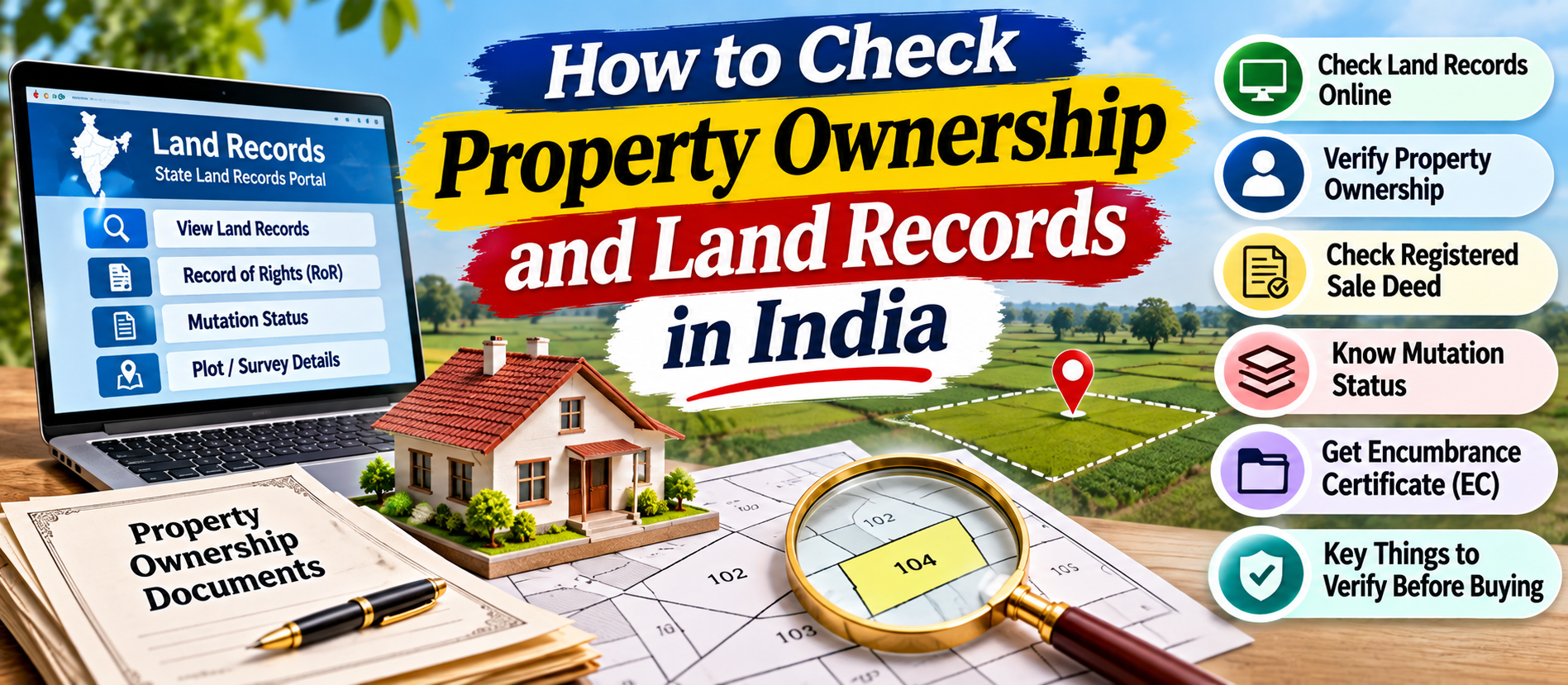
📋 Quick Summary
In this article:
1. What Are Property Ownership Records?
2. Why Should You Verify Property Ownership?
3. Understand the Main Land Record Terms
Record of Rights (RoR)
Khata, Khatian or Jamabandi
Khasra, Dag or Plot Number
Encumbrance Certificate or Registration Search
4. How to Check Land Records Online in India
Step 1: Identify the State and Local Revenue Area
Step 2: Find the Official State Land Records Portal
Step 3: Select the Correct District and Locality
Digiifrog | Property and Legal Awareness Guide
A practical guide to verifying ownership, reviewing land records and checking property documents before a purchase.
Buying land, a flat, a house or a commercial property is a major financial decision. Before paying an advance or signing an agreement, you should confirm that the seller has the legal right to transfer the property. You should also check whether the property has loans, disputes, restrictions or other claims attached to it.
In India, property information is maintained by different authorities. Revenue departments maintain land records. Sub-Registrar Offices register documents. Municipal bodies maintain property tax and building records. Courts and tribunals may hold information about pending disputes. These records serve different purposes. No single online search can confirm every aspect of ownership.
Many States and Union Territories now provide online access to land records. These portals make it easier to view a Record of Rights (RoR), survey details, plot maps, mutation status and other information. The Government of India is also modernising land administration through the Digital India Land Records Modernization Programme (DILRMP). However, digitisation does not remove the need for careful legal verification.
This guide explains how to check property ownership and land records in India. It covers online searches, state portals, registered deeds, mutation, encumbrance checks, property maps, common risks and practical steps for buyers, sellers and legal heirs.
1. What Are Property Ownership Records?
Property ownership records are documents and official entries that help establish who holds rights in a property and how those rights were acquired. The exact documents depend on the type of property, the State, the history of ownership and the way the property was transferred.
Common records include:
- Sale deed or conveyance deed: The registered instrument used to record a sale or transfer of property.
- Record of Rights (RoR): A revenue record that may show recorded holders, interests, land classification, area and other details.
- Mutation entry: An entry made in revenue or municipal records after a change such as sale, inheritance or gift.
- Survey or cadastral map: A map showing the location, boundaries or survey identification of a land parcel.
- Encumbrance or registration search: A search of registered transactions or specified interests affecting the property, within the scope of the records searched.
- Property tax records: Municipal or local authority records relating to assessment and payment of property tax.
- Allotment, lease or patta documents: Documents that may create or evidence specific rights, subject to their terms and applicable law.
These documents are not interchangeable. For example, a property tax receipt is not the same as a sale deed. A mutation entry is not, by itself, a complete title certificate. A map may help identify a parcel, but it does not independently prove who owns it.
2. Why Should You Verify Property Ownership?
Property verification helps identify legal and practical risks before a transaction. It is useful for buyers, sellers, lenders, tenants, heirs and people involved in family settlements.
- Confirm the seller’s authority: Check whether the person offering the property has a valid title or authority to transfer it.
- Trace earlier transfers: Review how the property moved from previous owners to the present seller.
- Identify mortgages and claims: Look for registered mortgages, charges, court orders and other recorded interests.
- Check land identity: Match the survey number, plot number, area, boundaries and location across documents.
- Find inheritance issues: Check whether all legal heirs or co-owners have the rights and consent required for the proposed transfer.
- Reduce fraud risk: Compare original documents with official records and confirm the identity of the parties.
- Support loan processing: Banks and financial institutions commonly conduct their own title and security checks before accepting property as collateral.
3. Understand the Main Land Record Terms
Land record terminology differs between States. The same type of record may have a different local name. Learn the terms used in the State where the property is located.
Record of Rights (RoR)
A Record of Rights is a revenue record that contains information about recorded rights and interests in land. Depending on the State, it may include the name of the recorded holder, plot or survey number, area, land use or classification, tenancy details and other entries. It is an important document to review, but it should be read with the title documents and other relevant records.
Khata, Khatian or Jamabandi
These terms are used in different States for records or accounts relating to landholders and land parcels. A Khatian in West Bengal, for example, is associated with the Record of Rights. Jamabandi is used in several northern States. Khata or Khatauni is used in some other regions. The exact contents and legal role depend on local law and administrative practice.
Khasra, Dag or Plot Number
A khasra, dag or plot number identifies a parcel of land in the relevant survey or revenue system. It helps the authority and the public locate the land in the records and maps. Do not assume that a number from an old survey is identical to a number in a later survey. Check the relevant survey history and correlation records where required.
Mutation
Mutation is the process of updating revenue or municipal records after a change in possession or recorded interest, such as a sale, inheritance, gift or partition. Mutation helps keep public records current. It is not the same as the legal transfer of title. The underlying deed, succession documents, court order or other legal basis must still be valid.
Encumbrance Certificate or Registration Search
An Encumbrance Certificate (EC), where available, is issued from registration records for a specified property and period. It may show registered transactions or interests recorded in the relevant registration system. It may not reveal every possible claim, unregistered arrangement, pending dispute, fraud or error. The search period, property description and scope of the database matter.
4. How to Check Land Records Online in India
There is no single public portal that provides every land record for every property across India. Land administration is largely handled by State and Union Territory authorities. The Department of Land Resources maintains information about State and UT land record services through the DILRMP portal.
Step 1: Identify the State and Local Revenue Area
Start with the exact location of the property. Note the State, district, tehsil or taluka, block, village, ward or mouza, depending on the local system. For urban property, also note the municipal area, ward, holding number and survey or plot details.
Step 2: Find the Official State Land Records Portal
Use the Department of Land Resources or the relevant State government website to locate the official portal. Avoid sponsored search results, unofficial agents and websites that imitate government portals. Check that the address belongs to a recognised government domain and that the service is described by the relevant department.
Step 3: Select the Correct District and Locality
Most portals ask you to select administrative details before searching. Choose the correct district, tehsil or block, village or mouza. A similar village name may appear in more than one district. Confirm the location before relying on the result.
Step 4: Search by Available Property Identifiers
Depending on the portal, you may be able to search using one or more of the following:
- Survey number, khasra number, dag number or plot number.
- Khata, khatian, khatauni or jamabandi number.
- Recorded holder’s name, where a name search is provided.
- Village, mouza, ward or other local area details.
Search by more than one identifier where possible. A name-only search can return several people with similar names. A plot number may also have changed after a resurvey or consolidation.
Step 5: Open and Review the Record of Rights
Check the recorded holder’s name, land area, plot number, land classification, share or interest, tenancy details and remarks. Compare these details with the seller’s documents. Check whether the record is current and whether the portal offers a digitally signed or certified copy.
Step 6: Review the Plot Map or Cadastral Map
Where available, open the official map and compare the parcel’s location and shape with the property shown to you. Confirm access roads, neighbouring plots and boundaries. A map is a useful cross-check, but it is not a substitute for a physical survey by a qualified surveyor where boundaries are important.
Step 7: Check Mutation and Application Status
If the seller says that a recent sale, inheritance or partition has been recorded, ask for the mutation order or application details. Check the status through the State portal or local revenue office. If mutation is pending, find out why. A pending mutation may point to incomplete documents, objections or a dispute, although the reason must be verified.
Step 8: Obtain a Certified or Digitally Signed Copy
For a transaction, do not rely only on a screenshot or an informal printout. Check whether the State portal provides a digitally signed RoR or certified extract. If not, apply through the designated revenue office or authorised service. Follow the portal’s instructions about fees, identity checks and collection.
5. How to Check Registered Sale Deeds and Registration Records
Land revenue records and registration records are maintained for different purposes. A revenue portal may show the recorded holder and land details. The registration department maintains registered instruments such as sale deeds, gift deeds, mortgages, leases and other documents that are registrable under law.
To review registration records:
- Find the official registration department website for the State where the property is located.
- Look for services such as deed search, document search, certified copy, index search or Encumbrance Certificate.
- Use the property details, registration office, document number, year, party name or other search fields supported by the portal.
- Check the registration date, document number, parties, property schedule and the Sub-Registrar Office.
- Where necessary, apply for a certified copy of the registered deed from the registration department.
- Compare the deed with the current RoR, survey map and previous title documents.
Section 17 of the Registration Act, 1908 identifies categories of documents for which registration is compulsory. Section 49 explains certain consequences of non-registration where registration is legally required. The effect of a particular document depends on its nature, wording, date and applicable law. A buyer should not decide the validity of a title merely by looking at a portal search result.
6. How to Check an Encumbrance Certificate
An encumbrance search can help identify registered transactions or interests affecting the property during a specified period. The exact service and terminology vary between States. Some portals provide an online EC. Other locations may require an application to the Sub-Registrar Office.
When reviewing an EC or registration search, check:
- The property description and survey or plot number.
- The name of the owner or parties appearing in the entries.
- The period covered by the search.
- Registered mortgages, releases, sales, gifts, leases or other listed transactions.
- Document numbers, registration dates and the relevant registration office.
- Whether the search covers the correct sub-district and all relevant property identifiers.
An EC is not a universal guarantee that the property is free from every claim. It may not disclose unregistered interests, certain statutory dues, pending litigation, forged documents, identity fraud or entries outside the search period or database. Ask a property lawyer to decide what further searches are appropriate for the transaction.
7. How to Check Property Ownership in West Bengal
In West Bengal, the official Banglarbhumi portal provides access to several land and land reform services. These include Record of Rights information, plot information, plot maps, mutation status and other citizen services. The Directorate of Registration and Stamp Revenue operates a separate registration portal for registered deeds and registration-related searches.
Checking Land Records on Banglarbhumi
- Visit the official Banglarbhumi portal.
- Open the relevant citizen service or property information facility.
- Select the district, block and mouza as required by the portal.
- Enter the Khatian number or plot number, depending on the search option.
- Review the available Record of Rights and plot information.
- Check the plot map and relevant RS/LR information where available.
- Use the portal’s service delivery options to request a digitally signed or certified record if required.
- Check mutation status separately if the property has recently changed hands.
West Bengal records may refer to CS, RS and LR survey stages. These are different survey or record periods. Do not assume that a number in one survey automatically matches a number in another. Ask the relevant land office or a qualified survey professional to confirm the correlation when the property history depends on it.
Checking Registered Deeds in West Bengal
Visit the official West Bengal Registration Department portal. The portal provides registration-related services, including searches of registration records by party name or property details, subject to the services and records available online. You may also apply for certified copies of digitised registered deeds through the prescribed process.
Compare the deed schedule with the Banglarbhumi record. Confirm the mouza, JL number where relevant, khatian, plot or dag number, area, boundaries and names. If the deed is old or the online result is incomplete, ask the relevant registration office for an official search or certified copy.
8. Examples of State and UT Land Record Portals
Portal names and services may change. Use the Department of Land Resources’ State/UT RoR directory as a starting point, then verify the link through the relevant government department. Examples of commonly used State systems include:
- West Bengal: Banglarbhumi – banglarbhumi.gov.in
- Andhra Pradesh: MeeBhoomi – verify the current link through the Andhra Pradesh government.
- Assam: Dharitree – verify the current link through the Assam government.
- Karnataka: Bhoomi – verify the current link through the Karnataka government.
- Maharashtra: Mahabhulekh / Bhulekh – verify the current link through the Maharashtra government.
- Rajasthan: Apna Khata – verify the current link through the Rajasthan government.
- Uttar Pradesh: Bhulekh – verify the current link through the Uttar Pradesh government.
- Odisha: Bhulekh – verify the current link through the Odisha government.
- Gujarat: AnyRoR – verify the current link through the Gujarat government.
- Telangana: The State’s current land records and registration services – verify through official Telangana government websites.
- Delhi: Delhi land records and registration services – verify through the Delhi government.
For an official State/UT directory, use the Department of Land Resources’ RoR availability page. Always check that the link still belongs to the relevant government department before entering personal or property details.
9. What Is the Digital India Land Records Modernization Programme?
The Digital India Land Records Modernization Programme (DILRMP) is a Government of India initiative led by the Department of Land Resources. It supports the computerisation of land records, digitisation and georeferencing of cadastral maps, computerisation of registration offices and integration of land-related systems.
The programme aims to make land information easier to access and improve the quality and consistency of records. The current DILRMP 3.0 direction includes work towards a connected land information system, georeferenced land parcels and the use of a Unique Land Parcel Identification Number (ULPIN), also known as Bhu-Aadhaar. The programme is implemented through States and Union Territories. The availability and maturity of services can therefore differ by location.
Digitised records are useful, but digitisation alone does not settle every ownership dispute. A digital entry may still need correction, a mutation may be pending, or an old deed may require examination. Buyers should continue to review the title chain and obtain legal advice for significant transactions.
10. Documents to Collect Before Buying a Property
The exact list depends on the property and State. A buyer should usually ask for the following documents where applicable:
- Current registered sale deed, conveyance deed or other root title document.
- Earlier title deeds covering a suitable chain of ownership period.
- Current Record of Rights, khatian, jamabandi or equivalent revenue extract.
- Mutation order and updated revenue record, if mutation has taken place.
- Encumbrance Certificate or registration search for an appropriate period.
- Survey map, cadastral map, site plan and boundary details.
- Latest property tax or land revenue receipts.
- Approved building plan, completion or occupancy certificate, where relevant.
- Society or apartment association documents and no-dues information, where relevant.
- Mortgage release or bank no-dues documents if the property was financed.
- Death certificate, legal heir documents, probate or succession documents where the property came through inheritance.
- Power of attorney and proof of authority if someone acts for the owner.
- Relevant court orders, partition deeds, family settlement documents or government permissions.
11. How to Verify the Chain of Title
The chain of title is the sequence of documents showing how ownership or other rights passed from one person to another. A property lawyer usually reviews the title chain for an appropriate period based on the property, local practice and transaction risks.
Start with the person who is selling the property. Ask how they acquired it. If they purchased it, obtain their registered sale deed and the earlier deeds. If they inherited it, review the succession documents and the rights of all legal heirs. If they received it through a gift, partition or court decree, obtain the relevant registered instrument or certified court record, as applicable.
Check that each document describes the same property. Compare the names, dates, areas, boundaries, survey numbers and shares. Look for gaps, unexplained transfers, missing signatures, inconsistent descriptions or references to documents that are not available.
Where the property has multiple co-owners, confirm who must sign the sale document. One co-owner may not be able to transfer the entire property without the rights or authority of the others. Where a power of attorney is used, verify its scope, validity, execution and whether it authorises the proposed transaction. A power of attorney should not be treated as a substitute for a sale deed where the law requires a conveyance.
12. Check for Mortgages, Loans and Other Claims
Ask the seller whether the property is mortgaged or has been offered as security for a loan. If a bank or financial institution has a charge, obtain the lender’s written release or no-dues documentation and confirm that the relevant charge has been discharged in the appropriate records.
Depending on the property and transaction, a lawyer may also check relevant registration records, court databases, revenue proceedings, insolvency records or other public records. Some secured interests may be recorded in systems beyond the local land registration portal. The correct search depends on the facts and the type of property.
Do not rely only on the seller’s statement that the property is “loan free”. Verify the claim through the relevant lender and official records. If a loan is being closed as part of the sale, arrange the payment and release process through documented steps that protect both parties.
13. Check Court Cases, Acquisition and Land Use Restrictions
A property may be affected by litigation, acquisition proceedings, planning restrictions, government reservations, tenancy rights, easements or environmental rules. These matters may not appear in a basic RoR or EC search.
Ask a lawyer to assess whether searches are needed in the relevant civil courts, revenue courts, tribunals or other forums. Check whether the property is subject to acquisition notices, road widening, development plans, coastal or environmental restrictions, forest rules, ceiling laws or other local controls. The correct checks depend on the location and type of land.
For agricultural land, confirm whether the buyer is legally eligible to acquire it and whether any land-use conversion or permission is required for the intended use. State laws may impose restrictions on agricultural land transfers, tenancy, tribal land, ceiling limits or conversion. Never assume that a property can be used for housing or commercial activity simply because a seller says it can.
14. Physical Verification of the Property
Online records should be matched with the property on the ground. Visit the site and check its location, access, boundaries, neighbouring properties, occupation and visible structures. Ask a qualified surveyor to measure the parcel if the area or boundary is important or disputed.
Check whether someone other than the seller occupies the property. A tenant, licensee, caretaker, co-owner or other person may have rights or claims that affect vacant possession. Ask for copies of relevant agreements and notices. Confirm how and when possession will be delivered.
For flats and buildings, inspect the unit number, floor, carpet or built-up area as described in the documents, parking allocation, common areas and building approvals. Verify the builder’s title and project approvals where applicable. For an apartment, also check the association or society records and outstanding dues.
15. Common Warning Signs in Property Transactions
- The seller refuses to show original title documents or certified copies.
- The seller’s name does not match the title deed or revenue record, and no valid explanation is provided.
- The property area, boundaries or survey numbers differ across documents.
- There are unexplained gaps in the chain of title.
- Mutation is pending or disputed, but the seller describes it as complete.
- A mortgage or charge appears without a clear release document.
- The seller asks for a large cash payment or refuses a written receipt.
- A person claims to act for the owner but cannot prove authority.
- There are multiple sale agreements or competing claims.
- The property is occupied by someone whose rights have not been explained.
- The seller pressures the buyer to sign before legal verification.
- The land is described as residential or commercial without supporting approvals.
A warning sign does not always prove fraud. It means that the buyer should stop, investigate and obtain professional advice before paying more money or signing a binding document.
16. What Should You Do if Land Records Show Incorrect Details?
Errors may occur in names, areas, plot numbers, shares or other entries. The correction process depends on the State and the type of error. First, obtain the current record and identify the exact entry that is wrong. Collect supporting documents such as registered deeds, earlier RoR extracts, survey records, identity documents, maps, tax receipts or court orders.
Apply to the competent revenue or registration authority using the prescribed process. Some States provide online correction or grievance services. Others require an application at the local land office. Keep the acknowledgement number and copies of all submissions. Attend hearings or field enquiries when directed.
If the disagreement concerns competing ownership claims, forged documents or a complex boundary dispute, an administrative correction request may not be enough. A civil court or other competent forum may need to decide the rights. Consult a property lawyer before choosing the remedy.
17. Is Mutation Proof of Ownership?
No. Mutation is generally an update to revenue or municipal records. It helps the administration record a change after a sale, inheritance, gift or other event. It is important for maintaining current records and may be needed for tax or administrative purposes.
However, mutation does not by itself create or conclusively establish title. The legal basis for the transfer must be valid. For example, a buyer should review the registered sale deed and the seller’s title, not rely only on a mutation entry. Similarly, an heir should review the succession documents and the rights of other legal heirs.
18. Can You Check Property Ownership by Name?
Some State portals allow searches by the recorded holder’s name. This can be useful, but it is not always conclusive. Different people may have the same or similar names. Names may be spelled differently across old and new records. A property may be recorded under a family member, company, trust or previous owner.
Use a name search only as an initial step. Confirm the result using the plot or survey number, village or mouza, khata or khatian details and registered deed. Never assume that a name match alone proves that a person owns the property being offered for sale.
19. Can You Check Land Records Without a Survey Number?
Sometimes. Depending on the State portal, you may be able to search by the recorded owner’s name, khata or khatian number, village, mouza or other local identifier. If you do not have a survey number, ask the seller for a copy of the latest RoR, previous deed or property tax record.
For urban property, a municipal holding number, flat number, ward, building address or registration document number may help locate records. The registration office or local revenue office may explain which identifiers are required for a formal search.
20. A Practical Property Verification Checklist
- Confirm the exact property location and local administrative area.
- Obtain the latest RoR or equivalent land record.
- Obtain and review the current registered title deed.
- Trace the chain of title through earlier documents.
- Compare plot numbers, survey details, area and boundaries.
- Check mutation status and obtain relevant orders.
- Search registration records and obtain an EC where available.
- Check mortgages, charges and lender release documents.
- Check relevant court, revenue and acquisition proceedings.
- Verify land use, planning approvals and building permissions.
- Inspect the property and confirm possession and access.
- Check tax, utility, society and other outstanding dues.
- Verify the identity and authority of every person signing.
- Ask a qualified property lawyer to provide a written title review for a significant transaction.
21. Frequently Asked Questions (FAQs)
Q1. How can I check who owns a piece of land in India?
Start with the official land records portal for the State where the land is located. Search using the district, village or mouza and the available plot, survey, khata or khatian details. Review the Record of Rights and compare it with the registered title deed and earlier ownership documents. A portal entry alone is not a complete title investigation.
Q2. Can I check land records online for free?
Many States provide basic land record searches online without a fee. However, certified copies, digitally signed extracts, registration searches or other services may carry charges. Check the official portal for the current service conditions and fees.
Q3. Is a Record of Rights proof of ownership?
A Record of Rights is an important revenue record, but it should not be treated as conclusive proof of title in every case. Review the registered deed, title chain, succession documents and other relevant evidence. The legal effect of a particular record depends on the applicable State law and facts.
Q4. What is the difference between a sale deed and mutation?
A sale deed is the instrument that records a sale or transfer of property when properly executed and registered as required by law. Mutation is the later update of revenue or municipal records to reflect the change. Mutation does not replace the sale deed or independently cure a defective title.
Q5. How do I check whether a property has a bank loan?
Ask the seller for details of any mortgage or loan. Review the relevant registration and encumbrance records, and contact the lender through a verified channel where appropriate. If the loan has been repaid, obtain the lender’s release or no-dues documents and confirm that required records have been updated.
Q6. Is an Encumbrance Certificate enough before buying property?
No. An EC is one part of due diligence. It may not reveal unregistered claims, all court disputes, every statutory restriction or records outside the period and system searched. Review the title chain, revenue records, litigation, approvals, possession and other relevant matters.
Q7. How can I check land records in West Bengal?
Use the official Banglarbhumi portal to review available RoR, plot information, maps and mutation services. Use the West Bengal Registration Department portal to search registration records and access deed-related services. Compare the records and obtain certified copies where needed.
Q8. Can I buy property if mutation is not complete?
Do not decide based only on mutation status. Find out why mutation is pending and examine the underlying title documents. There may be a routine delay, missing paperwork or a substantive objection. Obtain legal advice before proceeding.
Q9. What if the land record shows the wrong owner’s name?
Obtain the current record and supporting title documents. Apply for correction through the competent State revenue authority if the error is administrative. If the issue involves competing title claims or a dispute, consult a lawyer about the appropriate legal remedy.
Q10. Can I verify property ownership using only the seller’s Aadhaar or PAN card?
No. Identity documents help confirm a person’s identity, but they do not prove ownership of a particular property. Verify the title deed, revenue records, registration history and authority to sell. Handle personal identity information securely.
Q11. What is ULPIN or Bhu-Aadhaar?
ULPIN means Unique Land Parcel Identification Number. It is a parcel identification initiative under land record modernization. It is intended to help identify land parcels through a standardized unique number. Availability and implementation can vary by State and location. A ULPIN is an identifier, not a substitute for title verification.
Q12. Should I hire a property lawyer before buying land?
For a significant purchase, yes. A property lawyer can review the title chain, deeds, revenue entries, registration records, mortgages, litigation, permissions and local restrictions. A surveyor may also be needed to verify the physical boundaries and area.
22. Conclusion
Checking property ownership and land records in India requires more than searching for a name on a government website. Start with the official State land records portal. Review the Record of Rights, plot details, maps and mutation status. Then check registered deeds, registration history and encumbrance information. Match every record with the property on the ground.
💡 Key Insight
Remember that revenue records, registration documents, tax receipts and maps serve different purposes. Mutation does not automatically establish title. An online EC does not reveal every possible claim. A digital record can be useful, but it should be part of a wider due diligence process.
Before paying a substantial advance or signing a sale agreement, ask a qualified property lawyer to examine the documents and local legal requirements. For land where boundaries, area or access are uncertain, obtain a professional survey. Careful verification can help you avoid costly disputes and make a more informed property decision.
Legal Disclaimer
This article is for general information and educational purposes only. It is not legal advice and does not create a lawyer-client relationship. Land and property laws, record formats, registration procedures and portal services vary across States and Union Territories and may change. Online records may be incomplete or contain errors. The legal effect of a deed, revenue entry, mutation or certificate depends on the facts and applicable law. Readers should verify information with the relevant government authority and consult a qualified advocate and, where appropriate, a licensed survey professional before buying, selling, transferring or litigating over property.
Structured Data Recommendations
Use Article schema for the main article and Breadcrumb List schema if the page has a breadcrumb trail. FAQ Page structured data may be considered only where the FAQ content is visible and the implementation follows current Google Search policies. Do not add unsupported author credentials, ratings or legal guarantees.
Published by Digiifrog | www.digiifrog.com
For website development, digital solutions and online growth services, visit Digiifrog.
Ready to Grow?
Talk to us about a strategy tailored to your brand — we will help you stand out in search, AI discovery and social.


Comments (0)
Log in to leave a comment.