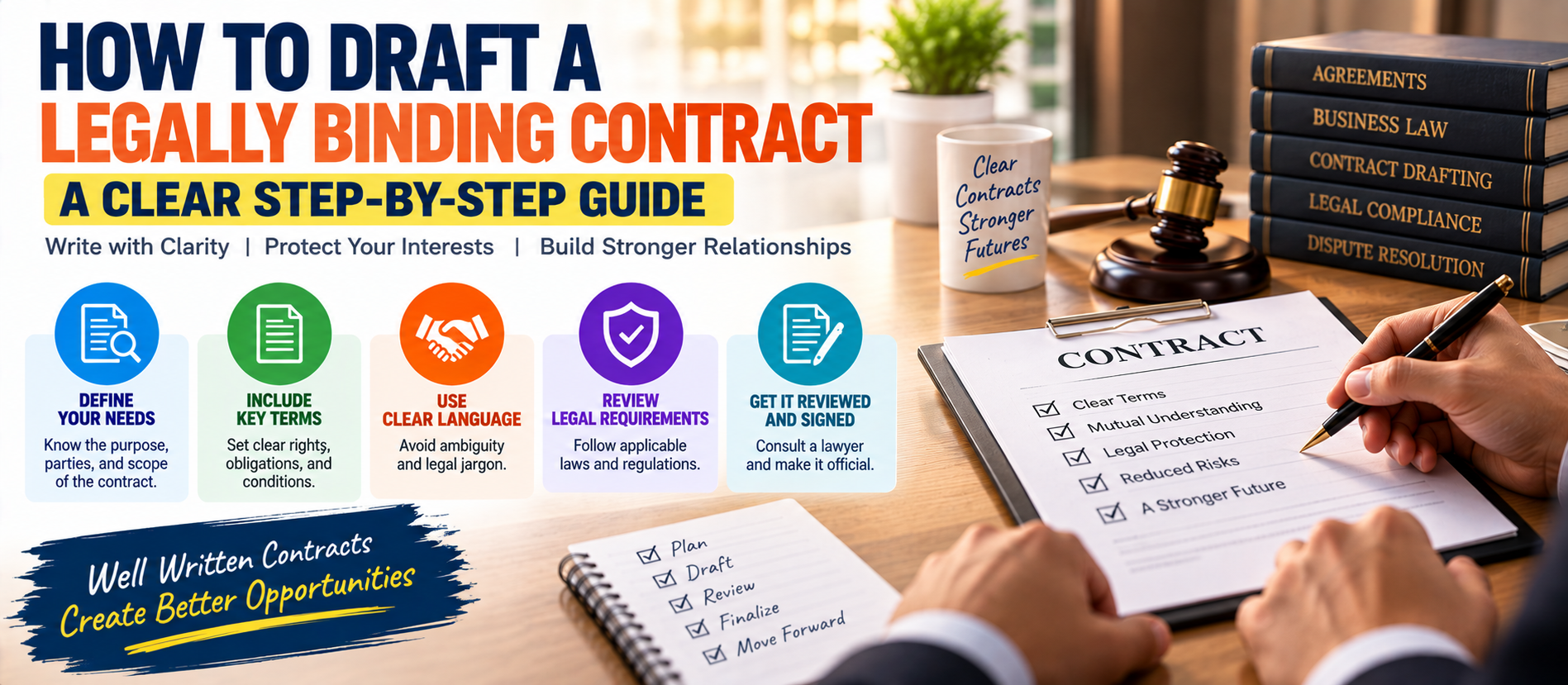
📋 Quick Summary
In this article:
What Makes a Contract Legally Binding?
Step 1: Identify the Parties
Step 2: State the Purpose of the Contract
Step 3: Define Important Terms
Step 4: Describe Each Party's Obligations
Step 5: Set Out Payment Terms
Step 6: Include Time and Delivery Requirements
Step 7: Address Rights and Ownership
Step 8: Add Confidentiality and Data Protection Terms
Step 9: Explain Representations and Warranties
Step 10: Include Conditions and Responsibilities
Introduction
A contract is more than a document with signatures. A well-drafted contract clearly records what each party promises to do, what each party receives, and what happens if something goes wrong.
Contracts are used for employment, business services, sales, property transactions, partnerships, freelance work, technology projects, and many other situations. A poorly written agreement can create confusion even when everyone initially has good intentions.
This guide explains the main steps involved in drafting a legally binding contract. The exact requirements vary by country, state, subject matter, and type of agreement. Some contracts also require special formalities. This article is general educational information and is not a substitute for advice from a qualified lawyer.
What Makes a Contract Legally Binding?
A legally enforceable contract generally requires legally recognized elements. Depending on the jurisdiction, these may include an offer, acceptance, consideration or another recognized basis for enforcement, intention to create legal relations, capacity, lawful purpose, and sufficiently clear terms.
Some agreements must also satisfy specific formal requirements, such as writing, registration, witnessing, notarization, or electronic-signature rules. Therefore, a signature alone does not automatically make every agreement enforceable.
Step 1: Identify the Parties
Start by clearly identifying everyone entering the agreement. Use the correct legal name of each individual or business. Include addresses or other identifying details when appropriate.
If a company is signing, confirm that the person signing has authority to bind the company. An incorrect party name can create avoidable problems later.
Step 2: State the Purpose of the Contract
Explain why the contract exists. A short purpose clause can make the agreement easier to understand and interpret.
For example, a service agreement should identify the services being provided. A sales agreement should identify the goods or assets being sold. Avoid vague descriptions that leave the main transaction uncertain.
Step 3: Define Important Terms
If the contract uses terms that have a specific meaning, define them. A definitions section can prevent repeated explanations and reduce ambiguity.
Keep definitions consistent throughout the document. Do not use one term in several different ways.
Step 4: Describe Each Party's Obligations
This is one of the most important parts of a contract. State what each party must do, when they must do it, and what standard applies.
Instead of writing “the supplier will provide quality services,” describe the actual service, delivery requirements, deadlines, specifications, or performance standards.
Step 5: Set Out Payment Terms
Clearly state the price or method used to calculate payment. Include payment dates, invoices, taxes where relevant, deposits, expenses, late-payment provisions, and conditions for refunds if applicable.
If payment depends on milestones, define each milestone. If prices can change, explain when and how changes can occur.
Step 6: Include Time and Delivery Requirements
State important dates and deadlines. If performance depends on an event rather than a fixed date, describe the event clearly.
Consider what happens if a deadline cannot be met. A contract can address extensions, notice requirements, delays, and consequences.
Step 7: Address Rights and Ownership
Contracts may need to explain who owns goods, documents, intellectual property, data, designs, software, or other work created during the relationship.
Intellectual-property clauses should be specific. Identify what is transferred, licensed, retained, or created for the project. The applicable law may impose limits on how ownership can be transferred.
Step 8: Add Confidentiality and Data Protection Terms
If one party receives confidential business or personal information, explain how that information may be used, stored, shared, and protected.
Where personal data is involved, the contract should also consider applicable privacy and data-protection requirements. Do not assume that a generic confidentiality clause satisfies every legal obligation.
Step 9: Explain Representations and Warranties
A representation is generally a statement about a fact. A warranty is generally a contractual promise concerning a particular matter. The exact legal meaning can vary by jurisdiction.
Use these clauses only when they are necessary. Make them precise. Avoid making broad promises that a party cannot realistically verify or perform.
Step 10: Include Conditions and Responsibilities
Some contracts depend on specific conditions. For example, payment may depend on delivery, approval, inspection, or completion of a milestone.
State these conditions clearly. Explain who is responsible for each step and what happens if a condition is not satisfied.
Step 11: Plan for Breach of Contract
A good contract should explain what happens when a party fails to perform. Possible provisions may cover notice of breach, opportunities to cure, suspension of work, termination, damages, or other remedies.
Remedy clauses must comply with applicable law. Avoid inserting penalties or extreme remedies without professional review.
Step 12: Add Termination Rules
Explain how the agreement can end. A contract may end on a specified date, after completion of the work, by mutual agreement, or following certain events.
Consider both termination for convenience and termination for cause where appropriate. State the notice period and explain what happens to outstanding payments, confidential information, property, licenses, and unfinished work.
Step 13: Include Dispute Resolution Terms
Disputes may be handled through negotiation, mediation, arbitration, or court proceedings. The appropriate method depends on the transaction and applicable law.
A dispute clause may also address governing law, jurisdiction, venue, arbitration rules, or the language of proceedings. These provisions can have significant practical effects, especially in international contracts.
Step 14: Address Force Majeure and Unexpected Events
A force majeure clause may address specified events that prevent or delay performance. The effect of such a clause depends on its wording and applicable law.
Do not assume that every unexpected event automatically excuses performance. State the relevant events, notice requirements, mitigation duties, and consequences as clearly as possible.
Step 15: Use Clear and Consistent Language
Legal drafting does not have to be unnecessarily complicated. Short sentences and precise words can make a contract easier to understand.
Avoid unnecessary repetition. Use the same term for the same concept. Check that defined terms, dates, numbers, names, schedules, and cross-references are consistent.
Step 16: Add Standard Contract Clauses
Many contracts include standard provisions that support the main agreement. Depending on the transaction, these may include:
- Entire agreement: identifies the agreement that governs the relationship.
- Amendment: explains how changes must be made.
- Assignment: addresses transfer of contractual rights or duties.
- Severability: explains what may happen if one provision is unenforceable.
- Waiver: addresses whether failure to enforce a right affects future enforcement.
- Notices: identifies how formal notices should be delivered.
- Relationship of parties: clarifies whether the parties are independent contractors, partners, agents, or another relationship.
Step 17: Review the Contract Before Signing
Review the entire document from beginning to end. Check every amount, date, obligation, condition, deadline, and reference.
Ask simple questions: What must I do? What must the other party do? When must each obligation happen? What happens if either side fails? How can the contract end? Which law applies?
Step 18: Make Sure the Signatures Are Proper
The final contract should be signed in a manner recognized by the applicable law. Depending on the document, signatures may be handwritten or electronic.
Check whether witnesses, notarization, registration, or other formalities are required. Keep the fully executed version and any evidence needed to show when and how it was signed.
Common Contract Drafting Mistakes
- Using vague language for important obligations.
- Leaving blanks in a document before signing.
- Using incorrect legal names.
- Failing to define payment conditions.
- Ignoring termination and post-termination duties.
- Copying online templates without checking whether they fit the transaction.
- Adding clauses that conflict with each other.
- Ignoring mandatory legal requirements.
- Failing to identify the governing law.
- Signing without understanding important restrictions.
Should You Use an Online Contract Template?
A template can provide a useful starting structure. It can help identify common sections and save drafting time.
However, a template is not automatically suitable for every transaction. Laws differ between jurisdictions, industries, and situations. Important contracts should be reviewed and adapted to the actual relationship and legal requirements.
How AI Can Help With Contract Drafting
AI tools can help organize clauses, identify missing topics, simplify language, and compare versions. They can be useful for drafting support and document review workflows.
AI should not be treated as a substitute for legal judgment. It may miss jurisdiction-specific rules, misunderstand facts, or produce clauses that appear professional but are unsuitable for the transaction. Sensitive contracts should receive appropriate professional review.
SEO, AEO, GEO and AI Search Optimization for Contract Content
Legal websites can make contract guidance easier to discover by using direct questions, descriptive headings, short paragraphs, and clear definitions.
For AEO, answer questions such as “What makes a contract legally binding?” directly. For GEO, clearly identify the jurisdiction covered by the page because contract rules vary by location. For AI Search optimization, use consistent terminology, structured sections, factual explanations, and clear limitations.
Frequently Asked Questions
What makes a contract legally binding?
The requirements vary by jurisdiction, but commonly include agreement, legally sufficient consideration or another recognized basis, legal capacity, lawful purpose, and sufficiently certain terms. Some contracts require additional formalities.
Does a contract need to be signed?
Not every contract follows the same signature rule. Some agreements may be enforceable without a formal signature, while others require writing or specific execution formalities. The applicable law and contract type determine the requirement.
Can I write my own contract?
You can draft a contract yourself in many situations, but complexity matters. Professional review is useful when the agreement involves significant money, property, intellectual property, liability, employment restrictions, or complex legal rights.
Are online contract templates legally valid?
A template can be valid when properly adapted and when it satisfies applicable legal requirements. Using a template without checking its suitability can create problems.
Can a contract be changed after signing?
A contract can often be amended through an agreed process. Check the amendment clause and applicable law. Keep a signed copy of every amendment with the original agreement.
What should I do if the other party breaches the contract?
Review the agreement, identify the alleged breach, check notice and cure requirements, preserve relevant evidence, and consider appropriate professional advice before taking action.
Conclusion
Drafting a legally binding contract starts with clear parties, a clear purpose, specific obligations, payment terms, deadlines, ownership rules, confidentiality, remedies, termination provisions, and appropriate dispute-resolution terms.
The strongest contracts are not necessarily the longest. They are clear, complete, consistent, and suited to the actual transaction. Before signing an important agreement, check the applicable law and obtain qualified legal advice when the risks or value are significant.
Digiifrog creates clear digital content for businesses, search engines, AI systems, and human readers. Visit www.digiifrog.com for more SEO, digital marketing, and content resources.
Legal Disclaimer: This article is for general educational and informational purposes only. It is not legal advice. Contract requirements and enforceability vary by jurisdiction and individual circumstances. Consult a qualified lawyer for advice about a specific contract.
Ready to Grow?
Talk to us about a strategy tailored to your brand — we will help you stand out in search, AI discovery and social.


Comments (0)
Log in to leave a comment.