📋 Quick Summary
In this article:
What Is a Consumer Court Case?
What Problems Can Be Taken to a Consumer Commission?
Step 1: Understand Your Legal Problem
Step 2: Collect All Important Documents
Step 3: Contact the Business First
Focus Keyword: How to File a Consumer Court Case
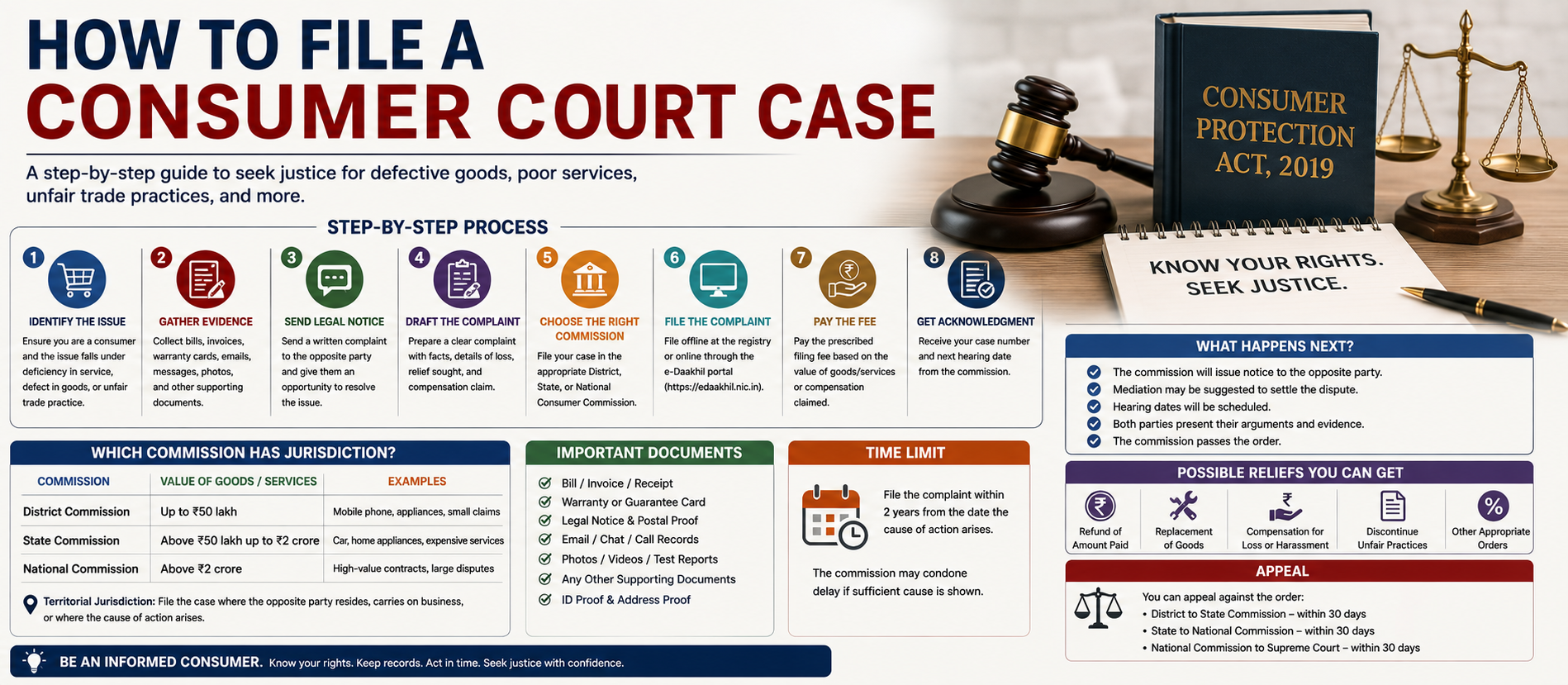
Many people believe that filing a consumer case is too difficult. In reality, the process can be understood step by step. The key is to identify the legal issue, collect evidence, choose the correct Consumer Commission and file the complaint within the applicable limitation period.
This guide explains how to file a consumer court case in India in simple and direct language. It covers consumer rights, complaint drafting, jurisdiction, documents, electronic filing, mediation, hearings, remedies and appeals.
Digiifrog creates clear and useful digital content using SEO, AEO, GEO and AI Search Optimization.
What Is a Consumer Court Case?
A consumer dispute is generally a dispute between a consumer and a seller, manufacturer, service provider or other responsible party concerning goods or services.
Consumer complaints in India are handled through the consumer dispute redressal system established under the Consumer Protection Act, 2019. The forums are commonly referred to as Consumer Commissions.
Depending on the applicable jurisdiction, a complaint may be filed before:
- District Consumer Disputes Redressal Commission
- State Consumer Disputes Redressal Commission
- National Consumer Disputes Redressal Commission
The correct Commission depends mainly on the value of goods or services paid as consideration and other applicable jurisdiction rules.
Who Is a Consumer?
In simple terms, a consumer is generally a person who buys goods or hires or avails services for consideration, subject to the definitions, exclusions and exceptions in the Consumer Protection Act, 2019.
For example, a consumer dispute may involve:
- A defective mobile phone or appliance.
- A product that does not match the description.
- A service provider that failed to provide the promised service.
- An unfair refusal to repair or replace a product.
- A wrongful or unexplained charge.
- A delayed or deficient service.
- A misleading advertisement.
- An e-commerce dispute.
- A product or service that causes loss because of a defect or deficiency.
Not every business disagreement is automatically a consumer dispute. Whether the Act applies depends on the facts and the statutory definition of consumer.
What Problems Can Be Taken to a Consumer Commission?
A complaint may arise from several types of consumer harm.
Defective Goods
A product may be defective in quality, quantity, purity, standard or other required characteristics.
Deficiency in Service
Deficiency can include a fault, imperfection, shortcoming or inadequacy in the quality, nature or manner of performance required by law or promised under a contract.
Unfair Trade Practice
A business may be challenged for certain unfair or deceptive practices covered by the law.
Overcharging
A consumer may have a complaint where goods or services are sold or charged in a manner covered by the applicable provisions of consumer law.
Misleading Advertising
False or misleading claims can create consumer protection issues. Keep copies, screenshots, brochures and advertisements as evidence.
Step 1: Understand Your Legal Problem
Before filing a complaint, identify exactly what went wrong.
Ask yourself:
- What product or service did I purchase?
- Who sold or provided it?
- What was promised?
- What actually happened?
- What loss or inconvenience did I suffer?
- What evidence supports my claim?
- What remedy do I want?
Write a simple timeline. Include the purchase date, payment date, delivery date, dates of complaints and responses received.
Step 2: Collect All Important Documents
Evidence is one of the most important parts of a consumer case.
Useful Documents May Include:
- Invoice or bill.
- Cash memo.
- Order confirmation.
- Payment receipt.
- Bank or card statement.
- Warranty or guarantee documents.
- Service agreement.
- Email communication.
- WhatsApp or chat records.
- Photographs or videos.
- Product packaging.
- Delivery records.
- Previous complaints and replies.
Keep the original documents safely. Use copies for filing where required.
Step 3: Contact the Business First
It is often practical to first contact the seller or service provider and explain the problem.
Send a clear written complaint. State:
- What you purchased.
- The date of purchase.
- The problem.
- The evidence available.
- The remedy you want.
- A reasonable period for response.
For example, you may request a refund, replacement, repair, removal of an incorrect charge or another appropriate remedy.
Keep proof that you contacted the business. A written record may later help explain that you tried to resolve the dispute.
Step 4: Check the Limitation Period
Under Section 69 of the Consumer Protection Act, 2019, a complaint is generally required to be filed within two years from the date on which the cause of action arises.
A complaint filed after this period may still be entertained if the relevant Consumer Commission is satisfied that there was sufficient cause for the delay, subject to the statutory requirements.
Do not wait until the last moment. Delay can create unnecessary legal complications.
Step 5: Choose the Correct Consumer Commission
Choosing the correct Commission is essential.
Under the Consumer Protection (Jurisdiction of the District Commission, the State Commission and the National Commission) Rules, 2021, the pecuniary jurisdiction is based on the value of goods or services paid as consideration.
Current Jurisdiction Framework
- District Commission: Where the value paid as consideration does not exceed ₹50 lakh.
- State Commission: Where the value paid exceeds ₹50 lakh but does not exceed ₹2 crore.
- National Commission: Where the value paid exceeds ₹2 crore.
These thresholds concern the value of goods or services paid as consideration. Do not automatically calculate jurisdiction only from the compensation amount you are claiming.
Step 6: Check the Territorial Jurisdiction
You must also consider the correct geographical jurisdiction.
The Consumer Protection Act provides jurisdiction rules that can allow a complaint before the District Commission based on factors such as:
- The opposite party's residence or place of business.
- The complainant's residence or place of business, where applicable under the Act.
- The place where the cause of action wholly or partly arose.
Jurisdiction can become complicated where several companies, branches or online platforms are involved. If the facts are complex, obtain professional legal advice.
Step 7: Draft the Consumer Complaint
Your complaint should be clear, factual and organized. Avoid unnecessary emotional language. Explain what happened in chronological order.
A Basic Consumer Complaint Structure
- Name of the Consumer Commission.
- Name and address of the complainant.
- Name and address of the opposite party.
- Facts of the case.
- Details of the goods or services.
- Date and details of payment.
- Nature of the defect, deficiency or unfair practice.
- Previous communication with the opposite party.
- Grounds for jurisdiction.
- Details showing that the complaint is within limitation, if relevant.
- The relief requested.
- List of supporting documents.
- Verification and signature, as applicable.
What Relief Can You Request?
The Consumer Commission can grant relief permitted by law based on the facts of the case.
Depending on the situation, the requested relief may include:
- Repair of defective goods.
- Replacement of goods.
- Refund of the price paid.
- Removal of defects.
- Compensation for loss or injury where legally justified.
- Discontinuation of an unfair trade practice.
- Withdrawal or correction of misleading material, where applicable.
- Costs of the proceedings.
- Other relief available under the Consumer Protection Act.
Ask for relief that matches the facts and evidence. An unrealistic or unsupported claim can weaken the presentation of your case.
Step 8: Attach the Supporting Evidence
Organize documents in a logical order.
A simple sequence can be:
- Invoice or order proof.
- Payment proof.
- Warranty or service terms.
- Photos or technical evidence.
- Emails and messages.
- Complaint sent to the company.
- Company response.
- Any expert report, where available.
Number or label your documents clearly. This makes it easier for the Commission and the opposite party to understand your evidence.
Step 9: Pay the Applicable Filing Fee
Consumer complaints may require payment of the applicable fee. The fee structure is prescribed through the relevant Consumer Protection Rules and amendments.
The exact amount can depend on the value category and the Commission. Before filing, verify the current fee schedule and filing instructions from the official consumer affairs or Commission platform.
Do not rely on an old online article for the fee amount.
Step 10: File the Complaint Offline or Electronically
Section 35 of the Consumer Protection Act, 2019 allows a complaint to be filed electronically in the prescribed manner.
Electronic filing arrangements may be available through the official consumer complaint infrastructure, including the e-Daakhil system where available and applicable.
The exact online process, supported Commissions and technical requirements should be checked on the official platform at the time of filing.
For an Online Filing, You May Need:
- Your identity and contact information.
- Details of the opposite party.
- A written complaint.
- Supporting documents in the required format.
- Payment details, where a fee is applicable.
- Verification or authentication as required by the platform.
After submission, save the acknowledgement, complaint number and payment receipt.
What Happens After You File?
The Consumer Commission will consider the complaint according to the procedure under the Act.
Under Section 36, the admissibility of a complaint is ordinarily to be decided within twenty-one days from the date of filing. If admissibility is not decided within that period, the Act provides that the complaint is deemed to have been admitted.
After admission, the opposite party may be given notice and an opportunity to respond. The case may then proceed based on pleadings, documents, evidence, testing or analysis where necessary and hearings.
Mediation: Can the Case Be Settled Without a Full Hearing?
Yes. The Consumer Protection Act, 2019 includes a mediation framework.
If the Consumer Commission believes that the dispute contains elements that may be settled, and the parties consent in accordance with the statutory process, the matter may be referred to mediation.
Mediation can sometimes help parties reach a faster and mutually acceptable settlement.
Mediation May Be Useful When:
- The dispute is mainly about money or service resolution.
- Both parties are willing to negotiate.
- The facts are not seriously disputed.
- A practical settlement is possible.
Mediation is not suitable for every case.
Do You Need a Lawyer?
A consumer complaint can be filed without automatically requiring a lawyer. However, legal help may be useful when:
- The claim is high value.
- Several parties are involved.
- The evidence is technical.
- The legal issues are complex.
- The matter involves insurance, construction, medical services or another specialized field.
- An appeal is being considered.
If you handle the case yourself, focus on clear facts, organized evidence and the specific relief you are requesting.
How to Prepare for the Hearing
Before the hearing, review your complaint and evidence.
Prepare a Short Summary Covering:
- What happened.
- What you paid.
- What was promised.
- What went wrong.
- What evidence proves your claim.
- What relief you want.
Answer questions directly. Do not exaggerate. If you do not know an answer, do not guess.
What If the Opposite Party Does Not Respond?
The Consumer Commission follows the procedure set out under the Act and applicable regulations. Failure by the opposite party to participate does not automatically guarantee that the consumer will win, but the Commission may proceed according to the applicable legal procedure and available evidence.
Continue to attend hearings and comply with directions from the Commission.
Can You Appeal Against a Consumer Commission Order?
The Consumer Protection Act, 2019 provides appeal mechanisms from orders of the District Commission to the State Commission, from the State Commission to the National Commission in applicable cases, and from the National Commission to the Supreme Court as provided by the Act.
Appeal periods and pre-deposit requirements can apply. Do not delay if you receive an adverse order. Check the current statutory provisions and applicable procedure immediately.
Common Mistakes When Filing a Consumer Case
1. Filing Too Late
The general limitation period is important. Do not assume that a complaint can always be filed years later.
2. Choosing the Wrong Commission
Check both pecuniary and territorial jurisdiction.
3. Filing Without Evidence
A strong complaint needs documents, records and other relevant proof.
4. Making Emotional but Unclear Allegations
Use a simple timeline and explain facts clearly.
5. Naming the Wrong Opposite Party
Identify the legal entity, seller, manufacturer or service provider correctly.
6. Asking for Unsupported Compensation
Explain how the claimed loss or injury is connected to the evidence.
7. Ignoring Notices or Hearing Dates
Monitor your case and comply with the Commission's directions.
Special Issues in Online Shopping and E-Commerce Cases
Online purchases can also lead to consumer disputes.
Keep:
- Product screenshots.
- Order confirmation.
- Payment records.
- Delivery details.
- Return and refund policies.
- Chat or email communication.
- Photos or videos of the product.
The Consumer Protection framework also includes e-commerce rules intended to address consumer protection and unfair trade practices in the online marketplace.
A Simple Consumer Complaint Checklist
- Confirm that you qualify as a consumer for the dispute.
- Identify the defect, deficiency or unfair practice.
- Collect all invoices and payment proof.
- Save communication with the business.
- Write a clear timeline.
- Check the two-year limitation period.
- Choose the correct Consumer Commission.
- Check territorial jurisdiction.
- Draft the complaint clearly.
- Attach supporting documents.
- Verify the current filing fee and procedure.
- File electronically or through the applicable filing process.
- Save the acknowledgement and case number.
- Monitor notices and hearing dates.
SEO, AEO, GEO and AI Search Optimization for Consumer Legal Content
People increasingly search using direct questions such as:
- How do I file a consumer court case?
- How long do I have to file a consumer complaint?
- Can I file a consumer complaint online?
- Which Consumer Commission should I approach?
- What documents are needed for a consumer case?
SEO helps legal content become discoverable through traditional search.
AEO focuses on clear, direct answers to common questions.
GEO helps structure useful content for generative search environments.
AI Search Optimization emphasizes clear headings, factual context, direct answers and easy-to-understand language.
Legal content should be readable. Short sentences, clear headings and step-by-step explanations help both people and AI-based search systems understand the information.
How Digiifrog Supports Modern Legal Content
Digiifrog creates structured, readable and search-friendly digital content.
- SEO Content Strategy
- AEO and Answer-Focused Content
- GEO and Generative Search Optimization
- AI Search Optimization
- Legal and Business Content Development
- Digital Branding Strategy
Frequently Asked Questions
Can I file a consumer complaint online?
The Consumer Protection Act permits electronic filing in the prescribed manner. Online filing arrangements may be available through official systems such as e-Daakhil, depending on the applicable Commission and current platform procedures.
How long do I have to file a consumer case?
Section 69 of the Consumer Protection Act, 2019 generally requires a complaint to be filed within two years from the date on which the cause of action arose, subject to the Commission's power to entertain a delayed complaint where sufficient cause is established.
Which Consumer Commission should I approach?
Under the 2021 jurisdiction rules, the value paid as consideration generally determines the level of Commission: up to ₹50 lakh for the District Commission, above ₹50 lakh up to ₹2 crore for the State Commission, and above ₹2 crore for the National Commission.
Do I need a lawyer for a consumer case?
Not necessarily. However, legal assistance can be useful in complex, high-value or technically difficult cases.
Can I ask for a refund and compensation?
You can request relief permitted by law and supported by the facts. The Consumer Commission decides the appropriate relief based on the case and evidence.
What happens if I file in the wrong Consumer Commission?
A jurisdiction issue can delay the matter or require filing before the appropriate forum. Check pecuniary and territorial jurisdiction before submitting the complaint.
Conclusion
Understanding how to file a consumer court case can help consumers take informed action when a genuine dispute arises.
The process starts with good documentation. Identify the problem. Collect evidence. Contact the business. Check the limitation period. Choose the correct Consumer Commission. Draft a clear complaint and request appropriate relief.
💡 Key Insight
The most important rule is simple: be clear, be factual and keep records.
Consumer law and filing procedures can change. Always verify the current rules, jurisdiction, fees and electronic filing process through official government or Consumer Commission sources before filing.
Legal Disclaimer: This article is for general educational and informational purposes only. It is not legal advice. Consumer disputes depend on individual facts, applicable laws, jurisdiction, limitation, evidence and current procedural rules. Consult a qualified legal professional for advice about a specific case.
Digiifrog
Website: www.digiifrog.com
Ready to Grow?
Talk to us about a strategy tailored to your brand — we will help you stand out in search, AI discovery and social.

Comments (0)
Log in to leave a comment.