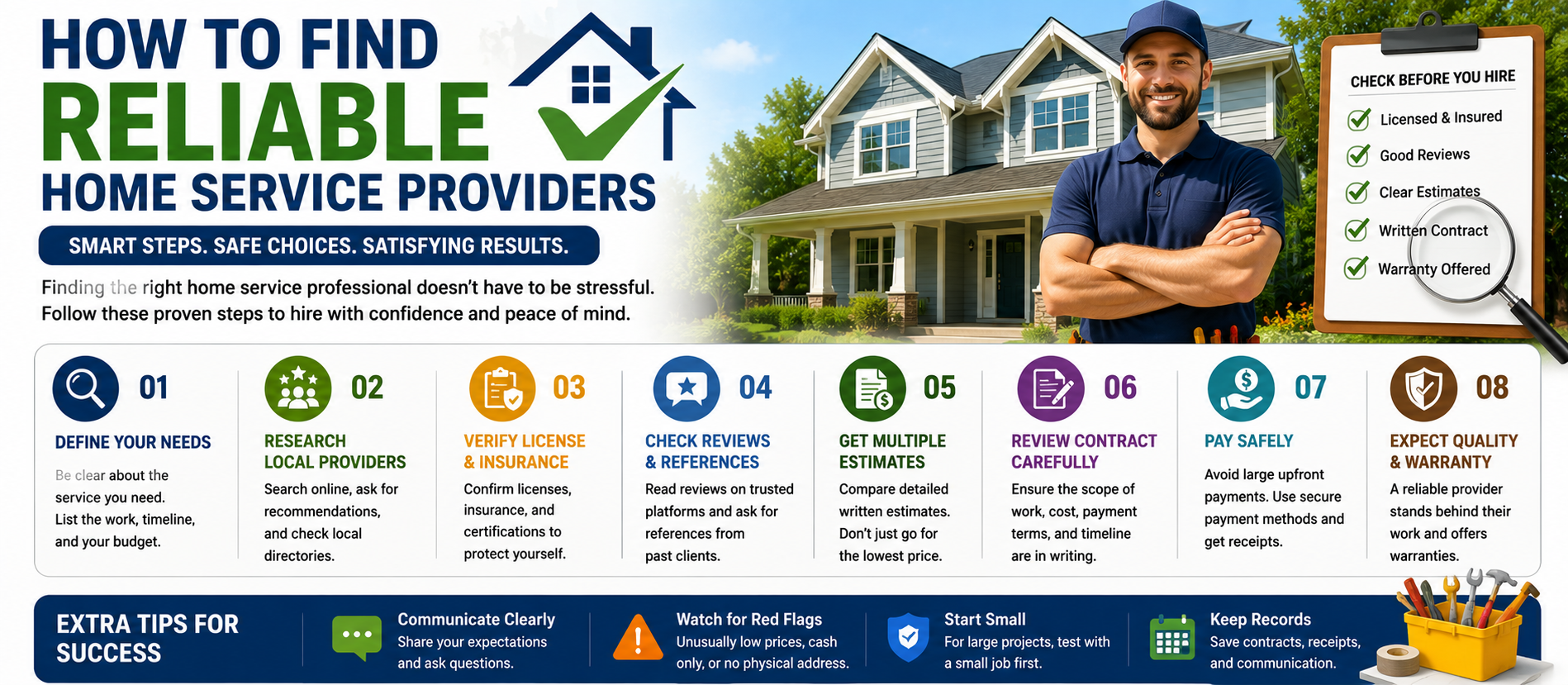
📋 Quick Summary
In this article:
What Makes a Home Service Provider Reliable?
1. Define the Home Service You Need
2. Decide Whether It Is an Emergency
3. Ask Friends, Family, and Neighbors
4. Search for Local Home Service Providers
5. Check the Company's Website
6. Verify Licensing and Registration
7. Verify Insurance
8. Check Relevant Certifications
9. Review Multiple Online Sources
10. Search the Business Name Plus Complaint Terms
11. Ask for Recent References
Finding a reliable home service provider can save homeowners time, money, stress, and potentially significant repair costs. Whether you need a plumber, electrician, HVAC technician, roofer, painter, cleaner, pest-control professional, landscaper, handyman, appliance technician, or remodeling contractor, choosing the right company is about more than finding the lowest quote.
How to find reliable home service providers starts with defining the job clearly, researching multiple candidates, verifying qualifications, checking references and reviews, comparing written estimates, understanding insurance and warranty terms, and putting important agreements in writing. Consumer-protection guidance from the U.S. Federal Trade Commission recommends checking licensing and insurance where applicable, getting recommendations, researching complaints, obtaining multiple written estimates, reading contracts carefully, and avoiding full upfront payment. citeturn0search2
For homeowners in India, the same basic principles are useful even though licensing, registration, permits, consumer rules, and professional requirements can vary by state, city, and service category. India's National Consumer Helpline states that consumers have rights including safety, information, choice, fair treatment, redressal, and consumer education. citeturn0search0
A reliable provider should be able to explain what work is required, what materials will be used, what the expected timeline is, what is included in the price, what could change the price, and how problems will be handled. This article provides a practical step-by-step system for finding, evaluating, hiring, and managing home service professionals.
This WordPress-ready HTML article is prepared for Digiifrog (www.digiifrog.com) with a strong focus on SEO, AEO, GEO, and AI Search optimization.
What Makes a Home Service Provider Reliable?
A reliable home service provider is not simply someone who arrives quickly or offers the lowest price. Reliability includes professional communication, appropriate qualifications, transparent pricing, dependable scheduling, safe working practices, quality workmanship, proper documentation, and reasonable after-service support.
Good contractors and service businesses should be able to explain their process instead of making vague promises. A current 2026 consumer checklist from Connecticut's Department of Consumer Protection recommends defining the project clearly, interviewing multiple contractors, and using referrals from people who have recently completed similar work. citeturn0search5
The exact credentials required depend on the service. A plumber, electrician, roofer, cleaner, landscaper, and general remodeling contractor do not necessarily need the same qualifications. The goal is to verify whatever credentials and protections are relevant to the work.
1. Define the Home Service You Need
Before searching for providers, write down exactly what you need. Instead of saying, “I need some plumbing work,” describe the problem as clearly as possible: a leaking kitchen faucet, low water pressure, a blocked drain, a recurring leak, or a bathroom renovation.
A clear project description helps providers prepare more useful estimates and makes it easier to compare different companies. For larger projects, photographs, measurements, product information, and examples of the desired result can be extremely helpful.
2. Decide Whether It Is an Emergency
Some home service problems require immediate action. Active flooding, serious electrical hazards, gas-related concerns, major roof leaks, sewage backups, or other dangerous conditions should not be treated like routine shopping decisions.
For non-emergency work, take time to research and compare providers. For urgent situations, prioritize safety and qualified assistance first, then review documentation and pricing as soon as practical.
3. Ask Friends, Family, and Neighbors
Personal recommendations can be a strong starting point because the person recommending the provider has direct experience with the service. Ask about the quality of work, communication, punctuality, final price, cleanup, and how the provider handled problems.
Do not treat one recommendation as proof that a company is suitable for every project. A contractor who did excellent painting work may not be the right choice for electrical, plumbing, structural, or roofing work.
4. Search for Local Home Service Providers
Online search can help you create a shortlist of local companies. Search using the specific service and location rather than a generic phrase such as “best contractor.” Examples include “residential electrician,” “bathroom renovation contractor,” “air conditioner repair,” or “home cleaning service” followed by the relevant city or area.
Look beyond the first result. A strong search result can be useful, but ranking alone does not prove workmanship, licensing, insurance, or reliability.
5. Check the Company's Website
A professional website should make it reasonably easy to understand what the company does, where it operates, how to contact it, and what types of projects it handles.
Look for service descriptions, project photographs, contact information, business details, FAQs, warranty information, and evidence of experience. Be cautious if a company makes extremely broad claims but provides almost no verifiable information.
6. Verify Licensing and Registration
Where licensing or registration is legally required, verify it through the relevant official authority rather than relying only on a number supplied in an advertisement.
The FTC recommends considering only contractors who are licensed and insured when those requirements apply and checking licensing information with the appropriate government authority. citeturn0search2
In India, requirements differ by service and jurisdiction. Do not assume that every home-service provider needs the same license. Ask what registration, certification, trade qualification, or local permission applies to the particular job.
7. Verify Insurance
Insurance can help protect homeowners and workers when something goes wrong. Depending on the service and jurisdiction, relevant coverage may include general liability or worker-related coverage.
Ask the provider for evidence of applicable insurance and understand what the policy is intended to cover. Consumer guidance from the FTC and BBB both recommends checking proof of insurance when evaluating contractors. citeturn0search2turn0search3
8. Check Relevant Certifications
Some services require specialized training or certification. HVAC technicians, electricians, pest-control operators, appliance specialists, and other professionals may have industry-specific credentials.
Ask whether the person performing the work is certified or trained for the particular equipment or system involved. A general handyman may be suitable for minor repairs but not for specialized technical work.
9. Review Multiple Online Sources
Online reviews can help identify patterns in customer experiences, but no single rating should determine your decision. Read both positive and negative reviews and look for recurring themes.
Pay attention to comments about communication, punctuality, workmanship, unexpected charges, cleanup, warranty support, and how the company responds to complaints.
BBB guidance recommends using reviews and business profiles as part of contractor research while also checking licensing, insurance, and business reputation. citeturn0search3
10. Search the Business Name Plus Complaint Terms
⚠ Watch Out
A practical research technique is to search the company name together with words such as “complaint,” “scam,” “review,” or “lawsuit” where appropriate. The FTC specifically recommends researching contractor names in this way as part of scam avoidance. citeturn0search2
One complaint does not automatically prove that a business is unreliable. Look for patterns, responses, dates, and the seriousness of the issue.
11. Ask for Recent References
Ask for references from recent projects that are similar to yours. A reliable provider should generally be comfortable explaining their experience with comparable work.
When contacting a reference, ask whether the project was completed on time, whether the final price matched expectations, whether the workmanship was satisfactory, and whether the provider responded when issues appeared.
12. Review the Provider's Portfolio
For visible projects such as remodeling, painting, landscaping, flooring, roofing, or carpentry, request photographs of completed work.
Do not judge solely by polished marketing images. Ask for examples similar to your project and, where practical, evidence that the images represent the company's actual work.
13. Interview at Least Two or Three Providers
Comparing multiple providers gives you a better understanding of the project scope, typical pricing, timelines, and proposed solutions.
The goal is not necessarily to collect the largest number of quotes. Two or three qualified candidates can be more useful than ten random estimates.
14. Ask the Same Questions to Every Provider
Use a consistent list of questions so that the estimates are easier to compare. Ask about scope, materials, labor, timeline, payment schedule, warranty, permits, cleanup, subcontractors, and potential additional costs.
Consistency helps prevent a common mistake: comparing a detailed quote from one company against a very limited quote from another.
15. Request a Detailed Written Estimate
A written estimate should explain what the provider intends to do and what you are paying for. The FTC recommends written estimates that describe the work, materials, completion date, and price. citeturn0search2
For larger projects, an estimate should ideally separate labor, materials, equipment, disposal, permits where applicable, and other significant costs.
16. Do Not Automatically Choose the Lowest Quote
The lowest estimate can be attractive, but price alone does not show whether the scope is complete. An unusually low quote may omit preparation, materials, repairs, cleanup, or other necessary work.
Ask why estimates differ significantly. A higher price may reflect better materials, more preparation, insurance, qualified labor, or a more comprehensive scope.
17. Understand What Is Included
Ask whether the quoted price includes materials, removal of old materials, disposal, cleanup, travel, equipment, permits, inspections, and taxes or fees where applicable.
Clarify whether the provider expects you to purchase materials directly or whether they will supply them.
18. Ask About Change Orders
Unexpected conditions can occur during home repairs. A written process for change orders can prevent disagreements.
Ask how additional work will be priced and whether you must approve changes before the provider performs them. Whenever practical, get changes in writing rather than relying on verbal conversations.
19. Review the Contract Carefully
💡 Key Insight
For significant projects, use a written contract. It should identify the parties, scope of work, materials, price, schedule, payment terms, change-order process, warranty terms, and other important obligations.
The FTC recommends reading contracts carefully and ensuring important promises made during calls or conversations are reflected in writing. citeturn0search2
20. Never Sign a Blank Contract
Do not sign a document containing blank spaces that could later be completed without your knowledge. Review every page, attachment, specification, and payment term before signing.
Keep a complete copy of the signed agreement and related estimates.
21. Understand the Payment Schedule
Payment should generally be tied to a clear project arrangement rather than an unexplained demand for the entire amount immediately.
The FTC warns homeowners against paying the full amount up front and notes that some jurisdictions limit down payments. citeturn0search2
Exact payment rules vary by location and contract type, so follow applicable local law. For large projects, milestone-based payments can make the relationship clearer when properly documented.
22. Be Careful With Cash-Only Demands
A request for cash is not automatically proof of fraud, but a provider who insists on cash only, refuses documentation, or avoids written agreements deserves additional scrutiny.
Consumer-protection authorities identify pressure for immediate payment and large upfront payments as warning signs in home-improvement scams. citeturn0search2turn0search6
23. Watch for Pressure Tactics
Reliable providers should allow you reasonable time to review an estimate and compare options for non-emergency work. Be cautious if someone insists that you must decide immediately because a special price will disappear within minutes.
Pressure can make it harder to identify hidden costs or compare the provider with competitors.
24. Be Careful With Unsolicited Door-to-Door Offers
Unsolicited offers are not automatically illegitimate, but homeowners should verify the provider independently rather than relying on the salesperson's claims.
Be particularly careful when someone claims to have discovered urgent damage that you cannot independently see or verify. Ask for documentation and consider obtaining another professional opinion.
25. Ask Who Will Actually Do the Work
Some companies use employees, while others subcontract portions of the project. Neither model is automatically good or bad.
Ask who will perform the work, whether subcontractors are insured and qualified, who supervises them, and who is responsible if a subcontractor causes damage.
26. Ask About Permits and Inspections
Some projects require permits or inspections. Requirements vary by jurisdiction and type of work.
Ask the provider whether permits are required, who will obtain them, and who will arrange inspections. Consumer-protection guidance identifies a contractor asking the homeowner to obtain required permits as a potential warning sign in certain situations. citeturn0search2turn0search6
27. Verify the Scope Before Work Begins
Before the first day of work, confirm the final scope, materials, colors, equipment models, access requirements, working hours, protection of furniture and floors, and cleanup expectations.
A short pre-project confirmation can prevent misunderstandings later.
28. Protect Your Home During the Project
Ask how floors, furniture, walls, landscaping, doors, and other areas will be protected. For interior projects, clarify dust control and cleanup. For exterior work, ask about protecting plants, vehicles, windows, and neighboring property.
Professional planning should account for the effect of the work on the rest of the property.
29. Communicate Through a Clear Contact Person
For larger projects, identify one person responsible for project communication. This makes it easier to track questions, approvals, schedule changes, and documentation.
Keep important decisions in email, text, or another written format where possible.
30. Document Existing Conditions
Take photographs of the work area before the project begins. This can be useful for documenting existing damage, furniture placement, landscaping, fixtures, and other conditions.
Documentation is especially valuable for large renovation, roofing, flooring, plumbing, and exterior projects.
31. Understand the Warranty
Ask what the provider's workmanship warranty covers, how long it lasts, and what conditions are excluded. Manufacturer warranties and contractor workmanship warranties are not necessarily the same.
Keep receipts, invoices, product information, and warranty documents in a safe place.
32. Ask What Happens If Something Fails
A useful provider should have a clear process for handling callbacks or defects. Ask who you contact, how quickly they respond, and whether labor or replacement materials are covered.
The quality of after-service support can be just as important as the original installation.
33. Evaluate Communication Before Hiring
Communication during the quoting stage can provide useful clues. Does the provider answer questions clearly? Do they arrive when promised? Do they send documents when they say they will?
Perfect communication is not realistic, but repeated missed calls, unexplained delays, vague answers, or disappearing for long periods can become significant problems during the actual project.
34. Look for Professional Documentation
Reliable providers often have organized estimates, invoices, contracts, service reports, product information, and warranty documents.
Good documentation does not guarantee workmanship, but disorganized paperwork can make disputes and misunderstandings more difficult to resolve.
35. Verify the Business Identity
Confirm the legal or trading name of the business, phone number, address where applicable, website, and other relevant business information.
Be cautious if a provider changes names frequently, refuses to provide basic business details, or cannot explain who you are contracting with.
36. Check for Complaints and Disciplinary History
Where official databases exist, check for complaints, disciplinary actions, registration status, or other relevant records.
Recent contractor-vetting guidance also recommends checking complaint history, reviews, permit history, and industry recognition rather than relying solely on marketing material. citeturn0news42
37. Do Not Rely on Reviews Alone
Reviews can be manipulated, incomplete, outdated, or biased. A company with thousands of reviews may still be unsuitable for a specialized project.
Use reviews as one part of a broader verification process that includes qualifications, references, insurance, written estimates, and direct communication.
38. Compare Materials, Not Just Prices
Two providers can quote different prices because they propose different materials or equipment. Ask for brand names, model numbers, grades, specifications, or equivalent descriptions where relevant.
This is particularly important for roofing, HVAC, plumbing fixtures, electrical equipment, flooring, windows, appliances, and remodeling materials.
39. Ask About Maintenance After Installation
Some home systems require regular maintenance. Ask what maintenance is recommended, who can perform it, and what happens if maintenance is skipped.
A provider who explains maintenance requirements can help you protect the investment beyond the initial project.
40. Get a Second Opinion for Major Repairs
For expensive or difficult-to-diagnose problems, a second opinion can be valuable. This is especially useful when a provider recommends replacing an expensive system or performing major structural work.
A second opinion does not mean the first professional is wrong. It simply gives you more information before committing to a significant expense.
41. Learn the Difference Between Repair and Replacement
Ask why a system needs replacement rather than repair. A trustworthy provider should be able to explain the technical reasoning, expected service life, risks, and cost difference.
Because homeowners often rely on professionals to diagnose problems they cannot easily verify themselves, clear explanations and documentation are especially important in home-service markets. Research on “credence” services highlights the information advantage providers may have over consumers, which can make transparent diagnosis and informed comparison valuable. citeturn0academia43
42. Watch for Unnecessary Upselling
A provider may legitimately identify additional work after inspecting a system. The important question is whether the recommendation is explained and supported.
Ask what happens if the additional work is not performed, whether it is urgent, and whether there is evidence of the problem.
43. Ask for Photos of Hidden Problems
When practical, ask the provider to photograph damage that will be covered by new materials. This can help you understand why repairs are needed and gives you a record of the condition before it is closed.
Photos should support, not replace, professional diagnosis.
44. Be Careful With Extremely Low Estimates
An extremely low estimate can indicate that important items are missing from the scope. Compare the details rather than assuming the lowest number is the best deal.
Recent consumer guidance specifically warns homeowners not to choose automatically based on the lowest bid and recommends asking for explanations when estimates differ significantly. citeturn0search2
45. Avoid Large Upfront Commitments
Do not agree to unusually large upfront payments without understanding the contract, local law, project requirements, and payment schedule.
Some projects legitimately require deposits for special-order materials, but the reason and amount should be clear and documented.
46. Keep All Receipts and Records
Save estimates, contracts, invoices, receipts, payment confirmations, photographs, permits, inspection records, product warranties, and correspondence.
Digital folders can make it easier to locate documents years later when you need warranty service or property records.
47. Use a Home Service Provider Checklist
- Define the work clearly.
- Research several providers.
- Check relevant licensing or registration.
- Verify insurance where applicable.
- Review references and portfolios.
- Read multiple sources of reviews.
- Request detailed written estimates.
- Compare scope and materials.
- Ask about permits.
- Review the contract.
- Understand payment milestones.
- Confirm warranty terms.
- Document existing conditions.
- Keep records and receipts.
48. Red Flags You Should Not Ignore
- Pressure to decide immediately
- Demand for full payment before work begins
- Refusal to provide a written estimate
- Refusal to provide applicable license information
- Refusal to provide proof of insurance
- Vague or constantly changing pricing
- Unusually low estimates with little detail
- Requests to bypass required permits
- Unexplained cash-only demands
- Inability to provide references
- Repeated unexplained communication failures
- Unclear business identity
Government and consumer-protection agencies identify several of these behaviors as warning signs, including pressure tactics, full upfront payment demands, permit concerns, missing insurance, and refusal to provide relevant credentials. citeturn0search2turn0search6
49. Green Flags of a Reliable Provider
- Provides a clear written scope.
- Answers questions directly.
- Provides relevant credentials.
- Shows proof of applicable insurance.
- Offers recent references.
- Explains material choices.
- Uses a written contract for significant work.
- Explains payment milestones.
- Discusses permits when applicable.
- Explains warranty coverage.
- Communicates schedule changes.
- Documents additional work before proceeding.
50. Home Service Providers for Different Types of Work
Plumbers
Look for experience with the specific plumbing system and problem. Ask about diagnosis, repair options, parts, labor, and warranty.
Electricians
Verify the appropriate trade qualifications and local requirements. Electrical work should prioritize safety and code compliance.
Roofers
Ask about roof inspection, materials, flashing, ventilation, warranty, cleanup, and how hidden damage will be handled.
HVAC Professionals
Ask about system diagnosis, efficiency, equipment sizing, maintenance, refrigerant-related requirements, and warranty.
Cleaning Companies
Clarify the rooms, tasks, cleaning products, frequency, staffing, insurance, and whether the same team will return.
Pest-Control Providers
Ask what pest is being treated, what treatment is proposed, what preparation is required, and what safety instructions apply.
Landscapers
Confirm plant selection, irrigation, maintenance, disposal, seasonal work, and whether the quote covers materials.
Handymen
Use handymen for tasks appropriate to their skills and verify whether specialized electrical, plumbing, structural, or regulated work requires another professional.
51. How to Find Reliable Providers Through Local Search
Local search is useful because home services are usually location-dependent. Search for the exact service, neighborhood or city, and problem type. For example, a homeowner should search for “bathroom renovation contractor” rather than simply “contractor.”
Then compare businesses based on service relevance, reviews, credentials, availability, written estimates, and communication.
52. Why Local Experience Matters
A provider familiar with your local area may understand common building styles, climate conditions, local suppliers, permitting processes, and recurring property issues.
However, “local” should not replace verification. A nearby provider still needs to demonstrate appropriate competence and reliability.
53. How AI Is Changing Home Service Selection
AI-powered search and recommendation tools are making it easier for homeowners to compare service categories, understand common repair issues, generate question lists, organize estimates, and summarize reviews.
However, AI-generated recommendations should not replace direct verification. Homeowners should still confirm licenses, insurance, references, pricing, and project details with the actual provider.
54. Digital Estimates and Customer Portals
Modern home service companies increasingly use digital estimates, online scheduling, customer portals, electronic contracts, automated appointment reminders, and digital invoices.
These systems can improve convenience and documentation, but technology alone does not guarantee workmanship. Evaluate the underlying business as well.
55. Home Service SEO, AEO, GEO and AI Search
For home service businesses, digital visibility is becoming increasingly important. SEO helps providers appear in traditional search results. AEO helps answer specific homeowner questions. GEO helps businesses become more discoverable in generative search experiences, while AI Search optimization emphasizes clear, useful, trustworthy, structured, and location-relevant content.
A strong home-service website should clearly explain services, service areas, credentials, project processes, pricing factors, emergency availability, warranties, FAQs, and customer expectations.
Useful content can answer questions such as how to choose a plumber, how to verify a contractor, what to ask a roofer, how to compare HVAC estimates, how much a home repair may cost, and what red flags to avoid.
56. How Reliable Providers Build Trust Online
Trustworthy home service businesses can strengthen their online presence by publishing real project examples, service explanations, transparent FAQs, customer testimonials, clear contact information, credentials, service-area pages, and useful educational content.
They should avoid exaggerated claims and instead provide information that helps homeowners make informed decisions.
57. Home Service Safety Should Come First
When a project involves electricity, gas, structural work, major plumbing, roofing at height, chemicals, or other hazards, homeowners should prioritize qualified professionals and applicable safety requirements.
Do not allow cost pressure to turn a specialized safety issue into an improvised DIY project.
58. What to Do If You Suspect Poor Workmanship
Document the problem with photographs and written notes. Review the contract and warranty. Contact the provider in writing and clearly describe the issue and requested resolution.
If the matter cannot be resolved, consult the relevant consumer-protection, licensing, regulatory, or dispute-resolution authority available in your jurisdiction. India's National Consumer Helpline provides information and grievance-support channels for consumers. citeturn0search0
59. A Simple 10-Step Hiring Process
- Define the project.
- Collect recommendations.
- Search for local providers.
- Create a shortlist.
- Verify credentials and insurance.
- Check reviews and references.
- Interview two or three candidates.
- Compare detailed written estimates.
- Sign a clear contract.
- Monitor the project and keep records.
60. Final Home Service Hiring Checklist
Before hiring, ask yourself:
- Do I understand exactly what work is needed?
- Have I compared more than one qualified provider?
- Did I verify relevant credentials?
- Did I check insurance where appropriate?
- Did I speak with references?
- Did I read reviews critically?
- Is the quote detailed?
- Are materials specified?
- Are payment terms clear?
- Is there a written contract?
- Are permits addressed?
- Is warranty coverage clear?
- Do I know who will perform the work?
- Do I have copies of all documents?
Frequently Asked Questions About Finding Reliable Home Service Providers
How do I find a reliable home service provider?
Start with recommendations and local search, then shortlist several providers. Verify relevant licensing or registration, insurance, references, reviews, written estimates, contracts, payment terms, and warranty information before hiring.
How many quotes should I get?
For significant non-emergency work, comparing two or three qualified providers is a practical starting point. More quotes are useful when the project is unusually expensive or specialized.
Should I choose the cheapest contractor?
No. Compare the complete scope, materials, qualifications, insurance, timeline, warranty, and payment terms. The lowest quote may omit important work.
What are the biggest contractor red flags?
Common warning signs include pressure to decide immediately, demands for full upfront payment, refusal to provide written details, missing credentials, missing insurance, unclear pricing, and requests to bypass required permits. citeturn0search2turn0search6
Should a home service provider provide a written contract?
For significant projects, a written contract is strongly advisable. It should clearly identify the scope, price, schedule, payment terms, materials, change-order process, and warranty.
How do I verify a contractor's license?
Use the relevant official licensing or registration authority for your jurisdiction when licensing applies. Do not rely solely on information printed in an advertisement or supplied verbally.
How important are online reviews?
Reviews can reveal patterns in customer experiences, but they should be combined with references, credentials, insurance checks, written estimates, and direct communication.
Should I pay a large deposit?
Payment rules vary by jurisdiction and project. Understand the legal requirements and contract terms, and be cautious about demands for full payment before work begins. citeturn0search2
What should be included in a home repair estimate?
The estimate should clearly describe the work, materials, price, expected timeline, and important exclusions. For larger projects, it should also explain labor, disposal, permits, equipment, and change-order procedures.
What should I do if a contractor discovers additional damage?
Ask for documentation and an explanation. Request a written change order showing the additional work and price, and approve it before the additional work begins whenever practical.
Conclusion
Finding reliable home service providers is a verification process, not a popularity contest. The safest approach is to define your project clearly, research multiple providers, verify relevant credentials and insurance, check references and reviews, compare detailed written estimates, understand the contract, and avoid pressure-driven decisions.
Consumer-protection guidance consistently emphasizes research, written estimates, relevant licensing and insurance checks, references, careful contract review, and caution around large upfront payments. citeturn0search2turn0search3turn0search5
For homeowners in India, understanding consumer rights is also important. The National Consumer Helpline identifies rights to safety, information, choice, fair treatment, redressal, and consumer education. citeturn0search0
The best provider is not necessarily the cheapest, the largest, or the company with the most advertisements. The strongest choice is the professional who can demonstrate relevant competence, communicate clearly, provide transparent documentation, explain the proposed solution, and stand behind the work.
For businesses looking to improve their digital presence, automate customer inquiries, build AI-powered websites, implement SEO, AEO, GEO, AI Search optimization, and develop modern technology solutions for home service companies, Digiifrog can help. Visit www.digiifrog.com to learn more.
Quick Answer: How Do You Find Reliable Home Service Providers?
To find a reliable home service provider, define the job clearly, ask trusted people for recommendations, research several local providers, verify relevant licenses and insurance, check recent references and reviews, request detailed written estimates, compare the scope rather than only the price, review the contract, understand payment and warranty terms, and avoid providers who use pressure tactics or demand full payment upfront. For major work, keep photographs, receipts, permits, estimates, contracts, and other project records.
Research Notes
This article incorporates consumer-protection and contractor-selection guidance reviewed from government and industry sources, including the U.S. Federal Trade Commission, Connecticut Department of Consumer Protection, Better Business Bureau, Massachusetts government consumer guidance, and India's National Consumer Helpline. Requirements for licensing, permits, insurance, deposits, contracts, and consumer remedies vary by location and service category, so homeowners should verify local requirements before hiring.
Ready to Grow?
Talk to us about a strategy tailored to your brand — we will help you stand out in search, AI discovery and social.

Comments (0)
Log in to leave a comment.