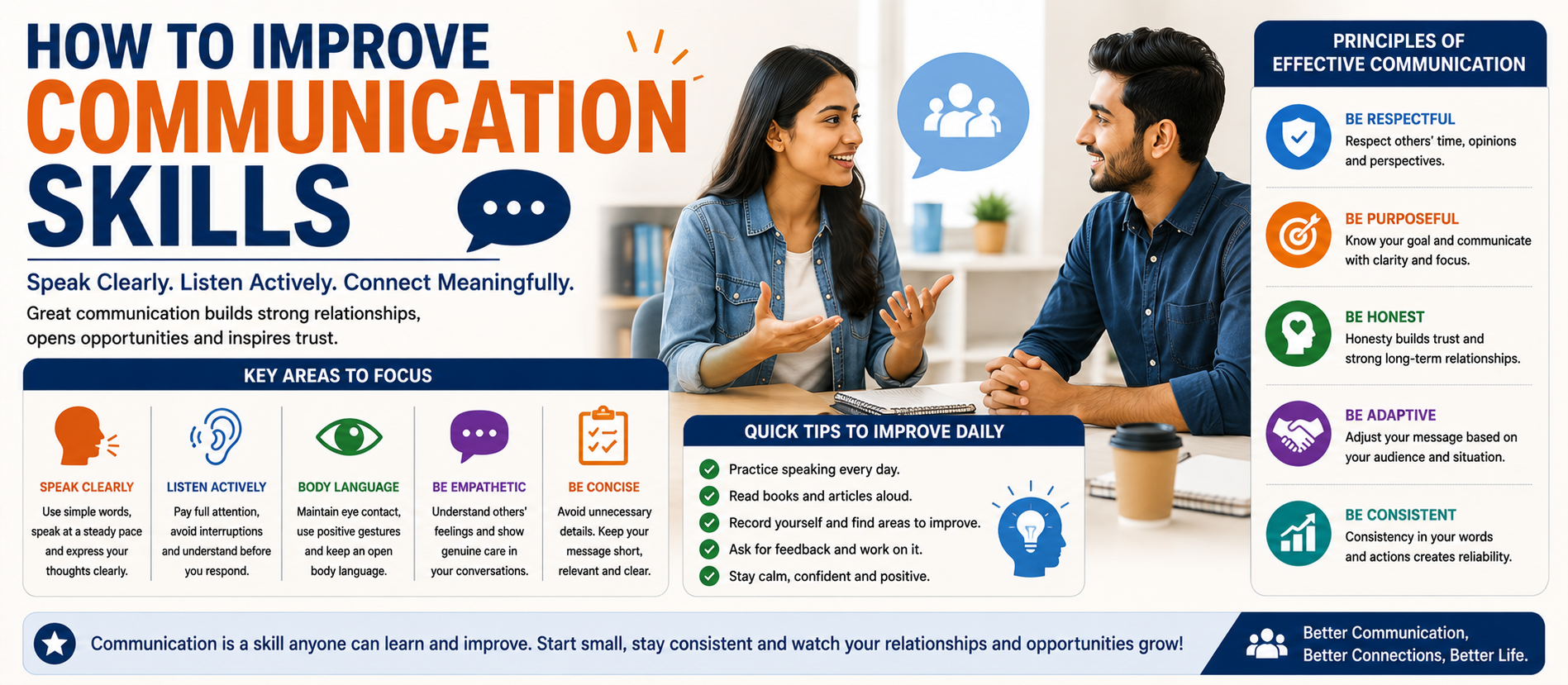
📋 Quick Summary
In this article:
Quick Answer: How Can You Improve Communication Skills?
What Are Communication Skills?
Why Are Good Communication Skills Important?
1. Start by Becoming a Better Listener
2. Think Before You Speak
3. Use Simple and Direct Language
4. Improve Your Verbal Communication
5. Pay Attention to Body Language
6. Ask Better Questions
7. Learn to Explain Complex Ideas Simply
💡 Key Insight
Communication is one of the most important skills in daily life. We use it when we speak with family, study with classmates, work with colleagues, write emails, attend meetings, give presentations, and communicate online.
Good communication is not only about speaking more. It is about sharing ideas clearly, listening carefully, understanding other people, and choosing the right message for the situation.
Many people believe that communication is a natural talent. Some people may find it easier to speak, but communication is also a skill that can be learned and improved through regular practice.
This guide explains how to improve communication skills in a simple and practical way. It covers verbal communication, active listening, body language, writing, confidence, workplace communication, and communication in a digital world.
Digiifrog creates clear, useful, and structured content for education, careers, technology, and digital growth with a focus on SEO, AEO, GEO, and AI Search Optimization.
Website: www.digiifrog.com
Quick Answer: How Can You Improve Communication Skills?
You can improve communication skills by listening actively, speaking clearly, organizing your ideas, using appropriate body language, asking useful questions, practicing regularly, and learning from feedback.
Improvement does not require becoming the loudest person in the room. Good communication means helping the right message reach the right person in a clear and respectful way.
What Are Communication Skills?
Communication skills are the abilities used to exchange information, ideas, feelings, instructions, and feedback.
They include:
- Speaking.
- Listening.
- Writing.
- Reading and understanding information.
- Body language.
- Facial expressions.
- Questioning.
- Giving and receiving feedback.
- Digital communication.
Communication is a two-way process. Sending a message is only one part. Understanding the response is equally important.
Why Are Good Communication Skills Important?
Clear communication can improve relationships, learning, teamwork, leadership, customer service, and problem-solving.
For students, communication skills can help with classroom discussions, group projects, interviews, and presentations.
For professionals, these skills can support meetings, teamwork, client communication, leadership, negotiation, and career growth.
Strong communication can also reduce misunderstandings. When people understand expectations, responsibilities, and ideas more clearly, work can become more efficient.
1. Start by Becoming a Better Listener
Many people focus on improving speaking skills but forget that listening is a major part of communication.
Active listening means giving attention to the speaker and trying to understand the message before preparing a response.
To become a better listener:
- Give the speaker your attention.
- Avoid interrupting unnecessarily.
- Do not prepare your answer while ignoring the message.
- Ask questions when something is unclear.
- Summarize important points to confirm understanding.
For example, you can say, “If I understand correctly, you are suggesting that we complete the first part before Friday.” This simple response can prevent confusion.
2. Think Before You Speak
Clear communication becomes easier when ideas are organized before they are expressed.
Before speaking, ask:
- What is my main point?
- Who am I speaking to?
- What information does this person need?
- What action or response do I expect?
You do not need to create a complete script for every conversation. However, taking a few seconds to organize an important message can make it clearer.
3. Use Simple and Direct Language
Complex language does not always create better communication.
Simple language can make an idea easier to understand and remember.
Instead of adding unnecessary words, focus on the main message.
For example:
Less clear: “It may potentially be beneficial for us to consider the possibility of implementing an alternative approach.”
Clearer: “We should consider a different approach.”
The second sentence is shorter and easier to understand.
4. Improve Your Verbal Communication
Verbal communication includes the words you use, your tone, pace, and clarity.
Useful habits include:
- Speak clearly.
- Avoid rushing.
- Pause between important ideas.
- Use examples when they help.
- Choose words that fit your audience.
- Avoid unnecessary jargon.
Good verbal communication is not about using difficult vocabulary. It is about making the message understandable.
5. Pay Attention to Body Language
Communication is not only verbal. Body language can affect how a message is understood.
Useful non-verbal communication habits may include:
- Maintaining appropriate eye contact.
- Using a natural posture.
- Showing attention when listening.
- Keeping facial expressions appropriate to the situation.
- Avoiding distracting movements when possible.
Body language can vary across cultures and individuals. The goal is not to follow a rigid formula. The goal is to appear attentive, respectful, and engaged.
6. Ask Better Questions
Good questions can improve understanding and lead to better conversations.
There are two common types of questions:
Closed Questions
These usually require a short answer.
Example: “Did you complete the assignment?”
Open Questions
These encourage explanation.
Example: “What challenges did you face while completing the assignment?”
Open questions can be useful when you need more information, ideas, or feedback.
7. Learn to Explain Complex Ideas Simply
A strong communicator can adjust an explanation to the listener.
Try this process:
- State the main idea first.
- Explain why it matters.
- Give an example if useful.
- Check whether the listener understands.
This approach is useful for teachers, students, managers, sales professionals, and technical experts.
8. Improve Your Written Communication
Emails, messages, reports, and online posts are important forms of communication.
Good writing should be easy to follow.
A simple structure can help:
- Start with the purpose.
- Present the important information.
- Use short paragraphs.
- Use headings or bullet points when useful.
- End with the required action or next step.
Example of a Clear Email Structure
Subject: Meeting Schedule for Project Review
Hello Team,
We will review the current project progress on Thursday at 3:00 PM.
- Please update your assigned tasks before the meeting.
- Bring any issues that require discussion.
- Share important documents in advance if possible.
Thank you.
This format makes the purpose and next steps easy to understand.
9. Build Confidence Through Practice
Many people know what they want to say but feel nervous when speaking.
Confidence often improves through repeated experience.
Start with smaller opportunities:
- Ask one question in a class or meeting.
- Explain a topic to a friend.
- Practice speaking for two minutes.
- Record yourself and review your delivery.
- Volunteer for a short presentation.
You do not need to become perfect before participating. Practice itself is part of the improvement process.
10. Practice Public Speaking
Public speaking can be challenging, but preparation can make it easier.
Before a presentation:
- Understand your audience.
- Identify the main message.
- Organize the presentation into clear sections.
- Practice aloud.
- Prepare for possible questions.
During the presentation, focus on communicating rather than trying to deliver every sentence perfectly.
11. Learn How to Give Feedback
Useful feedback should help a person understand what can be improved.
A simple approach is:
- Describe the specific situation or work.
- Explain what was effective or what needs improvement.
- Suggest a practical next step.
Avoid vague comments such as “This is bad.” A clearer comment would explain what needs to change and why.
12. Learn How to Receive Feedback
Communication improvement also requires listening to feedback.
When receiving feedback:
- Listen before reacting.
- Ask for examples if necessary.
- Separate useful information from emotional reactions.
- Decide what action can be taken.
You do not have to accept every opinion without thought. However, useful feedback can reveal communication habits that you may not notice yourself.
13. Adapt Your Communication to the Audience
The same message may need to be communicated differently to different audiences.
For example, a technical explanation for an expert may contain more specialized detail than an explanation for a beginner.
Before communicating, consider:
- What does the audience already know?
- What information do they need?
- What language will be easiest to understand?
- What is the purpose of the message?
Adapting your message is not changing the truth. It is choosing the clearest way to explain it.
14. Improve Communication Skills at Work
Workplace communication includes meetings, emails, reports, team discussions, client interactions, and feedback.
Useful workplace habits include:
- Prepare before important meetings.
- Be clear about responsibilities.
- Confirm important decisions in writing when appropriate.
- Communicate problems early.
- Respect other people's time.
- Use professional and understandable language.
Good workplace communication can improve teamwork and reduce avoidable confusion.
15. Handle Difficult Conversations Calmly
Not every conversation will be easy. Disagreements can happen in families, schools, workplaces, and businesses.
When a conversation becomes difficult:
- Focus on the issue rather than attacking the person.
- Listen to the other point of view.
- Use specific examples.
- Avoid unnecessary personal criticism.
- Ask what solution is possible.
You can disagree respectfully. The goal should be to understand the issue and move toward a constructive response.
16. Improve Digital Communication
Modern communication often happens through email, messaging platforms, video calls, and social media.
Digital communication has fewer non-verbal signals, so messages can sometimes be misunderstood.
Before sending an important message:
- Read it again.
- Check whether the tone is clear.
- Remove unnecessary words.
- Make the required action clear.
- Check names, dates, links, and attachments.
Short messages are useful, but important information should not be removed simply to make a message shorter.
17. Use Technology and AI Carefully
AI tools can support communication by helping users organize ideas, review writing, suggest clearer language, or prepare presentation outlines.
However, AI-generated communication should still be reviewed by a person.
Check for:
- Accuracy.
- Appropriate tone.
- Missing context.
- Incorrect assumptions.
- Unnatural wording.
The best use of technology is to support human communication, not remove human responsibility.
Common Communication Mistakes to Avoid
Common mistakes include:
- Interrupting constantly.
- Using unclear language.
- Assuming instead of asking.
- Writing long messages without structure.
- Ignoring the audience.
- Reacting before understanding the full situation.
- Using an inappropriate tone.
- Avoiding useful feedback.
Everyone makes communication mistakes. The important step is noticing patterns and improving them.
A Simple Daily Practice Plan
Morning: Read and Observe
Read a useful article, email, or report. Notice how the information is organized.
During the Day: Practice Active Listening
In one conversation, focus completely on understanding the other person before responding.
Practice Speaking
Choose one topic and explain it aloud in one or two minutes using simple language.
Practice Writing
Write a short message with a clear purpose and review it before sending.
End-of-Day Review
Ask yourself:
- Was I clear?
- Did I listen carefully?
- Where did misunderstanding happen?
- What can I improve tomorrow?
Small daily practice can create meaningful improvement over time.
Communication Skills for Students
Students can develop communication skills through classroom activities, group discussions, debates, presentations, writing assignments, and teamwork.
Useful habits include:
- Ask questions when a topic is unclear.
- Participate in discussions.
- Practice explaining lessons in simple words.
- Improve email and message writing.
- Learn to work respectfully with different opinions.
These skills can also support future interviews and professional opportunities.
Communication Skills for Career Growth
Technical knowledge is important, but the ability to explain ideas can also influence professional success.
Strong communication can help professionals:
- Present ideas.
- Work with teams.
- Manage clients.
- Lead projects.
- Handle feedback.
- Build professional relationships.
As workplaces become more connected through digital tools and global teams, clear and respectful communication becomes even more valuable.
SEO, AEO, GEO, and AI Search Optimization for Communication Content
People often search for direct questions such as:
- How can I improve my communication skills?
- What are the most important communication skills?
- How can I become a better listener?
- How can I speak with more confidence?
- How can I improve workplace communication?
SEO helps useful content become easier to discover through search engines.
AEO focuses on providing clear and direct answers to specific questions.
GEO helps structure content for generative search experiences.
AI Search Optimization focuses on clear language, logical organization, direct answers, and useful context that can be understood by both readers and AI-powered search systems.
How Digiifrog Supports Educational and Professional Content
Digiifrog develops structured and reader-friendly content for education, careers, business, technology, and digital growth.
- SEO Content Strategy
- AEO and Answer-Focused Content
- GEO and Generative Search Optimization
- AI Search Optimization
- Education and Career Content Development
- Clear and Readable Digital Content
Frequently Asked Questions
How can I improve my communication skills quickly?
Start with regular practice. Focus on active listening, clear speaking, organized writing, useful questions, and feedback. Small improvements repeated consistently can create progress over time.
What are the five main communication skills?
Important communication skills include listening, speaking, writing, reading and understanding information, and non-verbal communication such as body language.
How can I speak more confidently?
Prepare your main points, practice aloud, start with smaller speaking opportunities, and focus on communicating the message instead of trying to be perfect.
Why is listening important in communication?
Listening helps you understand the message, respond appropriately, ask better questions, and reduce misunderstandings.
How can I improve workplace communication?
Be clear about expectations, prepare for important discussions, listen actively, communicate problems early, use structured writing, and confirm important decisions when necessary.
Can AI help improve communication skills?
AI can help with writing suggestions, idea organization, practice, and language review. However, users should review AI-generated content for accuracy, tone, context, and suitability.
Conclusion
Learning how to improve communication skills is a long-term process, but the basic steps are simple.
Listen carefully. Organize your ideas. Use clear language. Ask useful questions. Pay attention to your audience. Practice speaking and writing. Learn from feedback. Improve gradually.
Good communication does not mean speaking perfectly in every situation. It means making a genuine effort to understand others and helping others understand you.
Clear communication is a skill. Like any skill, it becomes stronger through practice.
Disclaimer: This article is for general educational and informational purposes. Communication styles may vary based on culture, language, workplace, and personal circumstances. Adapt these suggestions to the specific situation and audience.
Digiifrog
Website: www.digiifrog.com
Ready to Grow?
Talk to us about a strategy tailored to your brand — we will help you stand out in search, AI discovery and social.

Comments (0)
Log in to leave a comment.