📋 Quick Summary
In this article:
Why Conversion Rate Optimization Matters
Strategies to Increase Website Conversion Rates
Introduction
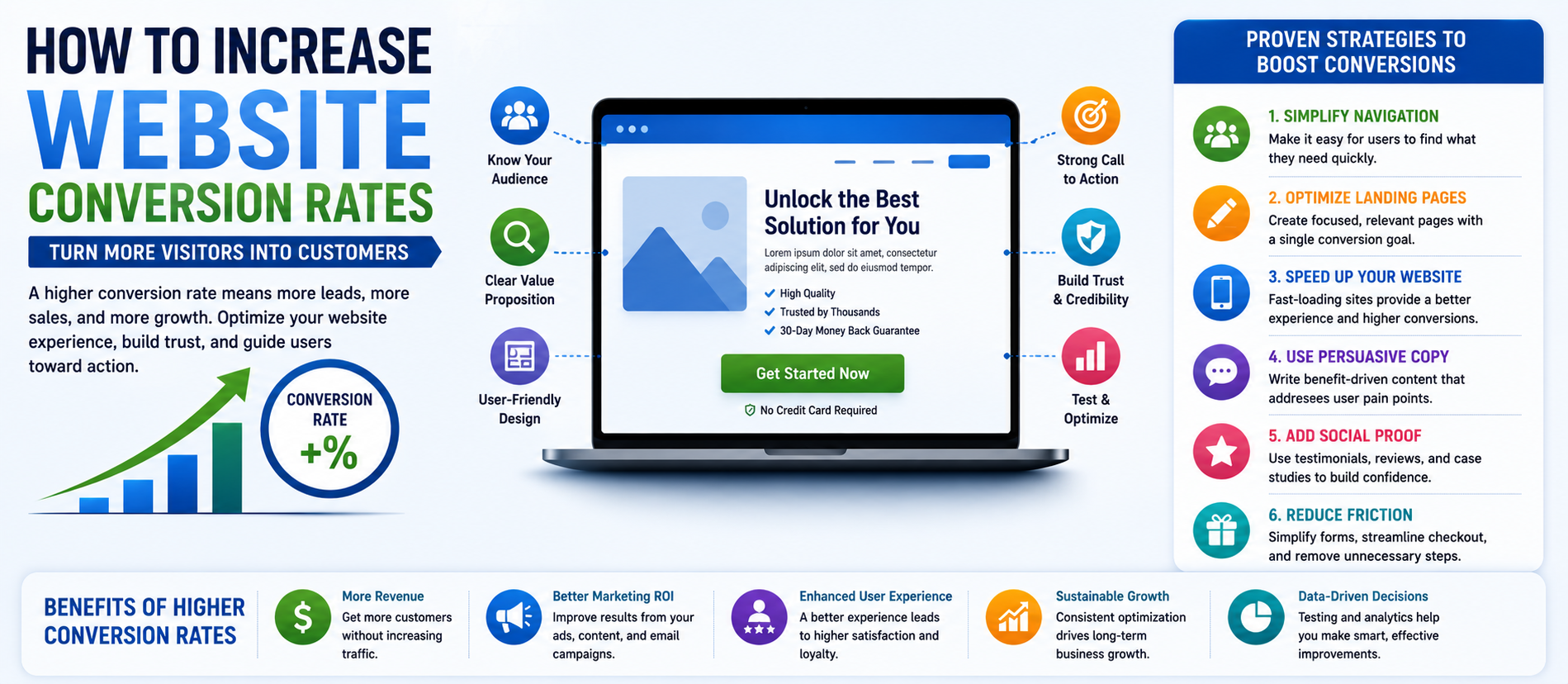
Driving traffic to your website is only half the battle. The real objective is converting visitors into leads, subscribers, or paying customers. Website Conversion Rate Optimization (CRO) focuses on improving the user experience, reducing friction, and encouraging meaningful actions. A successful CRO strategy combines data analysis, user psychology, persuasive design, and continuous testing. When integrated with SEO, AEO, GEO, and AI Search Optimization, conversion optimization creates sustainable business growth.
Website: www.digiifrog.com
Why Conversion Rate Optimization Matters
- Generates more leads without increasing traffic.
- Improves marketing ROI.
- Enhances user experience.
- Reduces customer acquisition costs.
- Supports long-term business growth.
Strategies to Increase Website Conversion Rates
- Create clear value propositions.
- Optimize landing pages for search intent.
- Use compelling calls-to-action (CTAs).
- Improve website speed and Core Web Vitals.
- Build trust with testimonials and reviews.
- Simplify navigation and forms.
- Optimize for mobile devices.
- Use heatmaps and session recordings.
- Perform A/B testing regularly.
- Personalize content based on user behavior.
- Implement live chat or AI assistants.
- Reduce checkout friction for eCommerce.
Key Metrics to Monitor
- Conversion Rate
- Bounce Rate
- Average Session Duration
- Cart Abandonment Rate
- Cost Per Acquisition (CPA)
- Return on Investment (ROI)
Common CRO Mistakes
- Ignoring mobile optimization.
- Using confusing CTAs.
- Collecting unnecessary form fields.
- Failing to analyze user behavior.
- Making changes without testing.
Frequently Asked Questions
What is a good website conversion rate?
💡 Key Insight
Conversion rates vary by industry, audience, and business model, making continuous optimization more important than comparing averages.
How often should websites be tested?
Successful businesses continuously test pages, offers, and user experiences using data-driven experiments.
Conclusion
Improving website conversion rates requires ongoing analysis, testing, and optimization. Businesses that focus on user experience, trust, speed, and relevant messaging can convert more visitors while maximizing the value of existing traffic.
Digiifrog
Website: www.digiifrog.com
This draft is intended for expansion into a fully original 2,200–2,800+ word article with CRO frameworks, UX principles, case studies, A/B testing workflows, KPI dashboards, and 25+ AEO-focused FAQs.
Ready to Grow?
Talk to us about a strategy tailored to your brand — we will help you stand out in search, AI discovery and social.

Comments (0)
Log in to leave a comment.