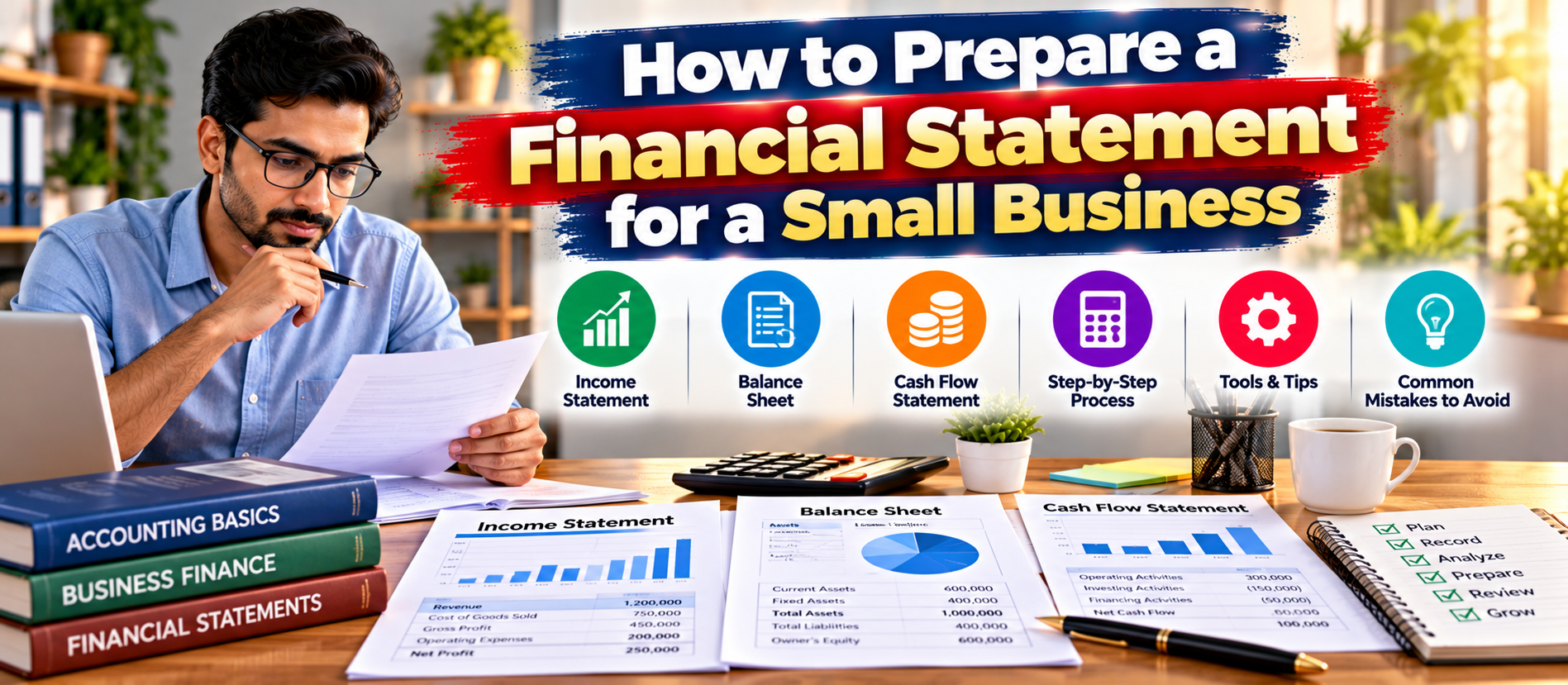
📋 Quick Summary
In this article:
What Is a Financial Statement?
The Three Main Financial Statements
1. Income Statement or Profit and Loss Statement
2. Balance Sheet
3. Cash Flow Statement
Step 1: Choose the Reporting Period and Purpose
Step 2: Collect and Organise Your Records
Step 3: Separate Business and Personal Transactions
Step 4: Record Every Transaction
Record sales and expenses consistently
A practical, step-by-step guide to understanding your numbers and making better business decisions.
Running a small business means making decisions every day. You decide what to buy, how much to charge, when to hire, and where to invest. These decisions become easier when you understand your business finances.
A financial statement turns daily transactions into a clear picture of business performance. It can show whether the business is earning a profit, how much it owes, what it owns, and whether it has enough cash to pay upcoming bills. These details matter whether you operate a shop, consultancy, digital agency, service company, manufacturing unit or online store.
Preparing financial statements may sound complicated, especially if you do not have an accounting background. However, the process becomes manageable when your records are organised and you follow a consistent method. You can begin with a spreadsheet or suitable accounting software, then seek professional help when your needs become more complex.
This guide explains how to prepare the main financial statements for a small business, with simple examples and an India-focused perspective. It is educational information, not a substitute for accounting, audit, tax or legal advice tailored to your business.
What Is a Financial Statement?
A financial statement is a structured report that summarises a business's financial activity and position. It uses information from sales, purchases, expenses, bank transactions, loans, assets and other records.
Financial statements help owners answer practical questions:
- Did the business make a profit during the month or year?
- How much cash is available to meet immediate expenses?
- How much do customers still owe the business?
- What amounts does the business owe suppliers, lenders or employees?
- Can the business afford to hire, expand or purchase equipment?
- Are costs increasing faster than sales?
- Is the business prepared to speak with a lender, investor or tax professional?
Financial statements are not only documents for compliance. They are tools for managing the business. Accurate reports help you notice problems early and make decisions based on evidence rather than guesswork.
The Three Main Financial Statements
1. Income Statement or Profit and Loss Statement
The income statement summarises income and expenses over a period, such as one month, one quarter or one financial year. It shows whether the business made a profit or a loss during that period.
It commonly includes sales or service revenue, direct costs, gross profit, operating expenses, interest, tax where applicable, and net profit. A service business may have fewer direct inventory costs than a retailer or manufacturer, but it still needs to record its operating expenses accurately.
2. Balance Sheet
The balance sheet shows the business's financial position on a specific date. It lists assets, liabilities and owner's equity. Assets are resources the business owns or controls. Liabilities are amounts it owes. Equity represents the owner's residual interest after liabilities are deducted from assets.
The basic accounting equation is:
Assets = Liabilities + Owner's Equity
The totals must balance. If they do not, there may be missing entries, duplicated transactions, incorrect classifications or calculation errors that need investigation.
3. Cash Flow Statement
The cash flow statement tracks cash entering and leaving the business during a period. It usually groups cash movements into operating, investing and financing activities.
- Operating activities: Cash collected from customers and paid for day-to-day operations.
- Investing activities: Cash used to buy or received from selling long-term assets, such as equipment.
- Financing activities: Cash from loans, loan repayments, owner contributions and other financing transactions.
The cash flow statement is important because profit and cash are not the same. A business may record a sale today but receive payment next month. It may also pay for stock before selling it. These timing differences can create cash pressure even when the business appears profitable.
Step 1: Choose the Reporting Period and Purpose
Before collecting figures, decide what the statement is for. You may want a monthly management report, a year-end summary, a lender's review or information for tax and compliance work. The purpose affects the level of detail and the reporting period.
Monthly reports are useful because they help you spot trends while there is still time to act. Quarterly reports can show whether a pattern is continuing. Annual statements provide a wider view and may be needed for tax filings, statutory compliance or external review, depending on the business.
Choose clear start and end dates. Use the same period when comparing income and expenses. For example, do not compare sales for a full month with expenses recorded for only three weeks. Consistency makes comparisons meaningful.
Step 2: Collect and Organise Your Records
Reliable statements start with reliable records. Gather the documents that support every major figure. Do not depend only on memory or the balance displayed in a banking app.
Essential records to collect
- Sales invoices, receipts and credit notes.
- Purchase invoices, supplier bills and expense receipts.
- Bank statements and payment-gateway reports.
- Cash register records and petty-cash vouchers.
- Payroll, contractor payments and employee-related records.
- Loan agreements, repayment schedules and interest statements.
- Inventory counts and stock valuation records, if relevant.
- Fixed-asset details for equipment, computers, furniture and vehicles used by the business.
- Tax records, GST records where applicable, and evidence of tax payments.
- Owner contributions, drawings, dividends or other transactions with owners.
- Customer balances, supplier balances and outstanding invoices.
Store digital copies in clearly named folders. Use consistent file names and maintain backups. Limit access to sensitive payroll, customer and banking information. Keep records for the period required by the rules that apply to your business.
Step 3: Separate Business and Personal Transactions
Mixing personal and business spending makes accounts harder to understand. It can also hide the true cost of running the business. Use a separate business bank account where appropriate and follow a consistent process for owner contributions and withdrawals.
If you accidentally pay a business bill from a personal account, record the transaction correctly and retain the supporting receipt. If you use business funds for a personal purchase, do not classify it as a normal operating expense. The appropriate accounting treatment depends on the business structure and local rules.
For sole proprietors, owner withdrawals are generally not the same as business expenses. For companies and other entities, payments to owners may need different treatment. Confirm the correct classification with an accountant rather than using one rule for every type of business.
Step 4: Record Every Transaction
Enter transactions into a bookkeeping system. A basic spreadsheet can work for a very small operation, but it should be structured and checked. Accounting software may reduce manual work by importing bank transactions, creating invoices and producing standard reports.
Each entry should have a date, description, amount, category, payment method and supporting reference. Where relevant, record whether a transaction is taxable, whether tax has been charged, and whether the amount has been paid or remains outstanding.
Use clear categories
Common income categories include product sales, service revenue, commission income and other operating income. Expense categories may include rent, salaries, utilities, advertising, software, delivery, repairs, professional fees and bank charges.
Do not create dozens of categories that make reports difficult to read. Start with a manageable chart of accounts and add detail when it helps decision-making. Use the same category for similar transactions unless the accounting treatment requires a distinction.
Record sales and expenses consistently
Under an accrual method, income and expenses are generally recorded when earned or incurred, subject to the applicable rules. Under a cash method, entries are generally based on money received and paid. Tax rules may impose specific requirements, and not every business can freely choose any method for every purpose.
Use a method that is appropriate for your business and follow it consistently. In India, the Income Tax Department explains accounting methods and related provisions in its official guidance. Check current rules or consult a qualified professional before choosing or changing a method.
Step 5: Reconcile Bank and Cash Records
Bank reconciliation means comparing the transactions in your bookkeeping system with the bank statement. It helps identify missing entries, duplicate entries, bank fees, direct deposits, failed payments and timing differences.
For each account, compare the opening balance, deposits, withdrawals and closing balance. Investigate any difference instead of inserting an unexplained adjustment just to make the numbers match.
Also count physical cash where the business handles cash. Compare the count with the recorded balance and investigate shortages or excess amounts. A regular reconciliation makes it easier to detect errors and suspicious transactions.
Step 6: Prepare the Income Statement
Once transactions are recorded and checked, prepare the income statement for the chosen period. The layout can vary by business type, but the core calculation is straightforward.
Basic income statement structure
- Total revenue
- Less: direct costs or cost of goods sold
- Equals: gross profit
- Less: operating expenses
- Equals: operating profit
- Less or add: interest and other relevant items
- Less: applicable income tax expense
- Equals: net profit or loss
Direct costs are costs directly linked to delivering a product or service. For a retailer, they may include the cost of goods sold. For a service firm, they may include project-specific labour or subcontractor costs, depending on how the business tracks them.
Simple example
Imagine a small design agency reports the following amounts for one month. These numbers are illustrative and do not represent a typical result for every business.
| ItemAmount (₹) | |
| Service revenue | 3,00,000 |
| Direct project costs | 60,000 |
| Gross profit | 2,40,000 |
| Rent and utilities | 30,000 |
| Salaries and contractor costs not included above | 90,000 |
| Software and subscriptions | 12,000 |
| Marketing and sales | 15,000 |
| Other operating costs | 8,000 |
| Operating profit before other items and tax | 85,000 |
The example shows how revenue becomes gross profit after direct costs, then operating profit after operating expenses. The final net profit may be different after interest, depreciation, taxes and other applicable items are considered.
Review profit margins
A margin helps you understand how much of each rupee of revenue remains after a particular category of cost.
- Gross profit margin: Gross profit divided by revenue, multiplied by 100.
- Net profit margin: Net profit divided by revenue, multiplied by 100.
Compare margins over time and across similar products or services. If revenue rises but margins fall, direct costs or overheads may be increasing too quickly. Do not judge performance from one figure alone; look at trends and business context.
Step 7: Prepare the Balance Sheet
Prepare the balance sheet as of a specific date, such as the final day of the month or financial year. Use the adjusted balances from your bookkeeping system.
List the assets
Assets may include cash, bank balances, customer receivables, inventory, prepaid expenses, equipment, vehicles and other property used by the business. Separate current assets, which are expected to be used, sold or converted into cash in the normal short-term operating cycle, from long-term assets where appropriate.
List the liabilities
Liabilities may include supplier balances, unpaid expenses, taxes payable, salaries payable, short-term borrowings and long-term loans. Separate current and non-current liabilities where the reporting format requires it.
Calculate owner's equity
Equity reflects the owner's residual interest. Depending on the business structure, it may include contributed capital, retained earnings or accumulated profits, less drawings or distributions. The labels and presentation differ between sole proprietorships, partnerships, limited liability partnerships and companies.
Illustrative balance sheet
| ItemAmount (₹) | |
| Assets | |
| Cash and bank balances | 1,20,000 |
| Customer receivables | 80,000 |
| Equipment after accumulated depreciation | 2,00,000 |
| Total assets | 4,00,000 |
| Liabilities | |
| Supplier and other current payables | 50,000 |
| Business loan outstanding | 1,00,000 |
| Total liabilities | 1,50,000 |
| Owner's equity | 2,50,000 |
| Total liabilities and equity | 4,00,000 |
In this example, total assets of ₹4,00,000 equal total liabilities of ₹1,50,000 plus owner's equity of ₹2,50,000. If your balance sheet does not balance, check opening balances, loan balances, asset purchases, owner transactions and retained profit or loss.
Step 8: Prepare the Cash Flow Statement
The cash flow statement helps you understand how cash changed during the reporting period. It is especially useful for businesses with delayed customer payments, seasonal sales, large inventory needs or loan repayments.
Start with the opening cash and bank balance. Add cash received and subtract cash paid, then classify the movements into operating, investing and financing activities. The net change should reconcile to the closing cash balance, after accounting for relevant cash equivalents and other applicable items.
Example of a simple cash movement report
| Cash movementAmount (₹) | |
| Opening cash and bank balance | 1,00,000 |
| Cash collected from customers | 2,50,000 |
| Operating payments | -1,80,000 |
| Equipment purchase | -30,000 |
| New loan received | 40,000 |
| Loan principal repaid | -10,000 |
| Closing cash and bank balance | 1,70,000 |
This simplified example assumes the listed items are the only cash movements. A formal statement may require more detail and a specific presentation format. Interest and tax cash payments should be classified consistently with the applicable accounting framework.
Step 9: Make Adjustments Before Finalising
Raw transaction lists do not always provide a complete picture. Before finalising statements, review whether the reporting period includes all required income, expenses, assets and liabilities.
- Accrued expenses: Record expenses incurred during the period even if the invoice or payment occurs later, when required by the accounting method.
- Outstanding income: Check whether completed work or delivered goods have been recorded correctly.
- Prepaid expenses: Some payments cover future periods and may need to be allocated over time.
- Depreciation: Long-term assets may need their cost allocated over their useful life under applicable rules.
- Inventory: Count stock and apply the required valuation method. Investigate damaged, obsolete or missing items.
- Bad or doubtful debts: Review overdue customer balances and the appropriate accounting treatment.
- Loan balances: Separate principal repayment from interest and verify the closing amount with lender records.
- Tax balances: Reconcile relevant taxes collected, paid, claimed or payable.
Not every adjustment applies to every business. The correct treatment depends on the entity, accounting framework, tax rules and transaction details. If you are unsure, ask an accountant to review the entries before filing or sharing the statements externally.
Step 10: Review the Statements for Accuracy
Before relying on the reports, carry out a final review. Check that the reporting dates are correct and that the figures agree with the underlying records.
- Compare sales totals with invoices, receipts and sales-platform reports.
- Compare expense totals with bills, receipts and payment records.
- Confirm bank and loan balances against external statements.
- Review unpaid customer invoices and supplier bills.
- Check that equipment purchases are not incorrectly treated as ordinary recurring expenses when they should be capitalised.
- Look for duplicate entries, unusual amounts and transactions recorded in the wrong period.
- Confirm that the balance sheet balances.
- Compare the cash flow statement's closing balance with the reconciled cash and bank records.
- Compare current results with previous months and investigate large differences.
Keep a record of who prepared and reviewed the statements, when they were finalised, and what adjustments were made. This creates a useful audit trail and helps explain later changes.
Step 11: Use the Statements to Make Decisions
Financial statements are most useful when you act on what they reveal. A report should lead to questions, not simply be saved in a folder.
Measure profitability
Compare revenue, gross profit and net profit across periods. If a service is popular but produces little margin, review pricing, delivery time and direct costs. If expenses rise faster than revenue, identify which costs are necessary and which may be reduced without harming quality.
Watch cash flow
Check whether customers pay on time and whether supplier terms fit your cash cycle. A profitable business can struggle if too much money is tied up in unpaid invoices or stock. Consider clearer payment terms, timely follow-up and a cash forecast that looks several weeks or months ahead.
Plan growth carefully
Before hiring, opening another location or buying equipment, estimate the cost and the expected benefit. Use conservative assumptions and consider what happens if sales are lower than expected or customers pay late. A growth decision should not depend on the most optimistic forecast alone.
Prepare for financing conversations
Lenders and investors may request historical statements, forecasts and supporting documents. Consistent records help explain how the business earns revenue, controls costs and manages liabilities. Never change or inflate figures to make a business appear stronger. Accurate information protects your credibility and helps others assess the real risks.
Step 12: Choose a Practical Accounting System
The right system is the one that keeps records accurate without creating unnecessary work. A small business with few transactions may begin with a spreadsheet. A growing business may benefit from accounting software that manages invoices, bank reconciliation, inventory, tax reports and multiple users.
When selecting a system, consider:
- Ease of use and the time required to maintain records.
- Support for the business's currency, taxes and reporting needs.
- Bank and payment-platform integration, where available.
- Invoice management and customer follow-up features.
- Access controls, data security and backup options.
- Ability to export reports and records if you change providers.
- Total cost, including subscriptions, setup and training.
Software does not guarantee accurate accounts. Incorrect categories, missing invoices and unreconciled transactions will still produce misleading reports. Establish a routine for entering transactions, reconciling balances and reviewing exceptions.
Common Mistakes to Avoid
- Preparing statements only once a year: This can hide cash or cost problems until they become serious.
- Recording sales as cash received: Unpaid invoices and actual cash balances are different.
- Mixing personal and business spending: This makes it difficult to measure real performance.
- Ignoring inventory: Incorrect stock records can distort profit and asset values.
- Forgetting loan principal: Loan repayments include components that may need different accounting treatment.
- Misclassifying capital purchases: Equipment and other long-term assets may need different treatment from everyday expenses.
- Skipping bank reconciliation: Missing or duplicated entries may remain unnoticed.
- Using inconsistent categories: Comparisons become unreliable when the same cost is classified differently each month.
- Relying only on profit: Cash flow, debt and working capital also matter.
- Ignoring professional advice: Complex tax, audit and reporting issues should be checked by a qualified professional.
Financial Statements in India: Important Compliance Note
Indian businesses may have different accounting, tax, audit and reporting obligations depending on their legal structure, turnover, activities and other facts. A sole proprietorship, partnership, LLP and company should not assume that the same rules apply to each of them.
The Income Tax Department provides guidance on business income, accounting methods, books of account and tax return requirements. GST obligations and company or LLP reporting requirements may also apply, depending on the circumstances. Thresholds, forms and rules can change, so verify the current requirements through official government sources before filing.
Preparing a management report for internal decisions is not always the same as preparing statutory financial statements. If you need reports for a tax return, audit, lender, investor or regulatory filing, confirm the required format and supporting documents. A chartered accountant or other appropriately qualified professional can help you meet the obligations relevant to your business.
Conclusion
Preparing financial statements for a small business becomes easier when you build a consistent bookkeeping routine. Start by choosing a reporting period, collecting records and separating personal transactions. Record each transaction, reconcile bank and cash balances, and prepare the income statement, balance sheet and cash flow statement. Then review adjustments and investigate unusual figures before using the reports to make decisions.
You do not need to master every accounting concept on day one. Focus first on accurate records and clear categories. Review your numbers monthly and seek professional support when tax, audit or reporting questions become complex.
Most importantly, use the statements to run the business better. They can help you set prices, control costs, manage customer payments, plan purchases and understand whether growth is financially sustainable. Good financial reporting is not only about looking back. It helps you make stronger decisions about what comes next.
Frequently Asked Questions
What are the three main financial statements for a small business?
The three main statements are the income statement, balance sheet and cash flow statement. They show performance over a period, financial position on a date and cash movements over a period.
Can I prepare financial statements using Excel?
Yes. A spreadsheet can work for a small business with relatively simple transactions. Use consistent categories, checked formulas, supporting documents, reconciliations and secure backups. Consider accounting software as transaction volume increases.
How often should a small business prepare financial statements?
Many businesses review basic reports monthly and compare results quarterly. Annual statements may be needed for tax, compliance, lending or owner reporting. The right frequency depends on the business and its obligations.
What is the difference between profit and cash flow?
Profit compares recognised income and expenses. Cash flow tracks cash received and paid. A business may be profitable but short of cash when customers have not paid, stock has not sold or loan repayments are due.
Do small businesses in India need an accountant?
Professional support is useful when you need to confirm accounting methods, tax treatment, audit requirements or statutory reporting. The exact requirement depends on your business structure and current rules.
What records should I keep before preparing statements?
Keep sales and purchase invoices, bank statements, receipts, payroll records, loan statements, inventory details, fixed-asset records, tax documents and evidence of owner contributions or withdrawals. Reconcile them before finalising reports.
Official Resources
- Income Tax Department of India: Business or Profession — information about business income, accounting methods and books of account.
- Income Tax Department: Income Computation and Disclosure Standards — official guidance on applicable tax-computation standards.
- Income Tax e-Filing Portal — current forms, services and taxpayer guidance.
- U.S. Small Business Administration: Manage Your Business — general educational information about financial records and statements.
About Digiifrog: Digiifrog shares practical digital and business insights to help readers make informed decisions. Visit www.digiifrog.com for more information.
Disclaimer: This article is for general educational purposes only and is not accounting, tax, audit, legal or financial advice. Reporting requirements vary by business structure and jurisdiction. Verify current rules through official sources and consult a qualified professional before relying on this information for statutory filings or material business decisions.
Ready to Grow?
Talk to us about a strategy tailored to your brand — we will help you stand out in search, AI discovery and social.


Comments (0)
Log in to leave a comment.