📋 Quick Summary
In this article:
Quick Answer: How Should You Prepare for a Competitive Exam?
1. Understand the Exam Before You Start Studying
2. Divide the Syllabus into Smaller Parts
3. Know Your Starting Level
4. Create a Realistic Study Plan
5. Start with the Most Important Topics
6. Build Strong Concepts Before Memorizing Answers
7. Use Active Learning
Useful Active Learning Methods
8. Practise Questions Every Day
Competitive exams can create pressure because many candidates compete for a limited number of seats, jobs, scholarships, or other opportunities. Good preparation requires more than studying for long hours. It requires a clear strategy.
💡 Key Insight
The most successful approach is usually simple: understand the syllabus, know the exam pattern, build a realistic study plan, learn the concepts, practise regularly, revise important topics, and analyze mistakes.
This guide explains how to prepare for competitive exams in a clear and practical way. The advice can be adapted for entrance examinations, government job exams, professional tests, scholarship exams, and other competitive assessments.
Digiifrog creates clear, structured, and search-friendly content using SEO, AEO, GEO, and AI Search Optimization.
Quick Answer: How Should You Prepare for a Competitive Exam?
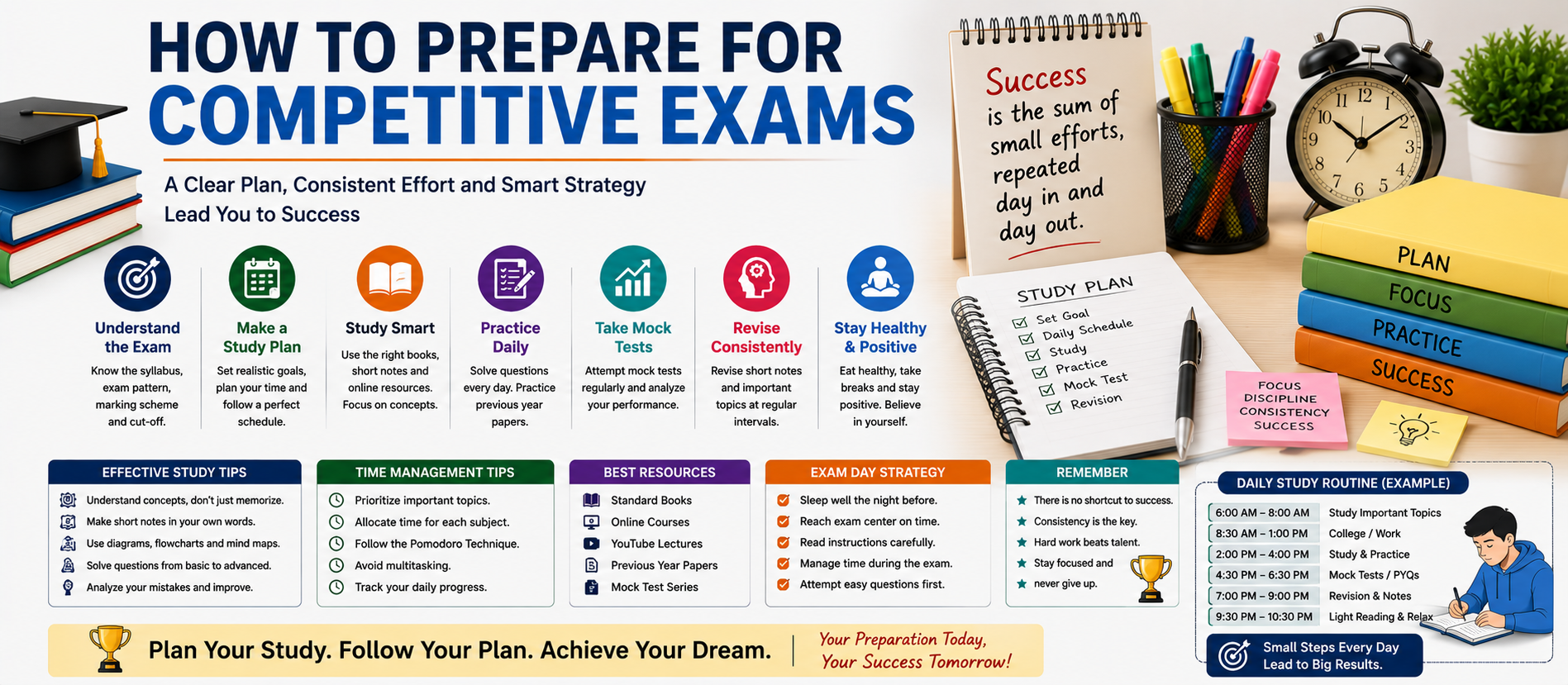
Start by understanding the official syllabus and exam pattern. Then create a realistic study plan, strengthen your weak areas, practise questions regularly, take mock tests, analyze your mistakes, and revise repeatedly.
Do not depend only on long study hours. Focus on productive study. A candidate who studies with concentration and follows a clear plan can often achieve more than someone who studies without structure.
1. Understand the Exam Before You Start Studying
Many students begin collecting books and joining courses before understanding the examination itself. This can waste time.
Before creating a study plan, find the official information for your specific examination.
Check These Important Points
- Official syllabus.
- Exam pattern.
- Subjects and topics.
- Number of questions.
- Total marks.
- Time limit.
- Question types.
- Negative marking, if applicable.
- Eligibility requirements.
- Important dates.
Always use the official examination website or official notification as the primary source for current rules. Exam patterns and requirements can change.
2. Divide the Syllabus into Smaller Parts
A large syllabus can feel difficult because students see it as one huge task. Break it into smaller sections.
For example:
- Subject.
- Unit.
- Chapter.
- Topic.
- Subtopic.
Create a simple syllabus tracker. Mark each topic as:
- Not Started.
- Learning.
- Completed Once.
- Needs Revision.
- Strong.
This helps you see your real progress. Do not rely only on memory or the feeling that you have studied enough.
3. Know Your Starting Level
Before following an advanced study schedule, understand your current level.
Take a diagnostic test or solve a previous paper under reasonable conditions. You do not need to score highly at this stage. The purpose is to identify:
- Your strong subjects.
- Your weak subjects.
- Topics you have never studied.
- Common mistakes.
- Problems with speed.
- Problems with accuracy.
Your preparation should be based on evidence. A diagnostic test gives you useful information for building a plan.
4. Create a Realistic Study Plan
A study plan should match your available time, current level, and exam date.
Do not create a schedule that requires twelve hours of study every day if you can realistically maintain only four or five productive hours. An unrealistic plan often creates guilt and leads to inconsistency.
A Simple Weekly Structure
- Concept Learning: Study new topics.
- Practice: Solve questions from completed topics.
- Revision: Review older material.
- Mock Test: Test your preparation under timed conditions.
- Error Analysis: Study your mistakes.
A good plan should also include buffer time. Some topics will take longer than expected.
5. Start with the Most Important Topics
Not every topic has the same value. Review previous papers and the official syllabus to understand which areas appear regularly.
You can organize topics using a simple priority system:
- High Priority: Important topics that appear frequently or carry significant marks.
- Medium Priority: Useful topics that should be covered after the core areas.
- Lower Priority: Topics that appear less often but should not be ignored if time allows.
Do not completely depend on past trends. The examination authority can change the pattern. Use previous papers to understand trends, not to predict every future question.
6. Build Strong Concepts Before Memorizing Answers
Competitive exams often test the ability to apply knowledge. Memorizing isolated answers may not be enough.
When learning a topic, ask:
- What is the main concept?
- Why does it work?
- Can I explain it in simple words?
- Can I solve a new question based on it?
- What mistakes are common?
One useful method is to explain the topic as if you are teaching a beginner. If you cannot explain it clearly, you may need more practice.
7. Use Active Learning
Reading notes again and again can create the feeling that you understand a topic. Active learning is stronger because it requires you to retrieve and apply information.
Useful Active Learning Methods
- Solve practice questions.
- Use flashcards for facts and formulas.
- Explain concepts aloud.
- Write short summaries from memory.
- Take topic-wise quizzes.
- Teach another person.
- Attempt questions before checking solutions.
The goal is not simply to recognize information. The goal is to recall and use it.
8. Practise Questions Every Day
Question practice is essential for most competitive exams.
Start slowly when learning a new topic. Focus on understanding the method. As your confidence improves, begin timed practice.
After solving questions, separate mistakes into categories:
- Concept error.
- Calculation error.
- Misread question.
- Memory error.
- Time pressure.
- Incorrect strategy.
- Careless mistake.
This is important because different problems require different solutions. If you repeatedly make concept errors, study the topic again. If you repeatedly make careless mistakes, change your checking process.
9. Maintain an Error Notebook
An error notebook can become one of your most useful revision resources.
For each important mistake, record:
- The topic.
- The question type.
- Your incorrect approach.
- The correct method.
- The reason for the mistake.
- A short reminder for the future.
Review this notebook regularly. Your mistakes can reveal more about your preparation than simply counting the number of hours you studied.
10. Learn Time Management
Competitive exams usually have a fixed time limit. Knowledge alone may not be enough if you cannot manage the paper efficiently.
During practice, learn:
- Which questions to attempt first.
- When to skip a difficult question.
- How much time to spend on each section.
- How to avoid getting stuck.
- How to leave time for review.
Do not spend five minutes fighting with one question when that time could be used to answer several easier questions.
11. Take Mock Tests Under Realistic Conditions
Mock tests help you practise the complete examination experience.
Try to follow the actual exam time limit. Avoid checking answers in the middle of the test. Sit in a distraction-free environment when possible.
After Every Mock Test, Review:
- Total score.
- Accuracy.
- Time spent on each section.
- Questions you skipped.
- Questions you guessed.
- Repeated mistakes.
- Topics that need revision.
A mock test is not only a score. It is a source of data about your preparation.
12. Analyze Mock Tests Carefully
Taking ten mock tests without reviewing them may not help as much as taking fewer tests and studying the results carefully.
For every incorrect answer, ask:
- Did I know the concept?
- Did I misunderstand the question?
- Did I make a careless mistake?
- Did I choose the wrong method?
- Did time pressure affect me?
- Could I solve this question with a better strategy?
This process turns mistakes into improvement.
13. Create a Revision System
Studying a topic once is rarely enough. Revision helps strengthen memory and improve recall.
A practical revision system can include:
- Quick review after learning.
- Another review after a few days.
- Regular weekly revision.
- Monthly review of major topics.
- Final revision using short notes and error lists.
You do not need to follow a rigid formula. The key is to revisit important material before you forget it.
14. Make Short Revision Notes
Do not try to rewrite an entire textbook during revision.
Create short notes containing:
- Important formulas.
- Definitions.
- Key facts.
- Common mistakes.
- Important methods.
- Quick examples.
Your final revision material should become shorter and more focused as the exam approaches.
15. Use Previous-Year Question Papers Wisely
Previous-year papers can help you understand:
- The general question style.
- Difficulty level.
- Frequently tested areas.
- Time requirements.
- Your current level of preparation.
Use papers from reliable sources. Check whether the official pattern has changed since older papers were published.
16. Avoid Too Many Study Resources
One common problem is resource overload. Students collect many books, PDFs, apps, video courses, and notes.
More material does not always mean better preparation.
A practical approach is:
- One primary source for each subject.
- A reliable question bank or practice source.
- Previous-year papers.
- Short revision notes.
- An error notebook.
Finish what you choose before constantly moving to a new resource.
17. Use Technology and AI Carefully
Digital tools can support competitive exam preparation.
You can use technology for:
- Digital flashcards.
- Study timers.
- Practice tests.
- Progress tracking.
- Organizing notes.
- Finding explanations.
AI tools can also help explain concepts, create practice questions, summarize your own notes, and quiz you.
Good AI Prompts for Students
- Explain this topic in simple language.
- Give me five practice questions without answers.
- Check my solution and identify the first step where my reasoning went wrong.
- Create a short revision quiz from these notes.
- Explain the difference between these two concepts.
Always verify important facts. AI can make mistakes. It should support your learning, not replace your thinking.
18. Manage Distractions
Concentration is a major advantage during exam preparation.
Create a simple study environment:
- Keep only required books and tools nearby.
- Turn off unnecessary notifications.
- Keep social media away during focused sessions.
- Set a clear task before starting.
- Take planned breaks.
Do not try to create perfect conditions every day. Build the ability to start and continue even when motivation is low.
19. Take Care of Sleep, Health, and Energy
Exam preparation is a long process. A tired brain may find it harder to focus, remember, and solve problems.
Try to maintain:
- A regular sleep routine.
- Reasonable physical activity.
- Regular meals and hydration.
- Short breaks during long study periods.
Do not treat exhaustion as proof of productive study. Sustainable preparation is usually more effective than repeated burnout.
20. Manage Exam Stress
Some level of stress is normal before an important exam. The goal is not always to remove stress completely. The goal is to manage it.
Useful strategies include:
- Follow a realistic daily plan.
- Focus on today's tasks.
- Avoid constant comparison with other candidates.
- Use mock tests to become familiar with pressure.
- Take short breaks when concentration falls.
- Talk to a trusted person when pressure becomes difficult to manage.
Do not allow one bad mock test to define your ability. Look for patterns over time.
21. What to Do in the Final Month
The final month should focus more on consolidation than collecting new resources.
- Review the syllabus tracker.
- Prioritize weak but important topics.
- Take and analyze mock tests.
- Revise formulas and short notes.
- Review your error notebook.
- Practice time management.
- Follow official exam updates.
Avoid major changes to your study method unless the current method is clearly failing.
22. What to Do One Week Before the Exam
During the final week:
- Focus on revision.
- Avoid learning large amounts of completely new material.
- Review common mistakes.
- Check the exam location or online test requirements.
- Prepare required documents.
- Maintain your normal sleep routine.
Always check the latest official instructions for your specific examination.
23. Exam-Day Strategy
Preparation continues until the exam is completed.
- Read the official instructions carefully.
- Manage your time.
- Start with a sensible strategy.
- Do not panic over difficult questions.
- Skip and return when appropriate.
- Watch for negative marking rules.
- Review answers if time remains.
Stay focused on the paper in front of you. You cannot control the preparation of other candidates.
A Sample Daily Study Plan
This is only an example. Adjust it according to your schedule.
- Session 1: Learn a new topic.
- Short Break
- Session 2: Solve questions from that topic.
- Break
- Session 3: Study a second subject.
- Session 4: Revise older topics.
- Final Review: Update your error notebook and plan the next day.
Consistency matters more than creating an impressive timetable that you cannot follow.
SEO, AEO, GEO, and AI Search Optimization for Education Content
Students increasingly search for direct answers to questions such as:
- How should I prepare for competitive exams?
- How many hours should I study for an entrance exam?
- How can I improve my exam score?
- How do I revise effectively?
- How should I analyze mock tests?
- Can AI help with exam preparation?
SEO helps useful educational content appear in traditional search results.
AEO focuses on providing direct, useful answers to specific questions.
GEO helps structure content for generative search experiences.
AI Search Optimization focuses on clear language, logical headings, concise answers, useful examples, and well-organized information.
How Digiifrog Supports Educational Content
Digiifrog creates structured, readable, and search-focused content for businesses, educational platforms, and digital audiences.
- SEO Content Strategy
- AEO and Answer-Focused Content
- GEO and Generative Search Optimization
- AI Search Optimization
- Educational and Business Content Development
- Digital Branding Strategy
Frequently Asked Questions
How should I start preparing for a competitive exam?
Start by reading the official syllabus and exam pattern. Then assess your current level, divide the syllabus into smaller topics, and create a realistic study plan.
How many hours should I study every day?
There is no single number that works for everyone. Your available time, current preparation level, and exam date matter. Focus on consistent and productive study rather than comparing study hours.
Are mock tests important?
Yes. Mock tests can help improve time management, identify weak areas, measure accuracy, and reveal common mistakes. Analysis after the test is equally important.
How can I improve my accuracy?
Analyze why you make mistakes. Separate concept errors, calculation errors, misread questions, and careless mistakes. Then practise the specific problem area.
Should I study from many books?
Usually, no. A small number of reliable resources used consistently is often more useful than collecting too many books and courses.
Can AI help with competitive exam preparation?
AI can help explain concepts, create practice questions, quiz you, and organize revision. However, you should verify important information and do your own thinking and problem-solving.
How should I revise before the exam?
Focus on important concepts, short notes, formulas, previous mistakes, and practice questions. Avoid wasting the final days collecting new resources.
Conclusion
Learning how to prepare for competitive exams is not about finding one secret method. Good preparation is a combination of clear planning, focused learning, regular practice, repeated revision, and careful analysis.
Start with the official syllabus. Understand the exam. Build a realistic plan. Strengthen concepts. Solve questions. Take mock tests. Study your mistakes. Revise regularly.
Do not measure your progress only by the number of hours you study. Measure it by what you understand, what you can recall, how accurately you solve questions, and how effectively you improve after mistakes.
Prepare with a plan. Practise with purpose. Review your mistakes. Improve every week.
Disclaimer: This article is for general educational and informational purposes. Every competitive examination has its own syllabus, eligibility criteria, dates, rules, and assessment methods. Always check the latest information on the official website or official notification of the relevant examination authority.
Digiifrog
Website: www.digiifrog.com
Ready to Grow?
Talk to us about a strategy tailored to your brand — we will help you stand out in search, AI discovery and social.


Comments (0)
Log in to leave a comment.