📋 Quick Summary
In this article:
Understanding Google Algorithm Updates
Why Websites Lose Rankings After Updates
Step 1: Confirm the Traffic Drop
Step 2: Identify Which Pages Were Affected
Step 3: Evaluate Content Quality
Step 4: Strengthen E-E-A-T Signals
Step 5: Improve User Experience
Step 6: Update Outdated Content
Step 7: Improve Topical Authority
Step 8: Audit Technical SEO
Step 9: Optimize Core Web Vitals
Step 10: Review Backlink Quality
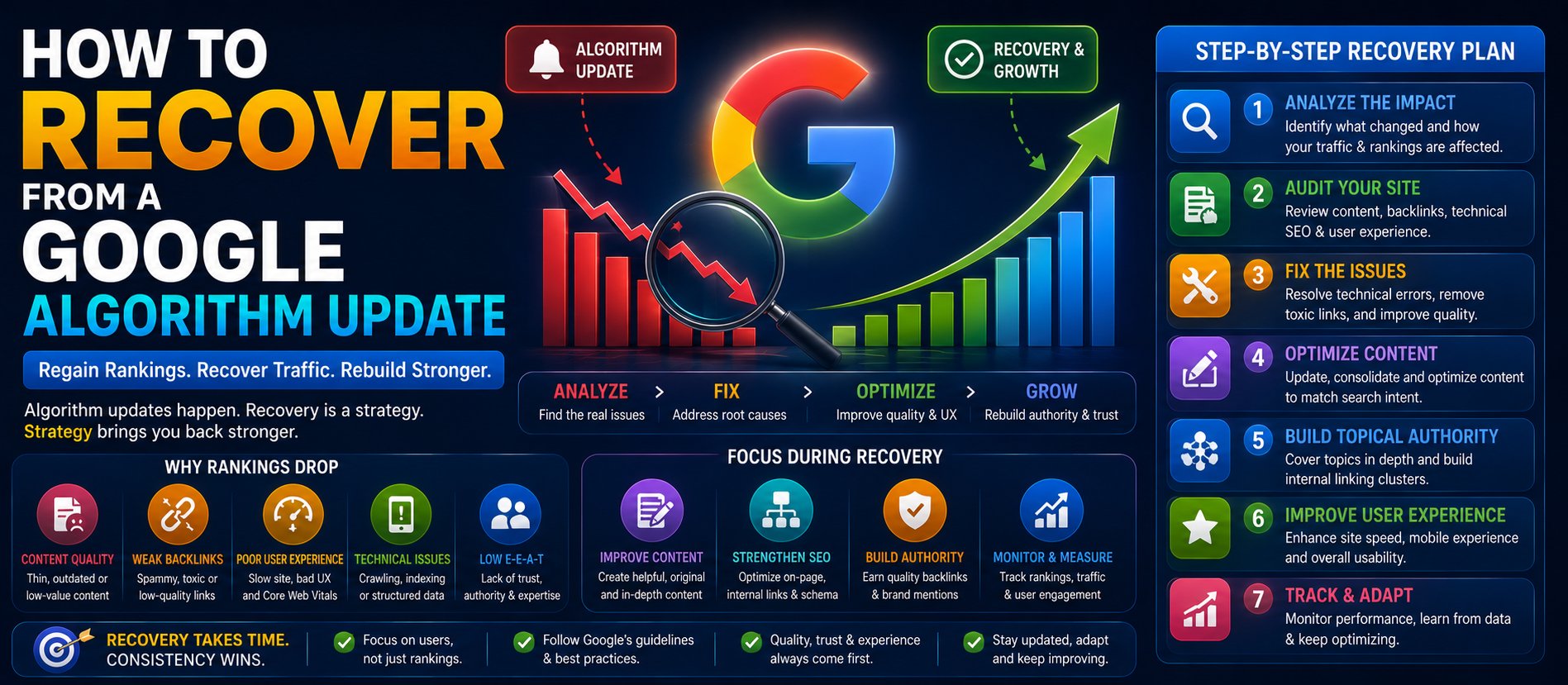
Google algorithm updates have always been a major concern for website owners, SEO professionals, bloggers, publishers, and businesses. One day a website may be generating thousands of visitors, leads, and conversions, and after a major update, rankings can suddenly decline. While algorithm updates can be frustrating, they are designed to improve search quality and provide users with more relevant, trustworthy, and helpful content.
💡 Key Insight
In 2026, Google's search ecosystem has become more sophisticated than ever. Artificial Intelligence, machine learning, Answer Engine Optimization (AEO), Generative Engine Optimization (GEO), AI Search Optimization, user experience signals, and E-E-A-T principles play increasingly important roles in determining rankings.
If your website has experienced traffic loss following a Google algorithm update, do not panic. Recovery is possible when you understand what changed and implement a strategic improvement plan.
This comprehensive guide explains how Google updates work, why rankings drop, and the most effective methods for recovering lost visibility and organic traffic.
Understanding Google Algorithm Updates
Google continuously updates its search algorithms to improve the quality of search results. Some changes are minor and occur daily, while others are major core updates that significantly affect rankings across industries.
Google updates typically focus on:
- Content quality
- User experience
- Spam prevention
- Authority evaluation
- Trust signals
- Search relevance
- AI-powered ranking improvements
The primary goal is always to provide better search experiences for users.
Why Websites Lose Rankings After Updates
Many businesses assume Google has penalized them when rankings decline. In reality, most ranking drops occur because competitors improved or because Google's evaluation methods evolved.
Common reasons include:
- Thin content
- Poor user experience
- Weak E-E-A-T signals
- Outdated information
- Low-quality backlinks
- Technical SEO issues
- Insufficient authority
Understanding the root cause is the first step toward recovery.
Step 1: Confirm the Traffic Drop
Before making changes, verify that traffic losses are connected to a Google update.
Analyze:
- Organic traffic trends
- Keyword rankings
- Search Console performance
- Conversion data
- Page-level performance
Compare traffic patterns before and after the update.
Step 2: Identify Which Pages Were Affected
Not all pages experience ranking declines equally.
Businesses should identify:
- Pages with traffic losses
- Keywords that declined
- Top-performing pages
- New competitors
This analysis helps prioritize recovery efforts.
Step 3: Evaluate Content Quality
Content quality remains one of the most important ranking factors.
Review whether your content:
- Answers user questions completely
- Provides original insights
- Offers accurate information
- Remains up to date
- Demonstrates expertise
Content that lacks depth often struggles after major updates.
Step 4: Strengthen E-E-A-T Signals
Google increasingly emphasizes Experience, Expertise, Authoritativeness, and Trustworthiness.
To improve E-E-A-T:
- Add author profiles
- Show credentials
- Cite reliable sources
- Display business information
- Publish expert insights
Strong E-E-A-T improves trust and rankings.
Step 5: Improve User Experience
User experience influences both engagement and search visibility.
Evaluate:
- Page design
- Navigation
- Content readability
- Mobile usability
- Site speed
Google increasingly rewards websites that provide positive experiences.
Step 6: Update Outdated Content
Many ranking losses occur because content becomes outdated.
Businesses should regularly update:
- Statistics
- Industry trends
- Case studies
- Examples
- Recommendations
Fresh content signals relevance and authority.
Step 7: Improve Topical Authority
Google increasingly rewards websites that demonstrate comprehensive expertise.
Build topical authority by:
- Creating topic clusters
- Publishing supporting articles
- Improving internal links
- Expanding subject coverage
Authority strengthens resilience against future updates.
Step 8: Audit Technical SEO
Technical issues can amplify ranking losses.
Review:
- Indexing problems
- Crawl errors
- Broken links
- Page speed
- Structured data
- Mobile performance
Technical optimization supports recovery efforts.
Step 9: Optimize Core Web Vitals
Core Web Vitals continue influencing rankings.
Focus on:
- Loading performance
- Interactivity
- Visual stability
Improved performance enhances both rankings and user satisfaction.
Step 10: Review Backlink Quality
Backlinks remain important, but quality matters more than quantity.
Analyze:
- Authority of linking domains
- Relevance of backlinks
- Spammy links
- Lost backlinks
A healthy backlink profile supports long-term SEO success.
Step 11: Strengthen Internal Linking
Internal links help search engines understand content relationships.
Benefits include:
- Improved crawlability
- Authority distribution
- Better user navigation
- Enhanced topical relevance
Strategic internal linking often improves rankings.
Step 12: Optimize for AEO
Answer Engine Optimization has become increasingly important.
Create content that:
- Answers questions directly
- Uses FAQ sections
- Includes concise summaries
- Targets featured snippets
AEO improves visibility within answer-driven search experiences.
Step 13: Implement GEO Strategies
Generative Engine Optimization helps websites appear within AI-generated answers.
Businesses should focus on:
- Authority building
- Entity optimization
- Structured content
- Trust signals
- Expert insights
GEO strengthens future search visibility.
Step 14: Prepare for AI Search Optimization
AI-powered search continues transforming search behavior.
Optimize content to be:
- Well structured
- Factually accurate
- Easy to summarize
- Semantically rich
- Authoritative
AI Search Optimization supports both current and future visibility.
Step 15: Monitor Competitors
Competitor analysis often reveals why rankings changed.
Review:
- Content quality
- Backlink profiles
- User experience
- Content depth
- Authority signals
Learning from successful competitors can accelerate recovery.
Common Recovery Mistakes
- Making drastic changes immediately
- Deleting content unnecessarily
- Buying backlinks
- Keyword stuffing
- Ignoring user experience
- Chasing shortcuts
Recovery requires patience, analysis, and consistent improvement.
How Long Recovery Takes
Recovery timelines vary depending on the severity of ranking losses and the improvements implemented.
Some websites recover within weeks, while others may require several months.
Google often reevaluates websites during future algorithm updates.
Consistent quality improvements provide the best chance of recovery.
Future-Proofing Your Website
The best defense against future algorithm updates is building a high-quality website focused on users.
Businesses should prioritize:
- Exceptional content
- E-E-A-T signals
- Technical excellence
- User experience
- AEO strategies
- GEO readiness
- AI Search Optimization
Future-proof websites are less vulnerable to ranking volatility.
Conclusion
Google algorithm updates can be challenging, but they also create opportunities for businesses willing to improve. Rather than searching for shortcuts, focus on quality, authority, trustworthiness, and user satisfaction.
Recovery requires a combination of content improvements, technical optimization, stronger E-E-A-T signals, AEO implementation, GEO readiness, and AI Search Optimization.
Organizations that invest in long-term quality will not only recover but often emerge stronger than before.
Digiifrog helps businesses recover from algorithm updates through advanced SEO audits, AEO, GEO, AI Search Optimization, content strategy, technical SEO, and performance-driven digital growth solutions.
Website: www.digiifrog.com
Whether you are managing a blog, local business website, eCommerce store, or enterprise platform, Digiifrog provides expert search optimization strategies designed to restore visibility and drive sustainable growth.
Ready to Grow?
Talk to us about a strategy tailored to your brand — we will help you stand out in search, AI discovery and social.
Comments (0)
Log in to leave a comment.