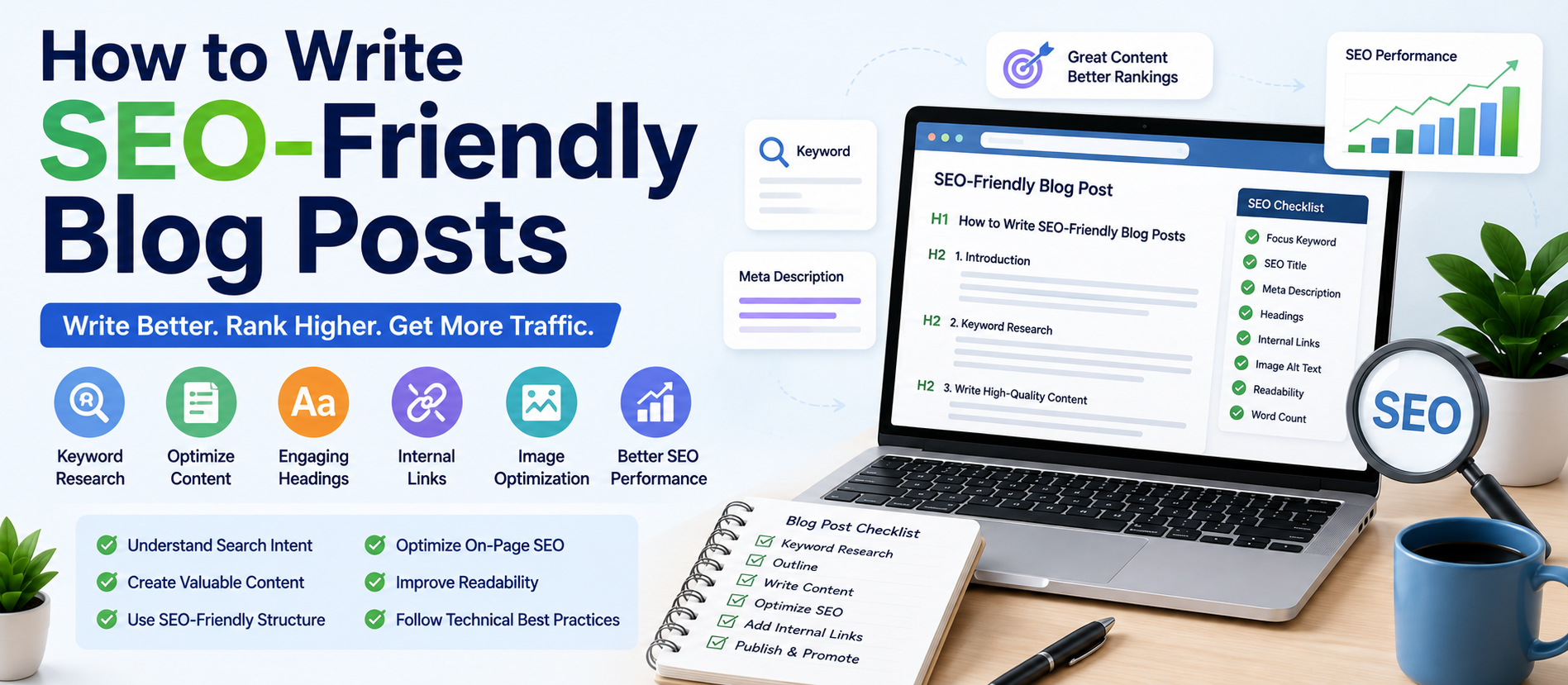
📋 Quick Summary
In this article:
What Is an SEO-Friendly Blog Post?
Why SEO-Friendly Blog Posts Matter
1. Start With Search Intent
2. Choose One Primary Target Keyword
3. Create a Clear, Descriptive Title
4. Build an Outline Before Writing
5. Write for People First
6. Use Keywords Naturally
7. Create Strong Headings and Short Sections
💡 Key Insight
Writing a blog post that people enjoy reading and search engines can understand requires more than adding a keyword several times. A strong SEO-friendly blog post starts with search intent, provides original value, uses a clear structure, answers important questions, and gives readers a satisfying experience. In 2026, the same principles are increasingly important for AI-powered search experiences as well as traditional search results.
Google's current guidance emphasizes helpful, reliable, people-first content rather than content created primarily to manipulate rankings. It also states that there is no preferred word count, so businesses should focus on covering a topic sufficiently instead of writing to an arbitrary length. citeturn0search0turn0search2
This guide explains how to write SEO-friendly blog posts that are optimized for traditional SEO while also supporting Answer Engine Optimization (AEO), Generative Engine Optimization (GEO), and AI Search Optimization.
Company: Designfo
Website: www.designfo.in
Contact: +91 9831037463
What Is an SEO-Friendly Blog Post?
An SEO-friendly blog post helps readers and search systems understand a topic. It answers a genuine need, uses clear language, and has a logical structure.
SEO does not mean writing for algorithms instead of people. Google describes SEO as useful when it is applied to people-first content. Its Search Essentials also recommend using words people actually search for in prominent places such as the title, main heading, alt text, and link text. citeturn0search0turn0search2
Why SEO-Friendly Blog Posts Matter
Blog content can help a business attract people at different stages of the customer journey. Informational articles can build awareness, comparison content can support consideration, and practical guides can create trust before a customer contacts the company.
- Increase organic search visibility.
- Answer customer questions.
- Build topical authority.
- Generate qualified website traffic.
- Support internal linking.
- Strengthen brand expertise.
- Support AEO and AI search visibility.
- Create long-term content assets.
1. Start With Search Intent
Before writing, identify what the searcher actually wants. A keyword can represent different intentions, and your article should satisfy the dominant need behind the query.
Common Search Intent Types
- Informational: The user wants to learn something.
- Commercial: The user is researching options.
- Transactional: The user is ready to take action.
- Navigational: The user wants to find a specific website or resource.
For example, someone searching "how to write SEO-friendly blog posts" is primarily looking for practical information. A step-by-step guide is more appropriate than a sales-heavy landing page.
2. Choose One Primary Target Keyword
Every article should have a clear main topic. Select one primary target keyword and then identify related phrases, questions, and subtopics.
For this article, the primary keyword is SEO-friendly blog posts. Related terms include:
- SEO blog writing
- SEO-friendly content
- how to write SEO blog posts
- blog SEO tips
- SEO content strategy
- search-optimized blog content
Use related language naturally. Do not repeat the exact keyword in every paragraph.
3. Create a Clear, Descriptive Title
Your title is important for both readers and search systems. Google recommends titles that are unique, clear, concise, and accurately describe the page. citeturn0search10
Good SEO Title Formula
Primary topic + clear benefit + useful qualifier
Examples:
- How to Write SEO-Friendly Blog Posts: A Complete Beginner's Guide
- SEO Blog Writing Tips for Small Businesses
- How to Create Search-Optimized Blog Content That Converts
⚠ Watch Out
Avoid exaggerated titles that promise something the article does not deliver.
4. Build an Outline Before Writing
A good outline prevents repetition and makes the article easier to scan. Organize the post around the questions a reader needs answered.
- Define the topic.
- Explain why it matters.
- Cover the main steps.
- Add examples and practical tips.
- Answer common questions.
- Finish with a useful conclusion and next step.
Use <h3> for major sections and <h4> for supporting subsections when appropriate.
5. Write for People First
The most important rule for SEO content writing is to make the article genuinely useful. Google prioritizes helpful, reliable information created for people rather than content designed primarily to manipulate rankings. citeturn0search0
Use simple explanations, specific examples, practical steps, and original observations. Avoid filling paragraphs with generic statements that do not help the reader make a decision or solve a problem.
6. Use Keywords Naturally
Keyword optimization is about relevance and clarity, not repetition. Include the primary topic where it makes sense, especially in prominent page elements.
Useful Keyword Locations
- SEO title
- Main heading
- Opening paragraphs
- Relevant subheadings
- Body copy
- Image alt text when descriptive and relevant
- Internal link text
- Meta description when appropriate
Do not use awkward keyword stuffing. Write the sentence naturally first and optimize it without damaging readability.
7. Create Strong Headings and Short Sections
Large blocks of text are difficult to scan, especially on mobile devices. Break the article into meaningful sections and use descriptive headings.
Instead of a heading such as "More Tips", use something specific such as "How to Optimize Blog Headings for Search Intent". Descriptive headings make the page easier to navigate and clarify its structure.
8. Answer Questions Clearly for AEO
Answer Engine Optimization (AEO) focuses on making information easy to understand and use in answer-oriented search experiences. A practical approach is to identify important customer questions and answer them directly.
A Useful Answer Format
Question: What makes a blog post SEO-friendly?
Answer: An SEO-friendly blog post satisfies search intent, provides original value, uses clear headings, includes relevant keywords naturally, has a strong technical foundation, and offers a good reader experience.
Follow a concise answer with additional explanation, examples, or steps. This creates content that is useful both for quick answers and deeper research.
9. Add Original Experience and Expertise
Generic summaries are easy to reproduce. Original experience is harder to replace and can make your content more valuable.
Where relevant, add:
- First-hand observations
- Case studies
- Original examples
- Expert commentary
- Lessons learned
- Data or research
- Practical workflows
Google's current people-first guidance encourages original information, analysis, substantial value, and clear evidence of expertise. citeturn0search0
11. Use Lists, Examples, and Visual Content
Bullets and numbered steps make complex information easier to scan. Examples help readers understand how a principle works in practice.
Relevant images, diagrams, screenshots, charts, and videos can also improve comprehension. Google's guidance for AI search recommends supporting textual content with high-quality, relevant images and videos when appropriate. citeturn0search8
12. Optimize Images Properly
Images should support the content rather than exist only for decoration. Use descriptive filenames and meaningful alt text when the image conveys information.
For example, instead of a generic filename such as image123.jpg, use a descriptive filename such as seo-friendly-blog-structure.jpg when appropriate.
Alt text should describe the image's meaningful content for users who cannot see it. Do not use alt text as a place to insert unrelated keywords.
13. Add Internal Links
Internal linking helps readers discover related resources and creates connections between pages on your website. Link naturally when another page provides useful additional information.
Use descriptive anchor text instead of vague phrases such as "click here." For example, "learn more about AI Search Optimization" gives more context than "click here."
15. Improve Technical SEO
Good writing cannot compensate for a website that search systems cannot access or process properly. Make sure important pages can be crawled and indexed, use a logical site structure, and provide a good experience across devices.
- Use crawlable URLs.
- Check indexing in Search Console.
- Fix important broken links.
- Use logical internal linking.
- Ensure mobile usability.
- Improve page speed and overall page experience.
- Reduce unnecessary duplicate content.
Google's current AI search guidance confirms that technical SEO remains relevant because generative search features are rooted in Google's core Search systems. citeturn0search7turn0search8
16. Optimize Blog Posts for GEO and AI Search
Generative Engine Optimization (GEO) and AI Search Optimization should not be approached as a collection of secret tricks. Google's current guidance recommends focusing on unique, valuable, non-commodity content and continuing established SEO practices for generative AI experiences. citeturn0search7turn0search8
To improve the usefulness of your content for modern AI-powered discovery:
- Answer real questions comprehensively.
- Use clear facts and terminology.
- Demonstrate first-hand expertise.
- Build topical depth.
- Maintain consistent business information.
- Support important claims with credible sources.
- Use structured data when appropriate and ensure it matches visible content.
18. Edit and Fact-Check Before Publishing
Never publish an article immediately after drafting it. Review the content for accuracy, repetition, grammar, outdated information, unclear claims, and missing context.
Final Editing Questions
- Does the article actually answer the searcher's question?
- Is the information accurate?
- Is the content original enough to be useful?
- Are headings descriptive?
- Are keywords natural?
- Are examples relevant?
- Are links useful?
- Is the conclusion actionable?
19. Avoid Common SEO Blog Writing Mistakes
- Keyword stuffing
- Writing only to reach a word count
- Copying or lightly rewriting competitors
- Publishing large amounts of low-value AI content
- Using clickbait titles
- Ignoring search intent
- Creating weak introductions
- Using generic headings
- Ignoring internal links
- Publishing without proofreading
- Ignoring technical SEO
- Writing for algorithms instead of readers
Google explicitly states that there is no preferred word count and warns against creating content primarily to attract search-engine visits or mass-producing pages without adding value. citeturn0search0turn0search3
20. Create a Simple SEO Blog Post Workflow
- Choose a clear topic.
- Research the search intent.
- Select a primary target keyword.
- Collect related questions and subtopics.
- Create an outline.
- Write the article for people first.
- Add original examples and expertise.
- Optimize titles, headings, links, and images.
- Add relevant structured data.
- Proofread and fact-check.
- Publish and monitor performance.
- Update the article when information meaningfully changes.
How Designfo Helps Businesses With SEO Content
Designfo helps businesses build content and digital marketing strategies designed around search visibility, customer intent, and measurable business outcomes. Our approach can combine SEO, content marketing, AEO, GEO, AI Search Optimization, website development, digital PR, and marketing automation.
Designfo Digital Growth Services
- SEO and Technical SEO
- SEO-Friendly Content Writing
- AEO, GEO and AI Search Optimization
- Content Marketing and Digital PR
- Marketing Automation
- Conversion Rate Optimization
Frequently Asked Questions
What makes a blog post SEO-friendly?
An SEO-friendly blog post matches search intent, provides useful original information, uses relevant keywords naturally, has a clear structure, supports good page experience, and follows technical SEO fundamentals.
How many words should an SEO blog post have?
There is no universal ideal word count. Google explicitly says creators should not write to a particular word count simply because they believe Google has a preferred length. Write enough to satisfy the user's need thoroughly without unnecessary filler. citeturn0search0
How many times should I use my target keyword?
There is no fixed keyword density requirement. Use the main topic naturally where it helps readers and search systems understand the page. Avoid repetition that makes the writing unnatural.
Does AI-generated content hurt SEO?
Using AI is not automatically a problem. Google states that content quality and usefulness matter, but generating large amounts of content with the primary purpose of manipulating search rankings can violate its spam policies. citeturn0search3turn0search4
Conclusion
Learning how to write SEO-friendly blog posts is less about manipulating rankings and more about becoming genuinely useful to the people searching for information. Start with search intent, choose a clear topic, create an organized outline, write original content, use keywords naturally, answer important questions, and make the page easy to read.
Then strengthen the article with internal links, relevant visuals, technical SEO, structured data, accurate information, and a clear user journey. For modern search, extend the same principles into AEO, GEO, and AI Search Optimization. Google's current guidance emphasizes unique, valuable, people-first content and confirms that established SEO best practices remain important for AI-powered search experiences. citeturn0search7turn0search8
The best SEO blog post is ultimately one that a reader would save, share, trust, and recommend even if search engines did not exist. Build content around that standard, and your blog becomes a stronger long-term asset for organic visibility, brand authority, and business growth.
Company: Designfo
Website: www.designfo.in
Contact: +91 9831037463
Ready to Grow?
Talk to us about a strategy tailored to your brand — we will help you stand out in search, AI discovery and social.


Comments (0)
Log in to leave a comment.