📋 Quick Summary
In this article:
Does Inflation Increase Real Estate Prices?
1. Inflation Raises Construction Costs
2. Higher Inflation Can Reduce Housing Affordability
3. Inflation and Mortgage Rates
4. Higher Mortgage Rates Reduce Purchasing Power
5. Inflation Can Support Rental Growth
6. Real Estate Income and Inflation
7. Commercial Real Estate and Inflation
8. Inflation and Property Replacement Cost
9. Inflation Can Slow New Housing Supply
10. Inflation and Home Sellers
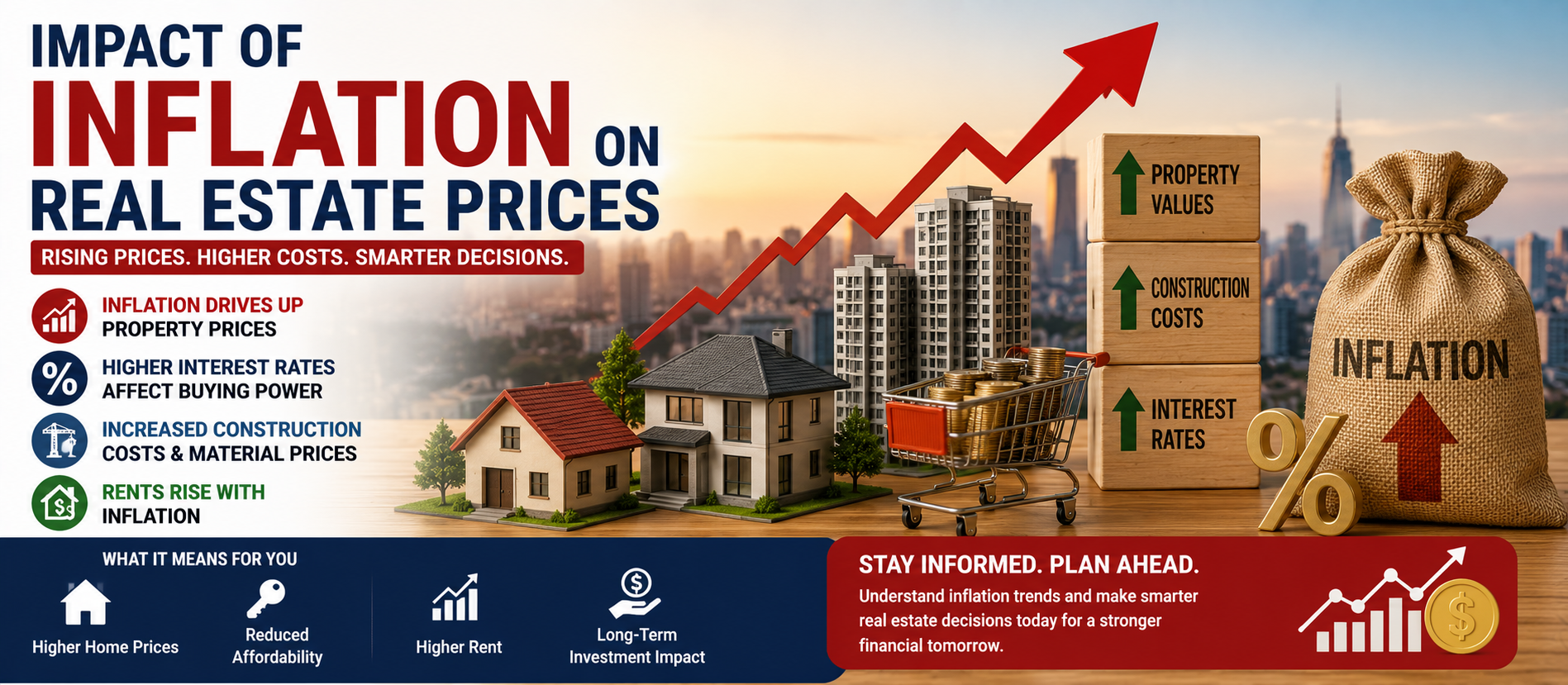
The impact of inflation on real estate prices is complex because inflation affects property values, rents, construction costs, mortgage rates, household budgets, investment returns, and the supply of new housing at the same time. During periods of rising prices, real estate can sometimes benefit from higher rents and replacement costs, but higher inflation can also lead to higher interest rates that reduce borrowing power and weaken demand.
💡 Key Insight
One important point is that inflation and home-price growth are not the same thing. The U.S. Bureau of Labor Statistics measures housing in the Consumer Price Index primarily through shelter costs, including rent and owners' equivalent rent, rather than treating the purchase price of a home as a consumer expense. citeturn0search5turn0search2
Interest rates are a major channel through which inflation affects real estate. The Federal Reserve's July 2026 Monetary Policy Report noted that U.S. inflation had moved higher, while house-price growth had moderated and mortgage rates remained substantially above the rates on many existing mortgages. citeturn0search0 The Dallas Fed also explains that mortgage rates respond to broader market rates, Treasury yields, yield-curve conditions, and interest-rate volatility rather than moving mechanically with the federal funds rate. citeturn0search1
This guide explains how inflation affects residential and commercial real estate, why higher inflation can push property values in different directions, how buyers and investors can evaluate inflation risk, and how real estate businesses can use SEO, AEO, GEO, and AI Search optimization to explain economic topics clearly.
This WordPress-ready HTML article is prepared for Digiifrog (www.digiifrog.com).
What Is Inflation?
Inflation is a sustained increase in the general price level of goods and services. When inflation rises, each unit of currency generally buys fewer goods and services than before.
For real estate, inflation matters because property is a physical asset with construction costs, operating expenses, financing costs, rents, and long-term cash flows. The effect is therefore different from the effect on a simple consumer purchase.
Does Inflation Increase Real Estate Prices?
Inflation can contribute to higher nominal real estate prices, but it does not guarantee that property values will rise. Higher construction costs can increase the replacement cost of buildings, while higher rents can support income-producing property values. At the same time, inflation can lead to tighter monetary policy and higher mortgage rates, reducing what buyers can afford.
The result depends on the balance between supply, demand, income growth, financing costs, rents, investor expectations, and local economic conditions.
1. Inflation Raises Construction Costs
Construction depends on labor, materials, transportation, equipment, energy, land development, and financing. When these costs rise, building new homes or commercial properties can become more expensive.
Higher replacement costs can support the value of existing properties, particularly when comparable new construction becomes significantly more expensive. However, expensive construction can also reduce the number of new projects that are financially feasible.
2. Higher Inflation Can Reduce Housing Affordability
Inflation does not affect only property prices. It can increase food, transportation, insurance, utilities, and other household expenses. If wages do not rise as quickly as living costs, households may have less money available for housing.
This can reduce the amount buyers are willing or able to spend, even if nominal home prices remain high.
3. Inflation and Mortgage Rates
One of the most important real estate effects of inflation comes through interest rates. When inflation remains elevated, monetary policymakers may maintain or increase interest rates to slow demand and stabilize prices.
Mortgage rates are not identical to central-bank policy rates, but monetary policy influences the broader financial conditions that affect mortgage pricing. The Dallas Fed notes that Treasury yields, the yield curve, and interest-rate volatility are important factors in mortgage-rate movements. citeturn0search1
4. Higher Mortgage Rates Reduce Purchasing Power
A higher mortgage rate increases the monthly payment required for the same loan amount. As a result, a buyer who could previously qualify for a certain home may need to choose a less expensive property when rates rise.
This creates an important distinction between property price and housing affordability. A home price can remain relatively stable while the monthly cost of buying it rises significantly because financing has become more expensive.
5. Inflation Can Support Rental Growth
Rental housing can be affected by inflation through operating expenses, household income, housing demand, and limited supply. Landlords may be able to raise rents when market conditions permit, although rent increases are constrained by tenant affordability, competition, lease terms, and applicable regulations.
The BLS measures rent and owners' equivalent rent as major components of shelter costs in the CPI. citeturn0search5
6. Real Estate Income and Inflation
Income-producing real estate can provide a partial inflation hedge when leases allow rents to increase over time. Properties with short lease terms or frequent rent resets may adjust faster than properties with long fixed leases.
However, rising rents do not automatically create higher investment returns. Operating expenses, taxes, insurance, maintenance, vacancy, and financing costs can also rise.
7. Commercial Real Estate and Inflation
Commercial real estate can respond differently depending on property type. Office, retail, industrial, multifamily, hospitality, and specialized properties have different lease structures and demand drivers.
Properties with contractual rent escalations may have more predictable income growth during inflationary periods. But if tenants face higher operating costs and weaker consumer demand, their ability to absorb rent increases may decline.
8. Inflation and Property Replacement Cost
Replacement cost is the estimated expense of rebuilding a similar property. Inflation in labor and materials can raise this cost and may contribute to higher valuations for existing assets in supply-constrained markets.
Replacement cost is only one valuation factor. Location, income, condition, comparable sales, land value, financing conditions, and investor demand remain important.
9. Inflation Can Slow New Housing Supply
When construction materials, labor, land development, and financing become more expensive, developers may postpone projects or reduce the number of units they build.
If demand remains strong while supply growth slows, existing housing can become relatively more valuable. However, weak demand can produce the opposite result, so inflation alone cannot determine future prices.
10. Inflation and Home Sellers
Sellers may see higher nominal prices during inflationary periods, but they should distinguish between nominal gains and real purchasing-power gains.
For example, if a property rises 10% in price while the general price level rises 8%, the property's real gain is much smaller than the headline 10% increase suggests.
11. Nominal vs. Real Property Returns
Nominal return measures the change in an investment's stated monetary value. Real return adjusts that result for inflation.
A property investor should consider both. A 7% annual property return may look attractive, but if inflation is 5%, the approximate inflation-adjusted gain is much smaller before taxes, transaction costs, maintenance, and financing.
12. Inflation and Real Estate Investment
Investors sometimes view real estate as an inflation-sensitive asset because property values, rents, and replacement costs can rise over time. Real estate can also provide income through rent.
But real estate is not automatically an inflation-proof investment. High interest rates, weak economic growth, falling occupancy, rising insurance costs, or declining tenant demand can offset inflation-related benefits.
13. Location Matters More During Inflation
Inflation affects different markets differently. Areas with strong employment, population growth, limited housing supply, diversified economies, and desirable amenities may have more resilience than areas experiencing population decline or weak job markets.
Local supply and demand should therefore be evaluated rather than relying only on national inflation statistics.
14. Inflation and Luxury Real Estate
Luxury property markets can behave differently because buyers may have stronger financial resources and different motivations. Scarce locations, waterfront properties, landmark homes, and highly desirable neighborhoods may retain demand even during periods of higher inflation.
However, luxury real estate remains sensitive to investment-market conditions, financing costs, economic confidence, and buyer wealth.
15. Inflation and Real Estate Development
Developers must evaluate land prices, construction costs, financing, expected sales prices, rents, absorption rates, and exit values. Inflation can make an existing project more expensive to complete while also changing the price buyers are willing to pay.
Long development timelines make inflation forecasting particularly important. Developers often use contingencies and conservative assumptions to manage cost uncertainty.
16. Inflation and Real Estate Operating Expenses
Property owners can face higher costs for maintenance, utilities, insurance, property management, repairs, cleaning, security, landscaping, and taxes. If rents cannot rise enough to offset these costs, net operating income can decline.
For investors, analyzing NOI rather than gross rental income is essential during inflationary periods.
17. Inflation and Cap Rates
A capitalization rate, or cap rate, compares a property's net operating income with its value. Higher interest rates and changing investor expectations can affect cap rates.
If cap rates rise while income stays constant, property values generally face downward pressure. If NOI grows enough to offset higher cap rates, value may remain stable or increase.
This is why inflation should be analyzed together with interest rates, rents, operating costs, and investor demand rather than in isolation.
18. Inflation and Property Taxes
Higher property values can sometimes lead to higher property-tax assessments, depending on local rules. Property taxes can therefore become another operating-cost consideration for owners and investors.
Tax treatment varies substantially by jurisdiction, so property-specific analysis is necessary.
19. Inflation and Insurance Costs
Insurance premiums can rise when rebuilding costs, weather risks, claims, or insurer expenses increase. This is especially relevant for properties in areas exposed to severe weather or other physical risks.
Higher insurance costs can reduce investment cash flow even when rents and property prices are rising.
20. How Buyers Can Respond to Inflation
- Focus on monthly affordability, not just purchase price.
- Compare mortgage rates and loan structures.
- Maintain an emergency reserve.
- Consider property operating costs.
- Review insurance and property taxes.
- Evaluate long-term local supply and demand.
- Stress-test the budget against higher expenses.
- Avoid assuming that property prices must rise with inflation.
21. How Investors Can Manage Inflation Risk
Investors can analyze lease structures, rent-growth assumptions, financing terms, operating expenses, vacancy, capital expenditures, and exit cap rates.
Stress-test the investment under several scenarios, including higher interest rates, slower rent growth, increased insurance costs, higher maintenance expenses, and weaker occupancy.
22. Inflation and Real Estate Marketing
⚠ Watch Out
Real estate businesses should avoid simplistic marketing statements such as “real estate always beats inflation.” Investment performance varies by property, financing, holding period, location, taxes, expenses, and market conditions.
Educational content that explains both potential benefits and risks can build more credibility with buyers, sellers, and investors.
23. SEO, AEO, GEO and AI Search for Inflation Real Estate Content
SEO can help real estate businesses attract people searching for inflation, home prices, mortgage rates, rental markets, and investment topics.
AEO focuses on direct questions such as “Does inflation increase home prices?”, “How does inflation affect mortgage rates?”, and “Is real estate a hedge against inflation?”
GEO and AI Search optimization can be strengthened by combining economic explanations with location-specific information. For example, a real estate business can create pages explaining how inflation affects housing affordability in a specific city, county, or metro area.
Use clear headings, concise answers, current statistics, reputable sources, definitions, examples, FAQs, and consistent business information. Avoid unsupported forecasts.
24. Real Estate Content Ideas About Inflation
- How inflation affects home prices in [city]
- Inflation and mortgage rates explained
- Does inflation make buying a home harder?
- How inflation affects rental property investors
- Inflation and commercial real estate
- How rising construction costs affect property prices
- Nominal vs. real real estate returns
- How investors can stress-test property cash flow
- Inflation and housing affordability
- How local housing supply changes inflation risk
Frequently Asked Questions About Inflation and Real Estate
Does inflation increase real estate prices?
Inflation can contribute to higher nominal property prices through construction costs, rents, wages, and replacement costs, but higher interest rates and weaker affordability can offset those effects. There is no guaranteed relationship.
Is real estate a good hedge against inflation?
Real estate can provide some inflation protection when rents, property values, or replacement costs rise, but it is not automatically an inflation-proof investment. Financing, taxes, insurance, vacancy, and operating costs can change the outcome.
How does inflation affect mortgage rates?
Persistent inflation can contribute to higher interest rates and borrowing costs. Mortgage rates are influenced by broader market rates, Treasury yields, expected inflation, and interest-rate volatility, not simply the central-bank policy rate. citeturn0search1turn0search3
Does inflation make homes less affordable?
It can. Inflation can raise household expenses, while higher mortgage rates can increase monthly payments. Together, these factors can reduce the amount a buyer can comfortably afford.
Why can rents rise during inflation?
Rents may rise because operating costs, household incomes, housing demand, and limited supply change. Actual rent growth depends on local market conditions, lease terms, affordability, and applicable regulations.
What is the difference between nominal and real home-price growth?
Nominal growth is the stated increase in a property's price. Real growth adjusts the change for inflation, showing how much purchasing power the increase represents.
Conclusion
The impact of inflation on real estate prices is neither automatically positive nor negative. Inflation can raise construction and replacement costs, support rent growth, and increase nominal property values. At the same time, it can reduce affordability, increase mortgage rates, raise operating expenses, and slow real estate development.
The most useful way to analyze inflation is therefore to look at the entire real estate system: interest rates, mortgage payments, rents, income growth, construction costs, inventory, local employment, insurance, taxes, operating expenses, and investor expectations.
Current U.S. data illustrate why this distinction matters. The Federal Reserve's July 2026 report described elevated inflation alongside moderated house-price growth and relatively high mortgage rates, while noting that many existing homeowners remain locked into much lower mortgage rates. citeturn0search0
For real estate agencies, property managers, developers, brokers, and investment businesses seeking modern websites, automated lead generation, content marketing, SEO, AEO, GEO, and AI Search optimization, Digiifrog can help. Visit www.digiifrog.com.
Quick Answer: How Does Inflation Affect Real Estate Prices?
Inflation can push real estate prices upward by increasing construction costs, rents, wages, and replacement costs, but it can also push prices downward or slow growth by increasing mortgage rates, reducing affordability, raising operating expenses, and weakening demand. The actual effect depends on local supply and demand, financing conditions, income growth, property type, and the severity and duration of inflation.
Important Note
Real estate markets are local, and economic conditions change over time. Inflation, mortgage rates, taxes, insurance, rents, property values, and investment returns vary by location and property type. This article is educational content, not financial, tax, legal, or investment advice. Use current local data and qualified professional advice for property-specific decisions.
Ready to Grow?
Talk to us about a strategy tailored to your brand — we will help you stand out in search, AI discovery and social.

Comments (0)
Log in to leave a comment.