📋 Quick Summary
In this article:
What Is Intelligent Automation?
Why Intelligent Automation Matters
Top Intelligent Automation Trends in 2026
1. Generative AI in Business Workflows
2. Hyperautomation
3. AI-Powered Decision Intelligence
4. Intelligent Customer Service
5. Autonomous IT Operations (AIOps)
6. Document Intelligence
7. Low-Code Automation Platforms
8. Intelligent Cybersecurity Automation
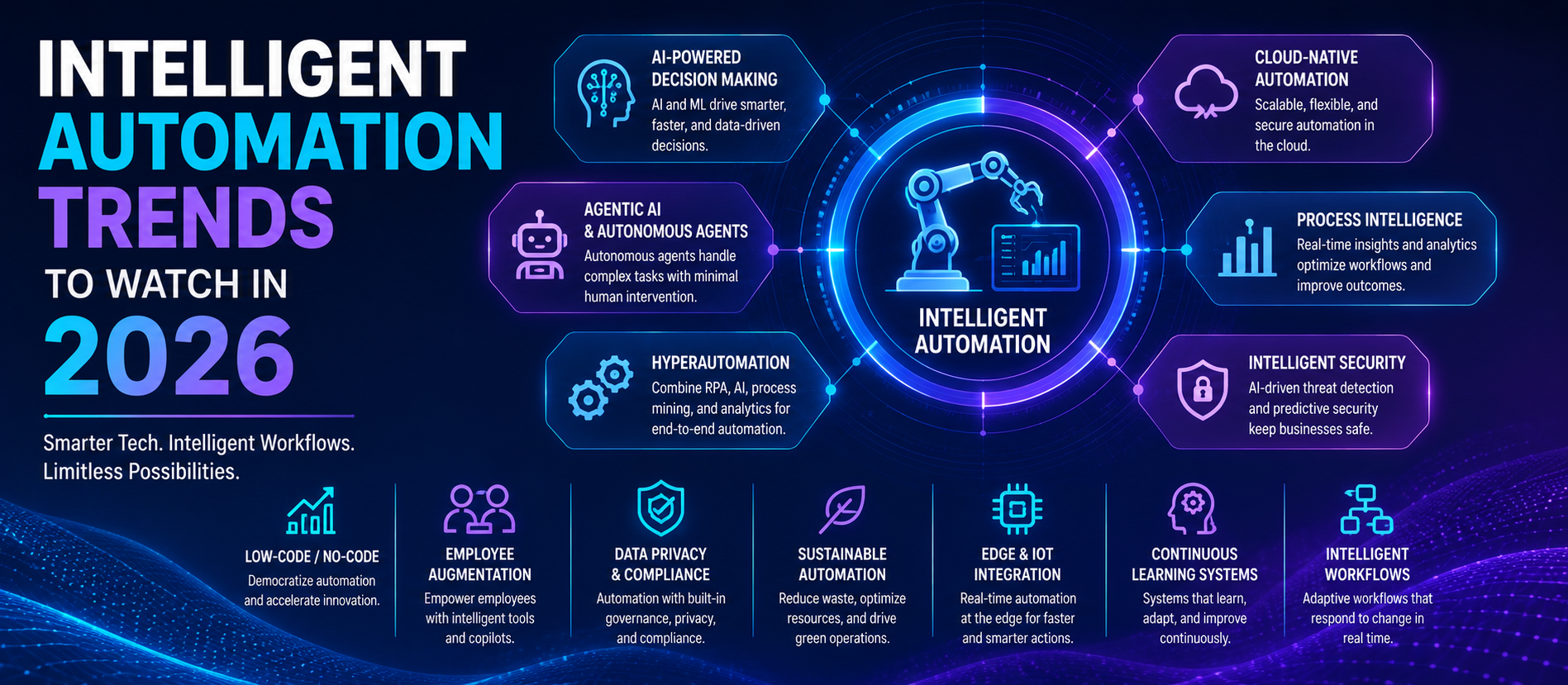
Intelligent Automation (IA) is transforming how businesses operate by combining Artificial Intelligence (AI), Robotic Process Automation (RPA), Machine Learning (ML), Natural Language Processing (NLP), and advanced analytics into unified business workflows. In 2026, organizations are moving beyond simple task automation and embracing intelligent systems that learn, adapt, and continuously improve business performance.
From finance and healthcare to manufacturing, retail, logistics, and customer service, intelligent automation enables businesses to reduce costs, improve productivity, accelerate decision-making, and deliver exceptional customer experiences. As competition increases and digital transformation accelerates, Intelligent Automation has become a strategic investment for organizations seeking long-term growth.
💡 Key Insight
This WordPress-ready guide explores the most important Intelligent Automation trends shaping 2026 while incorporating SEO, AEO, GEO, and AI Search Optimization strategies.
What Is Intelligent Automation?
Intelligent Automation combines AI technologies with workflow automation to automate repetitive, rules-based, and cognitive business processes.
Core Technologies
- Artificial Intelligence (AI)
- Robotic Process Automation (RPA)
- Machine Learning
- Natural Language Processing
- Computer Vision
- Predictive Analytics
Why Intelligent Automation Matters
- Lower operating costs
- Improved efficiency
- Reduced manual work
- Faster decision-making
- Greater accuracy
- Scalable operations
- Better customer experiences
Top Intelligent Automation Trends in 2026
1. Generative AI in Business Workflows
Generative AI is automating content creation, documentation, customer interactions, coding assistance, and knowledge management.
2. Hyperautomation
Businesses are combining RPA, AI, APIs, and workflow orchestration to automate entire business processes instead of isolated tasks.
3. AI-Powered Decision Intelligence
Predictive analytics and AI models provide real-time recommendations for finance, sales, supply chain, and operations.
4. Intelligent Customer Service
AI assistants, voice bots, multilingual chatbots, and sentiment analysis continue improving customer support.
5. Autonomous IT Operations (AIOps)
AI detects infrastructure issues, predicts failures, and automates incident response.
6. Document Intelligence
AI extracts information from invoices, contracts, forms, and business documents with minimal human intervention.
7. Low-Code Automation Platforms
Business users increasingly build automated workflows without extensive programming knowledge.
8. Intelligent Cybersecurity Automation
AI strengthens threat detection, security monitoring, vulnerability management, and compliance reporting.
Business Benefits
- Higher productivity
- Lower error rates
- Continuous process improvement
- Faster service delivery
- Better compliance
- Higher employee satisfaction
Industry Applications
- Finance and Banking
- Healthcare
- Manufacturing
- Retail & eCommerce
- Human Resources
- Logistics & Supply Chain
- Customer Support
SEO, AEO, GEO & AI Search Optimization
SEO
Optimize technical performance, internal linking, structured data, and high-intent automation keywords.
AEO
Create concise, authoritative answers for automation-related questions.
GEO
Optimize content for generative AI search platforms using clear structure and expertise.
AI Search Optimization
Publish trustworthy content with original insights that AI assistants can confidently reference.
Implementation Best Practices
- Identify repetitive workflows
- Prioritize high-impact automation
- Maintain strong data governance
- Monitor KPIs continuously
- Train employees for AI collaboration
- Review security and compliance regularly
Future Outlook
Intelligent Automation will continue evolving through autonomous agents, predictive orchestration, multimodal AI, industry-specific automation platforms, and deeper integration with enterprise software. Organizations that invest today will improve resilience, innovation, and long-term competitiveness.
Conclusion
Intelligent Automation is no longer optional for organizations seeking operational excellence. By combining AI, automation, analytics, and cloud technologies, businesses can streamline operations, reduce costs, improve customer experiences, and accelerate digital transformation.
At Digiifrog, we help businesses grow through SEO, AEO, GEO, AI Search Optimization, AI consulting, digital transformation, automation strategy, and performance-driven marketing solutions.
Website: www.digiifrog.com
Ready to Grow?
Talk to us about a strategy tailored to your brand — we will help you stand out in search, AI discovery and social.
Comments (0)
Log in to leave a comment.