📋 Quick Summary
In this article:
What Is LinkedIn Marketing for B2B Companies?
Why LinkedIn Is Important for B2B Marketing
1. Define Your LinkedIn Marketing Goals
2. Define Your Ideal B2B Audience
Build an Ideal Customer Profile
3. Optimize Your LinkedIn Company Page
4. Optimize Executive and Employee Profiles
5. Build a B2B Content Strategy
Content Pillars for B2B Brands
💡 Key Insight
LinkedIn Marketing has become an important part of modern B2B growth. Unlike many social platforms built primarily around entertainment or consumer discovery, LinkedIn is designed around professional identity, business relationships, industry conversations, expertise, and career development. That makes it especially useful for companies selling software, professional services, consulting, technology, manufacturing, finance, recruitment, cybersecurity, agencies, and other B2B solutions.
However, simply creating a Company Page and posting occasionally is not a complete B2B LinkedIn Marketing strategy. Successful companies use LinkedIn to build awareness, demonstrate expertise, engage decision-makers, generate demand, support sales conversations, distribute valuable content, and strengthen relationships throughout the buyer journey. LinkedIn itself recommends defining audiences and goals, optimizing company pages for search, publishing useful content, using rich media, running targeted campaigns, and measuring performance. citeturn0search1turn0search4
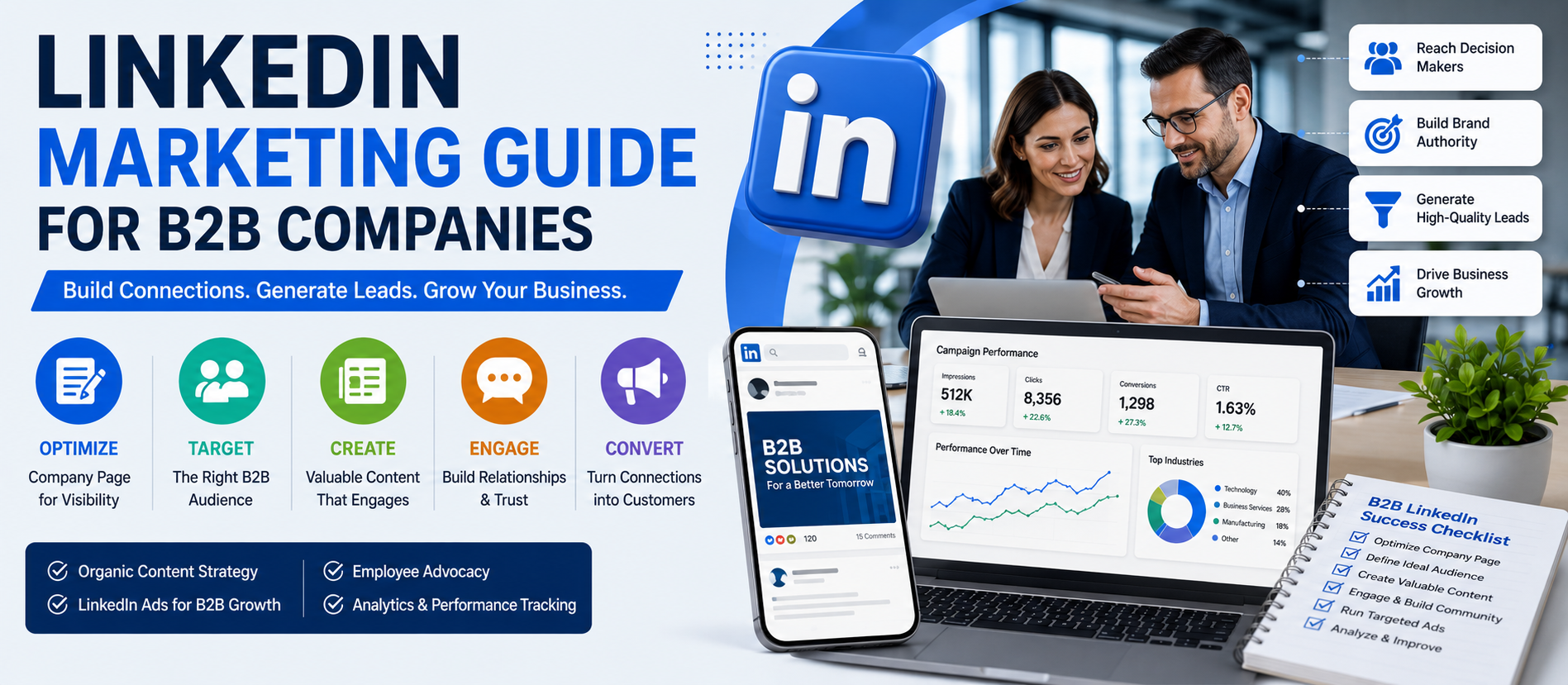
This LinkedIn Marketing Guide for B2B Companies explains how to build a practical strategy covering organic content, executive branding, employee advocacy, lead generation, LinkedIn Ads, audience targeting, content formats, analytics, SEO, AEO, GEO, and AI Search Optimization.
Company: Designfo
Website: www.designfo.in
Contact: +91 9831037463
What Is LinkedIn Marketing for B2B Companies?
LinkedIn Marketing is the use of LinkedIn's organic publishing, professional networking, company pages, personal profiles, advertising, events, analytics, and content tools to achieve business objectives.
For B2B organizations, the platform can support several stages of the customer journey:
- Brand awareness
- Thought leadership
- Demand generation
- Lead generation
- Account engagement
- Sales enablement
- Customer retention
- Talent and employer branding
Because B2B purchases often involve multiple stakeholders and longer decision cycles, LinkedIn works best when marketing is treated as a continuous relationship-building process rather than a collection of promotional posts. LinkedIn's own B2B marketing guidance highlights the importance of education, relationship-building, consensus across buying groups, and content that supports different stages of the buyer journey. citeturn0search0
Why LinkedIn Is Important for B2B Marketing
B2B buyers spend considerable time researching suppliers, technologies, services, and industry trends before speaking with sales teams. This creates a major opportunity for companies to become useful sources of information before a formal sales conversation begins.
LinkedIn can help businesses:
- Reach professional audiences.
- Build credibility in a specific industry.
- Showcase expertise through thought leadership.
- Distribute educational content.
- Generate and nurture leads.
- Support account-based marketing.
- Promote webinars and events.
- Connect marketing and sales activity.
LinkedIn's current B2B resources emphasize a combination of audience understanding, content, distribution, measurement, and professional relevance rather than relying on a single tactic. citeturn0search3turn0search5
1. Define Your LinkedIn Marketing Goals
Before creating posts or launching ads, decide what LinkedIn should accomplish for your business. A company focused on awareness will need a different strategy from a company focused on generating sales-qualified leads.
Common B2B LinkedIn Goals
- Increase brand awareness.
- Build category authority.
- Generate qualified leads.
- Drive traffic to high-value content.
- Promote webinars and events.
- Support sales prospecting.
- Increase engagement with target accounts.
- Strengthen customer relationships.
⚠ Watch Out
Choose a small number of primary goals and connect each one to measurable outcomes. Avoid using follower growth as the only definition of success.
2. Define Your Ideal B2B Audience
Effective LinkedIn Marketing for B2B Companies starts with audience clarity. Identify the companies you want to reach and the people involved in purchasing decisions.
Build an Ideal Customer Profile
- Industry
- Company size
- Location
- Revenue range
- Technology environment
- Business problem
- Buying triggers
- Budget level
Map the Buying Committee
Many B2B purchases involve multiple people. A technology purchase might involve a CEO, department head, technical evaluator, procurement team, finance stakeholder, and end users.
Create content for different roles instead of assuming one message will appeal equally to everyone.
3. Optimize Your LinkedIn Company Page
Your Company Page is often one of the first places prospects visit after discovering your brand. Make it clear, professional, and useful.
LinkedIn recommends keeping company information current and using relevant keywords and phrases in the About section so potential customers can understand what the organization offers and find it through search. citeturn0search1
Important Page Elements
- Professional company logo
- Clear cover image
- Specific company description
- Primary products or services
- Industry information
- Website URL
- Location information
- Relevant keywords
- Strong call to action
Write the About section for potential customers rather than filling it with generic corporate language.
4. Optimize Executive and Employee Profiles
B2B buyers do business with people, not just company logos. Executive profiles, founders, sales leaders, consultants, and subject-matter experts can therefore play a major role in building trust.
Encourage relevant team members to maintain professional profiles with:
- Clear professional headlines
- Relevant skills
- Current experience
- Useful profile summaries
- Evidence of expertise
- Case studies or achievements
- Links to relevant company resources
LinkedIn itself notes that profiles matter because people do business with people and recommends continually refining professional profiles. citeturn0search1
5. Build a B2B Content Strategy
Content should answer the questions your target buyers have before, during, and after the purchasing process. The strongest B2B content does not constantly promote a product. It helps the audience understand a problem and make a better decision.
Content Pillars for B2B Brands
- Industry insights
- Educational guides
- Customer problems
- Case studies
- Original research
- Expert opinions
- Product education
- Behind-the-scenes expertise
- Customer success stories
- Industry trends
LinkedIn recommends thought leadership and fresh ideas over overly sales-focused content, and encourages businesses to share useful material from both their own organization and other relevant sources. citeturn0search1
6. Use Multiple LinkedIn Content Formats
Different formats serve different purposes. Do not build your entire strategy around text posts.
- Short text posts
- Document or PDF posts
- Single-image posts
- Carousels
- Native video
- Polls
- Case studies
- Event promotions
- Newsletter content
LinkedIn's marketing guidance recommends experimenting with rich media and notes that visual content can increase engagement. citeturn0search1
7. Create Thought Leadership That Builds Trust
B2B thought leadership should provide a perspective, not simply repeat industry headlines. A useful thought-leadership post might explain why a common strategy fails, identify an emerging market shift, share a lesson from a project, or challenge a widely accepted assumption.
A Simple Thought Leadership Framework
- Identify a problem or industry observation.
- State your perspective clearly.
- Explain why the issue matters.
- Support the argument with evidence or experience.
- Provide practical recommendations.
- Invite professional discussion.
Strong thought leadership can help a company become associated with a specific problem, category, or point of view.
8. Use Employee Advocacy Strategically
Employees can extend the reach of company content because professional relationships often feel more personal than corporate broadcasts. Instead of forcing employees to copy and paste identical company posts, provide useful source material and encourage authentic commentary.
Employee advocacy works best when participants add their own experiences, observations, and professional perspectives.
9. Build a Consistent LinkedIn Posting System
Consistency matters more than publishing large quantities for a short period. Create a manageable editorial calendar.
Example Weekly Schedule
- Monday: Industry insight or trend.
- Tuesday: Educational tip or short guide.
- Wednesday: Customer story or case study.
- Thursday: Executive thought leadership.
- Friday: Industry discussion, poll, or behind-the-scenes content.
Adjust frequency based on your team's capacity and audience response. Quality should remain the priority.
10. Focus on Engagement, Not Just Publishing
Publishing is only one part of LinkedIn Marketing. Engage with relevant conversations, respond to comments, participate in industry discussions, and interact with prospects without immediately turning every interaction into a sales pitch.
Useful engagement can create relationships long before someone submits a lead form.
11. Use LinkedIn for Lead Generation
LinkedIn lead generation works best when the offer is valuable enough to justify an exchange of contact information. Instead of promoting a generic "Contact Us" message, offer a useful resource or next step.
Lead Magnet Examples
- Industry report
- Benchmark study
- Free checklist
- Audit
- Template
- Webinar
- Case study
- Strategy consultation
LinkedIn provides professional targeting filters and analytics that can support lead-generation programs. citeturn0search10
12. Use LinkedIn Ads for Targeted B2B Growth
Organic content builds relationships, while paid campaigns can accelerate reach among specific professional audiences. LinkedIn Campaign Manager supports campaign objectives, targeting, budgets, timelines, and conversion measurement. citeturn0search1turn0search8
Potential targeting criteria can include:
- Job titles
- Job functions
- Seniority
- Company size
- Industry
- Location
- Skills
- Company characteristics
Choose targeting based on your actual ideal customer profile rather than trying to reach everyone.
13. Create Full-Funnel LinkedIn Campaigns
A B2B buyer may need multiple interactions before becoming a customer. Your LinkedIn strategy should therefore support awareness, consideration, conversion, and retention.
Awareness
Use educational content, videos, industry insights, and thought leadership.
Consideration
Promote case studies, product education, comparison content, webinars, and research.
Conversion
Use demos, consultations, trials, lead forms, and strong commercial offers.
Retention
Share customer education, product updates, industry resources, and community content.
LinkedIn describes the B2B funnel in terms of stages such as awareness, interest, consideration, conversion, and loyalty. citeturn0search0
14. Use Account-Based Marketing on LinkedIn
LinkedIn Account-Based Marketing (ABM) can be useful for companies selling high-value solutions to a defined group of organizations.
Start with a list of target companies and identify the roles involved in their buying process. Then create content and advertising that addresses the business challenges of those accounts.
ABM works best when marketing and sales coordinate their messages, account priorities, outreach, and follow-up.
15. Use LinkedIn Analytics to Improve Performance
Analytics should tell you which topics, formats, audiences, and campaigns create meaningful business outcomes.
Important Metrics
- Impressions
- Reach
- Engagement rate
- Follower growth
- Video views
- Click-through rate
- Lead volume
- Lead quality
- Cost per lead
- Conversion rate
- Pipeline influenced
- Revenue generated
LinkedIn provides Page analytics and Campaign Manager reporting to help marketers monitor performance and optimize campaigns. citeturn0search1
16. Integrate LinkedIn with Your Website and CRM
LinkedIn should not operate as an isolated marketing channel. Connect campaigns with landing pages, analytics, CRM systems, email nurturing, and sales workflows where appropriate.
A useful B2B journey might look like:
- Prospect sees LinkedIn content.
- Prospect visits a website resource.
- Prospect downloads a guide.
- Lead enters the CRM.
- Marketing automation sends relevant follow-up.
- Sales receives a qualified lead.
- Sales and marketing measure the final outcome.
17. Optimize LinkedIn Content for SEO, AEO, GEO, and AI Search
LinkedIn content can support a broader digital visibility strategy. Businesses should use clear terminology and consistent brand information so their expertise is understandable across search engines and AI-powered discovery systems.
SEO focuses on discoverability in search engines. AEO focuses on answering questions clearly. GEO focuses on visibility in generative search experiences. AI Search Optimization emphasizes clear entities, useful content, authority, context, and trustworthy information.
Optimization Tips
- Use clear topic language.
- Answer customer questions directly.
- Publish original insights.
- Use consistent company descriptions.
- Link to useful website resources.
- Build topical authority over time.
- Support claims with credible information.
LinkedIn's B2B resources now explicitly include generative engines and AI among B2B marketing channels, reinforcing the importance of integrating professional content with broader search and discovery strategies. citeturn0search0
18. Avoid Common LinkedIn Marketing Mistakes
- Posting only promotional content.
- Using generic corporate language.
- Ignoring comments and conversations.
- Targeting an audience that is too broad.
- Publishing without a clear objective.
- Measuring followers instead of revenue impact.
- Creating repetitive AI-generated posts.
- Using employee advocacy as forced copy-and-paste activity.
- Sending aggressive sales messages to cold prospects.
- Failing to connect marketing activity with CRM outcomes.
19. Build a 90-Day LinkedIn Marketing Plan
Days 1–30: Foundation
- Define ICP and buyer personas.
- Optimize the Company Page.
- Improve executive profiles.
- Set measurable marketing goals.
- Create content pillars.
- Install appropriate tracking and analytics.
Days 31–60: Content and Engagement
- Publish consistently.
- Test multiple content formats.
- Develop executive thought leadership.
- Encourage authentic employee participation.
- Engage with relevant industry conversations.
- Identify high-performing topics.
Days 61–90: Lead Generation and Optimization
- Launch targeted paid campaigns where appropriate.
- Promote strong lead magnets.
- Test different audience segments.
- Improve landing pages.
- Connect leads with CRM workflows.
- Measure qualified leads and pipeline.
How Designfo Helps B2B Companies with LinkedIn Marketing
Designfo helps B2B companies create integrated digital growth strategies that combine LinkedIn Marketing, content marketing, SEO, AEO, GEO, AI Search Optimization, paid advertising, marketing automation, website development, and conversion optimization.
Our approach focuses on connecting visibility with measurable business outcomes. Instead of treating LinkedIn as a place to post company updates, we can position it as part of a broader demand-generation and customer-acquisition system.
Designfo Digital Growth Services
- LinkedIn Marketing
- B2B Lead Generation
- LinkedIn Ads Management
- Content Marketing
- Executive Thought Leadership
- SEO and Technical SEO
- AEO and GEO Strategy
- AI Search Optimization
- Marketing Automation
- Conversion Rate Optimization
Frequently Asked Questions
Why is LinkedIn important for B2B companies?
LinkedIn provides a professional environment where businesses can reach decision-makers, publish expertise, build relationships, generate demand, and run targeted advertising campaigns.
How often should a B2B company post on LinkedIn?
There is no universal posting frequency. A sustainable schedule is better than publishing large amounts of low-quality content. Start with a manageable schedule and optimize based on audience engagement and business results.
What type of content works best for B2B LinkedIn Marketing?
Educational guides, original insights, case studies, research, expert opinions, customer stories, videos, and practical industry content can all support B2B marketing when they are relevant to the target audience.
Should B2B companies use LinkedIn Ads?
Paid advertising can be useful when a company has a clearly defined audience, compelling offer, appropriate budget, and reliable measurement. Organic content and paid campaigns can work together rather than being treated as separate strategies.
How can LinkedIn generate leads?
Companies can generate leads through valuable content, lead magnets, webinars, targeted advertising, professional networking, landing pages, and structured follow-up processes.
How does LinkedIn support AI Search Optimization?
LinkedIn can contribute to a company's broader digital authority by publishing consistent expert content, strengthening professional entity information, sharing original insights, and creating credible references that support brand visibility across modern search experiences.
Conclusion
LinkedIn Marketing for B2B Companies is most effective when it is treated as a long-term business growth channel rather than simply a social media posting activity. The strongest strategies combine clear positioning, audience research, useful content, executive expertise, employee participation, targeted advertising, lead nurturing, analytics, and sales alignment.
Start with a clear ideal customer profile and measurable goals. Build a strong Company Page and professional profiles. Publish content that educates rather than constantly sells. Use LinkedIn Ads when targeted reach can accelerate your objectives. Connect leads with your CRM and marketing automation systems, and measure the impact on qualified opportunities and revenue.
Finally, integrate LinkedIn with SEO, AEO, GEO, and AI Search Optimization so your expertise can contribute to a wider digital presence. B2B buyers increasingly research companies across multiple channels, and brands that consistently provide useful, trustworthy information can build stronger visibility before a sales conversation ever begins.
Company: Designfo
Website: www.designfo.in
Contact: +91 9831037463
Ready to Grow?
Talk to us about a strategy tailored to your brand — we will help you stand out in search, AI discovery and social.

Comments (0)
Log in to leave a comment.