📋 Quick Summary
In this article:
Why Luxury Real Estate Photography Matters
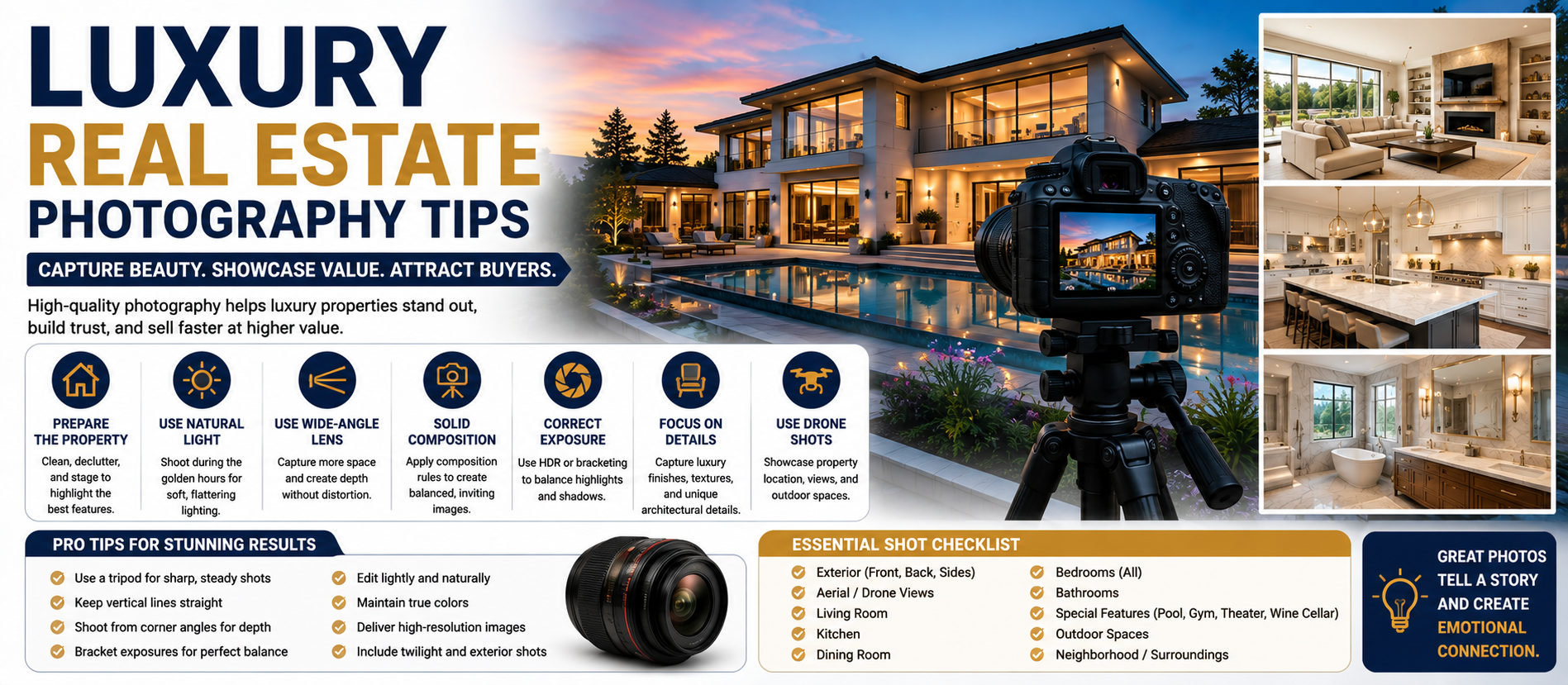
1. Prepare the Property Before the Shoot
2. Stage Each Room With a Purpose
3. Start With a Strong Exterior Hero Image
4. Photograph at the Right Time of Day
5. Use Natural Light Strategically
6. Use a Wide-Angle Lens Carefully
7. Keep Vertical Lines Straight
8. Show Architectural Details
9. Photograph Kitchens Like Design Spaces
10. Make Bathrooms Look Clean and Spacious
11. Capture Outdoor Living Areas
💡 Key Insight
Luxury real estate photography is one of the most important marketing tools for high-end properties. Buyers of premium homes expect more than ordinary listing photos. They want images that communicate architecture, design, space, materials, views, lifestyle, and the overall character of the property. Strong photography can help a luxury listing make a powerful first impression across property websites, search results, social media, brochures, email campaigns, and digital advertising.
Luxury photography is not simply about using an expensive camera. The quality of the final presentation depends on preparation, composition, lighting, exposure, color accuracy, lens selection, styling, editing, image sequencing, and the photographer's ability to show the property honestly. A technically impressive image can still be ineffective if it makes rooms look distorted or hides important details.
Google's current image-search guidance emphasizes discoverable image files, relevant surrounding page content, descriptive filenames and alt text, responsive delivery, high quality, and fast loading. These principles are especially useful for real estate websites where photography is central to the user's decision-making process. citeturn0search0turn0search2
This guide explains how real estate agents, brokers, photographers, builders, developers, and luxury property marketers can create a professional photography strategy that improves presentation while supporting SEO, AEO, GEO, and AI Search visibility.
This WordPress-ready HTML article is prepared for Digiifrog (www.digiifrog.com).
Why Luxury Real Estate Photography Matters
Luxury buyers often begin their property search online. Before scheduling a private viewing, they may examine dozens of photographs to understand the architecture, floor plan, finishes, outdoor spaces, neighborhood setting, and overall quality.
Professional images help a property communicate its strongest characteristics quickly. Good photography can also create consistency across listing portals, social media, websites, brochures, and digital campaigns.
The goal is not to make a property look artificially perfect. The goal is to present the property at its best while maintaining an accurate representation of what a buyer can expect to see in person.
1. Prepare the Property Before the Shoot
The camera cannot fix every preparation problem. Before photography begins, remove clutter, organize furniture, clean reflective surfaces, hide unnecessary cables, straighten curtains, arrange decorative objects, and complete obvious maintenance.
Luxury properties often contain many visual details. Too many accessories can make an expensive room look crowded. A controlled, minimalist presentation usually allows architecture and materials to become the focus.
2. Stage Each Room With a Purpose
Every room should communicate its intended use. Arrange living rooms to emphasize conversation and space, bedrooms to communicate comfort, offices to demonstrate functionality, and dining areas to show scale.
Do not over-stage the property. Luxury photography should feel sophisticated and natural rather than like a showroom filled with unnecessary decorations.
3. Start With a Strong Exterior Hero Image
The exterior image often becomes the first visual representation of a luxury property. Choose an angle that communicates architecture, landscaping, entrance design, and the relationship between the building and its surroundings.
⚠ Watch Out
Shoot from a position that provides depth. Avoid angles that make the building appear flat unless a deliberately symmetrical architectural composition is appropriate.
4. Photograph at the Right Time of Day
Timing can dramatically change the appearance of a property. Daylight photography can communicate brightness and architectural detail, while twilight photography can highlight exterior lighting, pools, landscaping, and indoor warmth.
For premium listings, consider a combination of daytime and twilight images when the property has meaningful features that benefit from both lighting conditions.
5. Use Natural Light Strategically
Natural light can create depth and atmosphere, especially in luxury interiors with large windows. Observe how sunlight enters each room and plan the shooting sequence around the strongest light.
Avoid allowing bright windows to become completely white while the interior becomes too dark. Balanced exposure is generally more useful than extreme contrast.
6. Use a Wide-Angle Lens Carefully
Wide-angle lenses can help show room relationships and make small spaces easier to understand. However, excessive wide-angle distortion can make walls, furniture, and architectural features appear unnatural.
Luxury photography should communicate scale accurately. Use the widest practical focal length rather than automatically choosing the widest lens available.
7. Keep Vertical Lines Straight
Architectural photography benefits from controlled vertical lines. Tilted cameras can make walls and door frames converge, creating an amateur appearance.
Use a level camera, appropriate lens positioning, and post-processing correction when necessary. Straight architectural lines are especially important in modern luxury properties with strong geometric designs.
8. Show Architectural Details
Luxury homes often contain details that justify their positioning in the premium market. Photograph custom millwork, stone surfaces, fireplaces, staircases, designer lighting, built-in cabinetry, specialty ceilings, premium appliances, and architectural features.
Do not fill the listing with dozens of nearly identical detail shots. Select details that help explain the property's quality and design story.
9. Photograph Kitchens Like Design Spaces
A luxury kitchen can be one of the strongest selling features. Show cabinetry, countertops, islands, appliances, lighting, storage, and the relationship between the kitchen and adjacent living spaces.
Remove excessive countertop items before the shoot. A clean surface allows materials and craftsmanship to become more visible.
10. Make Bathrooms Look Clean and Spacious
Bathrooms should be photographed with careful attention to reflections, lighting, towels, mirrors, glass surfaces, and fixtures. Hide personal products and keep counters visually simple.
Highlight premium materials such as natural stone, custom vanities, soaking tubs, large showers, heated floors, or specialized fixtures when they are genuine property features.
11. Capture Outdoor Living Areas
Luxury buyers often value outdoor living. Photograph terraces, patios, balconies, pools, gardens, outdoor kitchens, fireplaces, seating areas, views, and landscaping.
Outdoor images should show how the space can be used rather than simply documenting its existence. A well-composed image can communicate the lifestyle associated with the property.
12. Show the View When the View Is a Feature
If a property has a city skyline, ocean, mountain, lake, golf course, or architectural view, make it part of the photography strategy. Use compositions that connect the interior with the view rather than treating the view as an unrelated picture.
Be careful with exposure. A bright exterior view through a window can be difficult to balance with an indoor space, so professional exposure techniques may be required.
13. Use a Tripod When Appropriate
A tripod can improve consistency, framing, and low-light sharpness. It can also make multiple exposures from the same camera position easier to combine during post-processing.
For luxury interiors, a stable camera can help create clean, deliberate compositions instead of rushed handheld images.
14. Use Bracketing Responsibly
High-contrast interiors may require exposure bracketing so that bright windows and darker interior areas can both retain useful detail. Multiple exposures can then be blended carefully during editing.
The objective should be a natural result. Excessive HDR processing can create halos, unnatural colors, harsh textures, and an artificial appearance.
15. Keep Colors Accurate
Color accuracy matters because buyers need to understand what materials actually look like. White walls should not appear blue or yellow, wood should retain believable tones, and landscape colors should not become excessively saturated.
Google's image-quality guidance emphasizes authenticity, sharpness, correct exposure, balanced color, and avoiding dramatic filters that make imagery look artificial. citeturn0search4
16. Edit for Polish, Not Deception
Post-processing can correct exposure, white balance, minor distractions, perspective, dust spots, and other normal photographic issues. However, editing should not materially misrepresent the property.
Do not digitally add permanent features, enlarge rooms unrealistically, remove major defects without disclosure, or create views that do not exist. Accurate photography builds trust and reduces disappointment during property visits.
17. Use Twilight Photography Strategically
Twilight images can be highly effective for luxury homes with architectural lighting, pools, landscaping, balconies, outdoor entertainment areas, and dramatic entrances.
Turn on appropriate interior and exterior lights, balance the exposure, and capture the transition between daylight and evening. The image should still look like the actual property rather than a heavily manipulated fantasy scene.
18. Photograph Amenities Separately
If the property includes a gym, wine cellar, home theater, spa, library, game room, guest suite, elevator, smart-home system, or sports facility, photograph these features clearly.
Important amenities should be easy to find in the photo sequence. This helps buyers understand why the property differs from comparable listings.
19. Use Drone Photography Where Appropriate
Aerial photography can show lot size, landscaping, waterfront access, surrounding development, views, nearby amenities, and the relationship between the property and its environment.
Drone operations must follow applicable aviation rules and property/privacy requirements. The photographer should also consider whether aerial imagery genuinely adds information rather than simply adding another attractive picture.
20. Consider Floor Plans and Photography Together
Photography shows appearance, while floor plans help buyers understand spatial relationships. Combining both can make an online listing easier to evaluate.
Use photography to create visual interest and the floor plan to provide structural context. This is particularly useful for large luxury homes where room relationships may be difficult to understand from photographs alone.
21. Create a Logical Photo Sequence
The order of images matters. Begin with the strongest exterior or hero image, then move through major living spaces, kitchen, bedrooms, bathrooms, amenities, outdoor areas, and supporting details.
A logical sequence creates a virtual walkthrough and reduces confusion for online viewers.
22. Optimize Images for Real Estate Websites
High-quality images should not create unnecessarily slow pages. Google recommends using high-quality images while applying optimization and responsive-image techniques so pages remain fast and usable. citeturn0search0
Use appropriate formats, responsive image sizes, compression that preserves visual quality, and properly configured image dimensions. Large original camera files should not automatically be uploaded directly to a public website.
23. Use Descriptive Image Filenames
Instead of generic names such as IMG0001.jpg, use concise descriptive filenames that reflect the image content, such as luxury-modern-kitchen.jpg or waterfront-home-exterior.jpg.
Google recommends descriptive filenames because they provide useful context about image subject matter. citeturn0search0
24. Write Useful Alt Text
Alt text should describe the image accurately and naturally. For example, “Modern luxury kitchen with marble island and custom cabinetry” is more useful than “luxury real estate photography luxury home kitchen best house.”
Google recommends concise, descriptive alt text and warns against keyword stuffing. Good alt text also improves accessibility for people using screen readers. citeturn0search0turn0search3
25. Build SEO-Friendly Property Image Pages
Images should appear near relevant text. A property page can include the home's location, property type, major features, room descriptions, neighborhood information, and relevant specifications.
Google notes that the text surrounding an image helps provide context about what the image represents. citeturn0search2
26. Use Structured Data and Social Metadata
For suitable pages, structured data can help search engines understand important page and image relationships. Google also documents the use of preferred images through properties such as primaryImageOfPage and image metadata.
Open Graph image metadata can also help control which image is used when a property page is shared on supported platforms. citeturn0search0
27. Create a Luxury Property Photography Shot List
- Front exterior and architectural hero image
- Rear exterior
- Entry and foyer
- Main living room
- Dining area
- Kitchen and island
- Primary bedroom
- Primary bathroom
- Additional bedrooms
- Office or library
- Fireplace and architectural details
- Outdoor living areas
- Pool and landscaping
- Views and surrounding environment
- Garage and parking
- Special amenities
- Twilight hero image
- Drone views when useful
28. Common Luxury Real Estate Photography Mistakes
- Photographing before cleaning and staging.
- Using excessive wide-angle distortion.
- Tilting the camera and creating crooked verticals.
- Overusing HDR effects.
- Using inaccurate colors.
- Making rooms look unrealistically large.
- Ignoring outdoor spaces.
- Uploading huge unoptimized image files.
- Using generic image filenames.
- Leaving alt text blank on meaningful images.
- Keyword-stuffing image metadata.
- Using AI edits that materially misrepresent the property.
29. Luxury Photography and AI Search Optimization
AI Search optimization works best when property information is clear, factual, structured, and consistent. Image optimization should therefore work together with the surrounding page content.
Use descriptive headings, accurate property facts, clear room descriptions, location information, structured data where appropriate, and concise answers to common buyer questions. This creates a stronger information environment for traditional search engines and AI-powered discovery systems.
30. AEO and GEO for Luxury Real Estate Photography
Answer Engine Optimization (AEO) focuses on directly answering questions such as “What should luxury real estate photos include?” or “How do professional photographers photograph luxury homes?”
Generative Engine Optimization (GEO) can be supported by publishing detailed, location-specific, trustworthy content that explains property features and photography practices. Real estate businesses can create pages around cities, neighborhoods, property types, architectural styles, and buyer questions.
31. Use Photography as Part of a Complete Marketing Funnel
Photography should not exist separately from the rest of the marketing system. High-quality images can attract attention, support property pages, improve social content, strengthen brochures, and support email campaigns.
The broader funnel can move prospects from image discovery to property-page engagement, inquiry, private showing, consultation, and eventually transaction.
32. How Sellers Can Prepare for Luxury Photography
- Complete deep cleaning before the shoot.
- Remove unnecessary personal items.
- Organize closets and storage areas.
- Clean windows and reflective surfaces.
- Hide cables, bins, and distracting objects.
- Arrange furniture for clear sightlines.
- Refresh landscaping and outdoor areas.
- Replace burned-out lights.
- Complete small visible repairs.
- Discuss pets and vehicles with the photographer.
Frequently Asked Questions About Luxury Real Estate Photography
What makes luxury real estate photography different?
Luxury photography focuses heavily on architecture, design, materials, lifestyle, views, composition, lighting, and presentation. The goal is to communicate the property's character rather than simply document each room.
What camera lens is best for luxury real estate photography?
A moderate wide-angle lens is commonly useful for interiors, while longer focal lengths can help isolate architectural details and exterior features. The best choice depends on room size, architecture, and the desired composition.
Should luxury properties have twilight photos?
Twilight photography can be valuable when a property has strong exterior lighting, pools, landscaping, outdoor living areas, or dramatic architecture. It is most effective when it adds information rather than simply changing the mood.
Does professional photography help sell luxury homes?
Professional photography can improve online presentation and buyer engagement, but no photography method guarantees a sale. Pricing, location, property condition, market conditions, marketing reach, and buyer demand remain important.
How should luxury property images be optimized for Google?
Use crawlable image elements, descriptive filenames, concise alt text, relevant surrounding page content, responsive images, appropriate compression, and structured data where applicable. Google specifically recommends these practices for image discovery and search visibility. citeturn0search0turn0search2
Conclusion
Luxury real estate photography should make a premium property look exceptional without making it look unreal. The strongest results come from careful preparation, thoughtful composition, balanced lighting, accurate color, controlled perspective, professional editing, and a logical image sequence.
Photography also needs to work beyond the listing portal. Optimized filenames, useful alt text, fast-loading responsive images, relevant surrounding content, and structured data can help search engines understand and discover property imagery. citeturn0search0turn0search2
For real estate agencies, luxury brokers, developers, builders, photographers, and property marketing companies seeking modern websites, automated lead generation, content systems, SEO, AEO, GEO, and AI Search optimization, Digiifrog can help. Visit www.digiifrog.com.
Quick Answer: What Are the Best Luxury Real Estate Photography Tips?
The best luxury real estate photography tips are to prepare and stage the property carefully, use balanced natural and artificial light, keep architectural lines straight, choose wide-angle lenses carefully, capture premium details and outdoor spaces, use twilight and drone photography when appropriate, edit naturally, optimize image files for speed, use descriptive filenames and alt text, and connect every image with relevant property-page content.
Important Note
Real estate photography should accurately represent the property. Avoid deceptive editing, fabricated features, misleading views, or digital alterations that could create incorrect buyer expectations. Photography, advertising, disclosure, privacy, drone, and fair-housing requirements may vary by jurisdiction. Consult appropriate professionals when necessary.
Ready to Grow?
Talk to us about a strategy tailored to your brand — we will help you stand out in search, AI discovery and social.


Comments (0)
Log in to leave a comment.