📋 Quick Summary
In this article:
How Occupational Therapy Fits Into Rehabilitation
Who Can Benefit From Occupational Therapy?
What Does an Occupational Therapist Do?
Activities of Daily Living and Occupational Therapy
Occupational Therapy After Stroke
Occupational Therapy After an Injury or Surgery
Occupational Therapy for Older Adults
Occupational Therapy and Cognitive Rehabilitation
Adaptive Equipment and Environmental Changes
Introduction
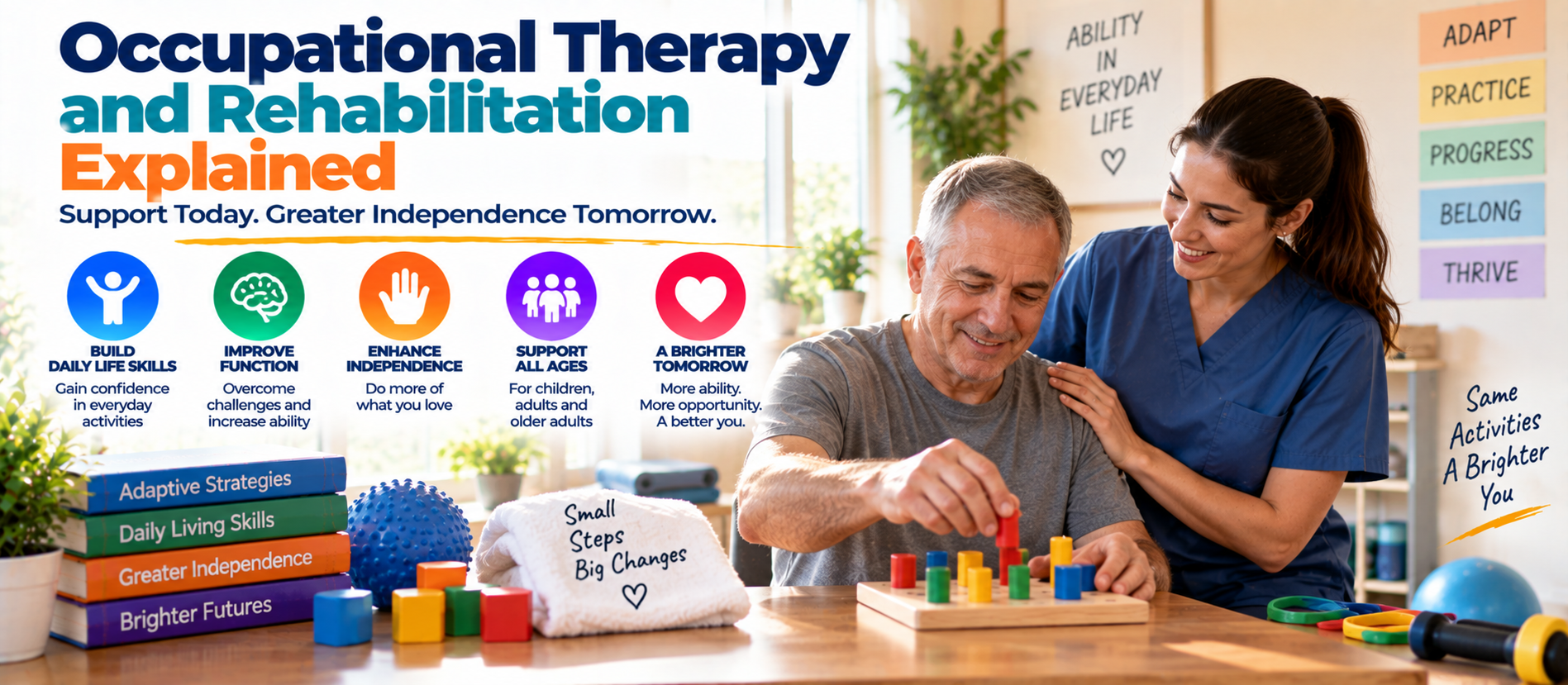
Occupational therapy and rehabilitation help people return to meaningful daily activities after an injury, illness, surgery, disability, or major life change. The goal is not simply to improve a body part. The goal is to help a person function better in real life.
Occupational therapy, often called OT, focuses on the activities people need and want to do. These may include dressing, bathing, eating, cooking, working, studying, managing a home, caring for family, using technology, or taking part in hobbies. Occupational therapists create treatment plans around the person's goals, abilities, environment, and daily routine. The American Occupational Therapy Association describes OT as the therapeutic use of everyday activities to improve participation in life.
Rehabilitation is broader. The World Health Organization defines rehabilitation as a set of interventions designed to optimize functioning and reduce disability while considering the person's environment. It can involve occupational therapists, physical therapists, speech and language professionals, psychologists, rehabilitation doctors, nurses, and other specialists.
What Is Occupational Therapy?
Occupational therapy is a person-centered health service. Here, the word “occupation” does not mean only a job. It means meaningful activities that fill a person's day.
💡 Key Insight
For one person, an important occupation may be preparing breakfast. For another, it may be returning to work, going back to school, playing with a child, writing, driving, or living safely at home.
An occupational therapist first learns what the person wants to achieve. The therapist then looks at the physical, cognitive, emotional, sensory, social, and environmental factors that may make those activities difficult. Treatment is designed around practical goals rather than a one-size-fits-all routine.
What Is Rehabilitation?
Rehabilitation helps a person regain, maintain, or improve function. It can be needed after a stroke, brain injury, fracture, surgery, neurological condition, chronic illness, burn, disability, or other health problem. Rehabilitation can also help people manage long-term limitations and remain independent.
WHO notes that rehabilitation can improve independence in everyday activities and participation in education, work, recreation, and family roles. It can be provided in hospitals, outpatient clinics, homes, schools, workplaces, and community settings.
Occupational therapy is one important part of this larger rehabilitation process.
How Occupational Therapy Fits Into Rehabilitation
OT connects physical recovery with everyday life. A person may regain enough strength to move an arm but still struggle to button a shirt. Someone may walk after a stroke but have difficulty preparing a meal safely. Another person may have good physical movement but experience memory, attention, or planning problems.
Occupational therapy addresses these functional challenges. The therapist may train a skill, change the way a task is performed, recommend adaptive equipment, modify the home, teach energy-saving methods, or help the person build safer routines.
This approach makes rehabilitation more practical. Instead of asking only, “Can you move your hand?” OT may ask, “Can you use that hand to make your morning meal safely?”
Who Can Benefit From Occupational Therapy?
People of many ages and with many different conditions can benefit from OT. Common groups include:
- People recovering from stroke or brain injury.
- People recovering from fractures, surgery, burns, or other injuries.
- People living with neurological conditions.
- Older adults who want to remain independent at home.
- Children who need help with school, play, motor skills, or daily routines.
- People with developmental or physical disabilities.
- People with cognitive or sensory difficulties.
- People returning to work after illness or injury.
- People who need help adapting to a chronic health condition.
OT is not limited to one age group or one diagnosis. AOTA notes that occupational therapy services can be provided across the lifespan and in homes, schools, hospitals, outpatient clinics, nursing facilities, workplaces, and community settings.
What Does an Occupational Therapist Do?
The process usually starts with an evaluation. The therapist discusses the person's medical history, daily routine, concerns, goals, and important activities. The therapist may observe how the person performs specific tasks and assess movement, coordination, sensation, cognition, communication, safety, or environmental barriers.
A treatment plan is then created. It may include:
- Practice of daily living activities.
- Fine-motor and coordination activities.
- Strength, movement, or endurance activities when appropriate.
- Cognitive strategies for memory, attention, planning, and problem solving.
- Energy conservation and fatigue-management techniques.
- Adaptive equipment recommendations.
- Home safety and accessibility changes.
- Work or school task modification.
- Caregiver and family education.
- Strategies for safer and more independent routines.
The therapist reviews progress and changes the plan when needed. AOTA describes evaluation, individualized intervention planning, and outcome evaluation as key parts of OT services.
Activities of Daily Living and Occupational Therapy
Activities of daily living, or ADLs, are central to rehabilitation. They include tasks such as bathing, dressing, eating, grooming, toileting, and moving between surfaces.
Instrumental activities of daily living, or IADLs, are more complex tasks needed for independent living. They can include cooking, shopping, managing medications, handling money, using communication devices, cleaning, transportation, and other household responsibilities.
OT can help a person regain these abilities, find safer ways to complete them, or use adaptive tools when full recovery is not possible. Research has found that tailored occupational therapy approaches can support daily activity performance, especially when interventions address the person's home environment and individual needs.
Occupational Therapy After Stroke
Stroke can affect movement, balance, sensation, vision, communication, memory, attention, and problem solving. OT may address dressing, bathing, arm use, coordination, cognitive challenges, home safety, and other practical activities. The exact program depends on the person's symptoms and goals.
Occupational Therapy After an Injury or Surgery
After an injury or surgery, people may have pain, weakness, stiffness, reduced coordination, or difficulty using an affected body part. OT can help with daily tasks such as dressing, typing, cooking, grip, and job activities while following medical precautions and healing requirements.
Occupational Therapy for Older Adults
Older adults may face changes in strength, balance, vision, memory, endurance, or mobility. These changes can increase the difficulty of everyday tasks and may affect safety at home.
OT can support aging in place by reviewing home hazards, recommending adaptive equipment, improving task methods, training daily activities, and developing strategies for memory or organization. Home-based interventions can be especially useful when the living environment is part of the problem. Research supports tailored home-based approaches for improving functional independence and daily participation in older adults.
Occupational Therapy and Cognitive Rehabilitation
Rehabilitation is not only about muscles and movement. Some people have difficulty with memory, attention, planning, organization, judgment, or problem solving after a neurological condition or injury.
OT can teach practical strategies to manage these challenges. A person may learn to use calendars, checklists, reminders, labels, routines, or step-by-step task systems. The therapist may also practice real activities to identify where problems occur.
The aim is to make everyday performance safer and more effective. Strategies are selected according to the person's abilities and environment.
Adaptive Equipment and Environmental Changes
Sometimes the best solution is not to make the person perform a difficult task in the same old way. It may be better to change the task or environment.
Examples include shower chairs, grab bars, raised toilet seats, dressing aids, specialized utensils, mobility-related equipment, communication tools, or workplace modifications. A therapist may also suggest changes to furniture placement, lighting, bathroom safety, or kitchen organization.
These changes can reduce unnecessary effort and improve safety. Rehabilitation often combines skill development with environmental adaptation.
Occupational Therapy vs. Physical Therapy
Occupational therapy and physical therapy often work together, but their goals are not identical.
Physical therapy commonly focuses on movement, mobility, strength, balance, physical function, and recovery of body movement.
Occupational therapy focuses strongly on how a person's abilities affect everyday activities and participation. OT may address self-care, home tasks, work, school, hobbies, cognition, sensory needs, and adaptive strategies.
There is overlap. Both professionals may work on strength, movement, balance, and functional activity. The best rehabilitation plan may involve both disciplines, depending on the person's needs. WHO identifies occupational therapy and physical therapy as parts of a multidisciplinary rehabilitation workforce.
What Happens During an Occupational Therapy Session?
A session may include assessment, practical task practice, exercises, education, equipment training, or environmental planning. A person recovering from stroke may practice dressing, reaching, meal preparation, or memory strategies. Someone with a hand injury may practice functional hand tasks. Children may work on classroom, play, handwriting, or daily-routine skills.
How Long Does Occupational Therapy Take?
There is no single treatment length. The timeline depends on the diagnosis, severity of limitations, medical status, goals, home environment, progress, and support. Some people need short-term therapy, while others need longer rehabilitation. Progress should be reviewed regularly.
Benefits of Occupational Therapy and Rehabilitation
Potential benefits include:
- Greater independence in daily activities.
- Improved safety at home and in the community.
- Better return to work, school, hobbies, and social activities.
- Better use of adaptive equipment and daily routines.
- Strategies for cognitive and sensory challenges.
- Better quality of life and participation.
AOTA identifies occupational performance, participation, prevention, health and wellness, quality of life, role competence, and well-being among OT outcomes.
How to Get the Most From Rehabilitation
Patients can support progress by attending sessions, following safety instructions, practicing recommended activities, asking questions, and reporting changes in symptoms or daily performance. Family members can learn safe assistance techniques and support routines without unnecessarily taking over tasks.
Goals should be realistic and meaningful. A small improvement in dressing, cooking, writing, or moving around the home can be an important step toward independence.
When Should You Consider Occupational Therapy?
Consider asking a healthcare professional about OT if a health condition makes dressing, bathing, eating, cooking, working, studying, household tasks, memory-based routines, hand use, or home safety difficult. OT may also help when a person can perform an activity but cannot do it safely, efficiently, or independently.
Frequently Asked Questions
What is occupational therapy mainly used for?
Occupational therapy helps people perform meaningful daily activities more safely and independently. It can support recovery after injury or illness and help people adapt to disability or long-term conditions.
Is occupational therapy only for older adults?
No. Children, adults, and older adults can all receive occupational therapy. Services are adapted to the person's age, abilities, environment, and goals.
Can occupational therapy help after a stroke?
Yes. OT can address daily activities, upper-limb function, cognition, safety, home routines, and community participation after stroke.
Does occupational therapy involve exercises?
It can. Exercises may be used when they support functional goals. OT often combines therapeutic activities with real-life task practice and adaptive strategies.
How is OT different from rehabilitation?
Rehabilitation is a broad process that aims to improve function and reduce disability. Occupational therapy is one specialized rehabilitation profession that focuses strongly on meaningful daily activities and participation.
Can occupational therapy help people live independently?
Yes. OT can improve daily skills, recommend adaptive equipment, teach safer methods, and modify the home or other environments to support independence.
Final Thoughts
Occupational therapy and rehabilitation are about more than recovering physical abilities. They are about helping people return to the activities that give structure and meaning to everyday life.
Good rehabilitation starts with the person's goals. It considers abilities, limitations, environment, routines, safety, and participation. Occupational therapists use practical activities, skill training, education, adaptive equipment, and environmental changes to help people function more independently.
For anyone recovering from injury, illness, surgery, neurological changes, disability, or age-related challenges, occupational therapy may be an important part of the rehabilitation team. The right plan is individualized, measurable, and focused on meaningful progress.
Digiifrog supports clear, useful, and search-friendly health education content. Visit www.digiifrog.com for more digital content and online solutions.
Health information in this article is for educational purposes only. Rehabilitation needs vary by person. Consult a qualified healthcare professional or licensed occupational therapist for individualized assessment and treatment.
Ready to Grow?
Talk to us about a strategy tailored to your brand — we will help you stand out in search, AI discovery and social.


Comments (0)
Log in to leave a comment.