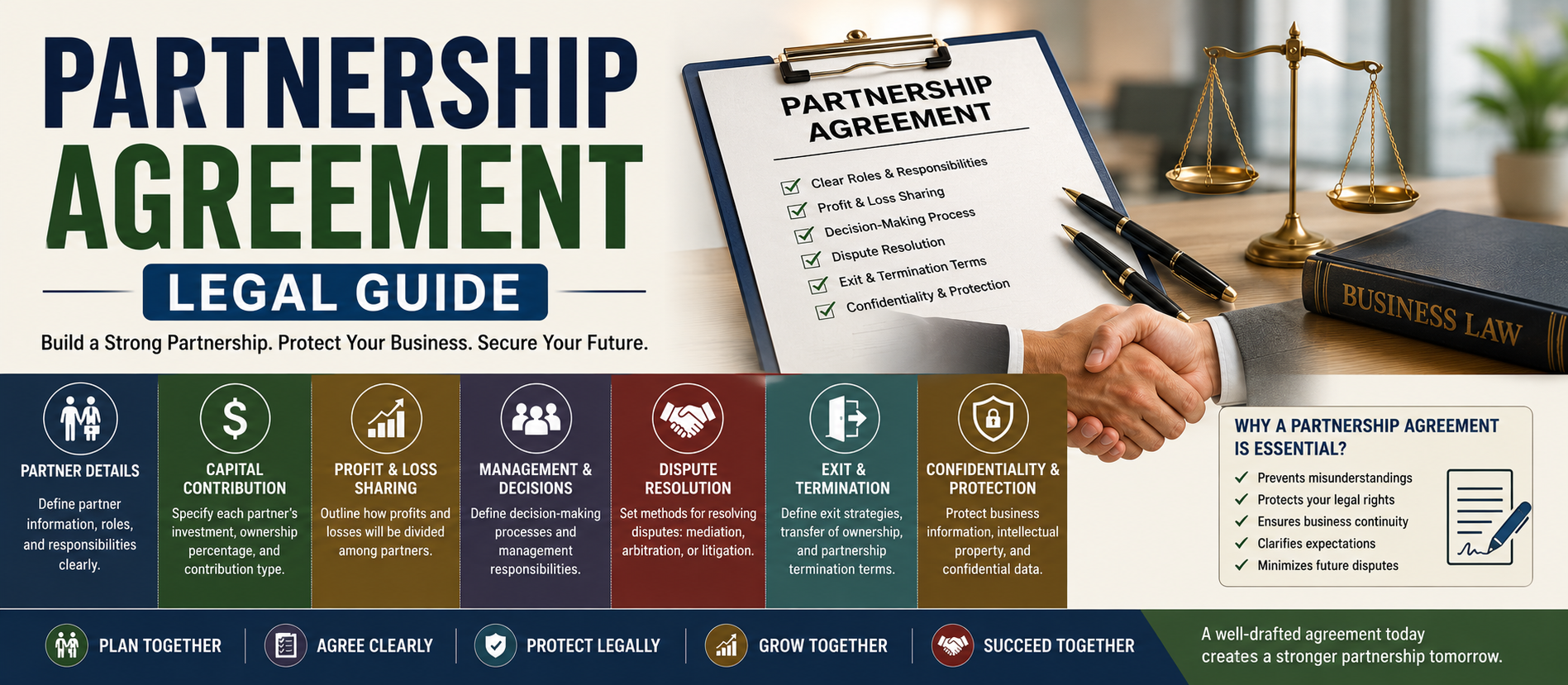
📋 Quick Summary
In this article:
What Is a Partnership Agreement?
Why Is a Partnership Agreement Important?
Who Should Be Named in the Agreement?
Choosing the Right Partnership Structure
Decision-Making and Voting Rights
Starting a business with another person can create exciting opportunities. Partners may bring different skills, money, experience, customers, and ideas to the business. However, a business partnership can also create serious problems when expectations are unclear.
A well-prepared partnership agreement helps partners understand their rights and responsibilities before disagreements happen. It can explain ownership percentages, capital contributions, profit sharing, management duties, voting rights, dispute resolution, and what happens when a partner leaves the business.
💡 Key Insight
This Partnership Agreement Legal Guide explains the most important issues business partners should consider. The information is written in clear and simple language. It is designed to help business owners understand common partnership agreement terms and prepare for informed discussions with qualified legal and financial professionals.
Disclaimer: This article is for general educational purposes only and is not legal advice. Partnership laws vary by country, state, and business structure. Consult a qualified lawyer or other appropriate professional before creating or signing a partnership agreement.
What Is a Partnership Agreement?
A partnership agreement is a written agreement between people or entities that agree to operate a business together. The agreement sets out how the partnership will be managed and how important business decisions will be made.
Depending on the jurisdiction and business structure, a partnership may be governed by default laws even if the partners do not create a written agreement. However, relying only on default legal rules can create uncertainty.
A written agreement allows partners to define important business arrangements in advance.
Why Is a Partnership Agreement Important?
Many partnerships begin with trust and enthusiasm. Partners may believe they will always agree. Unfortunately, business circumstances can change.
A disagreement may arise over:
- How much money each partner should invest.
- How profits should be divided.
- Who has authority to make decisions.
- How much work each partner should perform.
- Whether the business should borrow money.
- Whether a new partner should be added.
- What happens if one partner wants to leave.
A clear agreement cannot prevent every conflict, but it can provide a process for handling problems.
Who Should Be Named in the Agreement?
The agreement should clearly identify every partner. Depending on the legal structure, a partner may be an individual, company, trust, or another legally recognized entity.
Important details may include:
- Full legal name.
- Business or residential address, where appropriate.
- Legal status of the partner.
- Ownership percentage.
- Date the partner joined the business.
Accurate identification is important because the agreement should clearly establish who is responsible for the obligations and rights described in the document.
Choosing the Right Partnership Structure
Partnership laws and structures vary between jurisdictions. Before creating an agreement, partners should understand the type of business arrangement they are creating.
Common structures may include:
General Partnership
In a general partnership, partners may participate in managing the business and may have legal responsibilities for business obligations, depending on applicable law.
Limited Partnership
A limited partnership may include different categories of partners with different management rights and liability rules.
Limited Liability Partnership
A limited liability partnership, often called an LLP, may provide a different legal structure and liability framework. Availability and rules vary by jurisdiction.
Choosing the correct structure is important because it may affect taxes, management rights, registration requirements, and liability.
Ownership Percentages
The partnership agreement should explain how ownership is divided.
For example, ownership might be:
- 50% and 50%.
- 60% and 40%.
- Equal among three partners.
- Based on capital contributions or another agreed formula.
Ownership does not always have to match the amount of work performed by each partner. Partners can negotiate different arrangements, subject to applicable law.
The agreement should clearly state the ownership percentage of every partner to reduce future confusion.
Capital Contributions
Partners may contribute money, property, equipment, intellectual property, services, or other valuable assets to the business.
The agreement should explain:
- What each partner will contribute.
- The value of non-cash contributions.
- When contributions must be made.
- Whether additional contributions may be required.
- What happens if a partner fails to contribute as promised.
Non-cash contributions can create valuation disputes. Partners may need professional assistance to determine a fair value for important assets.
Profit and Loss Sharing
One of the most important parts of a partnership agreement is the method used to share profits and losses.
Partners should clearly decide:
- How profits will be calculated.
- How often distributions may be made.
- Whether profits will be shared according to ownership.
- How losses will be allocated.
- Whether money must remain in the business for operations.
Do not assume that ownership percentage automatically determines every financial distribution. The agreement and applicable law should be reviewed carefully.
Management Responsibilities
Partners should define who is responsible for important business activities.
Responsibilities may include:
- Sales and marketing.
- Finance and accounting.
- Daily operations.
- Hiring employees.
- Customer service.
- Technology and security.
- Supplier relationships.
Clear roles can reduce conflict. A partner who handles operations should understand the limits of their authority, while a partner responsible for finance should understand reporting and approval requirements.
Decision-Making and Voting Rights
Business decisions should not always require the same approval process. A partnership agreement can separate routine decisions from major decisions.
Routine decisions might be handled by the partner responsible for daily operations. Major decisions may require a vote or unanimous approval.
Major decisions may include:
- Taking a significant loan.
- Buying or selling major assets.
- Admitting a new partner.
- Changing the nature of the business.
- Entering a major contract.
- Selling the business.
- Dissolving the partnership.
The agreement should explain whether decisions require a majority vote, a specific percentage, or unanimous approval.
Partner Authority and Limits
Partners should understand who can legally or contractually act on behalf of the business.
The agreement may establish limits on:
- Signing contracts.
- Borrowing money.
- Opening financial accounts.
- Making large purchases.
- Hiring or dismissing employees.
Clear authority limits can help reduce financial risk and internal misunderstandings.
Partner Salaries and Compensation
Partners may receive compensation in different ways. One partner may work full-time while another contributes capital but has limited daily involvement.
The agreement should address whether partners receive:
- A salary or guaranteed payment where legally permitted.
- Profit distributions.
- Expense reimbursement.
- Performance-based compensation.
Tax treatment can differ depending on the business structure and local law. Professional tax advice may be necessary.
Business Expenses and Reimbursement
Partners often pay business expenses from personal funds during the early stages of a company. This can create disagreements later.
The agreement should establish:
- Which expenses the partnership will pay.
- How expenses must be approved.
- How partners request reimbursement.
- What records are required.
- Spending limits requiring additional approval.
Maintaining clear financial records is essential.
Bank Accounts and Financial Records
The partnership should have clear financial controls. The agreement may explain:
- Who can access business bank accounts.
- Who can authorize payments.
- Whether large payments require two approvals.
- How often financial reports will be shared.
- Who maintains accounting records.
Transparency is important. Partners should have access to financial information according to their legal rights and the partnership agreement.
Adding a New Partner
A new partner can change the balance of ownership and control. The agreement should explain how a new partner can be admitted.
The process may include:
- Approval by existing partners.
- Valuation of the business.
- Capital contribution requirements.
- Changes to ownership percentages.
- Signing an updated partnership agreement.
Clear rules help prevent one partner from introducing a new owner without appropriate approval.
When a Partner Wants to Leave
Partners may eventually want to leave because of retirement, illness, personal goals, disagreements, or a new business opportunity.
The agreement should contain an exit process. Important questions include:
- How much notice must the partner provide?
- Who can buy the departing partner's interest?
- How will the ownership interest be valued?
- How and when will payment be made?
A buyout provision can make a difficult transition more manageable.
Buy-Sell Provisions
A buy-sell provision explains what may happen when a partner leaves or certain major events occur.
Possible triggering events include:
- Retirement.
- Death.
- Long-term disability.
- Voluntary departure.
- Bankruptcy, where relevant under applicable law.
- A serious breach of the agreement.
The agreement may also provide a valuation method, such as an independent valuation, an agreed formula, or another legally appropriate process.
Death or Disability of a Partner
A partnership should prepare for unexpected events. Without a clear plan, surviving partners and family members may face uncertainty.
The agreement may explain:
- Whether the partnership continues.
- Whether the business buys the departing partner's interest.
- How the interest is valued.
- How payments are made to the estate or eligible recipient.
Insurance may sometimes be considered as part of business continuity planning, depending on the business and local legal and financial rules.
Confidentiality and Business Information
Partners may have access to valuable information such as customer lists, pricing, business plans, software, financial records, and trade secrets.
A partnership agreement may include confidentiality obligations explaining what information must be protected and how it may be used.
Confidentiality provisions should be carefully drafted because their enforceability and scope depend on applicable law.
Intellectual Property Ownership
Businesses may own trademarks, logos, software, websites, marketing content, inventions, and other intellectual property.
The agreement should clarify whether intellectual property created or contributed by a partner belongs to:
- The individual partner.
- The partnership.
- Another entity associated with the business.
This issue is especially important for technology companies, marketing agencies, creative businesses, and AI-based businesses.
Non-Compete and Non-Solicitation Clauses
Some partnership agreements include restrictions on competition or solicitation. These clauses may attempt to protect customers, employees, or confidential business relationships.
However, the legality and enforceability of restrictive clauses vary significantly by jurisdiction. Some restrictions may be limited or unenforceable.
Partners should obtain qualified legal advice before relying on these clauses.
Dispute Resolution
Disagreements can happen even with a detailed agreement. A partnership agreement should include a process for resolving disputes.
Possible methods include:
- Direct negotiation.
- Mediation.
- Arbitration, where legally appropriate.
- Litigation or court proceedings.
Mediation may help partners find a voluntary solution. Arbitration or litigation may provide a more formal process. The best approach depends on the partnership, contract terms, and applicable law.
Partner Duties and Conflicts of Interest
Partners may owe legal or contractual duties to the business and to one another, depending on the jurisdiction and partnership structure.
The agreement can address conflicts of interest. For example, a partner may need to disclose a business opportunity or financial interest that could compete with the partnership.
Clear disclosure rules can improve trust and reduce the risk of hidden conflicts.
Breaking the Partnership Agreement
A partner may breach an agreement by failing to contribute promised money, misusing business funds, disclosing confidential information, or violating another important obligation.
The agreement may explain:
- How a breach is reported.
- Whether the partner has time to correct the problem.
- Possible financial consequences.
- Whether the other partners may buy the partner's interest.
- How disputes will be resolved.
Consequences must comply with applicable law and should be professionally reviewed.
Dissolving the Partnership
A partnership may eventually close, sell its assets, merge with another business, or otherwise end.
The agreement should explain the dissolution process, including:
- Who can approve dissolution.
- How creditors and business obligations are handled.
- How assets are sold or distributed.
- How remaining funds are divided.
- How required registrations and accounts are closed.
A clear closing process can reduce disputes during the final stage of the business.
How to Create a Strong Partnership Agreement
A useful agreement should be clear, complete, and realistic. Partners should discuss difficult issues before signing.
A practical process may include:
- Choose the correct business structure.
- Identify all partners and ownership percentages.
- Document capital contributions.
- Define management roles.
- Set decision-making rules.
- Explain profit and loss sharing.
- Create financial controls.
- Plan for partner exits and buyouts.
- Include a dispute resolution process.
- Review the agreement with qualified professionals.
Common Partnership Agreement Mistakes
Common mistakes include using a generic document without understanding it, failing to define responsibilities, ignoring exit planning, leaving valuation rules unclear, and assuming friends or family will never disagree.
Other problems include failing to update the agreement when ownership changes or when the business grows.
A partnership agreement should be reviewed when major changes occur, such as a new partner joining, a major investment, expansion into a new market, or a significant change in business operations.
Partnership Agreements in the Digital and AI Business Era
Modern businesses may depend on digital assets, customer data, software platforms, AI systems, online accounts, and automated workflows. Partnership agreements should consider who owns and controls these assets.
Partners may need to address:
- Website and domain ownership.
- Social media accounts.
- Customer databases.
- AI tools and generated content.
- Software licenses.
- Cloud accounts and access credentials.
- Data security responsibilities.
Digital assets can have significant value. Clear ownership and access rules are increasingly important.
SEO, AEO, GEO and AI Search Optimization for Legal Business Content
Business owners increasingly search for legal information through traditional search engines, answer engines, and AI-powered platforms.
SEO helps useful content appear in search results. AEO, or Answer Engine Optimization, focuses on providing direct answers to common questions. GEO, or Generative Engine Optimization, helps AI systems understand structured, reliable information.
⚠ Watch Out
For legal business topics, content should use clear headings, direct answers, accurate terminology, and easy-to-understand explanations. Optimization should never replace legal accuracy.
Digiifrog supports modern digital growth through SEO, AEO, GEO, and AI Search optimization. Clear, structured, and helpful content can improve visibility across modern search environments.
Frequently Asked Questions
Is a partnership agreement legally required?
The legal requirements vary by jurisdiction and business structure. Even when a written agreement is not legally required, it can help clarify important business arrangements.
Can partners have unequal ownership?
Yes, unequal ownership may be possible depending on the applicable law and business structure. The agreement should clearly explain ownership percentages and related rights.
How should partnership profits be divided?
Partners can agree on a method that complies with applicable law and tax requirements. The agreement should clearly explain how profits and losses are calculated and distributed.
What happens when a partner leaves?
The partnership agreement should provide an exit process, including notice requirements, valuation, and buyout rules.
Should a partnership agreement be updated?
Yes. A review may be appropriate when ownership, business operations, financial arrangements, or major responsibilities change.
Do partners need a lawyer to create an agreement?
Legal requirements vary, but professional legal advice can help partners understand risks and create an agreement suitable for their specific situation.
Conclusion
A strong partnership agreement is one of the most important documents for a business owned by multiple partners. It helps establish clear expectations about ownership, contributions, management, profits, financial controls, and future changes.
The best time to discuss difficult issues is before a serious disagreement occurs. Partners should openly discuss money, responsibilities, authority, business goals, and exit plans.
A well-structured agreement cannot guarantee that partners will never disagree. However, it can provide a clear framework for making decisions and resolving conflicts.
Digiifrog
Website: www.digiifrog.com
Digital Growth Through SEO, AEO, GEO & AI Search Optimization.
Ready to Grow?
Talk to us about a strategy tailored to your brand — we will help you stand out in search, AI discovery and social.


Comments (0)
Log in to leave a comment.