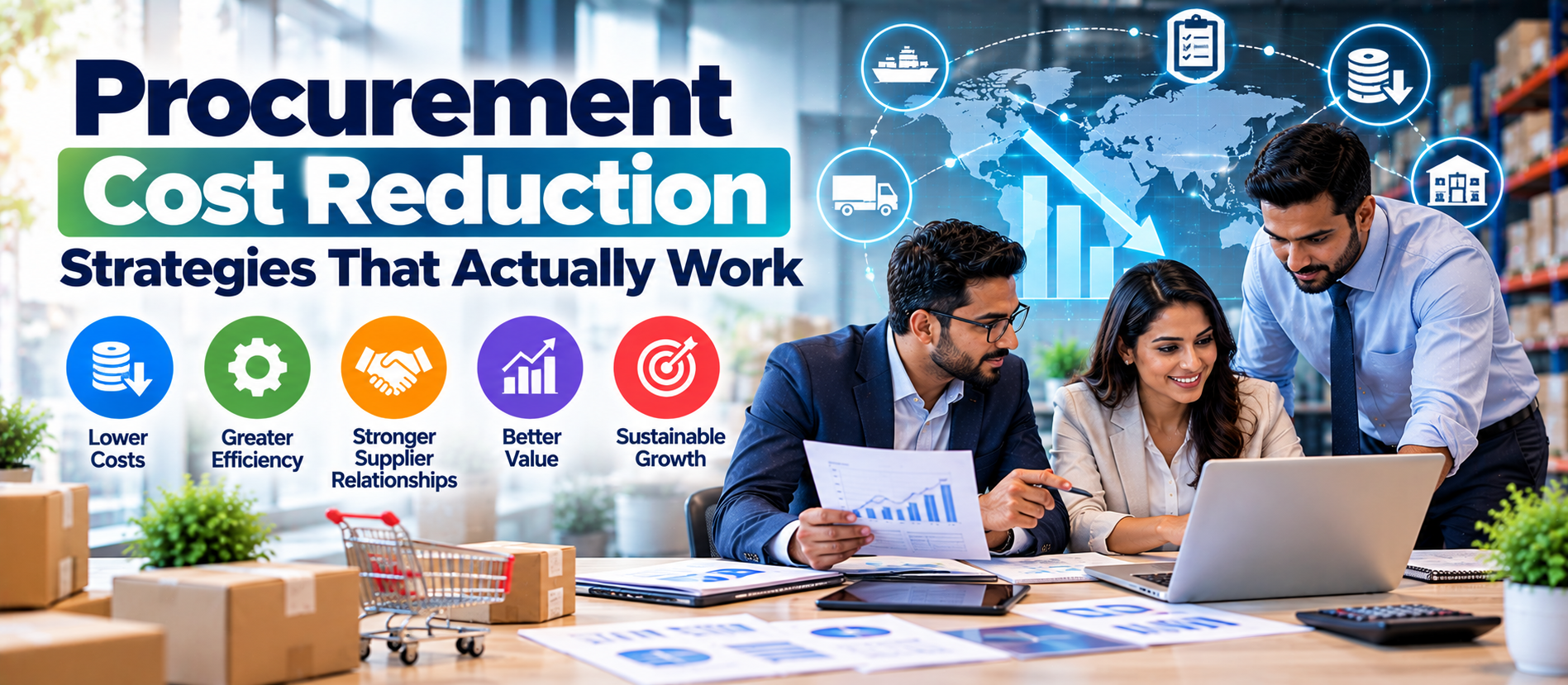
📋 Quick Summary
In this article:
What Is Procurement Cost Reduction?
Why Procurement Cost Reduction Matters in 2026
1. Start With Spend Analysis
2. Consolidate Suppliers Carefully
3. Use Strategic Sourcing Instead of Routine Buying
4. Negotiate Total Value, Not Just Unit Price
5. Apply Total Cost of Ownership Analysis
6. Reduce Unnecessary Demand
7. Standardize Specifications
8. Control Maverick Spend
9. Improve Contract Management
10. Improve Supplier Performance
Procurement has a direct impact on profit. Every rupee or dollar saved on purchasing can improve margins without requiring the company to win another customer.
But effective procurement cost reduction strategies are not limited to asking suppliers for lower prices. Sustainable savings come from understanding spend, reducing unnecessary demand, improving specifications, consolidating suppliers, negotiating smarter contracts, controlling purchasing behavior, and using technology to reduce process waste.
In 2026, procurement teams are also expected to balance cost with resilience, risk, speed, and digital transformation. A 2026 Economist Enterprise study supported by SAP found that cost control remains a defining procurement priority in India, while digital transformation, AI strategy, and spend analytics are major drivers of change.
This guide explains practical ways businesses can reduce procurement costs without damaging quality, supplier relationships, or supply continuity.
What Is Procurement Cost Reduction?
Procurement cost reduction is the process of lowering the total cost of acquiring goods and services while maintaining the quality, availability, performance, and risk standards the business needs.
It can involve reducing purchase prices, but it can also mean buying less, buying at the right time, reducing waste, improving payment terms, simplifying the supplier base, preventing unauthorized purchases, or reducing the internal cost of processing transactions.
A useful principle is simple: do not focus only on price; focus on total cost and business value.
Why Procurement Cost Reduction Matters in 2026
Companies are facing pressure from multiple directions. Input costs can change quickly. Supply disruptions can affect availability. Finance teams want better working-capital control. Business leaders expect procurement to prove measurable value.
Recent research reinforces this shift. SAP's 2026 procurement research reports that 54% of surveyed executives identify cost savings and optimization as procurement's primary contribution to the organization.
At the same time, cost cannot be separated from risk. ISM and Amazon Business research published in 2026 found that 71% of organizations say balancing cost and risk drives procurement strategy, while only 45% report being prepared for supply disruptions.
This means the goal is not simply “buy cheaper.” The goal is to create a procurement system that delivers lower total cost, reliable supply, strong quality, and measurable business value.
1. Start With Spend Analysis
You cannot reduce procurement costs effectively if you do not know where the money is going.
Start by collecting purchasing information from ERP systems, accounting software, procurement platforms, purchase orders, invoices, corporate cards, and other relevant sources. Then classify the data into useful categories.
Look for:
- High-spend categories
- Duplicate suppliers
- Unapproved suppliers
- Price differences for similar products
- Frequent small purchases
- Purchases outside negotiated contracts
- Expired or unused contracts
- High-cost urgent orders
- Excessive shipping charges
- Products with inconsistent specifications
Spend analysis often reveals savings that are invisible when purchasing data is reviewed one invoice at a time. SAP's 2026 procurement guidance similarly emphasizes consolidated spend data, classification, and analytics as foundations for identifying savings opportunities.
2. Consolidate Suppliers Carefully
Supplier fragmentation creates hidden costs. When several vendors provide similar goods or services, the business may lose volume leverage while increasing contract, onboarding, invoice, communication, and compliance work.
Supplier consolidation can help by concentrating suitable spend with fewer strategic suppliers.
However, consolidation does not mean choosing one supplier for everything. Over-consolidation can increase supply risk and reduce flexibility.
A better approach is to:
- Map suppliers by category.
- Identify overlapping capabilities.
- Compare supplier performance.
- Assess financial and operational risk.
- Estimate volume-based savings.
- Choose an appropriate supplier mix.
- Keep backup options for critical categories.
Gartner's 2026 research highlights supplier spread as a source of administrative burden, duplication, fragmented risk, and cost leakage.
3. Use Strategic Sourcing Instead of Routine Buying
Strategic sourcing looks at the full market and purchasing requirement before selecting a supplier.
Instead of automatically renewing the existing contract, procurement teams can review market conditions, supplier alternatives, specifications, expected demand, service levels, and total cost.
A strategic sourcing process can include:
- Category analysis
- Demand forecasting
- Market research
- Supplier discovery
- Request for Information (RFI)
- Request for Proposal (RFP)
- Competitive bidding
- Supplier evaluation
- Negotiation
- Contract implementation
This approach is particularly useful for high-spend categories where even a small percentage improvement can have a meaningful financial impact.
4. Negotiate Total Value, Not Just Unit Price
Price negotiation is important, but a lower unit price does not always produce a lower total cost.
During negotiations, consider:
- Payment terms
- Minimum order quantities
- Freight charges
- Delivery schedules
- Warranty terms
- Returns and replacement policies
- Volume discounts
- Price-adjustment clauses
- Service-level commitments
- Implementation fees
- Training and support
For example, Supplier A may offer a lower product price but charge high freight costs and require large minimum orders. Supplier B may have a slightly higher unit price but offer better delivery terms and smaller order quantities. Supplier B could have the lower total cost.
5. Apply Total Cost of Ownership Analysis
Total cost of ownership (TCO) measures the full economic impact of a purchase.
For a product, TCO may include purchase price, shipping, storage, installation, maintenance, energy use, downtime, disposal, warranty, and replacement costs.
For a software service, TCO may include subscription fees, implementation, integrations, training, support, administration, and unused licenses.
TCO prevents procurement teams from selecting an apparently cheap option that becomes expensive after purchase.
6. Reduce Unnecessary Demand
One of the most powerful procurement cost reduction strategies is to avoid unnecessary purchasing.
Before negotiating a better price, ask whether the business needs the same quantity, specification, frequency, or service level.
Demand management can include:
- Removing duplicate purchases
- Standardizing product specifications
- Reducing unnecessary customization
- Using shared equipment
- Eliminating unused subscriptions
- Reducing emergency purchases
- Improving demand forecasting
- Reviewing excessive inventory levels
The cheapest purchase is often the purchase the business does not need to make.
7. Standardize Specifications
Different departments sometimes buy products that perform the same function but have different specifications.
This can create unnecessary complexity.
Standardization can increase purchasing volume, simplify inventory, reduce training requirements, make supplier comparison easier, and improve negotiating power.
Work with engineering, operations, IT, finance, and end users before changing specifications. The objective is not to reduce quality. It is to remove unnecessary variation.
8. Control Maverick Spend
Maverick spend occurs when employees purchase outside approved suppliers, contracts, catalogs, or procurement processes.
It can happen because the approved process is slow, employees do not know which supplier to use, the required item is unavailable in the catalog, or the purchasing workflow is difficult.
To reduce maverick spend:
- Create approved supplier lists.
- Make catalogs easy to search.
- Set sensible approval thresholds.
- Provide clear purchasing policies.
- Use automated purchase workflows.
- Track purchases outside contracts.
- Fix process problems that encourage employees to bypass procurement.
Good procurement controls should make the right buying behavior easier, not simply add more approvals.
9. Improve Contract Management
Contract leakage can quietly reduce procurement savings.
Common problems include missed volume discounts, expired pricing, automatic renewals, unclaimed rebates, incorrect invoices, and purchases made outside agreed terms.
Create a central contract repository and track:
- Contract owner
- Supplier
- Start and end date
- Renewal date
- Pricing terms
- Discounts
- Service levels
- Volume commitments
- Termination clauses
- Price escalation rules
Automated alerts can help procurement teams act before important dates are missed.
10. Improve Supplier Performance
A supplier that frequently delivers late, sends defective products, or creates invoice errors can generate costs far beyond the purchase price.
Use supplier scorecards to measure:
- Quality
- On-time delivery
- Fill rate
- Lead time
- Price performance
- Invoice accuracy
- Responsiveness
- Compliance
- Innovation
Share performance data with suppliers and create improvement plans where needed.
Strong supplier relationships can support cost reduction through better forecasting, process improvement, packaging changes, joint planning, and reduced waste.
11. Use Competitive Bidding for the Right Categories
Competitive bidding can create useful price tension, but it should not be used for every purchase.
It works best when specifications are clear, several capable suppliers exist, and the category has enough value to justify the sourcing effort.
For strategic or highly specialized categories, a collaborative negotiation may produce better long-term value than a purely price-driven bidding process.
12. Improve Payment Terms and Working Capital
Procurement cost reduction can also involve improving cash-flow economics.
Depending on the business and supplier relationship, companies may negotiate early-payment discounts, longer payment terms, milestone-based payments, or better invoice schedules.
However, payment-term changes should be evaluated carefully. Extending payment terms can create supplier stress, especially for smaller suppliers. A cost-saving decision that damages a critical supplier may create a larger cost later.
13. Use Procurement Automation
Manual procurement processes increase transaction costs and create opportunities for errors.
Automation can streamline:
- Purchase requisitions
- Approval routing
- Purchase orders
- Supplier onboarding
- Three-way matching
- Invoice processing
- Contract alerts
- Spend reporting
- Supplier scorecards
The value is not only labor savings. Faster processing can also reduce late orders, duplicate purchases, approval delays, and data errors.
2026 research shows procurement leaders are moving from simply funding digital tools toward making them easier to deploy and integrate into real workflows.
14. Use AI for Spend Classification and Analysis
AI can help procurement teams process large amounts of purchasing data faster.
Potential use cases include:
- Spend classification
- Supplier matching
- Duplicate supplier detection
- Price anomaly detection
- Contract analysis
- Invoice anomaly detection
- Demand forecasting
- Supplier risk monitoring
- Market intelligence
- Purchase recommendations
In India's 2026 procurement study, spend analytics and AI strategy are among the leading drivers of digital transformation. The study also identifies contracting and sourcing as areas with significant process delays and targets for AI improvement.
AI should support procurement professionals, not remove human accountability from important commercial decisions. Data quality, governance, privacy, supplier fairness, and approval controls still matter.
15. Improve Inventory and Order Planning
Procurement and inventory are closely connected.
Overbuying increases carrying costs and creates obsolete inventory. Underbuying can cause stockouts, emergency freight, production delays, and lost sales.
Use historical demand, seasonality, lead times, safety-stock policies, supplier reliability, and business forecasts to improve purchasing decisions.
Where demand is volatile, use scenarios rather than relying on a single forecast.
16. Use Should-Cost and Market Benchmarking
A should-cost model estimates what a product or service should reasonably cost based on its inputs, labor, overhead, logistics, margins, and market conditions.
This gives procurement teams a stronger position during negotiations.
Market benchmarking can also compare supplier pricing, payment terms, service levels, and contract structures against available market information.
The goal is not to force an unrealistic price. The goal is to understand the economics well enough to identify where value can be improved.
17. Reduce Logistics and Packaging Costs
Procurement savings can extend beyond the purchase price.
Review packaging size, material usage, pallet configuration, freight class, shipment frequency, and delivery terms. Smaller packaging can sometimes reduce storage and transportation costs. Better order planning can reduce expensive urgent shipments.
Work with suppliers on packaging redesign where it does not compromise product protection.
18. Build Supplier Collaboration Into Cost Reduction
Not every saving should come from supplier margin reduction.
Suppliers often understand production, packaging, materials, and logistics better than the buyer. Collaborative projects can uncover savings that a price negotiation would miss.
Examples include:
- Joint demand planning
- Packaging redesign
- Specification simplification
- Delivery-frequency changes
- Process automation
- Quality improvement
- Local sourcing
- Reduced material waste
This approach can create savings while strengthening the supplier relationship.
19. Create Category-Specific Cost Strategies
Different procurement categories require different strategies.
| Category Useful Cost Reduction Approach | |
| Raw materials | Strategic sourcing, volume planning, should-cost analysis |
| Office supplies | Catalog controls, standardization, supplier consolidation |
| IT software | License optimization, usage analysis, contract negotiation |
| Logistics | Route optimization, shipment consolidation, carrier negotiation |
| Professional services | Scope control, rate benchmarking, outcome-based contracts |
| Facilities | Competitive sourcing, energy efficiency, service-level review |
| Marketing spend | Vendor consolidation, performance measurement, contract review |
20. Measure Savings That Finance Can Validate
A procurement savings number is useful only when the business can understand and validate it.
⚠ Watch Out
Define the baseline before claiming savings. Separate negotiated savings, cost avoidance, demand reduction, process savings, and price variance.
Useful KPIs include:
- Realized savings
- Negotiated savings
- Cost avoidance
- Spend under management
- Contract compliance
- Maverick spend
- Supplier concentration
- Purchase order cycle time
- Invoice exception rate
- Procurement cost per transaction
- Supplier on-time delivery
- Inventory carrying cost
GEP's 2026 procurement metrics research notes that cost savings remains a top priority for CPOs while speed, cycle-time reduction, and margin protection are also shaping technology investment.
Procurement Cost Reduction vs Cost Cutting
These terms are not the same.
Cost cutting often means reducing spending quickly. Procurement cost reduction should create sustainable economic improvement.
For example, choosing a lower-quality material may reduce purchase price but increase defects and customer complaints. Cutting supplier capacity may lower short-term spending but increase supply risk.
Good procurement optimization asks: How can we remove unnecessary cost while protecting the outcomes the business needs?
Common Procurement Cost Reduction Mistakes
- Focusing only on unit price
- Using the same strategy for every category
- Ignoring demand reduction
- Consolidating suppliers too aggressively
- Ignoring supplier risk
- Measuring savings only on paper
- Keeping procurement data in disconnected spreadsheets
- Automating poor processes without redesigning them
- Ignoring contract leakage
- Failing to involve finance and business stakeholders
A Practical 90-Day Procurement Cost Reduction Plan
Days 1–30: Find the Opportunity
- Collect procurement and payment data.
- Build a spend baseline.
- Identify the largest categories.
- Map suppliers and contracts.
- Find maverick spend.
- Identify price and specification differences.
Days 31–60: Prioritize and Act
- Select high-value opportunities.
- Review specifications and demand.
- Run sourcing events where appropriate.
- Negotiate priority contracts.
- Consolidate suitable suppliers.
- Improve approval and purchasing workflows.
Days 61–90: Lock In Savings
- Implement new contracts.
- Update catalogs and approved supplier lists.
- Track realized savings.
- Monitor supplier performance.
- Automate reporting.
- Review results with finance.
- Create a continuous-improvement pipeline.
How AI Search, AEO, and GEO Apply to Procurement Content
Procurement businesses and consulting firms can also use digital content to attract decision-makers searching for cost-reduction solutions.
SEO should target terms such as “procurement cost reduction strategies,” “procurement cost savings,” “supplier consolidation,” “spend analysis,” and “procurement automation.”
AEO requires direct answers to common procurement questions. Use clear definitions, short answer sections, tables, checklists, and FAQs.
GEO and AI Search Optimization require content that is easy for generative systems to understand and reference. Use specific terminology, structured headings, evidence-based statements, useful examples, and concise explanations.
For a procurement brand, strong content can include sourcing guides, supplier-management guides, cost-reduction checklists, procurement automation explainers, category strategy pages, case studies, and FAQ content.
Frequently Asked Questions
What are the most effective procurement cost reduction strategies?
The strongest strategies usually include spend analysis, strategic sourcing, supplier consolidation, demand management, total cost of ownership analysis, contract optimization, procurement automation, and supplier performance management.
How can companies reduce procurement costs without reducing quality?
Focus on waste, unnecessary specifications, demand, supplier performance, process inefficiency, contract leakage, and total cost. Do not reduce quality standards simply to achieve a lower purchase price.
Does supplier consolidation always reduce procurement costs?
No. Consolidation can improve purchasing leverage and reduce administrative work, but excessive concentration can increase supply risk. The right goal is an efficient supplier portfolio, not the smallest possible supplier count.
How does AI reduce procurement costs?
AI can help classify spend, identify anomalies, analyze contracts, detect duplicate suppliers, improve forecasts, monitor risk, and surface sourcing opportunities. Human review remains important for strategic decisions.
What is the difference between cost savings and cost avoidance?
Cost savings generally represent a measurable reduction from a previous or established baseline. Cost avoidance represents preventing an expected increase or additional cost. Organizations should report the two separately.
How often should procurement costs be reviewed?
Spend visibility should ideally be continuous or regularly refreshed. Strategic categories can be reviewed monthly or quarterly, while contracts and supplier performance should follow defined review schedules.
Conclusion
The best procurement cost reduction strategies do not depend on aggressive negotiation alone. They combine data, demand management, strategic sourcing, supplier collaboration, process improvement, contract control, automation, and disciplined measurement.
The modern procurement function has a broader responsibility. It must reduce cost while protecting supply, quality, resilience, working capital, and business performance.
For growing companies, the practical starting point is simple: understand where money is going, identify the largest sources of leakage, prioritize high-value categories, and turn savings opportunities into measurable actions.
As procurement becomes more digital, AI and analytics can help teams identify opportunities faster. But technology works best when the underlying data and processes are reliable. The strongest procurement organizations will combine human judgment with better data, automation, supplier collaboration, and continuous improvement. Current 2026 research points toward exactly this combination of cost discipline, digital transformation, risk management, and AI-enabled insight.
About Digiifrog: Digiifrog provides digital marketing, SEO, AI Search, AEO, GEO, content marketing, and technology-focused growth strategies for businesses. Visit www.digiifrog.com for more business and digital growth resources.
Sources and Further Reading
- SAP — 2026 Procurement Cost Savings Strategies and Procurement Imperative research.
- Gartner — 2026 research on optimizing costs through supplier consolidation.
- GEP — 2026 Procurement Executive Insight and Procurement Metrics research.
- Institute for Supply Management and Amazon Business — 2026 research on balancing procurement cost and supply-chain risk.
Ready to Grow?
Talk to us about a strategy tailored to your brand — we will help you stand out in search, AI discovery and social.

Comments (0)
Log in to leave a comment.