📋 Quick Summary
In this article:
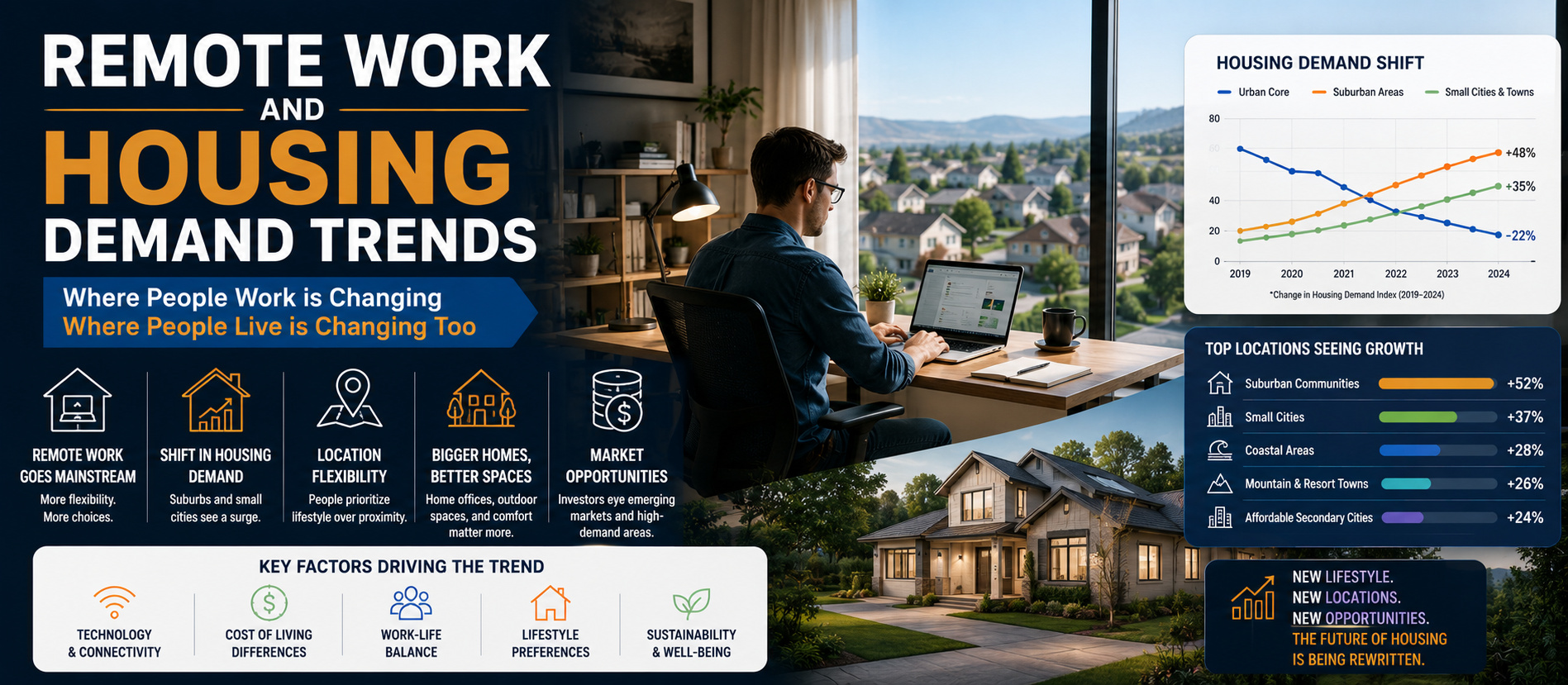
How Remote Work Changed Housing Preferences
Growing Demand for Larger Homes
Rural Real Estate Opportunities
Impact on Urban Housing Markets
The Rise of Hybrid Work Models
Internet Connectivity as a Housing Factor
Remote Work and Housing Prices
The rise of remote work has become one of the most significant forces reshaping the global real estate market. What began as a temporary workplace adjustment evolved into a long-term transformation that continues influencing where people live, how they purchase homes, and what features they prioritize when choosing properties.
Remote work has fundamentally altered housing demand patterns across urban, suburban, and rural markets. Employees no longer need to live close to corporate offices, allowing them to prioritize affordability, lifestyle, larger living spaces, and quality of life. As a result, housing markets around the world have experienced shifts in demand, pricing, construction trends, and investment opportunities.
This comprehensive guide explores the relationship between remote work and housing demand trends, examining how work-from-home culture is reshaping residential real estate, influencing investment strategies, and creating new opportunities for buyers, sellers, developers, and investors.
The Evolution of Remote Work
Remote work existed long before recent technological advancements, but widespread adoption accelerated dramatically due to improvements in internet connectivity, cloud computing, collaboration software, and digital communication tools.
Today, many organizations operate under:
- Fully remote work models
- Hybrid work arrangements
- Flexible scheduling systems
- Distributed workforce strategies
This flexibility has significantly reduced the importance of proximity to traditional office locations.
How Remote Work Changed Housing Preferences
Before remote work became mainstream, many homebuyers prioritized commuting convenience and urban accessibility. Today, housing priorities have shifted.
Modern buyers increasingly seek:
- Dedicated home offices
- Larger floor plans
- Private outdoor spaces
- Multi-functional rooms
- High-speed internet access
- Quiet neighborhoods
The home has become both a living space and a workplace, influencing purchasing decisions across all market segments.
Growing Demand for Larger Homes
One of the most noticeable trends has been increased demand for larger residential properties.
Remote workers often require:
- Home office space
- Video conferencing areas
- Private work environments
- Additional storage
- Flexible room configurations
This shift has driven interest in larger homes, particularly in suburban and exurban communities.
The Suburban Housing Boom
Suburban markets have benefited significantly from remote work adoption.
Many professionals discovered they could maintain their careers without living near major business districts. As a result, suburban areas offering larger homes and lower housing costs experienced increased demand.
Advantages of suburban living include:
- More space
- Lower property costs
- Family-friendly environments
- Access to outdoor amenities
- Reduced population density
These factors continue attracting remote workers and hybrid employees.
Rural Real Estate Opportunities
Remote work has also expanded interest in rural housing markets.
Buyers increasingly consider rural locations offering:
- Affordable housing
- Natural surroundings
- Large properties
- Lower living costs
- Lifestyle flexibility
Improved internet infrastructure has made rural living more practical for many professionals.
Impact on Urban Housing Markets
Major urban centers experienced mixed effects from remote work trends.
Initially, some cities saw reduced housing demand as workers relocated. However, urban markets continue benefiting from:
- Employment opportunities
- Cultural attractions
- Entertainment options
- Transportation networks
- Business ecosystems
Many cities have adapted by emphasizing lifestyle and convenience rather than commuting access.
The Rise of Hybrid Work Models
Hybrid work arrangements have become increasingly common.
Under hybrid models, employees split time between home and office environments.
This trend supports demand for properties located:
- Within commuting distance
- Near transportation hubs
- In suburban communities
- Close to regional business centers
Hybrid work continues influencing location decisions across housing markets.
Home Office Design Trends
Home office space has become a major selling feature.
Popular design elements include:
- Dedicated work rooms
- Soundproofing solutions
- Natural lighting
- Built-in storage
- High-speed connectivity infrastructure
Developers increasingly incorporate workspace functionality into new residential projects.
Demand for Smart Homes
Remote workers rely heavily on technology.
As a result, smart home features are becoming more valuable.
Examples include:
- Smart thermostats
- Automated lighting
- Advanced security systems
- Voice-controlled devices
- Energy management systems
Technology integration supports productivity and convenience.
Internet Connectivity as a Housing Factor
💡 Key Insight
Reliable internet access has become one of the most important housing considerations.
Properties with:
- Fiber-optic connections
- High-speed broadband
- Reliable network infrastructure
often attract stronger demand from remote professionals.
Remote Work and Housing Prices
Changes in housing demand have influenced property values in many regions.
Markets experiencing significant remote worker migration often report:
- Rising home prices
- Increased competition
- Higher rental demand
- Reduced inventory levels
These trends have created opportunities and challenges for buyers and investors alike.
Rental Market Transformations
Remote work has also affected rental housing demand.
Tenants increasingly prioritize:
- Additional living space
- Home office options
- Outdoor areas
- Flexible lease arrangements
Properties designed for remote lifestyles often command stronger rental demand.
Investment Opportunities Created by Remote Work
Real estate investors can benefit from evolving housing preferences.
Promising opportunities include:
- Suburban rental properties
- Build-to-rent communities
- Mixed-use developments
- Smart-home investments
- Flexible housing solutions
Investors who align with long-term lifestyle trends may achieve stronger returns.
Developer Response to Market Demand
Developers are adapting projects to accommodate remote work lifestyles.
New residential developments increasingly feature:
- Integrated office spaces
- Shared coworking facilities
- Enhanced internet infrastructure
- Flexible floor plans
- Community amenities
These features appeal directly to modern buyers and tenants.
Commercial Real Estate Implications
Remote work has influenced commercial real estate demand as well.
Companies increasingly evaluate:
- Office space utilization
- Flexible workspace models
- Coworking environments
- Distributed office networks
While office demand patterns have changed, high-quality commercial properties remain important for many organizations.
Long-Term Outlook for Housing Demand
Most analysts expect remote and hybrid work arrangements to remain influential for years to come.
Long-term housing trends may include:
- Continued suburban growth
- Flexible home designs
- Smart-home adoption
- Regional market diversification
- Technology-driven housing demand
Housing markets will likely continue adapting to changing work patterns.
Challenges Associated with Remote Work Migration
Rapid demand growth can create challenges.
Examples include:
- Housing affordability concerns
- Infrastructure strain
- Inventory shortages
- Rising property taxes
- Community development pressures
Local governments and developers must address these issues to support sustainable growth.
SEO, AEO, GEO, and AI Search in Real Estate Marketing
As remote workers increasingly research housing options online, digital visibility has become more important than ever for real estate professionals.
Businesses that optimize content for SEO, AEO (Answer Engine Optimization), GEO (Generative Engine Optimization), and AI Search can improve discoverability across Google, Bing, ChatGPT, Gemini, Perplexity, and emerging AI-powered search platforms.
Content covering housing demand trends, remote work lifestyle changes, relocation strategies, home office design, suburban growth, and investment opportunities can attract highly qualified audiences.
Educational, authoritative content is increasingly favored by both traditional search engines and AI-driven answer systems.
Frequently Asked Questions
How has remote work affected housing demand?
Remote work has increased demand for larger homes, suburban properties, home office spaces, and locations offering better lifestyle value.
Are suburban markets still benefiting from remote work?
Yes. Many suburban areas continue experiencing strong demand from remote and hybrid workers.
Why is internet access important in modern housing?
Reliable high-speed internet is essential for remote work productivity and digital communication.
What housing features are most popular among remote workers?
Dedicated home offices, larger floor plans, outdoor spaces, smart-home technology, and flexible living areas are highly sought after.
Will remote work continue influencing real estate?
Most experts expect remote and hybrid work arrangements to remain important drivers of housing demand.
Final Thoughts
Remote work has fundamentally transformed housing demand patterns across residential real estate markets. From suburban expansion and rural migration to smart-home adoption and flexible floor plan design, the housing industry continues adapting to changing workplace realities.
For buyers, sellers, investors, developers, and real estate professionals, understanding these trends is essential for making informed decisions and identifying future opportunities.
Digiifrog helps real estate professionals, developers, investors, and agencies increase visibility through advanced SEO, AEO, GEO, AI Search optimization, content marketing, and digital growth strategies.
Website: www.digiifrog.com
Ready to Grow?
Talk to us about a strategy tailored to your brand — we will help you stand out in search, AI discovery and social.

Comments (0)
Log in to leave a comment.