📋 Quick Summary
In this article:
Why Investors Choose Commercial Real Estate
Reward #1: Strong Cash Flow Potential
Reward #2: Longer Lease Agreements
Reward #3: Property Appreciation
Reward #4: Inflation Protection
Reward #5: Professional Tenant Relationships
Reward #6: Tax Advantages
Risk #1: High Initial Investment Requirements
Risk #2: Vacancy Risks
Risk #3: Economic Sensitivity
Risk #4: Financing Challenges
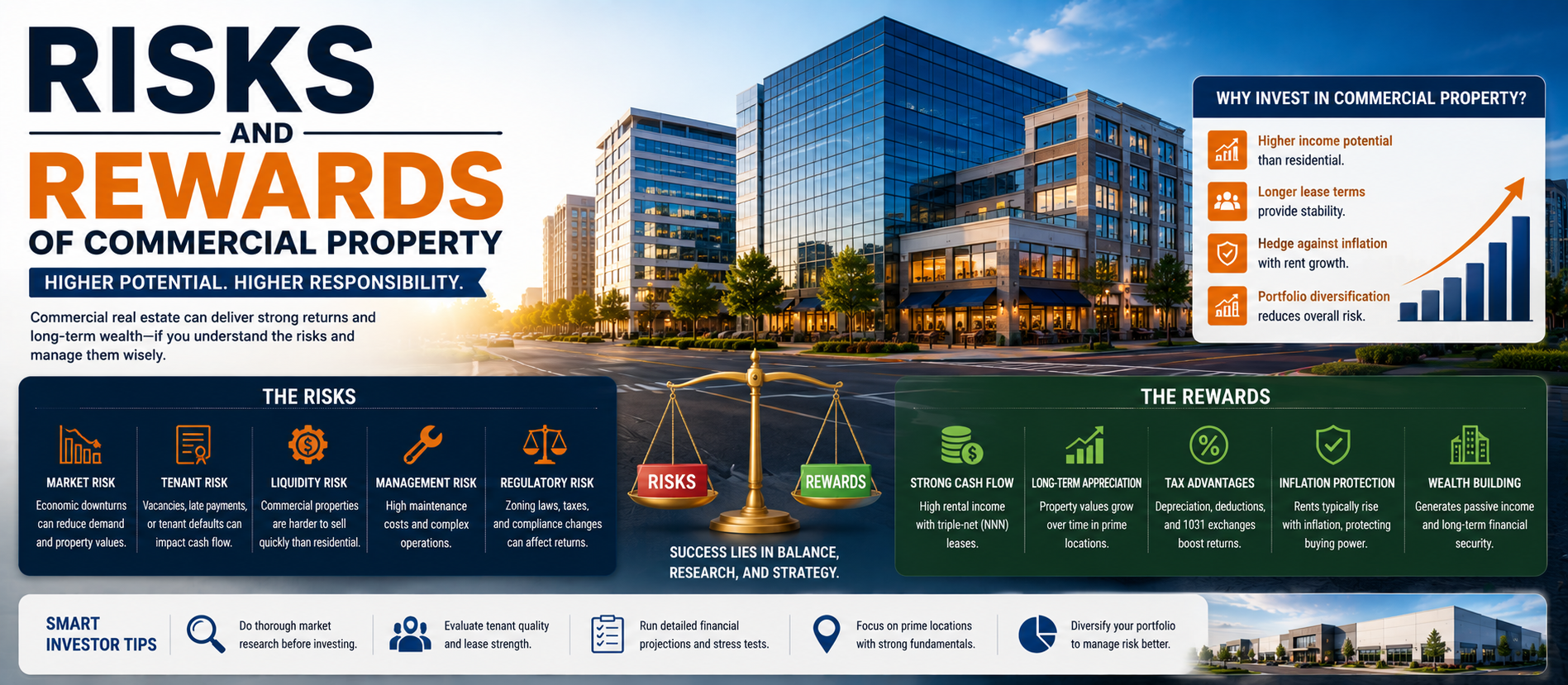
Commercial real estate has long been considered one of the most attractive investment classes for wealth creation, portfolio diversification, and passive income generation. From office buildings and retail centers to warehouses, industrial facilities, medical offices, and mixed-use developments, commercial properties offer investors opportunities that often exceed those available in residential real estate. However, with higher potential returns come unique risks that every investor must understand.
This comprehensive guide explores the major risks and rewards of commercial property investing, helping investors make informed decisions while maximizing long-term profitability.
What Is Commercial Property?
Commercial property refers to real estate used primarily for business purposes. Unlike residential real estate, commercial properties generate income through business tenants and commercial activities.
- Office buildings
- Retail centers
- Shopping malls
- Industrial facilities
- Warehouses
- Medical offices
- Hotels
- Mixed-use developments
- Apartment complexes
Why Investors Choose Commercial Real Estate
Commercial properties attract investors because of their income potential, scalability, and wealth-building opportunities.
- Higher rental income
- Longer lease terms
- Professional tenants
- Portfolio diversification
- Appreciation potential
- Tax advantages
Reward #1: Strong Cash Flow Potential
One of the biggest attractions of commercial property is the ability to generate substantial cash flow. Commercial leases often produce significantly higher rental income compared to residential properties.
Businesses are frequently willing to pay premium rents for desirable locations that support operations and customer access.
Reward #2: Longer Lease Agreements
Commercial leases commonly range from three to ten years or more. Longer lease terms provide greater income stability and reduce turnover costs.
This predictability allows investors to forecast revenue more accurately and improve financing opportunities.
Reward #3: Property Appreciation
Commercial property values can increase significantly over time. Appreciation may result from market growth, infrastructure improvements, economic expansion, and increased rental income.
Investors can build substantial equity through both market appreciation and strategic property improvements.
Reward #4: Inflation Protection
Commercial real estate often serves as an effective hedge against inflation.
- Rental rates may increase over time.
- Property values often rise alongside inflation.
- Lease agreements may include escalation clauses.
These factors help preserve purchasing power during inflationary periods.
Reward #5: Professional Tenant Relationships
Commercial tenants generally operate businesses and often maintain a professional approach to lease obligations. Many tenants invest heavily in their locations, encouraging long-term occupancy.
Reward #6: Tax Advantages
Commercial property owners may benefit from various tax advantages including depreciation, operating expense deductions, mortgage interest deductions, and capital improvement incentives.
Risk #1: High Initial Investment Requirements
Commercial properties often require significantly larger capital investments than residential properties.
- Larger down payments
- Higher acquisition costs
- Increased due diligence expenses
- Greater financing requirements
This can create barriers for new investors.
Risk #2: Vacancy Risks
Vacancy represents one of the largest risks in commercial investing. When a commercial tenant leaves, finding a replacement can take considerable time.
Extended vacancies may reduce cash flow and create financial pressure.
Risk #3: Economic Sensitivity
Commercial real estate performance often depends heavily on economic conditions.
- Business closures
- Economic recessions
- Changing consumer behavior
- Industry disruptions
These factors can affect tenant demand and rental income.
Risk #4: Financing Challenges
Commercial financing is generally more complex than residential lending.
Lenders closely examine:
- Net operating income
- Debt service coverage ratio
- Tenant quality
- Occupancy rates
- Property condition
Risk #5: Property Management Complexity
Commercial properties frequently require specialized management expertise.
- Tenant negotiations
- Lease administration
- Vendor coordination
- Building maintenance
- Regulatory compliance
Poor management can significantly reduce profitability.
Risk #6: Market Changes and Industry Shifts
Changes in technology, consumer preferences, and business operations can affect property demand.
Examples include remote work trends impacting office demand and e-commerce growth influencing retail properties.
How to Reduce Commercial Property Risks
- Conduct thorough market research
- Analyze tenant quality
- Diversify property types
- Maintain financial reserves
- Perform detailed due diligence
- Work with experienced professionals
Evaluating Commercial Investment Opportunities
Before purchasing a commercial property, investors should analyze:
- Location quality
- Local economic conditions
- Occupancy history
- Tenant stability
- Cash flow performance
- Future development plans
The Role of Technology in Commercial Real Estate
Modern investors increasingly rely on AI-powered analytics, predictive market data, property management platforms, and automation tools to identify opportunities and reduce operational risks.
SEO, AEO, GEO, and AI Search for Commercial Real Estate
Commercial real estate businesses can attract investors and tenants by optimizing content for SEO, AEO (Answer Engine Optimization), GEO (Generative Engine Optimization), and AI Search.
Educational content covering financing, investment analysis, commercial leasing, market trends, and risk management helps improve visibility across Google, Bing, ChatGPT, Gemini, Perplexity, and emerging AI search platforms.
Frequently Asked Questions
Is commercial real estate riskier than residential real estate?
Commercial real estate often involves larger investments and more complex market dynamics, but it can also generate higher returns.
What commercial property type offers the best returns?
Returns vary by location, market conditions, and management quality. Industrial, multifamily, and well-located retail assets are often popular choices.
Can beginners invest in commercial property?
Yes. Many investors begin through partnerships, syndications, REITs, or smaller commercial properties.
Final Thoughts
Commercial real estate offers a compelling combination of cash flow, appreciation potential, inflation protection, and portfolio diversification. However, investors must also navigate risks including vacancies, financing challenges, economic cycles, and management complexity.
The most successful investors carefully balance risk and reward through research, planning, diversification, and professional guidance. With the right strategy, commercial property can become a powerful long-term wealth-building asset.
Digiifrog helps real estate professionals, investors, brokers, and developers increase visibility through advanced SEO, AEO, GEO, AI Search optimization, content marketing, and digital growth solutions.
Website: www.digiifrog.com
Ready to Grow?
Talk to us about a strategy tailored to your brand — we will help you stand out in search, AI discovery and social.


Comments (0)
Log in to leave a comment.