📋 Quick Summary
In this article:
Quick Answer: Repair or Replace?
When Roof Repair Usually Makes More Sense
1. The Damage Is Small and Localized
2. The Roof Is Relatively Young
3. There Is Only One Small Leak
4. Most Roofing Materials Still Look Healthy
5. The Roof Has Been Properly Maintained
When Roof Replacement Usually Makes More Sense
1. Damage Is Widespread
2. Repairs Keep Failing
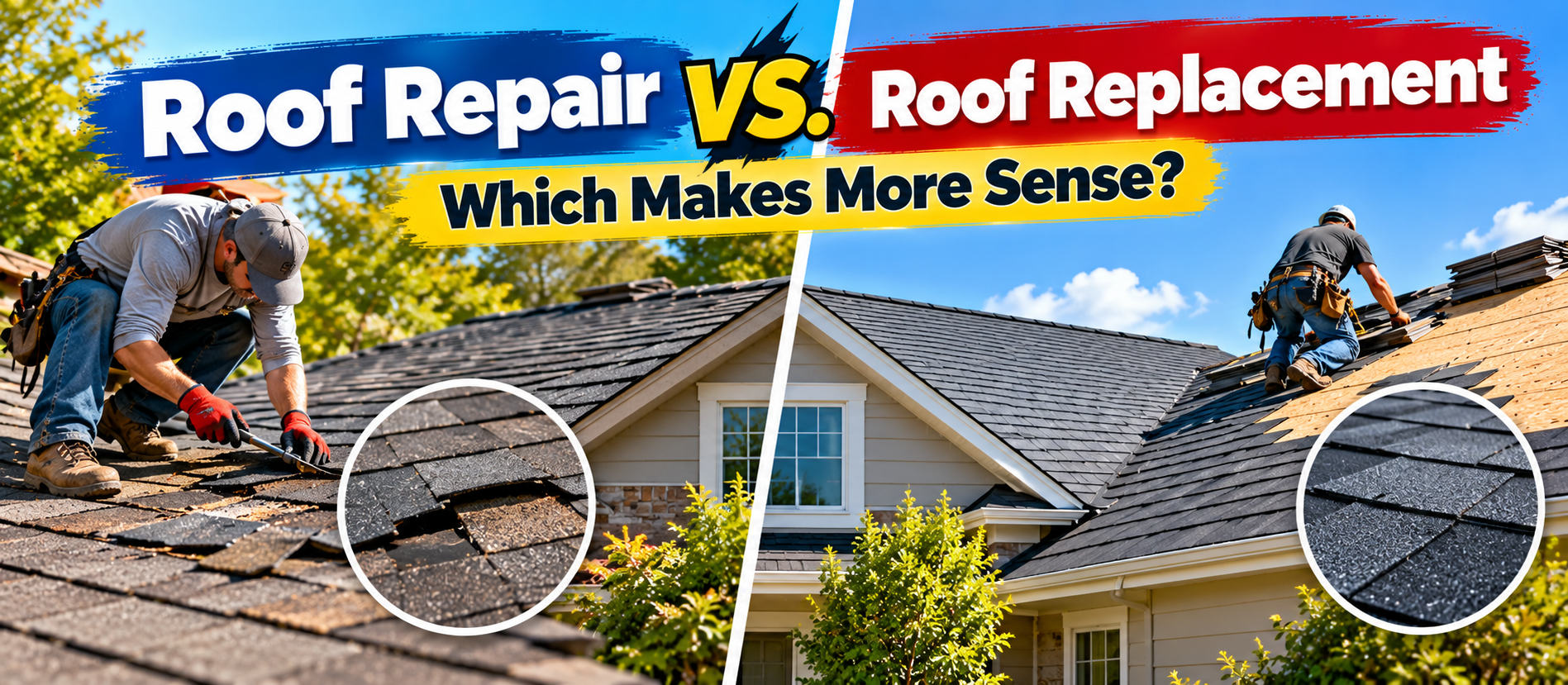
Your roof protects your home from rain, wind, heat, moisture, and other weather conditions. When a roofing problem appears, one of the first questions homeowners ask is simple: Should I repair my roof or replace it?
The right answer depends on the size of the damage, the age and condition of the roof, the roofing material, the condition of the roof deck, the number of previous repairs, and your long-term plans for the property.
A small leak does not automatically mean you need a new roof. In the same way, replacing one damaged shingle does not solve a roof that has widespread deterioration. Making the right choice requires a careful inspection and a clear understanding of the problem.
In this guide, we compare roof repair vs. roof replacement in practical terms. You will learn when repair usually makes sense, when replacement becomes more reasonable, what warning signs to look for, how cost should be evaluated, and what questions to ask a roofing contractor.
Quick Answer: Repair or Replace?
Roof repair usually makes more sense when the damage is localized and the rest of the roof is in good condition. Examples include a small flashing problem, a limited leak, a few damaged shingles, or a small area of storm damage.
Roof replacement usually makes more sense when damage is widespread, the roof is near the end of its useful life, repeated repairs are becoming expensive, or the underlying roof system has significant deterioration.
The decision should not be based on roof age alone. A relatively old roof can sometimes remain serviceable after targeted repairs, while a newer roof can require major work after severe storm damage or poor installation.
What Is Roof Repair?
Roof repair means correcting a specific problem without replacing the entire roofing system. The work may involve replacing damaged shingles, fixing flashing, sealing a localized penetration, repairing a small damaged section, correcting a leak source, or replacing selected roofing components.
FEMA guidance describes roof repair and replacement as work that can involve different parts of a roof system, including drainage, flashing, vents, roofing membranes, insulation, roof decks, and related components. The scope can range from a localized area to a large portion of the roof.
A good repair should address the actual cause of the problem. Simply covering visible water stains or applying a temporary patch without finding the source may not provide a durable solution.
What Is Roof Replacement?
Roof replacement involves removing the existing roofing material and installing a new roofing system. Depending on the property and roofing type, replacement may also involve repairing or replacing damaged decking, underlayment, flashing, vents, drip edges, gutters, or other components.
In many replacement projects, the roof can be inspected more thoroughly because old covering materials are removed. This can reveal hidden moisture damage, deteriorated decking, failed fasteners, or other conditions that were not visible from the surface.
FEMA distinguishes roof replacement from repair by describing replacement as removing the existing roof covering, addressing damaged substrate where necessary, and installing a new roof covering.
When Roof Repair Usually Makes More Sense
1. The Damage Is Small and Localized
If a roof has one clearly defined damaged area and the surrounding roofing is in good condition, repair may be the most practical option.
For example, a few missing shingles after a storm may not justify replacing an otherwise healthy roof. A damaged flashing detail around a vent may also be repairable without replacing the whole roof.
2. The Roof Is Relatively Young
A newer roof may still have substantial service life remaining. If an inspection shows that most of the roofing system is sound, a targeted repair can make financial sense.
However, the roof's installation quality, material type, weather exposure, maintenance history, and local conditions should also be considered.
3. There Is Only One Small Leak
A single leak does not automatically mean the roof has failed. Water can enter through damaged flashing, a roof penetration, a small opening, or a localized section of roofing.
The important point is to identify the actual entry point. Water can travel along roofing layers or framing before appearing as an interior ceiling stain, so the visible stain may not be directly below the roof defect.
4. Most Roofing Materials Still Look Healthy
If the majority of shingles, tiles, metal panels, membrane areas, or other roofing materials remain in good condition, replacing only damaged areas may be appropriate.
5. The Roof Has Been Properly Maintained
Regular inspection and maintenance can help identify minor issues before they become larger problems. FEMA recommends routine inspection of roof surfaces and drainage areas and addressing damage before it creates larger vulnerabilities.
When Roof Replacement Usually Makes More Sense
1. Damage Is Widespread
If large areas of the roof are damaged, repeated patching may become inefficient. A roof with extensive deterioration may need a complete replacement instead of a series of isolated repairs.
2. Repairs Keep Failing
Repeated leaks in different locations are a warning sign. If a contractor has repaired one area several times and new problems continue to appear, the roofing system may be approaching the end of its practical service life.
3. The Roof Is Near the End of Its Expected Life
Every roofing material has a typical service-life range, but there is no universal replacement age. Asphalt shingles, metal, tile, slate, and low-slope roofing systems behave differently.
Age becomes more important when it appears together with widespread wear, recurring leaks, missing materials, exposed underlayment, sagging, or other signs of deterioration.
4. The Roof Deck Has Significant Damage
The roof covering is only one part of the system. If moisture has damaged the roof deck or supporting components, replacing surface materials alone may not solve the problem.
FEMA notes that roof work may extend beyond the outer covering to the substrate, deck, and supporting system when conditions require it.
5. You Are Planning a Major Home Project
If you are adding solar, changing roof-mounted equipment, remodeling an attic, or making another major improvement that depends on a reliable roof, replacement may be worth considering if the existing roof is already near the end of its service life.
The U.S. Department of Energy advises homeowners considering solar to think about whether the roof will need repair or replacement during the solar system's life. Coordinating roof work and solar installation can sometimes avoid removing and reinstalling panels later.
Roof Repair vs. Roof Replacement: Side-by-Side Comparison
| Factor Roof Repair Roof Replacement | ||
| Damage | Usually localized | Usually widespread or systemic |
| Upfront cost | Usually lower | Usually higher |
| Project duration | Usually shorter | Usually longer |
| Best for | Small defects and isolated leaks | Old or extensively damaged roofs |
| Remaining roof life | Usually substantial | Often limited or uncertain |
| Structural work | May be limited | More opportunity to inspect and replace damaged substrate |
| Long-term planning | Useful for extending service life | Useful for resetting the roof's service life |
Common Signs You May Need Roof Repair
- A small, clearly identified leak
- A few missing or damaged shingles
- Localized flashing damage
- A damaged roof vent or penetration
- A small area of storm damage
- Minor damage around a skylight
- Limited loose or missing fasteners on certain roofing systems
- Localized damage that has not affected the roof deck
These signs do not prove that repair is the right answer. They simply indicate situations where a repair assessment is reasonable.
Common Signs You May Need Roof Replacement
- Widespread missing or damaged roofing materials
- Repeated leaks across different parts of the roof
- Large areas of deteriorated roofing
- Significant roof deck damage
- Persistent moisture problems
- Visible sagging or major structural concerns
- A roof that is near the end of its expected service life and showing extensive wear
- Frequent repairs with rising costs
- Storm damage affecting a large portion of the roof
- Roofing materials that can no longer be reliably repaired or matched
Why Roof Leaks Should Never Be Ignored
A roof leak can start as a small problem and become a larger building issue. Moisture can damage insulation, ceilings, drywall, wood framing, and other materials. Persistent moisture can also contribute to mold and deterioration.
Roof leaks can be difficult to diagnose because water may travel before it becomes visible inside the home. A ceiling stain is therefore a reason for investigation, not simply a reason to repaint the ceiling.
Energy.gov building-science guidance emphasizes the importance of controlling rainwater and checking roofing assemblies for water infiltration and damaged materials.
Roof Age: Important, But Not the Only Factor
Homeowners often ask, “How old is too old for a roof?” There is no single number that answers this question for every roof.
Roof age should be considered alongside:
- Roofing material
- Installation quality
- Local weather exposure
- Ventilation
- Maintenance history
- Previous repairs
- Moisture exposure
- Storm damage
- Condition of flashing and drainage
- Condition of the roof deck
A professional inspection is more useful than using age alone as a replacement trigger.
How Weather Affects the Repair-or-Replace Decision
Roofs face continuous exposure to wind, rain, heat, humidity, snow in some climates, hail in some regions, and temperature changes. Severe weather can accelerate deterioration.
After a major storm, look for missing roofing materials, loose components, damaged flashing, blocked drainage, visible openings, and interior water stains. Do not assume a roof is safe simply because damage is not obvious from ground level.
FEMA guidance on roof coverings notes that damaged or decayed materials and connections can allow wind-driven rain to enter a building and increase vulnerability.
Repairing a Roof After Storm Damage
Storm damage can create a difficult decision because some damage is localized while other damage affects a large portion of the roof.
A qualified inspection should determine:
- How much roofing material is damaged
- Whether the underlayment is affected
- Whether flashing has failed
- Whether the roof deck is damaged
- Whether water entered the building
- Whether similar damage exists in multiple areas
- Whether the roof can be repaired with compatible materials
Do not let a contractor recommend full replacement solely because the roof is not new. At the same time, do not choose a cheap patch if the inspection shows that the entire system is deteriorating.
How Multiple Repairs Affect the Decision
One repair is not necessarily a problem. Several repairs over many years can also be normal for an aging roof.
The concern begins when repairs become frequent, expensive, or ineffective. If you are repeatedly paying for different leaks and damaged areas, compare the total repair cost with the cost and expected value of replacement.
For example, repairing one flashing problem may be sensible. Repairing five separate leaks in an aging roof within a short period may suggest that a broader solution deserves consideration.
Consider the Roof's Whole System
A roof is more than the visible surface. Depending on the design, a roofing system can include:
- Roof covering
- Underlayment
- Flashing
- Roof deck
- Ventilation components
- Drip edges
- Drainage systems
- Gutters and downspouts
- Insulation
- Roof-mounted equipment
FEMA's roofing maintenance guidance identifies several of these components as part of roof repair and replacement work.
A good contractor should explain which part has failed and why the proposed solution addresses the actual cause.
Roof Repair Cost vs. Roof Replacement Cost
Repair is usually less expensive than replacement because the work is limited. However, cost alone should not decide the project.
Roof repair pricing can depend on the location and size of the damaged area, roofing material, accessibility, labor, flashing, underlayment, and whether hidden damage is discovered.
Roof replacement pricing can depend on roof size, pitch, material, tear-off requirements, decking repairs, flashing, ventilation, disposal, access, labor, permits, and local requirements.
The cheapest quote may not be the best value. A low price that does not address the underlying problem can lead to another repair later.
Think About Long-Term Value
A repair may be the best choice when it safely extends the useful life of a healthy roof. Replacement may be the better value when the roof is deteriorating and continued repairs are simply delaying an inevitable project.
Ask yourself:
- How much life is likely left in the existing roof?
- How many major repairs have been completed?
- Are new problems appearing in different areas?
- Is the roof protecting the home reliably?
- Will another repair solve the actual cause?
- Are you planning to sell the property?
- Are you planning solar or another roof-mounted upgrade?
- Can you afford to postpone replacement if the roof is deteriorating?
Roof Repair May Be Better for a Short-Term Property Plan
If you plan to sell a property soon, a limited repair may sometimes make more sense than a full replacement, particularly when the roof is still serviceable.
However, this should be evaluated carefully. A roof with serious defects can affect buyer confidence, inspection results, financing, insurance, and negotiations.
Do not hide roof problems. Proper documentation of completed repairs can help provide buyers with a clearer maintenance history.
Roof Replacement May Be Better for Long-Term Ownership
If you plan to remain in the home for many years and the roof is already showing widespread deterioration, replacement may offer greater long-term value.
A new roof can provide a fresh roofing system, updated components, new warranty coverage where applicable, and an opportunity to address hidden substrate or flashing issues.
Replacement is also an opportunity to review ventilation, drainage, insulation, and roof-mounted equipment rather than treating the roof covering as an isolated component.
Roofing Material Matters
The repair-or-replace decision varies by material.
Asphalt Shingles
Localized missing or damaged shingles can often be repaired. Replacement becomes more likely when shingles are extensively deteriorated, brittle, missing across large areas, or near the end of their useful life.
Metal Roofing
Metal roofs may have repairable panel, fastener, flashing, or sealant issues. Widespread corrosion, large damaged areas, or systemic installation problems may require more extensive work.
Tile Roofing
Individual broken tiles may sometimes be replaced. However, underlayment and supporting components also need assessment when leaks occur.
Flat or Low-Slope Roofing
Low-slope systems can develop membrane, flashing, drainage, ponding, and insulation problems. The correct solution depends heavily on the roofing system and the extent of moisture intrusion.
Do Not Ignore the Roof Deck
One of the biggest differences between a surface repair and a more serious roofing project is the condition of the substrate or deck.
If the roof deck is soft, rotten, structurally damaged, or significantly affected by moisture, simply replacing surface materials may not be enough.
A professional should explain whether deck repairs are needed and whether the quoted replacement price includes a specific allowance or unit price for damaged decking.
Roof Replacement and Solar Panels
If your home has solar panels, roof planning becomes more important. Installing a new roof may require panels and mounting equipment to be removed and reinstalled.
⚠ Watch Out
The U.S. Department of Energy recommends considering roof condition when evaluating rooftop solar and notes that coordinating roof replacement with solar work can help avoid future panel removal and reinstallation.
If you are considering solar and your roof is already near the end of its service life, discuss both projects before installing new equipment.
Questions to Ask a Roofing Contractor
- What is the exact source of the problem?
- Is the damage localized or widespread?
- How much of the roof is affected?
- What is the current condition of the roof deck?
- How much useful life do you estimate remains?
- Can the roof be repaired safely?
- What would happen if we repair it instead of replacing it?
- Why are you recommending replacement?
- Will you replace damaged flashing and underlayment?
- Does the estimate include removal and disposal?
- Will you inspect the attic or roof deck where appropriate?
- What warranty applies to materials and workmanship?
- Are permits required?
- Are you insured and properly licensed where required?
- Can you provide references or examples of similar work?
What a Good Roofing Estimate Should Include
A written estimate should be detailed enough that you can compare different contractors fairly. It should identify the roofing material, scope of work, number of layers to be removed if applicable, expected deck repairs, flashing work, ventilation work, cleanup, disposal, warranty terms, payment schedule, and exclusions.
If two estimates are dramatically different, do not compare only the final price. Compare what each contractor is actually offering.
Common Mistakes Homeowners Make
Choosing Repair Only Because It Is Cheaper
A cheap repair is not a bargain if the roof needs replacement and the same problem keeps returning.
Replacing the Roof Without Understanding the Cause
Replacement is not a substitute for diagnosis. A contractor should explain why replacement is necessary.
Ignoring Attic Evidence
Water stains, damp insulation, mold-like growth, damaged wood, or daylight entering through roof areas can provide useful clues about roof performance.
Waiting Until a Small Leak Becomes a Major Leak
Small roofing problems can become more expensive when moisture reaches insulation, ceilings, walls, or structural components.
Accepting a Verbal Quote
Always get important project terms in writing.
Hiring Based Only on the Lowest Price
Roofing quality depends on materials, installation, flashing, preparation, safety, and workmanship. Price should be compared with scope and value.
Simple Roof Decision Checklist
- Small localized damage: Get a repair assessment.
- One isolated leak: Find and repair the source.
- Multiple recurring leaks: Ask whether replacement is more practical.
- Widespread material deterioration: Compare replacement options.
- Damaged roof deck: Get a detailed structural assessment.
- Severe storm damage: Document the damage and arrange a professional inspection.
- Old roof plus major wear: Request both repair and replacement estimates.
- Upcoming solar installation: Evaluate roof life before installing panels.
- Planning long-term ownership: Compare lifetime value, not just upfront cost.
Frequently Asked Questions
Is it cheaper to repair or replace a roof?
A localized repair is normally less expensive than full replacement. But if the roof has widespread deterioration or repeated failures, replacement may provide better long-term value.
How do I know if my roof needs replacement?
Look at the overall condition rather than one symptom. Widespread damage, repeated leaks, significant deck deterioration, extensive material wear, and frequent repairs can all indicate that replacement deserves serious consideration.
Does one roof leak mean I need a new roof?
No. A single leak can come from a localized defect such as damaged flashing, a penetration, or a small damaged area. The source should be identified before deciding on replacement.
Can a damaged roof deck be repaired?
In many cases, damaged sections can be replaced as part of a larger roofing repair or replacement project. The appropriate method depends on the extent and type of damage.
Should I repair a roof before selling my house?
It depends on the roof's condition and your property strategy. Minor repairs may be sensible, while a severely deteriorated roof can affect buyer negotiations and inspections. Get a professional assessment before deciding.
Can I replace only part of my roof?
Sometimes. Partial replacement can make sense when damage is limited and the existing roofing materials can be properly integrated. Material compatibility and the overall roof condition should be evaluated first.
How long can I wait to repair a roof leak?
Do not assume a leak will remain small. Moisture can cause secondary damage. Arrange an inspection as soon as practical, especially after active leaking or severe weather.
Should roof replacement include new flashing?
Flashing is a critical part of water management around roof penetrations, walls, chimneys, skylights, and other transitions. Ask the contractor what flashing will be replaced, reused, or repaired and why.
Does a new roof improve energy efficiency?
A roof project can provide an opportunity to improve insulation, ventilation, air sealing, and other building-envelope details. The actual energy benefit depends on the existing construction and the improvements included in the project.
Should I get more than one roofing estimate?
Yes. Multiple detailed estimates can help you understand whether the recommended work is consistent. Compare scope, materials, warranties, repair assumptions, and exclusions instead of comparing price alone.
Final Verdict: Roof Repair or Roof Replacement?
Choose roof repair when the problem is limited, the roofing system is generally healthy, and a professional can correct the actual cause.
Choose roof replacement when the roof has widespread damage, significant structural or deck problems, recurring failures, extensive deterioration, or limited useful life remaining.
The smartest decision is rarely based on age or price alone. It comes from understanding the condition of the complete roofing system and comparing the short-term cost of repair with the long-term value of replacement.
Before spending money on either option, get a detailed inspection from a qualified roofing professional. Ask for the findings in writing. Request both repair and replacement options when the situation is not obvious. Then compare the scope, expected service life, warranties, maintenance needs, and total cost.
A well-maintained roof protects your home, belongings, and investment. Whether that protection comes from a targeted repair or a complete replacement depends on the condition of the roof today and the goals you have for the property tomorrow.
For more practical home-service, business, digital marketing, SEO, AEO, GEO, and AI Search content, visit Digiifrog at www.digiifrog.com.
Reference Sources
- FEMA – Maintenance Recommendations and Retrofit Options for Roof Coverings
- FEMA – Roof Repair and Replacement Guidance
- U.S. Department of Energy – Consumer's Guide to Buying a House with Solar Panels
- U.S. Department of Energy – Should I Replace My Rooftop Solar System?
Ready to Grow?
Talk to us about a strategy tailored to your brand — we will help you stand out in search, AI discovery and social.

Comments (0)
Log in to leave a comment.