📋 Quick Summary
In this article:
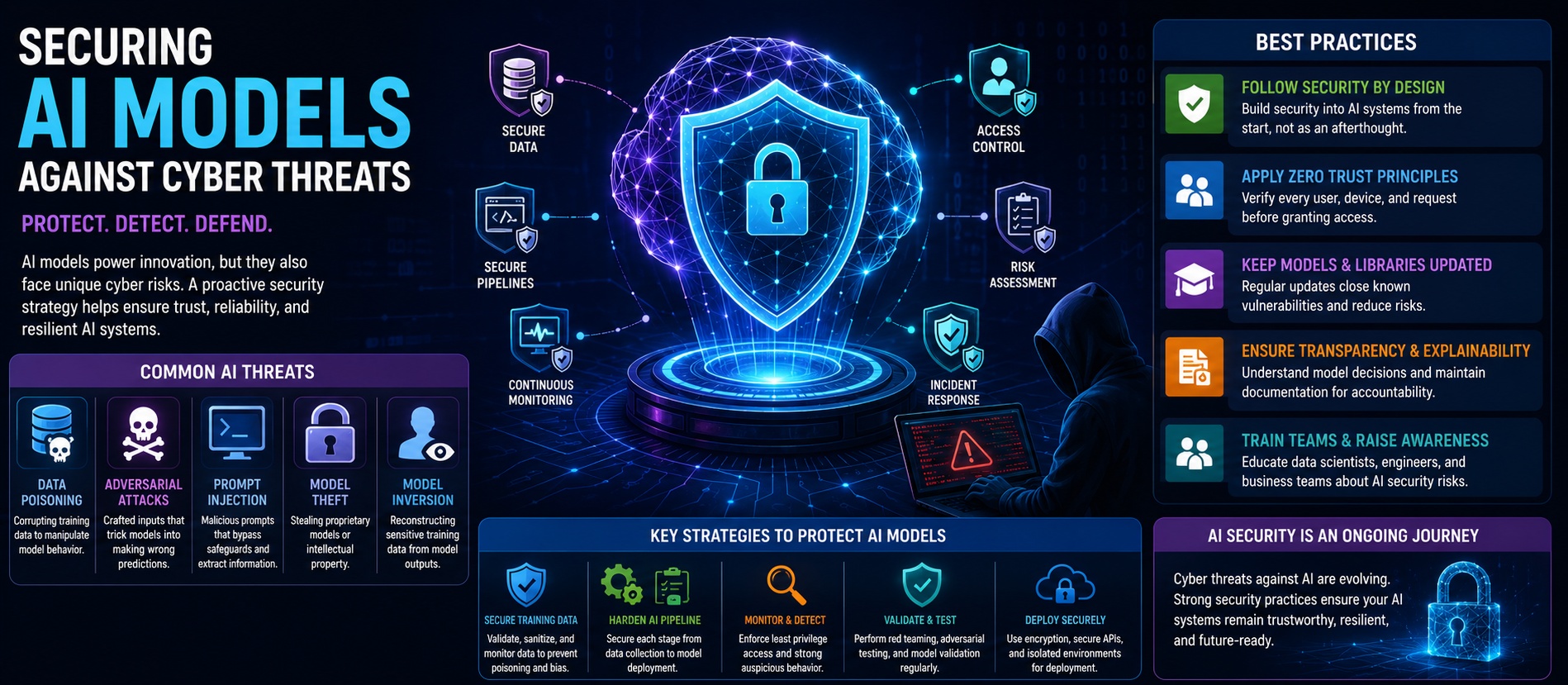
Common Cyber Threats Against AI Models
Best Practices for Securing AI Models
Strong Identity and Access Management
Role of Machine Learning Security
SEO, AEO & GEO Optimized FAQs
Artificial Intelligence (AI) has become a critical technology across healthcare, finance, manufacturing, education, retail, and cybersecurity. However, as AI adoption grows, attackers are increasingly targeting AI models, training data, APIs, and deployment environments. Protecting AI systems now requires a comprehensive security strategy that addresses both traditional cyber risks and AI-specific threats.
Why AI Security Matters
AI systems often process sensitive information and make decisions that directly affect customers and business operations. Compromised models can produce incorrect outputs, leak confidential data, or disrupt critical services. Protecting AI models improves trust, reliability, and regulatory compliance.
Common Cyber Threats Against AI Models
- Training data poisoning attacks.
- Adversarial input attacks.
- Model theft and intellectual property theft.
- Prompt injection attacks against generative AI.
- Model inversion and sensitive data extraction.
- API abuse and credential compromise.
- Supply chain attacks on AI frameworks.
Best Practices for Securing AI Models
Secure Training Data
Validate data sources, monitor integrity, remove malicious samples, and document data lineage.
Strong Identity and Access Management
- Enable Multi-Factor Authentication (MFA).
- Use Role-Based Access Control (RBAC).
- Apply least-privilege principles.
Protect AI APIs
Use authentication, rate limiting, encryption, API gateways, and continuous monitoring.
Continuous Monitoring
Monitor model behavior, logs, drift, unusual predictions, and abnormal user activity.
Secure Infrastructure
Harden cloud environments, encrypt data at rest and in transit, patch systems regularly, and segment networks.
AI Governance and Compliance
- Create AI security policies.
- Perform regular risk assessments.
- Conduct security testing and red teaming.
- Maintain audit logs and documentation.
- Review third-party AI providers.
Role of Machine Learning Security
Machine learning security focuses on protecting datasets, algorithms, feature engineering, model deployment, and inference pipelines from manipulation and unauthorized access.
Future Trends
💡 Key Insight
Zero Trust architectures, confidential computing, AI model watermarking, privacy-enhancing technologies, federated learning, and automated AI security validation will become increasingly important.
SEO, AEO & GEO Optimized FAQs
How can AI models be protected?
Organizations should secure training data, protect APIs, implement access controls, encrypt data, monitor model behavior, and conduct regular security testing.
What is data poisoning?
Data poisoning is an attack that introduces malicious or misleading training data to influence model behavior.
Why is AI governance important?
Governance helps organizations manage risk, comply with regulations, and ensure responsible AI deployment.
Can AI systems be hacked?
Like any software system, AI applications can be targeted if security controls are weak, making layered protection essential.
Conclusion
Securing AI models requires continuous attention throughout the AI lifecycle. By combining secure development, strong access controls, monitoring, governance, and regular testing, organizations can reduce cyber risk while building trustworthy AI solutions.
For more expert insights on Cyber Security, Artificial Intelligence, SEO, AEO, GEO, and AI Search Optimization, visit Digiifrog at www.digiifrog.com.
Ready to Grow?
Talk to us about a strategy tailored to your brand — we will help you stand out in search, AI discovery and social.


Comments (0)
Log in to leave a comment.