📋 Quick Summary
In this article:
Can Smart Home Technology Increase Property Value?
1. Smart Thermostats
2. Smart Lighting
3. Smart Security Systems
4. Smart Locks and Access Control
5. Smart Water Leak Detection
6. Smart Energy Monitoring
7. Smart Appliances
8. Smart Shades and Window Controls
9. Smart Irrigation
10. Whole-Home Automation
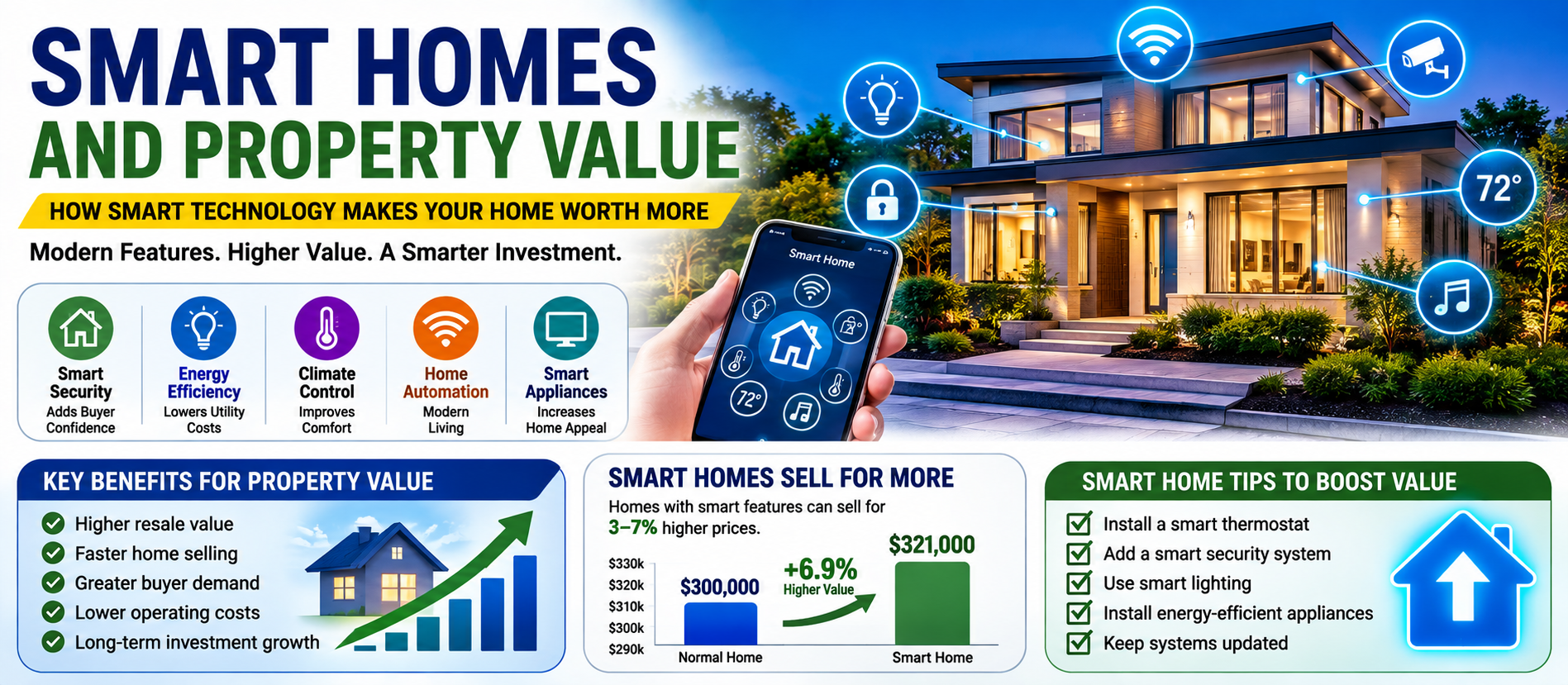
Smart homes and property value are becoming increasingly connected as homeowners, buyers, landlords, and real estate professionals pay more attention to technology, energy efficiency, security, comfort, and convenience. Smart thermostats, connected lighting, security cameras, smart locks, leak sensors, energy monitors, automated shades, and integrated home systems can make a property more functional. However, not every smart device automatically increases a home's market value.
The real value of smart home technology depends on factors such as the quality of the installation, usefulness of the system, energy savings, security benefits, ease of use, buyer demand, compatibility, maintenance requirements, and the overall quality of the property. A sophisticated system that is difficult to operate may be less appealing than a simple, reliable setup that solves everyday problems.
Energy efficiency can be particularly relevant. U.S. Department of Energy research has found relationships between home energy performance and sale prices in markets using Home Energy Score assessments. One Berkeley Lab study found that final sale prices were 0.5% higher for each one-point increase in the 10-point Home Energy Score scale in the studied markets. citeturn0search2
⚠ Watch Out
This guide explains which smart home features can add practical value, how technology can support energy efficiency and security, what buyers should consider, how sellers can present smart upgrades, common mistakes to avoid, and how real estate businesses can use SEO, AEO, GEO, and AI Search optimization to attract technology-focused property buyers.
This WordPress-ready HTML article is prepared for Digiifrog (www.digiifrog.com).
What Is a Smart Home?
A smart home uses connected devices and software to automate, monitor, or remotely control household functions. Devices may communicate through Wi-Fi, Bluetooth, hubs, or other connectivity standards and can often be controlled through mobile applications, voice assistants, schedules, or automated routines.
Smart technology can control lighting, heating and cooling, entry systems, appliances, cameras, irrigation, water detection, energy usage, and other home functions.
Can Smart Home Technology Increase Property Value?
It can contribute to a property's appeal and, in some cases, support a higher market value, but there is no universal dollar amount that every smart device adds to a home. Buyers may value technology differently depending on location, price range, age of the property, lifestyle, and local market expectations.
The strongest smart-home investments usually solve a clear problem. Energy-saving equipment may help reduce operating costs, while security systems can provide convenience and peace of mind. Technology that is permanently integrated into the property may also be more valuable than inexpensive gadgets that buyers can easily purchase themselves.
1. Smart Thermostats
Smart thermostats are among the most practical connected-home upgrades. They can allow homeowners to schedule heating and cooling, adjust settings remotely, and sometimes learn household patterns.
Because heating and cooling can represent a significant part of household energy use, a well-configured smart thermostat can improve comfort and potentially reduce unnecessary energy consumption. DOE research also highlights the potential of automated controls to reduce energy use more effectively than simple energy-monitoring tools. citeturn0search12
2. Smart Lighting
Smart lighting can provide scheduling, remote control, dimming, occupancy-based automation, and scene settings. LED lighting combined with intelligent controls can make a home more efficient and convenient.
For property value, lighting technology is usually most useful when it is simple to operate and complements the home's overall design rather than becoming a complicated collection of disconnected devices.
3. Smart Security Systems
Connected security systems can include cameras, doorbells, motion sensors, alarms, smart locks, and window sensors. These features can make monitoring a property more convenient.
Security technology may be particularly attractive to families, frequent travelers, landlords, and buyers who value remote monitoring. Sellers should clearly explain what equipment remains with the property and whether subscriptions are required.
4. Smart Locks and Access Control
Smart locks can provide keyless entry, temporary access codes, remote locking, and activity notifications. They can be useful for homeowners, rental-property owners, and service providers.
However, buyers should consider battery backup, manual override options, compatibility, cybersecurity, and the ability to transfer ownership of the device.
5. Smart Water Leak Detection
Water damage can be expensive. Leak sensors can alert homeowners to unusual moisture or water flow before a small problem becomes a major incident.
For property owners, early detection can potentially reduce damage and support preventive maintenance. A smart water-monitoring system may therefore provide practical value beyond convenience.
6. Smart Energy Monitoring
Energy monitors can help homeowners understand electricity consumption and identify unusually high usage. More advanced systems can coordinate appliances, batteries, solar generation, electric vehicles, and other loads.
DOE's work on grid-interactive efficient buildings shows how connected controls, sensors, and analytics can optimize energy consumption and potentially reduce costs. citeturn0search5
7. Smart Appliances
Connected refrigerators, ovens, washing machines, dryers, and other appliances can provide remote notifications and automated functions. Their direct contribution to property value is less certain because appliances are frequently replaced and technology becomes outdated.
When choosing smart appliances for resale value, prioritize energy efficiency, reliability, mainstream compatibility, and useful functions rather than novelty features.
8. Smart Shades and Window Controls
Automated blinds and shades can control sunlight, privacy, and indoor temperature. Scheduled shading can also work with heating and cooling strategies.
These systems may be especially useful in homes with large windows, strong solar exposure, or high-end automation systems.
9. Smart Irrigation
Connected irrigation systems can adjust watering schedules based on weather, soil conditions, or programmed routines. This can improve convenience and potentially reduce unnecessary water use.
For properties with substantial landscaping, smart irrigation may be a more meaningful upgrade than decorative connected devices.
10. Whole-Home Automation
A whole-home system can connect lighting, climate, security, entertainment, shades, and other functions into one control environment. Integration can make a property feel more sophisticated and easier to manage.
However, complexity can become a disadvantage. Buyers may hesitate if they believe the system requires expensive specialist support or is difficult to operate.
11. Energy Efficiency and Property Value
Smart technology becomes more valuable when it contributes to measurable building performance. Efficient HVAC equipment, insulation, air sealing, efficient windows, solar systems, heat pumps, and smart controls can work together as a complete energy strategy.
DOE describes high-performance homes as systems in which building components work together to deliver efficiency, comfort, health, and durability. citeturn0search8
For sellers, documenting energy improvements can help buyers understand benefits that may not be visible during a standard showing.
12. Smart Homes Can Improve Comfort
Property value is not only about resale price. Comfort can also affect buyer perception. Automated temperature control, lighting scenes, motorized shades, air-quality monitoring, and quiet HVAC operation can improve the everyday experience of living in a home.
When technology works automatically in the background, buyers may perceive it as part of the home's quality rather than as a collection of gadgets.
13. Smart Technology and Home Security
Security can be one of the strongest practical arguments for connected-home technology. Doorbell cameras, motion sensors, smart locks, and alarm systems can provide alerts and remote monitoring.
Still, security technology introduces privacy and cybersecurity considerations. Owners should change default passwords, enable strong authentication where available, keep firmware updated, and remove personal accounts before transferring devices to a buyer.
14. Smart Home Technology for Rental Properties
Landlords can use smart locks, leak sensors, thermostats, energy monitoring, and maintenance alerts to improve property management. These tools can make access and preventive maintenance more efficient.
However, landlords should establish clear policies about tenant privacy, data collection, device access, and maintenance. Local landlord-tenant laws may restrict how monitoring devices are used.
15. Does Every Smart Upgrade Add Value?
No. A smart upgrade is most likely to support property appeal when it is useful, reliable, professionally installed, easy to operate, and appropriate for the property's price range.
A $50 gadget rarely adds its full purchase price to a home's market value. Buyers may instead value a complete system that improves energy efficiency, security, comfort, or convenience.
16. Focus on Useful Technology, Not Gadget Count
A home with twenty unrelated smart devices is not necessarily more valuable than a home with five well-integrated systems. Excessive complexity can create compatibility problems and maintenance costs.
A practical smart-home package might include a thermostat, lighting controls, security system, smart locks, and water-leak monitoring.
17. Compatibility Matters
Buyers want technology that works together. Before installing smart products, check compatibility, connectivity requirements, app support, and ownership-transfer procedures.
Industry standards continue to evolve, so investors should avoid creating a system that depends entirely on one discontinued product or proprietary platform.
18. Professional Installation Can Matter
💡 Key Insight
Professional installation can improve reliability, wiring quality, documentation, and system integration. This is especially important for whole-home automation, security systems, electrical equipment, and integrated HVAC controls.
Keep receipts, manuals, warranties, installation records, and system diagrams. Documentation can make a smart home easier to maintain and easier to explain to future buyers.
19. Smart Home Technology and Insurance
Some smart devices may help homeowners identify risks such as leaks, smoke, or unauthorized entry. Whether a device qualifies for an insurance discount depends on the insurer, policy, location, and approved equipment.
Do not advertise a guaranteed insurance saving unless the insurer has confirmed the benefit.
20. Smart Home Technology and Resale
When preparing a home for sale, sellers should present smart technology as a set of practical features rather than simply listing brand names.
Explain what each system does, what equipment stays with the property, whether subscriptions are required, how the buyer receives account access, and whether warranties can be transferred.
21. How Sellers Can Maximize Smart-Home Appeal
- Repair or remove unreliable devices.
- Make sure all systems are working before showings.
- Provide a simple smart-home feature sheet.
- Document energy-saving upgrades.
- Explain subscription costs clearly.
- Transfer ownership and accounts properly.
- Change or remove personal passwords and access codes.
- Keep manuals, warranties, and installation records.
22. Common Smart Home Mistakes
- Installing technology without a clear purpose.
- Choosing incompatible devices.
- Ignoring cybersecurity.
- Failing to update software and firmware.
- Leaving personal accounts connected when selling.
- Installing complex systems without documentation.
- Assuming every device increases property value.
- Ignoring subscription and replacement costs.
23. Smart Home ROI: What Should Homeowners Prioritize?
When budget is limited, prioritize improvements that combine usefulness with measurable operating benefits. Energy efficiency, climate control, water protection, security, and durable lighting are often easier to explain to buyers than entertainment-focused gadgets.
Consider total cost, expected lifespan, maintenance, energy savings, buyer demand, and compatibility before investing.
24. Smart Homes and Energy Performance in 2026
The broader market is moving toward homes that combine efficient building systems with connected controls. DOE's current Efficient New Homes program emphasizes energy savings, comfort, health, and durability, illustrating how modern home performance is increasingly treated as an integrated system rather than a collection of isolated products. citeturn0search0turn0search8
For property owners, this means smart technology should ideally support the home's broader efficiency strategy instead of existing separately from it.
25. SEO, AEO, GEO and AI Search for Smart-Home Real Estate Businesses
Real estate companies, home technology providers, builders, and property managers can use SEO to attract traditional search traffic, AEO to answer direct buyer questions, and GEO and AI Search optimization to improve visibility in generative search.
Useful content topics include “Do smart homes increase property value?”, “Which smart home upgrades are worth it?”, “Best smart technology for a home sale,” “How smart thermostats save energy,” and “What smart devices should stay when selling a house?”
Location-focused pages can also explain local buyer preferences, energy-efficiency standards, available incentives, installation services, and smart-home trends.
Smart Home Upgrade Checklist
- Smart thermostat
- Energy-efficient lighting and controls
- Smart locks
- Security camera or doorbell
- Water-leak sensors
- Energy monitoring
- Smart irrigation where appropriate
- Efficient HVAC and connected controls
- Reliable home networking
- Professional installation and documentation
Frequently Asked Questions About Smart Homes and Property Value
Do smart homes increase property value?
Smart technology can improve a home's appeal and may support value, but there is no universal dollar increase. The impact depends on usefulness, quality, energy performance, buyer demand, installation, and the local market.
What smart home upgrades add the most value?
Practical upgrades such as smart thermostats, security systems, smart locks, water-leak detection, efficient lighting, and integrated energy controls can be more useful than novelty devices.
Does a smart thermostat increase home value?
It may contribute to buyer appeal, especially when combined with efficient HVAC equipment and documented energy savings. It should be viewed as part of the home's overall efficiency strategy.
Should sellers leave smart devices behind?
It depends on the purchase agreement and local practice. Sellers should clearly identify which devices remain and transfer ownership or access properly.
Can smart technology reduce energy costs?
It can. Connected controls can automate heating, cooling, lighting, and other loads. DOE research indicates that automated controls can help reduce energy consumption. citeturn0search12
Are smart homes more attractive to buyers?
Many buyers appreciate technology that improves convenience, security, comfort, and efficiency. However, preferences vary, so useful and easy-to-operate systems are generally more practical than excessive automation.
Can smart home technology hurt resale value?
It can if the system is unreliable, difficult to operate, expensive to maintain, incompatible with common platforms, or tied to costly subscriptions.
Conclusion
Smart homes and property value are connected most effectively when technology delivers practical benefits that buyers can understand. Smart thermostats, energy controls, security systems, smart locks, water sensors, efficient lighting, and integrated automation can improve convenience, comfort, safety, and potentially operating costs.
However, homeowners should not install technology simply because it is fashionable. The strongest strategy is to select reliable systems, integrate them properly, document their benefits, protect user data, and maintain the equipment.
Energy performance is particularly important because it can affect both ongoing ownership costs and buyer perception. DOE research has found meaningful relationships between energy performance and home sale prices in certain markets, while current DOE programs emphasize efficiency, comfort, health, and durability as connected aspects of high-performance homes. citeturn0search2turn0search0
For real estate, property management, construction, and home-technology businesses seeking modern websites, AI-powered solutions, automated lead generation, SEO, AEO, GEO, and AI Search optimization, Digiifrog can help. Visit www.digiifrog.com.
Quick Answer: Can Smart Homes Increase Property Value?
Yes, smart home technology can contribute to property value when it improves energy efficiency, security, comfort, convenience, or property management and is reliable, well-integrated, and easy to use. However, individual devices do not automatically add their purchase price to a home's resale value. Buyers and sellers should evaluate smart technology alongside location, condition, energy performance, market demand, and the overall quality of the property.
Important Note
Property values vary by market and individual property. Smart-home technology is only one factor in valuation. Energy savings, incentives, insurance benefits, and installation requirements also vary by location, provider, equipment, and applicable rules. Consult qualified real estate, energy, electrical, insurance, and tax professionals for property-specific advice.
Ready to Grow?
Talk to us about a strategy tailored to your brand — we will help you stand out in search, AI discovery and social.


Comments (0)
Log in to leave a comment.