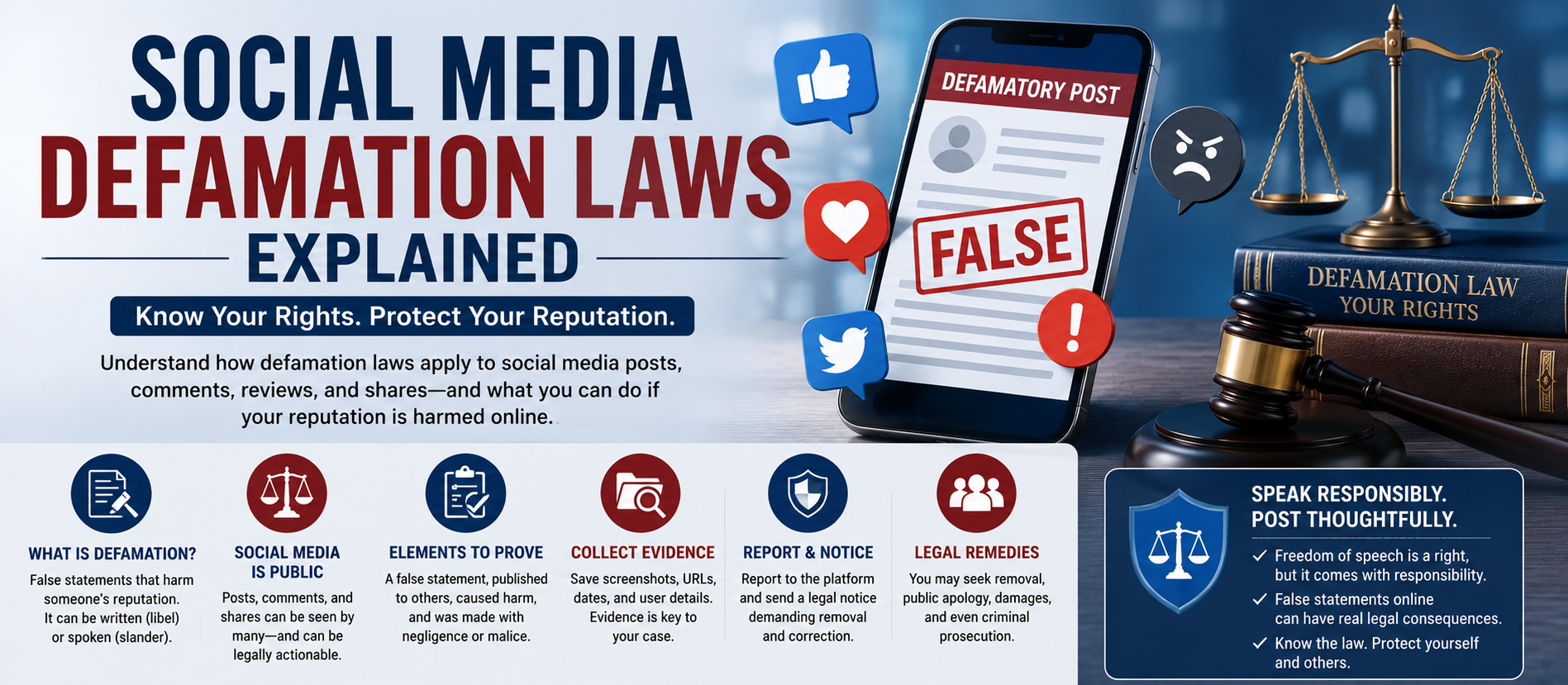
📋 Quick Summary
In this article:
How Social Media Changed Defamation Risks
Libel and Slander in the Online World
What Can Be Considered a Defamatory Social Media Statement?
Truth Is Often an Important Defense
Opinion Versus False Statements of Fact
Can You Be Defamed Through a Comment or Review?
Anonymous Accounts and Online Defamation
How to Preserve Evidence of Social Media Defamation
Social media has made communication faster than ever. A person can publish a comment, review, video, post, or message that reaches hundreds or thousands of people within minutes. While online platforms allow people to share opinions and information, they can also be used to spread false statements that seriously harm another person's reputation.
💡 Key Insight
This is where social media defamation laws become important. A harmful online statement is not automatically defamation. The law usually distinguishes between false statements presented as facts and opinions, jokes, criticism, or other protected expression.
Understanding the difference is important for individuals, businesses, creators, employees, and social media users. This guide explains social media defamation in clear language. It covers common legal concepts, evidence, possible defenses, practical response steps, and the role of platforms and AI in modern online communication.
What Is Defamation?
Defamation generally refers to a false statement that harms a person's or organization's reputation and meets the legal requirements established in the relevant jurisdiction.
The exact legal definition varies. However, a defamation claim commonly involves questions such as:
- Was a statement made about an identifiable person or organization?
- Was the statement communicated to someone else?
- Was the statement presented as a factual claim rather than protected opinion?
- Was the statement false?
- Did the statement cause reputational or other legally recognized harm?
- Did the speaker act with the level of fault required by applicable law?
Every negative comment is not defamation. A person may legally express an opinion, provide fair criticism, or describe a truthful experience, depending on the circumstances and applicable law.
How Social Media Changed Defamation Risks
Traditional defamation cases often involved newspapers, television, letters, or spoken statements. Social media changed the speed and scale of publication.
A harmful statement can be:
- Posted on a social networking platform.
- Shared through a public comment.
- Published in a video.
- Repeated by another account.
- Included in an online review.
- Sent through a group or community page.
- Republished through screenshots or reposts.
Online content can remain available for a long time and may be copied across multiple platforms. This can make reputation management and evidence preservation more difficult.
Libel and Slander in the Online World
Defamation is traditionally divided into two broad categories: libel and slander.
Libel
Libel generally refers to defamatory statements in a fixed or recorded form. Written social media posts, articles, comments, images containing statements, and some other recorded content may fall into this category depending on local law.
Slander
Slander generally refers to spoken defamatory statements. A live stream, podcast, video, or audio conversation may raise different legal questions depending on how the statement was made and preserved.
The distinction between libel and slander is not identical in every jurisdiction. Online content may involve both written and spoken communication.
What Can Be Considered a Defamatory Social Media Statement?
A social media statement may create legal risk when it makes a false factual accusation that can harm a person's or business's reputation.
For example, a statement may raise concerns if someone falsely accuses an identifiable person of committing a serious crime, engaging in professional misconduct, committing fraud, or performing an act that damages their reputation.
Context matters. Courts and legal authorities may examine the complete post, surrounding discussion, audience, language, and whether a reasonable reader would understand the statement as an assertion of fact.
Truth Is Often an Important Defense
In many legal systems, truth is an important defense to a defamation claim. However, the specific rules and burden of proof vary by jurisdiction.
This does not mean that people should publish private information simply because they believe it is true. Other laws may apply, including privacy, confidentiality, harassment, data protection, or other legal restrictions.
Before publishing serious accusations, individuals and businesses should understand the risks of sharing unverified information.
Opinion Versus False Statements of Fact
One of the most important questions in online defamation cases is whether a statement is an opinion or an assertion of fact.
Consider the difference between:
- "I did not like the service."
- "In my opinion, the company has poor customer service."
- "The company committed fraud."
The first two statements may be understood as personal opinions or experiences. The third statement may be interpreted as a factual accusation depending on the context.
Simply adding the words "in my opinion" does not automatically protect a statement. Context and the actual meaning of the communication may still matter.
Can You Be Defamed Through a Comment or Review?
Yes, a short online comment or review may potentially create legal issues if it meets the legal requirements for defamation in the relevant jurisdiction.
However, businesses should not assume that every negative review is unlawful. Customers are generally allowed to share genuine opinions and truthful experiences.
A negative review may be legally protected even when it harms a business's reputation. The key question is often whether the review contains false factual claims that meet the applicable legal standard.
Defamation Against Businesses
Businesses and organizations may also face harmful false statements online. The legal rules for business defamation vary by jurisdiction.
A company may be concerned about false claims involving:
- Fraud or criminal activity.
- Product safety.
- Professional misconduct.
- Financial dishonesty.
- False accusations about employees or owners.
Business owners should carefully distinguish between genuine customer criticism and potentially false factual allegations. Responding aggressively to legitimate criticism can create additional reputation problems.
Anonymous Accounts and Online Defamation
Anonymous accounts can make a situation more complicated. A person may publish harmful statements using a fake name or anonymous profile.
Identifying an anonymous speaker may require legal procedures, platform cooperation, or other steps permitted under applicable law. The process can vary significantly depending on the platform and jurisdiction.
Do not attempt to hack accounts, access private information illegally, or threaten suspected individuals. Preserve evidence and seek appropriate legal guidance.
How to Preserve Evidence of Social Media Defamation
Online posts can be edited or deleted quickly. If you believe a statement may be legally important, preserve evidence as soon as possible.
Useful evidence may include:
- Screenshots showing the complete post.
- The username or account name.
- Date and time information.
- The platform where the content appeared.
- Links or post identifiers, where available.
- Comments and replies that provide context.
- Evidence showing reposting or sharing.
Do not alter screenshots. Preserve the original information whenever possible.
Document the Harm
Depending on the jurisdiction and legal claim, evidence of harm may be relevant.
Possible records may include:
- Lost business opportunities.
- Cancelled contracts.
- Customer messages.
- Professional consequences.
- Financial records.
- Evidence of widespread publication.
Not every jurisdiction requires the same proof of damages. A qualified professional can explain what evidence may matter in a particular case.
What Should You Do First?
If you discover a harmful social media post, reacting immediately in anger may make the situation worse. A careful approach is usually better.
1. Save the Evidence
Take screenshots and record important details before the content disappears.
2. Read the Full Context
Do not rely on one cropped screenshot. Review the complete conversation, video, thread, or post.
3. Avoid Public Arguments
Public arguments can increase the visibility of harmful content. Consider whether a public response is necessary.
4. Review Platform Rules
Many platforms have reporting systems for harassment, impersonation, threats, privacy violations, and other content.
5. Seek Legal Advice When Appropriate
Serious allegations, significant business damage, threats, or repeated harassment may justify professional legal guidance.
Can You Ask the Platform to Remove a Post?
Social media platforms have their own content policies and reporting procedures. A post may be removable if it violates platform rules, but a platform is not required to remove every statement that a person dislikes.
⚠ Watch Out
When reporting content, provide accurate information and follow the platform's official process. Avoid making false reports.
Platform rules can change, so users should check current policies directly through the relevant service.
Sending a Legal Notice or Demand Letter
In some situations, a lawyer may send a letter requesting that a statement be removed, corrected, or otherwise addressed.
A legal notice should not be used casually as a threat. The language, legal basis, and strategy can affect the dispute.
Sending an unsupported or overly aggressive demand can sometimes increase public attention to the original post. A qualified legal professional can help evaluate the situation.
Can You Sue for Social Media Defamation?
Whether a lawsuit is available depends on the facts and applicable law. A person considering legal action may need to evaluate:
- Whether the statement is legally actionable.
- Whether the speaker can be identified.
- Whether the court has jurisdiction.
- Whether a filing deadline applies.
- What evidence is available.
- Whether measurable damages can be shown.
- Whether a legal defense may apply.
Litigation can be expensive and time-consuming. Other options, such as correction, mediation, negotiation, or platform reporting, may sometimes be more practical.
Public Figures and Higher Legal Standards
Some jurisdictions apply different standards to public officials, public figures, or individuals involved in matters of public concern.
For example, the level of fault required to establish liability may be higher in certain cases. These rules are complex and vary between jurisdictions.
A person should not assume that having a large social media following automatically makes them a public figure for every legal purpose.
Sharing Someone Else's Defamatory Post
Repeating or republishing a harmful statement may also create legal questions. Sharing a statement can expand its audience and increase reputational damage.
Legal responsibility for republication varies depending on jurisdiction, intent, platform features, context, and other factors.
Before reposting serious accusations, users should consider whether the information has been verified.
Influencers, Creators, and Defamation Risk
Influencers and content creators often comment on businesses, public events, products, and other people. Their audience size can increase the impact of a statement.
Creators should distinguish between:
- Personal opinions.
- Verified facts.
- Unconfirmed allegations.
- Satire or entertainment.
Large audiences do not remove the need for accuracy. Responsible content practices include verifying serious claims and clearly separating opinion from factual reporting.
Employees and Workplace Social Media Posts
Employees may create legal and workplace risks when they post about employers, coworkers, customers, or confidential information.
However, employees may also have certain legal rights to discuss workplace conditions, depending on local law.
Businesses should avoid assuming that every negative employee post can be punished. Employment rights and social media policies should be reviewed carefully.
Cross-Border Social Media Defamation
Social media is global. A post may be created in one country, viewed in another, and concern a person or business located somewhere else.
This creates difficult questions about:
- Which country's law applies.
- Where a claim can be filed.
- Whether a court has jurisdiction.
- How evidence can be obtained.
- How a judgment may be enforced.
Cross-border disputes often require specialized legal advice.
Social Media Defamation and AI-Generated Content
Artificial intelligence has created new challenges for online reputation. AI tools can generate realistic text, images, audio, and video. False AI-generated content may spread rapidly if users assume it is authentic.
Possible risks include:
- AI-generated false accusations.
- Deepfake videos.
- Manipulated audio.
- Fake screenshots or fabricated conversations.
- Automated accounts spreading false information.
The legal analysis may involve defamation law, privacy law, platform policies, intellectual property law, and other legal rules.
Businesses and individuals should verify digital evidence carefully before making public accusations.
How Businesses Can Reduce Defamation Risks
Businesses that publish content regularly should create clear communication policies.
Useful practices include:
- Verify serious factual claims before publishing.
- Train employees and social media teams.
- Use clear approval procedures for sensitive posts.
- Avoid publishing unverified accusations.
- Keep records supporting factual claims.
- Create a process for responding to complaints.
Responsible communication can reduce legal and reputational risk.
How to Respond to False Statements About Your Business
A business response should be strategic and professional.
Consider the following approach:
- Preserve the original post and related evidence.
- Verify whether the statement is actually false.
- Review the full context.
- Consider the size and impact of the audience.
- Determine whether a calm public response is appropriate.
- Use platform reporting tools when relevant.
- Seek professional advice for serious claims.
In some cases, a polite factual response may be better than an extended public dispute.
Common Defenses in Defamation Cases
Defenses depend on the jurisdiction, but common legal concepts may include:
- Truth or substantial truth.
- Opinion.
- Privilege in certain legal contexts.
- Lack of required fault.
- Other statutory or constitutional protections.
These defenses are highly fact-specific. A defense that applies in one jurisdiction may not apply in another.
Statutes of Limitations and Filing Deadlines
Defamation claims may have strict filing deadlines. The time period can vary significantly depending on the jurisdiction.
The date a statement was first published, republished, discovered, or otherwise legally recognized may affect the deadline. Online publication creates additional legal questions.
Do not delay if you are considering legal action. Check the relevant deadline with a qualified professional or official legal resource.
Common Mistakes to Avoid
- Responding with anger before preserving evidence.
- Sharing the harmful post and increasing its reach.
- Assuming every negative review is defamation.
- Making public threats without legal advice.
- Ignoring filing deadlines.
- Editing or manipulating evidence.
- Attempting to identify anonymous users through illegal methods.
- Posting new unverified accusations in response.
Careful documentation and professional communication are usually more effective.
SEO, AEO, GEO and AI Search Optimization for Legal Content
People increasingly search for legal information through search engines, AI assistants, answer engines, and AI-generated search results.
SEO helps useful information appear in traditional search results. AEO, or Answer Engine Optimization, focuses on direct answers to common questions. GEO, or Generative Engine Optimization, focuses on making structured information easier for generative AI systems to understand.
Legal content should use clear headings, direct explanations, accurate terminology, and simple language. However, optimization should never replace legal accuracy or jurisdiction-specific advice.
Digiifrog focuses on modern digital visibility through SEO, AEO, GEO, and AI Search optimization. Clear and well-structured content can help businesses communicate effectively across changing search environments.
Frequently Asked Questions
What is social media defamation?
Social media defamation generally involves a harmful statement published online that meets the legal requirements for defamation in the relevant jurisdiction.
Is every negative social media review defamation?
No. People can often express genuine opinions and truthful experiences. Whether a statement is legally defamatory depends on the facts and applicable law.
Can I report a defamatory post to a social media platform?
You may use the platform's official reporting process if the content violates its policies. However, platforms may not remove content solely because someone disagrees with it.
Should I respond publicly to a false post?
It depends on the situation. A calm factual response may help in some cases, while public arguments can increase attention to harmful content.
Can anonymous social media users be identified?
Possibly, but the process depends on applicable law, the platform, and available legal procedures.
How long do I have to file a defamation claim?
Filing deadlines vary by jurisdiction. You should check the applicable deadline as soon as possible.
Can AI-generated content be defamatory?
Potentially. AI-generated text, images, audio, or video can create legal issues when false content harms a person's or organization's reputation. The legal analysis depends on the facts and jurisdiction.
Conclusion
Understanding social media defamation laws is important in a world where information can spread instantly. A harmful online statement is not automatically illegal, and negative opinions are not automatically defamation.
The key legal questions often involve truth, context, whether a statement is presented as fact, publication, harm, and the legal standards of the relevant jurisdiction.
If you believe you have been harmed by a false online statement, preserve evidence, avoid emotional public reactions, review available platform procedures, and consider professional legal guidance when the matter is serious.
Businesses and individuals can also reduce risk by verifying facts, communicating responsibly, and avoiding the publication of unconfirmed accusations.
Digiifrog
Website: www.digiifrog.com
Digital Growth Through SEO, AEO, GEO & AI Search Optimization.
Ready to Grow?
Talk to us about a strategy tailored to your brand — we will help you stand out in search, AI discovery and social.


Comments (0)
Log in to leave a comment.