📋 Quick Summary
In this article:
What Are AI-Generated Phishing Emails?
How AI-Powered Phishing Works
How to Defend Against AI-Generated Phishing
SEO, AEO & GEO Best Practices
AEO & GEO Optimized FAQs
What are AI-generated phishing emails?
Why are AI phishing attacks more dangerous?
How can businesses prevent AI phishing?
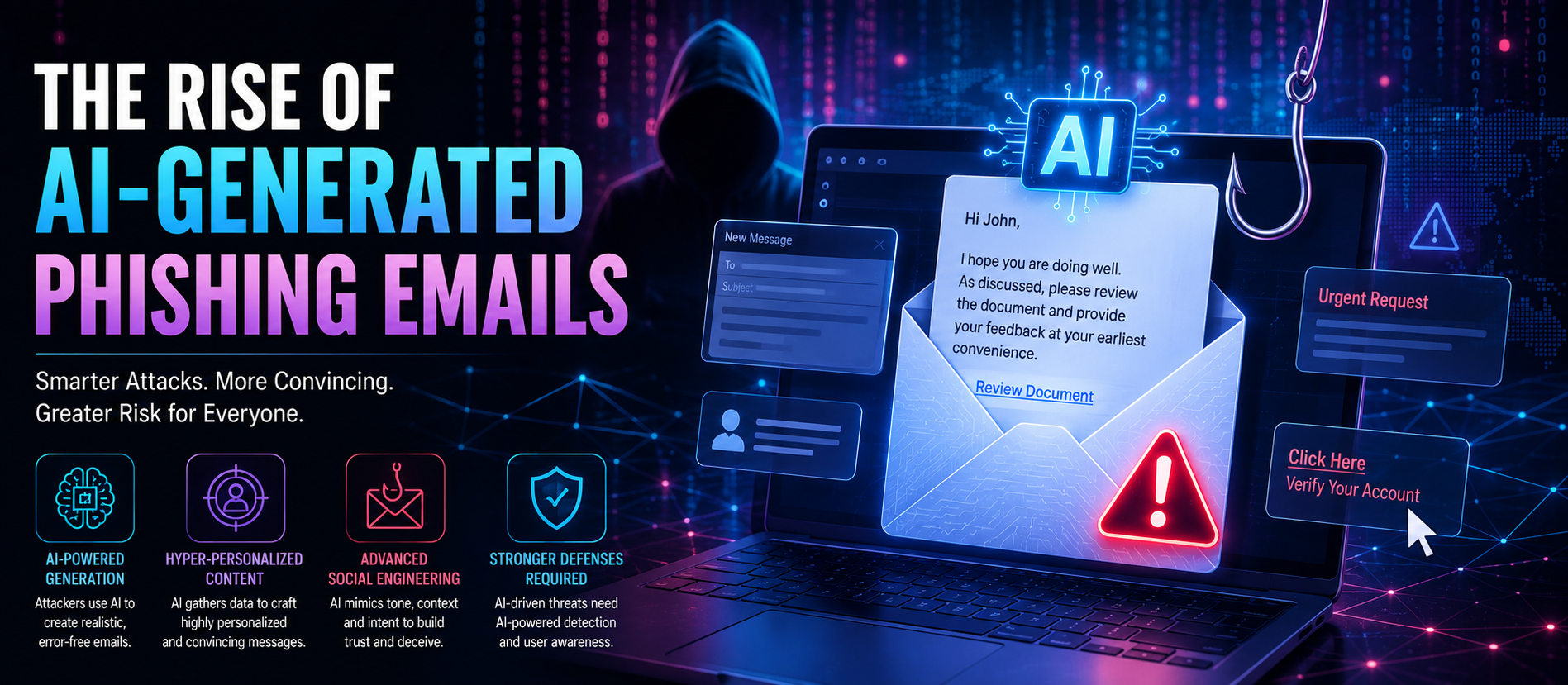
Artificial Intelligence has transformed the cyber threat landscape. One of the fastest-growing threats is the rise of AI-generated phishing emails, which use generative AI to produce convincing messages that imitate trusted brands, executives, financial institutions, and colleagues. These attacks are more personalized, grammatically correct, and scalable than traditional phishing campaigns.
This WordPress-ready guide explains how AI-generated phishing emails work, why they are increasing, their impact on businesses, and the best defense strategies. The article is optimized for SEO, AEO, GEO, and AI Search optimization.
What Are AI-Generated Phishing Emails?
AI-generated phishing emails are fraudulent messages created or enhanced with generative AI tools. Attackers can rapidly create realistic emails tailored to specific individuals or organizations, increasing the likelihood that recipients will click malicious links, download malware, or disclose sensitive information.
Why AI Phishing Is Growing
- Generative AI creates natural, error-free language.
- Large-scale personalization is easier than ever.
- Attackers can automate campaigns.
- Publicly available information enables targeted attacks.
- Remote work increases reliance on email communication.
How AI-Powered Phishing Works
- Collect public information about the target.
- Generate realistic email content.
- Imitate trusted brands or colleagues.
- Include malicious links or attachments.
- Use urgency or authority to encourage action.
Common Types of AI Phishing
- Business Email Compromise (BEC)
- Spear phishing
- Credential harvesting
- Invoice and payment fraud
- Cloud account phishing
- Executive impersonation
Business Impact
- Financial loss
- Data breaches
- Ransomware infections
- Identity theft
- Operational disruption
- Reputational damage
How to Defend Against AI-Generated Phishing
- Enable Multi-Factor Authentication (MFA).
- Use advanced email security filtering.
- Provide regular security awareness training.
- Verify unusual payment or password requests.
- Deploy DMARC, SPF, and DKIM.
- Keep systems updated and monitored.
- Implement Zero Trust security principles.
The Role of AI in Defense
AI also helps defenders by detecting suspicious patterns, identifying phishing attempts, analyzing sender behavior, and automating incident response. Combining AI-powered detection with human verification provides stronger protection.
SEO, AEO & GEO Best Practices
Use structured headings, semantic keywords, FAQs, and practical examples to improve discoverability across Google, Bing, ChatGPT, Gemini, Copilot, and other AI-powered search systems.
AEO & GEO Optimized FAQs
What are AI-generated phishing emails?
They are phishing emails created or enhanced with AI to appear more convincing and personalized.
Why are AI phishing attacks more dangerous?
They are scalable, realistic, and can be customized for specific victims, increasing success rates.
How can businesses prevent AI phishing?
Use MFA, email authentication, employee training, AI-powered email filtering, and continuous monitoring.
Conclusion
AI-generated phishing emails represent one of the biggest cyber security challenges of 2026. Organizations that combine modern email security, Zero Trust, employee awareness, and AI-assisted threat detection will be better prepared to defend against evolving phishing campaigns.
For more expert insights on Cyber Security, Cloud Security, SEO, AEO, GEO, AI Search Optimization, and Digital Transformation, visit Digiifrog at www.digiifrog.com.
Ready to Grow?
Talk to us about a strategy tailored to your brand — we will help you stand out in search, AI discovery and social.


Comments (0)
Log in to leave a comment.