📋 Quick Summary
In this article:
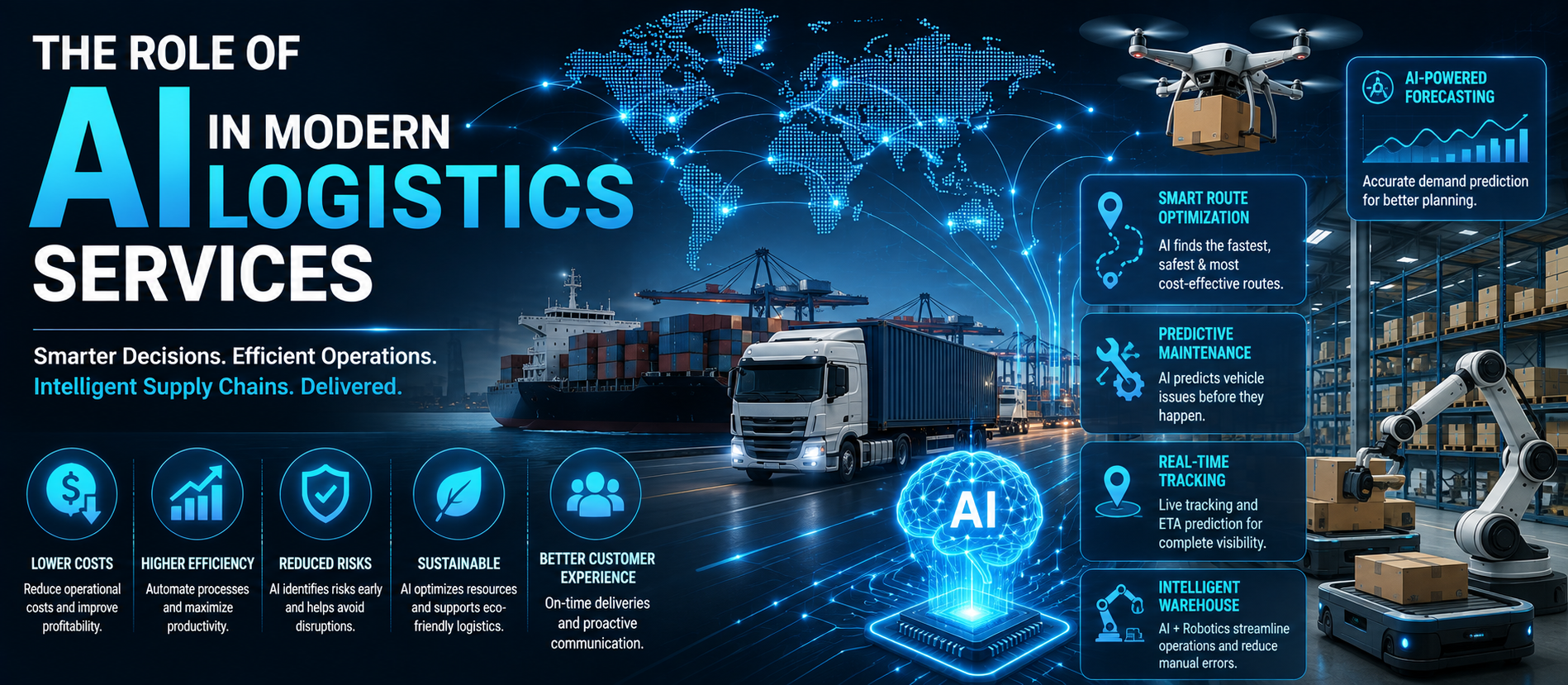
Why AI Matters for Modern Logistics
1. AI-Powered Demand Forecasting
2. Intelligent Route Optimization
3. AI for Fleet Management
4. Predictive Maintenance for Logistics Vehicles
5. AI in Warehouse Management
6. Computer Vision in Warehouses
7. AI and Warehouse Robotics
8. Intelligent Inventory Management
9. AI for Shipment Tracking and Visibility
10. Predictive Delivery Estimates
Logistics is one of the most data-intensive and operationally complex areas of modern business. Every day, logistics companies coordinate shipments, warehouses, vehicles, drivers, suppliers, customers, routes, inventory, documents, delivery schedules, and costs. Even a small disruption can create delays that affect customer satisfaction and profitability. As supply chains become more connected and customer expectations continue to rise, artificial intelligence in logistics is becoming an increasingly important technology for improving visibility, forecasting, automation, and decision-making.
The role of AI in modern logistics services extends far beyond automated chatbots. AI can analyze large volumes of operational data, forecast demand, optimize routes, predict equipment problems, identify unusual events, improve warehouse processes, support customer service, and help logistics managers make faster decisions. When combined with cloud computing, Internet of Things devices, GPS data, automation, robotics, and business intelligence, AI can become an important layer across the logistics value chain.
In 2026, logistics businesses are also exploring AI agents and intelligent automation for multi-step workflows. These systems can potentially monitor shipments, summarize exceptions, update systems, communicate approved information, and create tasks for human teams. However, successful AI adoption requires reliable data, cybersecurity, human oversight, clear objectives, and careful integration with existing logistics systems.
This WordPress-ready HTML article is prepared for Digiifrog (www.digiifrog.com) with a strong focus on SEO, AEO, GEO, and AI Search optimization.
What Is AI in Logistics?
AI in logistics refers to the use of artificial intelligence, machine learning, predictive analytics, computer vision, natural-language processing, optimization algorithms, and intelligent automation to improve logistics operations.
AI can support activities across the logistics lifecycle, including:
- Demand forecasting
- Route optimization
- Fleet management
- Warehouse management
- Inventory planning
- Shipment tracking
- Delivery prediction
- Customer service
- Document processing
- Fraud and anomaly detection
- Predictive maintenance
- Supply chain risk management
The objective is not simply to replace people. In many logistics environments, AI is most useful when it helps people identify problems earlier, make better decisions, and automate repetitive activities.
Why AI Matters for Modern Logistics
Traditional logistics operations often depend on large numbers of transactions and constantly changing conditions. Fuel costs, traffic, weather, customer demand, vehicle availability, warehouse capacity, supplier performance, and delivery priorities can change quickly.
AI can process multiple data sources simultaneously and identify patterns that are difficult to detect manually. This can help logistics companies respond faster and improve resource utilization.
- Improve delivery efficiency
- Reduce unnecessary transportation costs
- Increase warehouse productivity
- Improve demand visibility
- Reduce delivery delays
- Improve customer communication
- Detect operational risks earlier
- Support better fleet utilization
1. AI-Powered Demand Forecasting
💡 Key Insight
Demand forecasting is one of the most important applications of AI in logistics. Businesses need to estimate how much inventory customers will require and when demand is likely to change.
AI models can analyze historical orders, seasonality, product trends, regional demand, promotions, customer behavior, and other relevant information to support forecasts.
⚠ Watch Out
Better forecasts can help businesses avoid both excessive inventory and stock shortages. Forecasts are not guarantees, so logistics teams should continuously compare predictions with actual market conditions.
2. Intelligent Route Optimization
Transportation routes influence delivery time, fuel consumption, vehicle utilization, and operating costs. AI-based route optimization can evaluate multiple variables and recommend efficient routes.
Depending on the system, routing models may consider traffic, delivery windows, vehicle capacity, distance, road restrictions, driver schedules, and changing conditions.
Dynamic routing can also help logistics teams respond when unexpected events occur, such as traffic congestion, vehicle breakdowns, or urgent delivery requests.
3. AI for Fleet Management
Fleet operators need to manage vehicles, drivers, fuel, maintenance, routes, and utilization. AI can analyze fleet data to identify inefficient patterns and support better resource allocation.
- Vehicle utilization analysis
- Fuel consumption monitoring
- Route efficiency
- Driver scheduling support
- Maintenance prediction
- Delivery performance analysis
Fleet managers can use these insights to improve operational planning while maintaining appropriate safety and compliance practices.
4. Predictive Maintenance for Logistics Vehicles
Unexpected vehicle failures can disrupt delivery schedules and create additional costs. Predictive maintenance uses data from vehicles and maintenance records to identify patterns that may indicate an increased likelihood of equipment problems.
Instead of relying only on fixed maintenance intervals, organizations can use condition and usage information to support maintenance planning.
Human technicians remain important for diagnosis, repairs, safety checks, and final maintenance decisions.
5. AI in Warehouse Management
Warehouses involve receiving, storing, picking, packing, sorting, and dispatching products. AI can help optimize these processes by analyzing inventory movement, order patterns, warehouse layouts, and labor requirements.
AI-supported warehouse systems can help determine where frequently requested products should be positioned and how work should be prioritized.
6. Computer Vision in Warehouses
Computer vision allows systems to analyze images and video. In logistics environments, it can support package identification, inventory verification, quality checks, safety monitoring, and selected automated inspection processes.
Computer vision can reduce manual inspection work in suitable environments, although systems should be tested carefully before being relied upon for critical decisions.
7. AI and Warehouse Robotics
AI can work alongside robotics to improve material handling. Autonomous mobile robots and other automated systems can assist with moving goods, picking workflows, sorting, and warehouse navigation.
AI can help coordinate these systems by assigning tasks, analyzing congestion, and adjusting workflows according to operational conditions.
8. Intelligent Inventory Management
Inventory management requires balancing product availability with storage costs. AI can analyze sales history, demand forecasts, lead times, supplier performance, and inventory levels to support replenishment decisions.
Intelligent inventory systems can help organizations identify slow-moving products, potential shortages, and unusual demand changes.
9. AI for Shipment Tracking and Visibility
Customers increasingly expect accurate shipment information. AI can combine GPS data, carrier information, scanning events, estimated arrival times, and other signals to improve shipment visibility.
When a shipment deviates from its expected path or timing, an intelligent system can flag the exception for investigation.
10. Predictive Delivery Estimates
Estimated delivery dates can influence customer satisfaction and operational planning. AI can analyze historical transportation patterns and current conditions to improve estimated arrival calculations.
Accurate predictions can help logistics companies communicate more realistic delivery expectations rather than relying only on static schedules.
11. AI for Last-Mile Delivery
Last-mile delivery is often one of the most complex and expensive parts of logistics. Multiple delivery addresses, narrow time windows, traffic, failed deliveries, and customer preferences create operational challenges.
AI can support last-mile planning by optimizing routes, predicting delivery times, identifying likely delivery problems, and helping coordinate driver workloads.
12. AI-Powered Customer Service
Logistics companies receive frequent customer questions about shipment status, delivery dates, tracking numbers, changes, and exceptions. AI assistants can answer routine questions by retrieving information from approved logistics systems.
Human representatives can handle complex complaints, sensitive situations, disputes, and cases requiring judgment.
13. AI for Logistics Document Processing
Logistics involves many documents, including invoices, shipping records, purchase orders, customs information, delivery confirmations, and carrier documents.
AI-powered document processing can extract structured information from suitable documents and transfer it into business systems. This can reduce manual data entry and accelerate administrative workflows.
14. AI and Supply Chain Risk Management
Logistics operations can be affected by supplier delays, transportation disruptions, extreme weather, geopolitical events, labor shortages, infrastructure problems, and demand changes.
AI analytics can monitor relevant operational data and help identify patterns associated with increased risk. Early warnings can allow teams to investigate alternatives and prepare contingency plans.
15. AI for Supplier Performance Analysis
Supplier reliability directly affects logistics performance. Businesses can use analytics to compare delivery times, order accuracy, quality, lead times, and other performance indicators.
AI can help identify recurring patterns and highlight suppliers that require closer attention or improvement discussions.
16. AI-Powered Logistics Cost Optimization
Logistics costs include transportation, fuel, labor, storage, inventory, packaging, maintenance, and administrative expenses. AI can analyze these costs alongside operational data to identify inefficiencies.
- Transportation cost analysis
- Fuel efficiency
- Warehouse utilization
- Route efficiency
- Inventory carrying costs
- Delivery failure costs
- Resource utilization
Cost optimization should balance financial efficiency with service quality, safety, and customer expectations.
17. AI for Freight Planning
Freight planning requires decisions about shipment consolidation, carrier selection, vehicle capacity, routes, timing, and delivery requirements. AI-based optimization can evaluate combinations of constraints and recommend efficient plans.
This can be particularly valuable when shipment volumes and delivery requirements change frequently.
18. AI for Load Optimization
Using available vehicle capacity efficiently can reduce transportation costs. AI systems can support load planning by considering package dimensions, weight, destination, delivery sequence, and vehicle capacity.
Better load planning can reduce unnecessary trips and improve asset utilization.
19. AI for Customs and Compliance Support
International logistics can involve complex documentation and regulatory requirements. AI can assist with document classification, information extraction, and workflow checks.
Because customs and regulatory requirements can have significant legal consequences, automated systems should support rather than replace qualified human review.
20. AI and Logistics Security
Security is important for transportation and supply-chain operations. AI can support anomaly detection across access logs, transactions, shipment patterns, and operational systems.
AI can also be used to identify unusual behavior that may require investigation, but organizations should implement appropriate privacy, cybersecurity, and governance controls.
21. AI Agents for Logistics Operations
AI agents represent an emerging stage of logistics automation. Unlike simple software rules, an AI agent may be designed to interpret information, plan a sequence of actions, use approved tools, and escalate exceptions.
A logistics AI agent could potentially monitor shipment exceptions, retrieve tracking information, prepare a customer update, create an internal task, and request human approval before taking a sensitive action.
Agentic systems should have clearly defined permissions, audit trails, escalation rules, and human oversight.
22. AI and IoT in Logistics
Internet of Things devices can generate information from vehicles, warehouses, containers, equipment, and environmental sensors. AI can analyze this information to support operational decisions.
For example, sensor data can help monitor temperature-sensitive shipments or identify unusual equipment behavior.
23. AI for Cold Chain Logistics
Cold chain logistics requires careful management of temperature-sensitive products. AI can analyze sensor data, identify temperature deviations, and alert operators when conditions move outside acceptable ranges.
This can be useful for food, pharmaceuticals, and other temperature-sensitive goods, subject to applicable industry requirements and validation.
24. AI for Sustainability in Logistics
Businesses are increasingly interested in reducing transportation emissions and improving resource efficiency. AI can support sustainability initiatives by optimizing routes, reducing empty vehicle capacity, improving load planning, and analyzing fuel consumption.
These measures can potentially reduce waste while improving operational efficiency.
25. AI-Powered Logistics Analytics
Modern logistics organizations generate large amounts of operational data. AI-powered analytics can turn this information into dashboards, forecasts, alerts, and recommendations.
- Delivery performance
- On-time delivery rate
- Fleet utilization
- Warehouse productivity
- Inventory turnover
- Transportation costs
- Customer satisfaction
- Exception rates
Analytics becomes more valuable when the organization defines clear actions for important findings.
26. AI Improves Logistics Decision-Making
Logistics managers often make decisions under time pressure. AI can provide decision-support by comparing options and highlighting relevant information.
For example, when a vehicle becomes unavailable, an optimization system may identify alternative vehicles, routes, or schedules that could reduce the impact of the disruption.
Human managers remain responsible for considering practical constraints and making final decisions where appropriate.
27. AI for Workforce Planning
Warehouses, transportation companies, and logistics providers need to plan staffing according to workload. AI can analyze order volumes, seasonal patterns, historical activity, and operational schedules to support workforce planning.
Workforce analytics should be used responsibly and in accordance with applicable employment and privacy requirements.
28. AI and Logistics Forecasting
Forecasting extends beyond customer demand. Logistics businesses can forecast shipment volumes, vehicle requirements, warehouse workload, staffing needs, and capacity requirements.
More accurate forecasts can help organizations prepare resources before demand peaks.
29. AI Helps Manage Logistics Exceptions
Exceptions are a normal part of logistics. Deliveries can be delayed, addresses can change, vehicles can break down, inventory can become unavailable, and documents can contain errors.
AI can monitor workflows and prioritize exceptions according to potential impact. This helps human teams focus on the problems that require immediate attention.
30. Benefits of AI in Modern Logistics
- Faster operational decision-making
- Improved route efficiency
- Better demand forecasting
- Reduced manual administration
- Improved inventory visibility
- Better warehouse productivity
- Improved customer communication
- Early detection of operational risks
- Potential reduction in avoidable costs
- Greater scalability
31. Challenges of Implementing AI in Logistics
AI adoption is not automatically successful. Logistics organizations must address several challenges before deploying intelligent systems at scale.
Data Quality
AI models require reliable and relevant data. Inconsistent tracking information, missing records, and disconnected systems can reduce accuracy.
System Integration
AI solutions may need to connect with transportation management systems, warehouse systems, ERP platforms, GPS systems, CRM software, and other applications.
Cybersecurity
Connected logistics environments create additional security considerations. Access controls, monitoring, encryption, and secure integrations are important.
Employee Adoption
Employees need training and clear explanations of how AI supports their responsibilities.
Model Reliability
AI predictions can be wrong. Organizations should monitor performance and establish procedures for reviewing unexpected results.
32. How to Implement AI in a Logistics Business
- Define a specific operational problem.
- Identify the data required to solve it.
- Assess data quality and availability.
- Map existing logistics systems.
- Select a practical AI use case.
- Run a controlled pilot.
- Measure operational outcomes.
- Train employees.
- Establish security and governance.
- Integrate successful solutions into workflows.
- Monitor performance continuously.
- Scale only after demonstrating business value.
33. Start With High-Value AI Use Cases
Businesses do not need to deploy AI across every logistics process at once. A better approach is to identify use cases where data is available, the process is measurable, and the potential business value is meaningful.
Examples include delivery prediction, route optimization, document processing, customer-service automation, demand forecasting, and predictive maintenance.
34. Measuring AI ROI in Logistics
AI projects should be evaluated against measurable operational outcomes.
- Reduction in delivery delays
- Improved vehicle utilization
- Reduced transportation cost
- Improved inventory turnover
- Reduced manual processing time
- Improved forecast accuracy
- Reduced maintenance disruptions
- Improved customer satisfaction
- Higher warehouse productivity
ROI calculations should also include software costs, integration, training, infrastructure, maintenance, data preparation, and governance.
35. Human Expertise Remains Essential
AI can improve logistics decision-making, but human expertise remains essential. Logistics professionals understand customer relationships, operational constraints, safety requirements, supplier relationships, local conditions, and business priorities.
The strongest model is often human-plus-AI, where intelligent systems process information and recommend actions while experienced professionals provide context, judgment, and accountability.
36. AI, Cloud Computing and Logistics Transformation
Cloud computing provides scalable infrastructure for logistics applications, analytics, data storage, APIs, and AI services. Cloud-based transportation management, warehouse management, and analytics systems can help organizations connect information across locations.
When cloud platforms, IoT devices, AI, and automation are integrated, logistics companies can build more connected operating environments.
37. AI, SEO, AEO, GEO and AI Search for Logistics Businesses
AI transformation also affects how logistics companies market their services online. SEO helps logistics businesses improve visibility in traditional search. AEO focuses on answering customer questions clearly. GEO helps content become useful for generative search experiences, while AI Search optimization emphasizes structured, trustworthy, context-rich information.
Logistics companies should publish useful content around freight services, delivery solutions, warehouse management, route optimization, supply-chain technology, AI logistics, tracking, fulfillment, and frequently asked customer questions.
AI-powered analytics can also help logistics marketers understand which services, questions, locations, and content topics generate qualified business interest.
38. Future Trends in AI-Powered Logistics
- AI agents for logistics workflows
- Autonomous vehicle technologies
- AI-powered warehouse robotics
- Real-time supply-chain visibility
- Predictive logistics planning
- Intelligent route optimization
- Computer vision inspection
- Automated document processing
- Digital twins for logistics operations
- AI-supported sustainability planning
- Advanced predictive maintenance
- Natural-language logistics analytics
Frequently Asked Questions About AI in Logistics
What is the role of AI in modern logistics services?
AI helps logistics companies analyze data, forecast demand, optimize routes, manage inventory, predict maintenance needs, improve warehouse operations, monitor shipments, automate customer service, and identify operational risks.
How does AI improve logistics efficiency?
AI can improve efficiency by optimizing routes, forecasting demand, reducing manual work, improving resource allocation, identifying operational problems earlier, and supporting faster decision-making.
Can AI reduce logistics costs?
AI can potentially reduce avoidable costs by improving route efficiency, fleet utilization, inventory planning, warehouse productivity, maintenance scheduling, and administrative workflows. Actual savings depend on implementation and operating conditions.
How does AI help with route optimization?
AI-based optimization can consider factors such as traffic, distance, delivery windows, vehicle capacity, schedules, and changing conditions to support more efficient routing decisions.
Can small logistics businesses use AI?
Yes. Cloud-based AI, route planning, customer-service, analytics, fleet, and automation tools can make AI capabilities accessible to smaller logistics businesses without requiring large internal AI teams.
Will AI replace logistics workers?
AI is likely to automate some repetitive activities, but logistics still requires human judgment, physical operations, customer relationships, safety management, and exception handling. Many organizations will use AI to augment rather than completely replace human workers.
What is predictive maintenance in logistics?
Predictive maintenance uses operational and equipment data to identify patterns that may indicate a higher likelihood of maintenance issues, helping organizations plan maintenance before certain failures occur.
What are the biggest challenges of AI in logistics?
Major challenges include data quality, system integration, cybersecurity, implementation costs, employee adoption, model reliability, governance, and the need for ongoing monitoring.
Conclusion
AI is becoming a powerful technology for modern logistics services because it can connect large volumes of operational data with forecasting, optimization, automation, and decision support. From route planning and fleet management to warehouses, inventory, customer service, and supply-chain risk, AI can improve many parts of the logistics lifecycle.
The most successful logistics AI strategies will not begin with technology for its own sake. They will begin with clear business problems and measurable outcomes. Companies should identify high-value use cases, improve their data foundations, integrate AI carefully, train employees, and establish appropriate cybersecurity and governance.
AI agents, predictive analytics, computer vision, robotics, cloud computing, and IoT are likely to make logistics increasingly intelligent and connected. At the same time, human expertise will remain essential for safety, customer relationships, complex decisions, and accountability.
For businesses looking to implement AI-powered logistics solutions, intelligent automation, analytics, digital transformation, AI agents, modern websites, and technology-driven business systems, Digiifrog can help develop practical strategies. Visit www.digiifrog.com to learn more.
Quick Answer: How Is AI Transforming Modern Logistics?
AI is transforming modern logistics by optimizing routes, forecasting demand, improving fleet and warehouse management, predicting maintenance needs, tracking shipments, automating documents and customer service, detecting operational risks, and supporting supply-chain decisions. When combined with cloud computing, IoT, analytics, robotics, and human expertise, AI can help logistics companies build faster, more efficient, visible, and scalable operations.
Ready to Grow?
Talk to us about a strategy tailored to your brand — we will help you stand out in search, AI discovery and social.

Comments (0)
Log in to leave a comment.