📋 Quick Summary
In this article:
Quick Answer: What Are the Biggest Outsourcing Trends?
1. AI-Enabled Outsourcing Is Reshaping Service Delivery
Common AI-enabled outsourcing use cases include:
2. Outcome-Based Contracts Will Become More Important
3. Managed Services Will Move Beyond Cost Reduction
4. Human and AI Hybrid Teams Will Become Normal
5. Nearshoring and Right-Shoring Will Matter More Than Simple Offshoring
6. Global Capability Centers Will Expand Hybrid Sourcing Models
7. Specialized Expertise Will Be More Valuable
8. Cybersecurity Outsourcing Will Remain a Major Priority
9. Data Governance Will Become a Core Vendor Selection Issue
10. Cloud Outsourcing Will Focus on Optimization, Not Only Migration
Outsourcing is changing. For many years, businesses mainly used outsourcing to reduce labor costs. A company could move selected tasks to an external provider and pay less than it would for an in-house team.
Cost still matters. However, modern outsourcing decisions are becoming more strategic. Businesses now look for specialized skills, technology expertise, operational flexibility, faster delivery, stronger resilience, and access to global talent.
Artificial intelligence is accelerating this change. Automation can handle some repetitive work. AI can support research, analysis, customer service, software development, and business operations. At the same time, businesses still need people for judgment, domain expertise, relationship management, quality control, and complex decisions.
As a result, the question is no longer simply, “Should we outsource?” A better question is, “Which work should remain in-house, which work should be automated, and which work should be handled by an external specialist?”
This guide explains the top outsourcing trends businesses should watch in 2026. It uses clear language and a structured format designed to support SEO, AEO, GEO, and AI Search Optimization.
Digiifrog creates structured, readable, and search-friendly content for businesses, technology companies, B2B brands, and digital growth strategies.
Quick Answer: What Are the Biggest Outsourcing Trends?
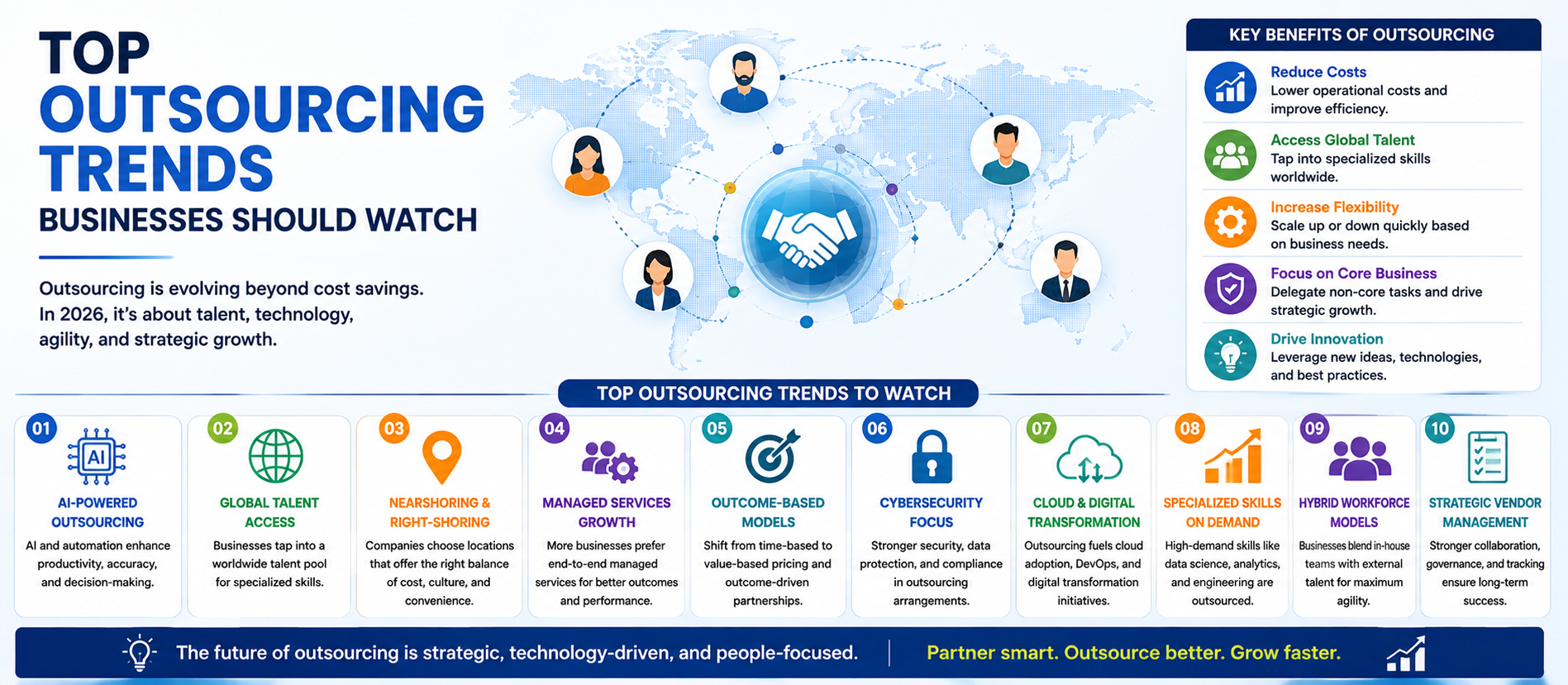
The biggest outsourcing trends include AI-enabled service delivery, outcome-based contracts, managed services, hybrid workforce models, global capability centers, nearshoring and right-shoring, cybersecurity outsourcing, specialized talent partnerships, stronger vendor governance, cloud management, automation, and a greater focus on measurable business outcomes.
The central change is simple: outsourcing is moving away from a pure headcount and cost model toward a model based on expertise, technology, resilience, speed, and results.
1. AI-Enabled Outsourcing Is Reshaping Service Delivery
AI is one of the most important forces changing outsourcing. Providers are increasingly combining human teams with automation, generative AI, analytics, and AI agents.
This does not mean every outsourced role will disappear. Instead, many workflows are being redesigned.
A traditional outsourced team might spend hours collecting data, preparing reports, responding to routine requests, or processing repetitive transactions. AI tools can reduce the manual work involved in these tasks. Human specialists can then focus more on review, exception handling, strategy, and complex customer needs.
Common AI-enabled outsourcing use cases include:
- Customer service automation and escalation.
- Document processing.
- Finance and accounting support.
- Software development assistance.
- IT operations monitoring.
- Data analysis and reporting.
- Cybersecurity monitoring.
- Marketing operations.
The important point is that businesses should not judge an outsourcing provider only by team size. They should also ask how the provider uses technology to improve quality, speed, and efficiency.
2. Outcome-Based Contracts Will Become More Important
Traditional outsourcing agreements often focus on hours, full-time equivalents, transactions, or headcount. That approach can create a problem. A provider may earn more by supplying more people even when technology could complete the same work more efficiently.
Outcome-based outsourcing changes the focus.
Instead of paying mainly for effort, businesses may define a measurable result. Depending on the service, that result could involve:
- Resolved customer cases.
- Reduced processing time.
- Improved service availability.
- Faster invoice processing.
- Higher customer satisfaction.
- Qualified business outcomes.
- Reduced operational errors.
Outcome-based models require clear definitions. Both parties need to agree on what success means, how it will be measured, and what happens when factors outside the provider’s control affect the result.
This model can create better alignment, but it requires stronger data, reporting, governance, and contract design.
3. Managed Services Will Move Beyond Cost Reduction
Managed services are becoming a strategic option for businesses that need continuous operational support and specialized expertise.
A managed service provider may take responsibility for a defined business or technology function, often with agreed service levels and performance targets.
Common managed services include:
- Managed IT services.
- Cloud operations.
- Cybersecurity services.
- Network management.
- Finance operations.
- Human resources services.
- Customer support.
- Compliance operations.
The modern value proposition is changing. Businesses increasingly want providers to bring technology, specialized talent, automation, and innovation instead of simply replacing internal labor.
4. Human and AI Hybrid Teams Will Become Normal
One of the most practical outsourcing models in 2026 is the hybrid workforce.
A workflow may include an in-house manager, an external specialist, AI tools, automation systems, and a managed service provider. Each part of the workflow handles the work it is best suited to perform.
For example, an internal finance leader may define policy and approve major decisions. An outsourced team may handle routine processing. Automation may collect and organize data. AI may identify exceptions. A human expert may review complex cases.
This model can improve flexibility, but it also creates management challenges. Businesses need clear ownership, communication, security controls, and performance measures.
5. Nearshoring and Right-Shoring Will Matter More Than Simple Offshoring
Offshoring remains an important model, but location decisions are becoming more complex.
Businesses increasingly evaluate:
- Time-zone overlap.
- Language skills.
- Talent availability.
- Data and regulatory requirements.
- Political and operational risk.
- Travel convenience.
- Customer proximity.
Nearshoring means working with providers in a nearby country or region. It can improve collaboration and reduce time-zone challenges.
Right-shoring is a broader strategy. It means selecting the most suitable location for each type of work rather than assuming that the lowest-cost location is always the best choice.
A customer-facing role may benefit from time-zone alignment. A specialized engineering task may require access to a particular talent market. A highly sensitive process may need to remain in-house.
6. Global Capability Centers Will Expand Hybrid Sourcing Models
Global capability centers, sometimes called global in-house centers, give organizations another option between full outsourcing and keeping all work at headquarters.
💡 Key Insight
In this model, a company establishes or operates its own center in another location. The center may handle technology, analytics, finance, engineering, product development, or other important functions.
This approach can provide more direct control over talent and intellectual property while still offering access to global skills and cost advantages.
However, building an in-house global center requires management capacity. Companies must consider local employment requirements, compliance, data governance, culture, infrastructure, and long-term operating costs.
For many organizations, the future will not be a choice between outsourcing and insourcing. It will be a combination of both.
7. Specialized Expertise Will Be More Valuable
General outsourcing services will continue to exist, but specialized expertise is becoming increasingly important.
Businesses often need skills that are difficult or expensive to build internally. Examples include:
- AI and machine learning.
- Cloud architecture.
- Cybersecurity.
- Data engineering.
- Compliance.
- Industry-specific software.
- Advanced analytics.
- Product engineering.
In these cases, outsourcing is not only a labor decision. It is a way to access knowledge.
Businesses should therefore evaluate a provider's technical depth, domain experience, talent development, and ability to solve complex problems.
8. Cybersecurity Outsourcing Will Remain a Major Priority
Cybersecurity has become too complex for many businesses to manage entirely with a small internal team.
Managed security providers can support functions such as:
- Security monitoring.
- Threat detection.
- Incident response.
- Vulnerability management.
- Identity management.
- Compliance support.
- Security testing.
However, outsourcing security does not mean outsourcing accountability. Business leaders must still understand their responsibilities, review provider performance, manage access, and maintain an incident response plan.
When selecting a security provider, businesses should ask about data access, breach notification, service levels, audit rights, subcontractors, and recovery procedures.
9. Data Governance Will Become a Core Vendor Selection Issue
Outsourcing often requires external access to systems and information. AI-enabled services may increase the amount of data that is processed.
This makes data governance a central business issue.
Important questions include:
- What data will the provider access?
- Where will the data be stored?
- Who can access it?
- Can subcontractors access the data?
- How long will information be retained?
- How is data deleted when the relationship ends?
- Is customer information used to train AI systems?
Strong data governance should be supported by contracts, technical controls, policies, access management, and regular reviews.
10. Cloud Outsourcing Will Focus on Optimization, Not Only Migration
Many organizations have already moved important systems to the cloud. The next challenge is managing those environments efficiently.
Cloud outsourcing may include:
- Infrastructure management.
- Cost optimization.
- Security monitoring.
- Performance management.
- Backup and recovery.
- Compliance support.
- Cloud modernization.
Businesses are increasingly interested in providers that can help improve an existing environment rather than simply move systems from one location to another.
11. Vendor Consolidation Will Increase
Some companies have accumulated too many vendors. This can create unnecessary costs, integration problems, duplicate tools, and security complexity.
As a result, many businesses will look for fewer but deeper strategic relationships.
This does not mean using only one provider. A single-provider strategy can create dependency and concentration risk. Instead, businesses may reduce unnecessary fragmentation while keeping alternatives for critical services.
A good vendor portfolio should balance:
- Specialization.
- Cost.
- Resilience.
- Competition.
- Innovation.
- Operational simplicity.
12. Multi-Vendor Governance Will Become More Important
Many organizations use several outsourcing providers at the same time. One provider may manage infrastructure while another manages software development and another handles security.
Without coordination, gaps can appear between providers.
Businesses need clear answers to questions such as:
- Who owns the end-to-end service?
- Who responds when multiple systems fail?
- How is performance measured across vendors?
- Who manages shared security responsibilities?
- How is information exchanged?
Vendor governance is becoming an important internal capability. The business needs a clear operating model, not just a collection of separate contracts.
13. Automation Will Reduce Demand for Purely Repetitive Work
Some outsourced tasks are highly repetitive and rules-based. These tasks are increasingly suitable for automation.
This may include:
- Data entry.
- Basic document classification.
- Routine reporting.
- Simple customer requests.
- Standard workflow routing.
The outsourcing market will not disappear because of automation. Instead, the type of work being outsourced is changing.
Providers will need to show how they combine automation with human expertise. Businesses will need to redesign workflows rather than simply replace people with software.
14. Customer Experience Outsourcing Will Require Better Human-AI Balance
Customer service outsourcing is evolving quickly. AI can answer common questions and support agents with knowledge and recommendations.
However, customers still expect access to a human when an issue is complex, sensitive, or unresolved.
A strong customer experience model should determine:
- Which issues can be automated.
- When to transfer a customer to a human.
- How external teams access customer information.
- How quality is monitored.
- How customer feedback improves the process.
The goal should not be to automate every interaction. The goal should be to provide fast and effective service while preserving human support where it adds value.
15. Outsourcing Contracts Will Need Stronger AI and Technology Clauses
Traditional contracts may not fully address AI-enabled service delivery.
Modern agreements may need to consider:
- Use of AI and automation.
- Human review requirements.
- Data ownership.
- Intellectual property rights.
- Security responsibilities.
- Audit rights.
- Performance metrics.
- Model or technology changes.
- Subcontractor use.
- Exit and transition planning.
Businesses should seek appropriate legal and technical advice when negotiating complex outsourcing agreements.
16. Resilience and Business Continuity Will Influence Location Decisions
Cost is only one part of a sourcing decision. Businesses must also consider what happens when a supplier, region, network, or workforce is disrupted.
A resilient outsourcing strategy may include:
- Multiple delivery locations.
- Backup providers for critical functions.
- Documented business continuity plans.
- Regular disaster recovery testing.
- Clear communication procedures.
- Knowledge transfer plans.
Resilience can be especially important for critical services such as technology operations, finance, customer support, and cybersecurity.
17. Strategic Partnerships Will Replace Simple Vendor Relationships
A traditional vendor relationship often focuses on a transaction. The customer defines the work and the vendor completes it.
A strategic outsourcing relationship is broader. The provider may contribute ideas, technology, specialized expertise, and process improvements.
For this model to work, both sides need transparency.
The customer should clearly communicate business goals and priorities. The provider should explain capabilities, risks, technology changes, and improvement opportunities.
Regular governance meetings can focus on:
- Service performance.
- Cost and efficiency.
- Security.
- Innovation opportunities.
- Future capacity.
- Business risks.
18. Skills-Based Outsourcing Will Grow
Businesses are increasingly thinking about work in terms of capabilities rather than job titles.
A company may not need to hire a full department for a short-term requirement. It may need a specific skill for a project, transformation program, or period of growth.
This can include access to:
- Data scientists.
- Cloud engineers.
- AI specialists.
- UX designers.
- Security experts.
- Finance professionals.
- Marketing specialists.
Skills-based outsourcing can provide flexibility, but companies should avoid losing important internal knowledge. Strategic knowledge should be documented and retained.
19. Measuring Business Value Will Become Essential
In the past, outsourcing success was often measured by cost savings. In 2026, businesses need a broader scorecard.
Useful measures may include:
- Cost efficiency.
- Service quality.
- Delivery speed.
- Customer satisfaction.
- Error rates.
- Security performance.
- Automation gains.
- Business outcomes.
- Innovation delivered.
The right metrics depend on the service. A software engineering partner should not be evaluated in exactly the same way as a customer support provider.
20. SEO, AEO, GEO, and AI Search Will Influence Outsourcing Marketing
Businesses researching outsourcing services increasingly ask direct questions through search engines and AI-powered tools.
Examples include:
- What business functions should be outsourced?
- What is the difference between outsourcing and managed services?
- Should I choose offshore or nearshore outsourcing?
- How can AI improve outsourcing?
- What should be included in an outsourcing contract?
Outsourcing companies can improve visibility by publishing clear, accurate, and useful content.
SEO supports visibility in traditional search results.
AEO focuses on direct answers to important questions.
GEO helps organize information so generative systems can understand the topic, company, expertise, and context.
AI Search Optimization benefits from structured content, clear service descriptions, strong evidence, useful FAQs, and consistent brand information.
Outsourcing Trends Comparison Table
| Trend Main Benefit Main Business Consideration | ||
| AI-enabled outsourcing | Speed and efficiency | Governance and human oversight |
| Outcome-based contracts | Better alignment with results | Clear performance measurement |
| Managed services | Specialized ongoing support | Service levels and accountability |
| Nearshoring | Time-zone and collaboration benefits | Talent and location availability |
| Global capability centers | Greater control over global talent | Management and regulatory complexity |
| Cybersecurity outsourcing | Access to specialist expertise | Shared responsibility and access controls |
| Vendor consolidation | Simpler operations | Concentration risk |
| Skills-based outsourcing | Flexible access to expertise | Knowledge retention |
How Businesses Should Prepare
A practical outsourcing strategy begins with understanding the work itself.
- Map important business processes. Identify repetitive, specialized, strategic, and high-risk activities.
- Decide what should remain in-house. Keep strong control over critical strategy, sensitive knowledge, and activities that require internal ownership.
- Identify automation opportunities. Determine which tasks can be simplified before outsourcing.
- Select the right delivery model. Compare in-house teams, managed services, nearshore providers, offshore providers, and hybrid models.
- Evaluate expertise, not only price. Review technology, domain knowledge, security, and delivery capability.
- Define measurable outcomes. Use clear KPIs and service expectations.
- Strengthen governance. Assign internal owners and establish review processes.
- Plan for change. Include knowledge transfer, exit planning, and business continuity.
Common Outsourcing Mistakes to Avoid
Choosing Only on Price
The cheapest provider may not deliver the best long-term value. Quality, security, reliability, and management effort should also be considered.
Outsourcing a Broken Process
If a process is inefficient, outsourcing it may simply move the problem somewhere else. Improve and standardize the workflow first where possible.
Using Vague Performance Metrics
Both parties need clear definitions of quality, speed, availability, and success.
Ignoring Data and Security Risks
External access should be controlled, documented, and reviewed.
Failing to Maintain Internal Knowledge
A business should not become completely dependent on a provider for critical knowledge.
Assuming AI Removes the Need for Management
Automation can improve delivery, but people still need to manage risk, quality, accountability, and customer impact.
Frequently Asked Questions
What is the biggest outsourcing trend in 2026?
AI-enabled outsourcing and outcome-based service delivery are among the biggest trends. Providers are increasingly expected to combine technology, automation, and specialized human expertise to deliver measurable business value.
Is outsourcing only about reducing costs?
No. Modern outsourcing can provide access to skills, technology, flexibility, innovation, operational resilience, and faster scaling.
What is the difference between outsourcing and managed services?
Outsourcing is a broad term for using an external provider to perform work. Managed services usually involve an ongoing provider relationship in which the provider manages a defined function or service against agreed responsibilities and performance expectations.
What is right-shoring?
Right-shoring means selecting the most suitable location and delivery model for a specific type of work. It considers factors such as skills, cost, time zones, security, regulation, and business needs.
Will AI eliminate outsourcing?
AI is changing outsourcing rather than simply eliminating it. Routine work may become more automated, while demand can increase for providers with AI, technology, security, and domain expertise.
How should a business choose an outsourcing provider?
Evaluate relevant expertise, service quality, security practices, technology capability, communication, pricing, governance, references, business continuity, and the ability to measure results.
Conclusion
The top outsourcing trends businesses should watch show that the industry is moving toward a more flexible and technology-driven model.
AI is changing service delivery. Outcome-based contracts are changing how providers are paid. Managed services are becoming more strategic. Hybrid workforce models are combining internal teams, global talent, and automation. Cybersecurity, data governance, resilience, and vendor management are becoming more important.
The best outsourcing strategy will depend on the business. There is no universal model.
Some companies may benefit from nearshoring for closer collaboration. Others may build a global capability center for greater control. A growing business may use managed services to access expertise without hiring a large internal team. Another organization may combine several approaches.
The key is to treat outsourcing as an operating-model decision, not simply a purchasing decision. Businesses that match the right work with the right people, technology, location, and governance model will be better positioned to improve efficiency while protecting quality and resilience.
Disclaimer: This article is for general educational and informational purposes only. Outsourcing, employment, tax, data protection, cybersecurity, and contract requirements vary by country and jurisdiction. Businesses should obtain appropriate legal, financial, security, and professional advice before entering significant outsourcing arrangements.
Digiifrog
Website: www.digiifrog.com
Ready to Grow?
Talk to us about a strategy tailored to your brand — we will help you stand out in search, AI discovery and social.

Comments (0)
Log in to leave a comment.