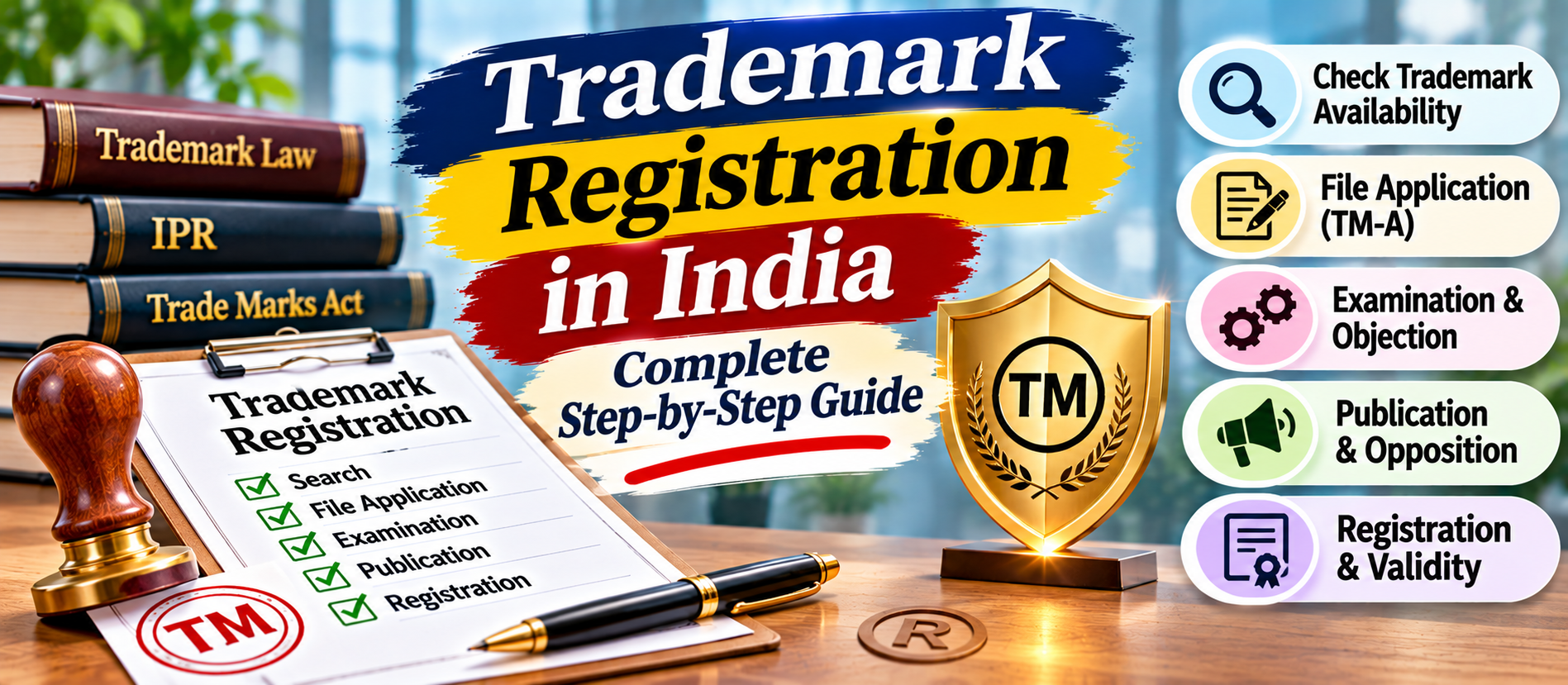
📋 Quick Summary
In this article:
1. Introduction
2. What is a trademark?
Examples of marks that may be registered
3. Why should you register a trademark in India?
4. Types of trademarks in India
4.1 Word mark
4.2 Device or logo mark
4.3 Label mark
4.4 Service mark
4.5 Collective mark
4.6 Certification mark
Digiifrog | Intellectual Property and Business Law Guide
A practical guide for business owners, startups, entrepreneurs, creators and professionals.
Table of Contents
- Introduction
- What is a trademark?
- Why should you register a trademark?
- Types of trademarks
- Who can apply?
- Trademark search and availability
- Understanding trademark classes
- Documents and information required
- Step-by-step registration process
- Examination and trademark objections
- Publication and opposition
- Government fees and other costs
- How long does registration take?
- Rights after registration
- Validity and renewal
- Common mistakes to avoid
- Practical checklist
- Frequently asked questions
- Conclusion
1. Introduction
A brand is more than a business name or logo. It is the identity customers recognize when they see a product, visit a website or use a service. A distinctive brand can help a business build trust and stand apart from competitors. But a brand can also be copied, misused or confused with another business if it is not properly protected.
Trademark registration is one of the main ways to protect a brand in India. It gives the registered proprietor legal rights over the mark for the goods or services covered by the registration. It can also make it easier to take action against confusingly similar use by others.
Trademark law in India is governed mainly by the Trade Marks Act, 1999 and the Trade Marks Rules, 2017, as amended. Applications are handled by the Trade Marks Registry under the Office of the Controller General of Patents, Designs and Trade Marks (CGPDTM), commonly known as IP India.
This guide explains the registration process in simple English. It covers trademark searches, classes, documents, online filing, examination, objections, opposition, official fees and renewal. It is designed for Indian businesses, startups, freelancers, creators and individuals who want to understand the process before applying.
2. What is a trademark?
A trademark is a mark that can be represented graphically and is capable of distinguishing the goods or services of one person from those of others. It may include a name, word, logo, label, device, signature, numeral, shape of goods, packaging or combination of colors, subject to the legal requirements.
In simple terms, a trademark helps customers identify the commercial source of a product or service. For example, a distinctive brand name on a product or a logo used by a service provider may function as a trademark.
Examples of marks that may be registered
- A distinctive business or product name.
- A logo or symbol used to identify a brand.
- A label or stylized word mark.
- A slogan that is capable of distinguishing the goods or services.
- A distinctive shape of goods or packaging, if the legal conditions are met.
- A sound mark represented in the manner required by the Rules.
- A combination of colors, where it meets the statutory requirements.
Not every name, phrase or design can be registered. A mark must satisfy the legal tests and must not conflict with earlier rights or fall within a statutory refusal ground.
3. Why should you register a trademark in India?
Trademark registration can protect a brand asset and support long-term business growth. Important benefits include:
- Exclusive statutory rights: Registration gives the proprietor the exclusive right to use the mark in relation to the registered goods or services, subject to the Act and the conditions on the register.
- Legal action against infringement: A registered proprietor can bring an infringement action where the legal requirements are met.
- Brand recognition: Registration helps establish a clear link between a mark and the business behind it.
- Commercial value: A trademark can be licensed, assigned or used in business arrangements, subject to legal requirements.
- Support for expansion: A registered brand may help when entering new markets, launching product lines or building a franchise model.
- Public record: Registration places the mark on the official register and gives public notice of the registered claim.
- Use of the ® symbol: Once the mark is registered, the proprietor may use the registered trademark symbol in relation to the registered goods or services.
Registration does not mean that every similar-looking mark is automatically prohibited in every situation. The scope of rights depends on the registered mark, the goods and services, the evidence, earlier rights and the provisions of the Act.
4. Types of trademarks in India
The right type of application depends on what you want to protect and how the mark is used.
4.1 Word mark
A word mark protects the word or words themselves, subject to the specification and registration. It is often useful when the brand name is the main identifier and the business may use it in different fonts or visual styles. A word mark still needs to be distinctive and legally acceptable.
4.2 Device or logo mark
A device mark protects the particular visual representation filed with the application. It may include a logo, graphic, stylized lettering or a combination of words and design elements. If the logo changes significantly, the new version may need a separate application.
4.3 Label mark
A label mark may include a combination of brand wording, artwork, layout and other visual features. The application should clearly show the label for which protection is requested.
4.4 Service mark
A service mark identifies services rather than physical goods. Examples may include advertising, education, financial services, software services, hospitality or consultancy, depending on the relevant class.
4.5 Collective mark
A collective mark distinguishes the goods or services of members of an association from those of other businesses. The application requires the relevant regulations governing use of the mark.
4.6 Certification mark
A certification mark indicates that goods or services meet defined standards relating to characteristics such as origin, material, quality or method of manufacture. The applicant must satisfy the statutory requirements and provide the prescribed regulations.
4.7 Series marks
A series application may be possible for marks that resemble each other in their material particulars and differ only in limited non-distinctive matters permitted by the Act. The Registrar decides whether the marks qualify as a series.
4.8 Other forms
Indian trademark law can also accommodate certain non-traditional marks, such as sound marks and marks involving shape or color combinations, if they meet the statutory and evidentiary requirements. The representation must follow the Rules and enable the mark to be clearly identified.
5. Who can apply for trademark registration?
A trademark application may be filed by an individual, a sole proprietor, a partnership firm, a limited liability partnership, a company, a trust, an association or another legally eligible person or entity. Two or more persons may also apply jointly where the legal requirements are met.
The applicant should be the person or entity that owns or is entitled to own the mark. This point matters. If a founder personally owns a brand but a company files the application, the ownership position should be considered and documented correctly.
An applicant may apply on a proposed-to-be-used basis or claim prior use. If the mark has already been used in India, the application should state the correct date of first use and include the prescribed user affidavit and supporting evidence when required. Do not claim an inaccurate use date.
Individual, startup and small enterprise categories
The official fee schedule provides a reduced application fee for an individual, recognized startup or eligible small enterprise. Other applicants pay the higher fee. The applicant must select the correct category and provide the required supporting evidence. A company should not claim a reduced category merely because it is new or small in everyday terms.
6. Trademark search: Check availability before applying
A trademark search is one of the most important steps. Filing a mark without checking existing registrations and applications can lead to objections, opposition, delay or legal disputes.
6.1 Search the exact name
Start by searching the proposed brand name in the official IP India public search system. Search for the exact spelling and relevant class. Check registered marks as well as pending applications.
6.2 Search similar names and spellings
Do not search only for an exact match. Also consider:
- Different spellings and phonetic equivalents.
- Singular and plural forms.
- Similar sounding words.
- Spacing, punctuation and word order variations.
- Translations and transliterations, where relevant.
- Similar logos or visual elements.
- Marks used for related goods or services.
6.3 Check the correct class
A name may appear available in one class but conflict with an earlier mark in another class if the goods or services are related or other legal factors apply. A search should cover the relevant class and any commercially important related classes.
6.4 Review the status and details
Open the relevant records. Review the mark, applicant, filing date, goods or services, status and other available details. A mark shown as abandoned or refused may still require careful review because earlier use or other rights could exist.
An online search is a useful first check, but it is not a guarantee that registration will be granted. A professional clearance search can assess similarity, legal risk and the proposed specification in more depth.
7. Understanding trademark classes in India
India follows the International Classification of Goods and Services, commonly called the Nice Classification. It divides goods and services into 45 classes:
- Classes 1–34: Goods.
- Classes 35–45: Services.
The correct class depends on the actual goods or services for which the mark will be used. A business may need more than one class if it operates in different categories.
Examples of common trademark classes
| Class General area Examples | ||
| 9 | Technology and electronics goods | Computer software recorded or downloadable, electronic devices and related goods as classified. |
| 25 | Clothing | Clothing, footwear and headgear. |
| 30 | Food products | Many prepared foods, bakery products, spices and confectionery. |
| 35 | Business and advertising services | Advertising, business management, business administration and office functions. |
| 36 | Financial and real estate services | Financial affairs, monetary affairs, insurance and real estate services. |
| 41 | Education and entertainment | Education, training, entertainment and sporting or cultural activities. |
| 42 | Technology and scientific services | Software development, technology services, scientific and technological research. |
| 43 | Food and accommodation services | Restaurant, café, catering and temporary accommodation services. |
| 44 | Health and beauty services | Medical, hygienic, beauty care and related services. |
These are broad examples, not a substitute for checking the current official class headings and detailed goods and services descriptions. Do not select a class only because another business in your industry uses it. Describe the actual goods or services accurately.
Single-class and multi-class applications
An applicant can apply for one mark in one class or use a multi-class application for several classes, subject to the Rules. The official fee is charged for each mark and each class. A multi-class application may be convenient, but the applicant should understand that different classes can face different objections or opposition issues.
8. Documents and information required for trademark registration
The documents depend on the applicant type, the mark and whether prior use is claimed. Common requirements include:
- Applicant details: Full legal name, address, nationality or legal status, and contact information.
- Trademark representation: The word, logo, label or other representation to be registered.
- Goods and services description: A clear description under the correct Nice class or classes.
- Applicant category proof: Documents supporting an eligible individual, startup or small enterprise fee category.
- User affidavit and evidence: Where prior use is claimed, the prescribed affidavit and supporting evidence should be prepared.
- Power of Attorney: Authorization in Form TM-M where an agent or representative is appointed, as applicable.
- Identity and address information: Details or supporting records requested by the filing process.
- Company or entity details: Incorporation or registration information where the applicant is an organization.
- Priority documents: Where a convention priority claim is made, the required particulars and documents must be provided.
Useful evidence of use may include dated invoices, product packaging, advertising materials, website pages, catalogues, sales records and other genuine business records. Evidence should relate to the mark and the goods or services stated in the application.
9. Trademark registration process in India: Step by step
Step 1: Choose a distinctive brand name or logo
Select a mark that customers can recognize and distinguish from competitors. Invented words, unusual combinations and distinctive symbols are often easier to protect than generic or descriptive terms. Avoid names that are likely to confuse customers with existing brands.
Step 2: Conduct a trademark search
Search the official database for identical and similar marks. Review relevant classes, pending applications and registered marks. Consider a professional search if the brand is important to the business or the search results are complex.
Step 3: Select the correct trademark class
Identify the goods and services for which the brand is or will be used. Check the current Nice Classification and prepare a precise specification. Consider future commercial plans, but do not claim goods or services without a genuine basis.
Step 4: Decide the applicant and use basis
Confirm who owns the mark. Decide whether the application is based on prior use or proposed use. If prior use is claimed, verify the date and collect supporting evidence. Incorrect ownership or use information can create serious problems later.
Step 5: Prepare Form TM-A
Form TM-A is the prescribed application form for ordinary trademark registration. It includes applicant details, the mark, the class, the goods or services and other required information. The application should be checked carefully before submission.
Step 6: File the application online
Use the official IP India e-filing portal. Upload the mark representation and supporting documents, complete the application details and pay the prescribed fee for each mark and class. Keep the acknowledgement and application number safely.
Step 7: Receive the application number
After successful filing, the application receives an official number. The applicant can use it to track the application status. Filing does not mean that the mark has been accepted or registered.
Step 8: Examination by the Trade Marks Registry
The Registry examines the application. It may raise objections based on absolute grounds, relative grounds or formal requirements. The applicant may receive an examination report asking for a response or clarification.
Step 9: Reply to objections or attend a hearing
If an objection is raised, the applicant should review the legal grounds and submit a clear reply with relevant facts and evidence. The Registry may schedule a hearing if the objection is not resolved on the written response or if a hearing is otherwise required.
Step 10: Publication in the Trade Marks Journal
If the application is accepted, it is advertised in the Trade Marks Journal. This gives third parties an opportunity to oppose the registration within the statutory period.
Step 11: Opposition period
Any person may oppose the application on legally recognized grounds within four months from the date of advertisement or re-advertisement, taking into account the statutory period and permitted extension under Section 21. If an opposition is filed, the applicant must submit a counterstatement and take part in the opposition proceedings.
Step 12: Registration certificate
If no opposition is filed within the permitted period, or if opposition proceedings are decided in the applicant's favor, the mark may proceed to registration, subject to the Act and Registry procedure. The registration certificate is issued and the details appear in the register.
Step 13: Use and maintain the mark
Use the registered mark consistently for the goods or services covered by the registration. Monitor possible misuse, preserve evidence of use and diarize the renewal deadline. A registration is valuable only when the owner maintains and manages it properly.
10. Trademark examination and objections
The Registrar may refuse an application on absolute or relative grounds. Understanding the difference helps applicants prepare a suitable response.
10.1 Absolute grounds for refusal
Section 9 deals with absolute grounds. A mark may face objection if it lacks distinctive character, consists exclusively of indications that describe characteristics of the goods or services, or has become customary in the current language or established trade practices. Other grounds include marks that may deceive the public, hurt religious susceptibilities, contain scandalous or obscene matter, or are prohibited under applicable law.
A descriptive term is not always impossible to register. In some cases, evidence may show that the mark has acquired a distinctive character through use before the relevant date. The legal test and evidence must be assessed carefully.
10.2 Relative grounds for refusal
Section 11 deals with conflicts with earlier trademarks and other specified rights. An application may be refused where the mark is identical or similar to an earlier mark and the goods or services are identical or similar, creating a likelihood of confusion or association. The law also addresses certain well-known marks and other protected rights.
10.3 How to respond to an examination report
Read every objection and identify the section or rule cited. A response may include:
- Arguments explaining why the mark is distinctive.
- Evidence of use and acquired distinctiveness, where relevant.
- Clarification or restriction of the goods and services specification.
- Evidence or legal submissions distinguishing an earlier mark.
- Documents correcting formal defects.
- A request for a hearing where appropriate.
Do not send a generic reply that simply states the mark is unique. Address each objection with facts and legal reasoning. Check the deadline stated in the examination report and the applicable Rules. Missing a deadline can lead to abandonment or refusal.
11. Publication and opposition
Publication in the Trade Marks Journal is a public notice that the Registry has accepted the application for advertisement. It does not mean that registration is final. A third party may oppose the mark if it believes that registration would violate its rights or the Act.
How does opposition work?
- Notice of opposition: The opponent files the prescribed notice, generally in Form TM-O, within the statutory period.
- Counterstatement: The applicant must file a counterstatement within the prescribed period after receiving the notice.
- Evidence: The parties file evidence in support of their respective positions under the Rules.
- Hearing: The Registrar may hear the parties or their authorized representatives.
- Decision: The Registrar decides whether the application should proceed, be refused or be allowed subject to conditions.
Opposition proceedings can take time and may involve legal costs. A strong search before filing can reduce risk, but it cannot prevent every opposition. Applicants should respond promptly and obtain professional advice if a notice is received.
12. Trademark registration fees in India
The official government fee depends on the applicant category, filing mode, number of marks and number of classes. The following table summarizes the standard online filing fee for a new trademark application in Form TM-A shown in the IP India fee schedule.
| Applicant category Online government fee Physical filing fee | ||
| Individual, eligible startup or small enterprise | ₹4,500 per mark per class | ₹5,000 per mark per class |
| All other applicants | ₹9,000 per mark per class | ₹10,000 per mark per class |
These are official application fees, not the total cost of professional assistance. Eligibility for the reduced category must be supported by the required documents. The fee is payable for each mark and each class. For example, applying for one logo in two classes generally means paying the application fee for two class entries.
Other possible costs
- Trademark availability or clearance search.
- Professional fees for preparing and filing the application.
- Reply to an examination report.
- Representation at a show-cause hearing.
- Opposition or rectification proceedings.
- Expedited processing fee, if requested and available under the Rules.
- Renewal fee every ten years.
Professional fees are not fixed by the government for all service providers. They vary with the number of classes, complexity of the mark, search requirements and whether objections or opposition arise. Ask for a written quotation that separates government fees from professional charges.
Expedited processing
The Trade Marks Rules provide a route to request expedited processing after the application number is received, using the prescribed form and fee. The current IP India fee schedule lists an e-filing fee of ₹20,000 for an individual, startup or small enterprise and ₹40,000 for other applicants, per mark per class. Availability and procedural conditions should be confirmed on the official portal before applying. Expedited processing does not guarantee registration or remove examination and opposition requirements.
Opposition fee
The current official fee schedule should be checked for the applicable TM-O opposition fee and the number of classes involved. The total cost of an opposition is usually higher if professional drafting, evidence and hearings are required.
Official fees can change. Always verify the amount on the IP India website immediately before payment.
13. How long does trademark registration take in India?
There is no guaranteed fixed period for every application. A straightforward application may progress faster than a mark that receives objections or opposition. The timeline depends on Registry workload, the quality of the application, examination issues, hearing schedules and third-party proceedings.
The main stages are:
- Search and preparation: depends on the applicant and complexity of the mark.
- Filing: an application number is generally generated after successful filing and payment.
- Examination: timing depends on the Registry's processing and the application category.
- Response or hearing: the applicant must act within the deadline in the Registry communication.
- Journal publication: follows acceptance or the relevant Registry decision.
- Opposition: third parties have four months from advertisement or re-advertisement, subject to the statutory framework.
- Certificate: may be issued after the opposition period expires without opposition, or after opposition is resolved in the applicant's favour.
Do not treat a filing receipt or an application status such as “Objected” or “Accepted” as proof of final registration. Check the official status and certificate.
14. Rights and responsibilities after trademark registration
Registration provides important rights, but the proprietor should understand their scope and responsibilities.
Rights of a registered proprietor
- The exclusive right to use the mark for the registered goods or services, subject to the register and the Act.
- The right to seek legal remedies for trademark infringement where the legal requirements are met.
- The ability to license or assign the mark through appropriate legal arrangements.
- The right to use the ® symbol in relation to the registered mark and covered goods or services.
Responsibilities of the proprietor
- Use the mark in a consistent way.
- Keep records of genuine commercial use.
- Monitor the market and online platforms for possible misuse.
- Take timely action where infringement or passing off is suspected.
- Keep ownership and address details updated with the Registry.
- Pay renewal fees before the registration expires.
- Use the mark for the goods or services covered by the registration.
A registered mark may be vulnerable to removal for non-use under Section 47 if the statutory conditions are met. Registration should therefore form part of an active brand-management plan.
15. Trademark validity and renewal in India
A trademark registration is valid for 10 years from the date of application, subject to the Act. It can be renewed for further periods of 10 years by paying the prescribed fee.
The proprietor should apply for renewal within the prescribed period before expiry. The Rules also provide a process for renewal after expiry within the permitted period, subject to additional fees and conditions. If the mark is not renewed, it may be removed from the register. Restoration may be possible in limited circumstances under the Act and Rules, but it should not be treated as an automatic right.
Keep a renewal calendar for every mark and class. If ownership changes, make sure the assignment is documented and recorded properly so that renewal notices and Registry records remain accurate.
16. Common mistakes to avoid
- Skipping the search: An identical or similar earlier mark can create serious problems.
- Choosing a descriptive name: A generic or descriptive term may be difficult to register unless the legal test for acquired distinctiveness is met.
- Selecting the wrong class: Protection may not cover the goods or services the business actually provides.
- Filing under the wrong owner: The applicant should be the correct legal owner or person entitled to apply.
- Claiming an incorrect use date: Prior-use claims should be accurate and supported by evidence.
- Submitting a poor logo image: The filed representation should be clear and match the mark for which protection is sought.
- Overly broad specifications: Goods and services should be precise and justified.
- Ignoring Registry emails or notices: Missed deadlines can lead to abandonment or refusal.
- Assuming application means registration: A pending application does not provide the same rights as a completed registration.
- Using ® too early: Do not represent a mark as registered before registration is granted.
- Forgetting renewal: A registration can lapse if it is not renewed in time.
17. Practical trademark registration checklist
- Choose a distinctive brand name, logo or other mark.
- Confirm who legally owns the mark.
- Search exact and similar marks in the IP India database.
- Review relevant classes and related goods or services.
- Decide whether the application is for a word mark, logo or another mark type.
- Prepare the correct goods and services specification.
- Decide whether the filing is based on prior use or proposed use.
- Collect the user affidavit and evidence if prior use is claimed.
- Prepare applicant details and category documents.
- Complete Form TM-A and supporting documents.
- Pay the official fee for each mark and class.
- Save the application number and filing acknowledgement.
- Track examination, objections, hearings and Journal publication.
- Respond to any opposition within the prescribed time.
- After registration, use the mark consistently and monitor renewal dates.
18. Frequently asked questions about trademark registration in India
Q1. How can I register a trademark in India?
Search for conflicting marks, select the correct class, prepare applicant and mark details, file Form TM-A with the prescribed fee, respond to examination objections, wait for Journal publication and complete the opposition stage before registration.
Q2. What is the government fee for trademark registration?
The standard e-filing fee is ₹4,500 per mark per class for an individual, eligible startup or small enterprise. For other applicants, it is ₹9,000 per mark per class. Check the latest official schedule before payment.
Q3. Can an individual register a trademark?
Yes. An individual can apply in their own name if they are the owner or person entitled to the mark.
Q4. Can I register a business name as a trademark?
Yes, if the name functions as a trademark, is distinctive and does not fall within a refusal ground or conflict with earlier rights. Company or business-name registration does not automatically provide trademark registration.
Q5. What is Form TM-A?
TM-A is the prescribed application form for registration of a trademark for goods or services in India. It includes the mark, applicant information and class details.
Q6. How many trademark classes are there?
There are 45 classes under the Nice Classification: 34 for goods and 11 for services.
Q7. Can I apply for a trademark in more than one class?
Yes. A multi-class application may be filed where appropriate. The official fee is charged for each mark and each class, and the specification should accurately cover the intended goods or services.
Q8. What does “TM” mean?
The TM symbol is commonly used to indicate that a business is claiming a mark as a trademark. It does not mean that the mark has been registered.
Q9. When can I use the ® symbol?
Use ® only after the mark is registered, and only in relation to the registered mark and the goods or services covered by the registration. Misrepresenting an unregistered mark as registered can create legal problems.
Q10. How long is a trademark valid in India?
A trademark registration is valid for 10 years and can be renewed for further 10-year periods by paying the prescribed fee.
Q11. What happens if the Registry objects to my application?
You must file a response within the prescribed deadline. The response should address the legal grounds and may include evidence, explanations or a request for a hearing. Professional advice may be useful where the objection is complex.
Q12. Can someone oppose my trademark application?
Yes. A person may oppose the application within four months from its advertisement or re-advertisement, under Section 21 and the applicable Rules. The applicant then has to file a counterstatement within the prescribed period.
Q13. Does trademark registration protect my brand worldwide?
No. Indian registration generally protects the mark in India for the registered goods or services. Separate applications or an international filing strategy may be needed for other countries.
Q14. Can I trademark a slogan?
A slogan may be registrable if it is distinctive and functions as a trademark. A phrase that merely describes a product's quality or makes a common promotional claim may face objections.
Q15. Can I trademark a logo and a brand name together?
Yes. You may file a combined mark containing the name and logo. You may also consider separate applications for the word mark and device mark, depending on your protection strategy and budget.
Q16. Is a trademark agent compulsory?
No. An applicant may file directly. However, a trademark professional can help with searches, classification, drafting, objections, hearings and opposition proceedings.
19. Conclusion
Trademark registration is an important step in protecting a brand in India. It can help a business secure rights over its name, logo or other distinctive mark and build a stronger foundation for commercial growth.
The process begins before the application is filed. A good search, correct class selection, accurate ownership details and a clear goods or services description can reduce avoidable problems. After filing, applicants should monitor the Registry, respond to objections, watch for opposition and renew the registration on time.
💡 Key Insight
Every brand has different legal and commercial needs. If the name or logo is important to your business, consider obtaining professional advice before filing. A carefully planned application can help protect the value you are building in your brand.
For more business, digital marketing and legal awareness resources, visit Digiifrog – www.digiifrog.com.
Legal Disclaimer
This article is published by Digiifrog for general educational and informational purposes. It is not legal advice and does not create a lawyer-client relationship. Trademark law, official fees, Registry procedures and administrative practices may change. The fee figures in this article are based on the official IP India fee information available at the time of preparation and should be verified immediately before filing. The registrability of a mark depends on its facts, prior rights, goods and services, and the applicable law. Consult a qualified Indian trademark professional for advice on a specific application or dispute.
Ready to Grow?
Talk to us about a strategy tailored to your brand — we will help you stand out in search, AI discovery and social.


Comments (0)
Log in to leave a comment.