📋 Quick Summary
In this article:
What Is a Property Insurance Exclusion?
Why Property Insurance Exclusions Matter
Named-Peril vs. Open-Peril Coverage
Named-Peril Policies
Open-Peril Policies
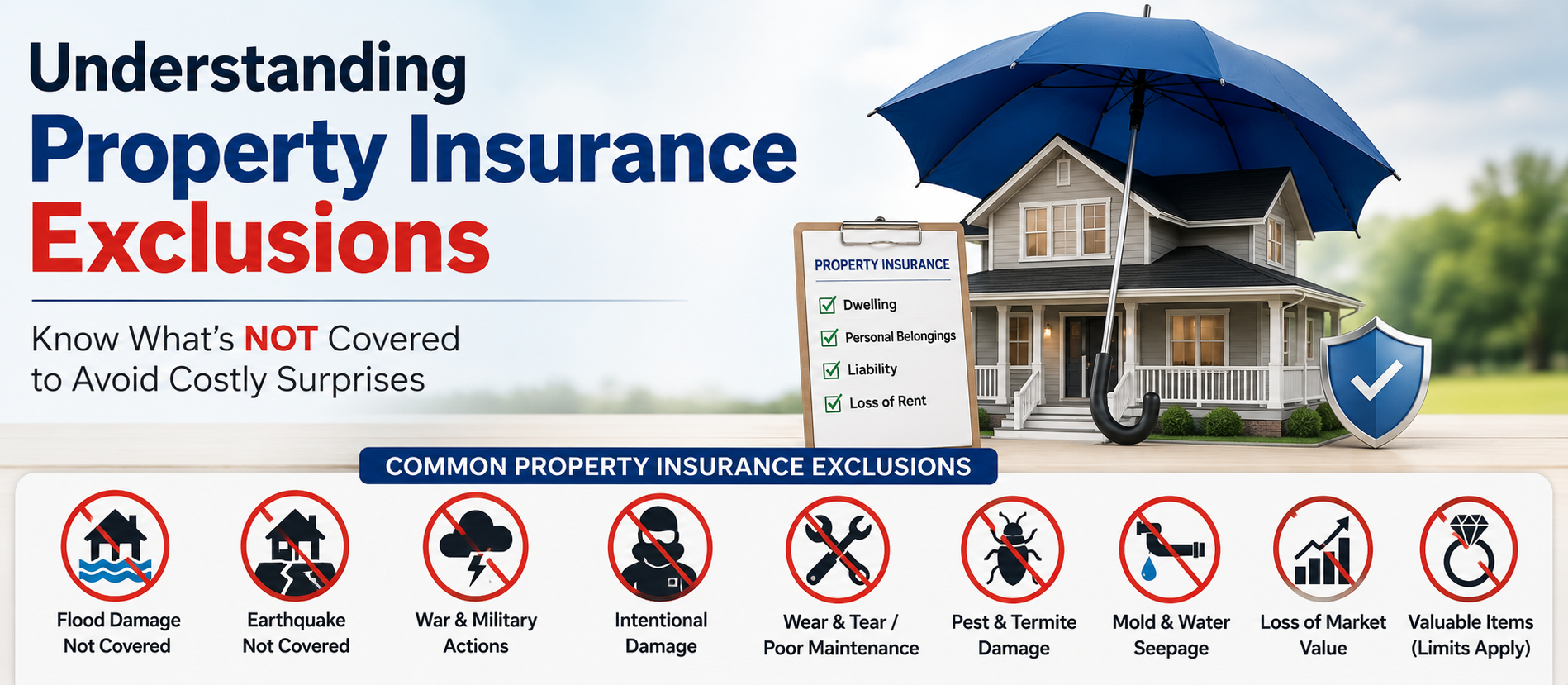
Common Property Insurance Exclusions
1. Flood Damage
2. Earthquake and Earth Movement
3. Wear and Tear
4. Neglect and Poor Maintenance
5. Mold and Fungi
6. Termites and Pest Infestations
Introduction
Property insurance is designed to protect homes, buildings, belongings, and financial interests against specified risks. Yet one of the most misunderstood parts of an insurance policy is the exclusions section. Many policyholders assume that because they have “comprehensive” or “all-risk” property insurance, every type of damage is automatically covered. In reality, insurance coverage depends on the exact policy language, covered perils, exclusions, conditions, deductibles, limits, and endorsements.
Understanding property insurance exclusions before a loss occurs can help homeowners, landlords, renters, and business owners identify gaps in protection and decide whether additional coverage is appropriate. A policy may exclude certain natural disasters, maintenance-related damage, particular types of property, business activities, or specific causes of loss. Some risks can be insured through endorsements or separate policies, while others may remain outside the available coverage.
⚠ Watch Out
This WordPress-ready guide from Digiifrog explains common property insurance exclusions, how exclusions work, what policyholders should review, and how to reduce the risk of unexpected coverage gaps. The article is structured for SEO, AEO, GEO, and AI Search Optimization.
Website: www.digiifrog.com
What Is a Property Insurance Exclusion?
An insurance exclusion is a provision in a policy that removes certain risks, losses, property, circumstances, or situations from coverage. Exclusions are part of the contract and can limit the broad protection described in an insuring agreement.
The National Association of Insurance Commissioners (NAIC) explains that homeowners policies generally contain declarations, an insuring agreement, an exclusions section, and general conditions. The exclusions section identifies specific perils or coverages that are not included and can modify the protection described elsewhere in the policy.
💡 Key Insight
It is therefore important to read the complete policy rather than relying only on a summary page, advertisement, or verbal description.
Why Property Insurance Exclusions Matter
Exclusions matter because the financial consequences of an uncovered loss can be substantial. A homeowner might discover after a major storm that flood damage requires separate coverage. Another policyholder might learn that gradual deterioration, termite damage, or a home-based business loss is not covered under a standard policy.
The NAIC notes that standard homeowners insurance commonly covers the dwelling, personal property, liability, and certain additional living expenses, while separate or optional coverage may be needed for risks such as flood, earthquake, sewer backup, or umbrella liability.
Understanding exclusions helps you answer three important questions:
- What risks does my current policy cover?
- Which important risks are excluded?
- Can I purchase an endorsement or separate policy for an excluded risk?
Named-Peril vs. Open-Peril Coverage
Named-Peril Policies
A named-peril policy covers losses caused by perils specifically listed in the policy. If a cause of loss is not listed, coverage may not apply unless another policy provision provides protection.
Open-Peril Policies
An open-peril policy, sometimes described as an all-risk policy, generally covers causes of loss unless they are specifically excluded by the policy. This does not mean that every possible loss is covered. Exclusions and policy conditions remain important.
The NAIC explains that homeowners policies may be structured around named perils or around broader coverage subject to listed exclusions. The exact policy language determines the protection.
Common Property Insurance Exclusions
1. Flood Damage
Flood is one of the most important exclusions for property owners to understand. Standard homeowners policies in the United States typically do not cover flood damage. Flood insurance may need to be purchased separately.
Flood risk is not limited to properties located directly beside a river or coastline. Heavy rainfall, storm surge, overflowing waterways, rapid snowmelt, and other events can create flooding. Property owners should evaluate their local risk and investigate available flood coverage rather than assuming a homeowners policy is sufficient.
2. Earthquake and Earth Movement
Earthquake damage is commonly excluded from standard homeowners insurance. Other forms of earth movement may also have exclusions or restrictions, depending on the policy.
In areas with meaningful seismic risk, property owners can investigate earthquake endorsements or separate earthquake insurance. Coverage availability, deductibles, limits, and exclusions vary significantly by location and insurer.
3. Wear and Tear
Insurance is generally designed to protect against sudden and accidental covered losses, not ordinary deterioration caused by age or use. Roof aging, worn plumbing, deteriorating siding, old appliances, and other maintenance issues may not be covered simply because they eventually fail.
Property owners should distinguish between damage caused by a covered sudden event and damage resulting from long-term deterioration. Regular maintenance can reduce the likelihood of disputes and help protect the property.
4. Neglect and Poor Maintenance
Policies may exclude or restrict losses connected to neglect, lack of maintenance, or failure to take reasonable steps to protect property. For example, ignoring a known leak for an extended period can create additional damage that may be treated differently from the original sudden loss.
Keep records of maintenance, inspections, repairs, and improvements. These records can be useful when establishing the condition of the property and the circumstances surrounding a claim.
5. Mold and Fungi
Mold coverage can be complicated. Some policies contain exclusions or limited coverage for mold, fungi, rot, or similar conditions. Coverage may depend on the source of the moisture, whether the underlying event is covered, policy limits, and specific endorsements.
Do not assume that every mold problem is covered simply because the property has insurance. Review the exact mold and water-damage provisions in your policy.
6. Termites and Pest Infestations
Damage from termites, rodents, insects, and other infestations is often treated as a maintenance issue rather than a sudden insured event. Standard property policies may therefore exclude or restrict such losses.
Regular pest inspections and preventive maintenance are especially important for properties in areas where termite or pest activity is common.
7. Sewer or Drain Backup
Water entering a property through a backed-up sewer or drain may not be covered by a standard policy unless appropriate coverage has been added. Sewer-backup endorsements may be available depending on the insurer and location.
Property owners should review whether water backup coverage exists, what the limit is, and whether special deductibles apply.
8. Certain High-Value Personal Property
Jewelry, artwork, collectibles, antiques, firearms where legally applicable, musical instruments, and other high-value possessions may have special limits under a standard policy. The property may be covered for certain losses but only up to a relatively low sublimit.
Valuable possessions may require scheduling, endorsements, or separate personal articles coverage. Keep receipts, appraisals, photographs, and other ownership records.
9. Home-Based Business Property
A standard homeowners policy may provide limited or no coverage for business inventory, equipment, records, or liability associated with a home-based business. The NAIC specifically advises homeowners to discuss business use of the home with their insurer and obtain appropriate coverage.
Remote workers, online sellers, consultants, designers, and other home-based professionals should not assume that household insurance automatically covers business property or commercial liability.
10. Certain Detached Structures or Special Property
Detached garages, sheds, fences, pools, guest houses, and other structures can have separate limits or conditions. Personal property stored inside a detached structure may also be subject to policy limitations.
Review the “other structures” section and confirm that the coverage limit is sufficient for the buildings and improvements on your property.
11. Vacant or Unoccupied Property
Policies may contain special conditions or exclusions when a property remains vacant or unoccupied for an extended period. This can matter when a homeowner travels for a long time, renovates a property, moves out before selling, or owns an investment property.
Notify the insurer when circumstances change and ask whether vacancy or unoccupancy affects coverage.
12. Certain Acts or Intentional Damage
Intentional damage caused by an insured is generally treated differently from accidental damage. Policies can contain exclusions relating to intentional acts, fraud, or misrepresentation.
Always provide truthful information when purchasing insurance and reporting a claim.
13. Ordinance or Law-Related Costs
After a covered loss, local building codes may require a property owner to make upgrades beyond the original construction standard. Standard coverage may not fully address these additional expenses unless appropriate ordinance-or-law coverage is included.
This can be particularly important for older buildings that may need substantial upgrades after major damage.
14. War, Nuclear Events, and Certain Extreme Risks
Policies can contain exclusions for unusual or catastrophic risks such as war, nuclear hazards, or other specifically defined events. These provisions vary by policy and jurisdiction.
For most consumers, the key lesson is to review the actual exclusions rather than assuming that a broad policy covers every conceivable cause of loss.
Exclusions vs. Coverage Limits
An exclusion and a coverage limit are not the same thing. An exclusion means the policy does not cover a particular loss or circumstance. A coverage limit means the policy may cover the loss but only up to a specified amount.
For example, a policy might cover personal property but impose a lower sublimit on jewelry. That does not necessarily mean jewelry is completely excluded. It means the coverage may be limited unless additional protection is purchased.
Exclusions vs. Deductibles
A deductible is the portion of a covered loss that the policyholder is responsible for before the insurer pays according to the policy. An exclusion is different: if a loss is excluded, the deductible does not turn it into a covered loss.
Understanding the difference can prevent costly misunderstandings when evaluating your policy.
How to Find Exclusions in Your Policy
Start with the declarations page, but do not stop there. The declarations page summarizes key information such as the insured property, effective dates, coverages, limits, premium, and discounts. Then review the insuring agreement, exclusions, endorsements, definitions, and conditions.
Pay special attention to words such as:
- Excluded
- Not covered
- Does not apply
- Unless
- Limited to
- Subject to
- Endorsement
- Special limit
- Deductible
How Endorsements Can Fill Coverage Gaps
An endorsement modifies an insurance policy by adding, removing, or changing coverage. Depending on the insurer and location, endorsements may address risks such as sewer backup, scheduled personal property, home business exposure, equipment breakdown, or ordinance-and-law costs.
Not every endorsement is available everywhere. Ask your insurer or agent which options are available for your property and how much protection they provide.
Why a Home Inventory Matters
A home inventory can make it easier to identify possessions after a covered loss. The NAIC recommends maintaining an inventory of belongings and periodically updating it as new items are purchased.
A useful inventory can include:
- Photographs or videos.
- Purchase receipts.
- Serial numbers.
- Appraisals for valuable items.
- Descriptions and approximate values.
- Copies stored securely outside the home.
How to Reduce the Risk of Coverage Gaps
- Read the entire policy at least once each year.
- Review exclusions after major policy changes.
- Ask questions about unfamiliar terminology.
- Disclose home businesses and major property changes.
- Consider flood and earthquake risk separately.
- Review valuable-property sublimits.
- Check coverage for detached structures.
- Maintain the home and document repairs.
- Update your home inventory.
- Review coverage after renovations or major purchases.
Questions to Ask Your Insurance Provider
- What are the most important exclusions in my policy?
- Is flood damage covered?
- Is earthquake damage covered?
- What water-related losses are excluded?
- What is the coverage limit for jewelry and valuables?
- Is my home-based business covered?
- Are detached structures adequately insured?
- What happens if the property becomes vacant?
- Do I have sewer-backup coverage?
- Are ordinance-and-law costs covered?
- Which endorsements are available?
- Do special deductibles apply to certain catastrophes?
Common Mistakes Policyholders Make
- Assuming “all-risk” means everything is covered.
- Never reading the exclusions section.
- Ignoring flood and earthquake exposure.
- Failing to insure valuable possessions separately.
- Not telling the insurer about a home business.
- Underestimating the cost to rebuild the property.
- Forgetting to insure detached structures adequately.
- Failing to update coverage after renovations.
- Not maintaining a home inventory.
- Waiting until after a loss to ask what is covered.
Frequently Asked Questions
What are property insurance exclusions?
Property insurance exclusions are policy provisions that remove specific risks, causes of loss, property types, or circumstances from coverage.
Does homeowners insurance cover flooding?
Standard homeowners policies in the United States typically exclude flood damage. Separate flood insurance may be available. Coverage rules vary by country and policy.
Does homeowners insurance cover earthquakes?
Earthquake damage is commonly excluded from standard U.S. homeowners policies. Separate coverage or an endorsement may be available depending on the insurer and location.
Is mold covered by property insurance?
Mold coverage varies. Policies may exclude or limit mold-related losses, and coverage can depend on the cause of the moisture and the policy terms.
Are termites covered by homeowners insurance?
Termite and pest damage is commonly excluded because it is generally considered a maintenance issue rather than a sudden covered event.
Does property insurance cover a home-based business?
A standard homeowners policy may provide limited coverage or exclude certain business property and liability. Business owners should discuss their activities with an insurer.
Can I buy coverage for an excluded risk?
Sometimes. An endorsement or separate policy may provide protection for certain excluded risks, depending on availability and location.
What is the difference between an exclusion and a deductible?
An exclusion removes a risk from coverage, while a deductible is the amount the policyholder pays toward a covered loss before the insurer pays according to the policy.
How often should I review property insurance exclusions?
Review the policy at least annually and whenever you renovate, purchase valuable property, start a home business, change occupancy, or experience another major change.
Conclusion
Understanding property insurance exclusions is essential for protecting your home, belongings, and financial security. The most important lesson is simple: never assume that a broad insurance policy automatically covers every risk. Flood, earthquake, mold, pests, maintenance problems, home-business exposure, high-value possessions, sewer backup, and other risks may require special attention.
Read the declarations page, insuring agreement, exclusions, endorsements, definitions, and conditions together. Maintain an accurate home inventory, review coverage limits, ask about available endorsements, and reassess your policy whenever your property or circumstances change.
Insurance is ultimately a contract, and the exact policy wording controls. When an exclusion or coverage question is unclear, ask the insurer or a qualified insurance professional for a written explanation before a loss occurs.
Digiifrog
Website: www.digiifrog.com
Insurance laws, policy forms, exclusions, endorsements, deductibles, and coverage availability vary by country, state, insurer, and individual policy. This article is for educational purposes and is not personalized insurance, legal, or financial advice.
Ready to Grow?
Talk to us about a strategy tailored to your brand — we will help you stand out in search, AI discovery and social.


Comments (0)
Log in to leave a comment.