📋 Quick Summary
In this article:
Benefits of Virtual Reality in Education
History & Geography
VR and Artificial Intelligence
Meta Title: Virtual Reality in Education Explained | Benefits, Challenges & Future
Meta Description: Learn how Virtual Reality (VR) is transforming education through immersive learning, virtual classrooms, simulations, and interactive experiences.
Website: www.digiifrog.com
Brand: Digiifrog – Education, AI, Career & Digital Growth Insights
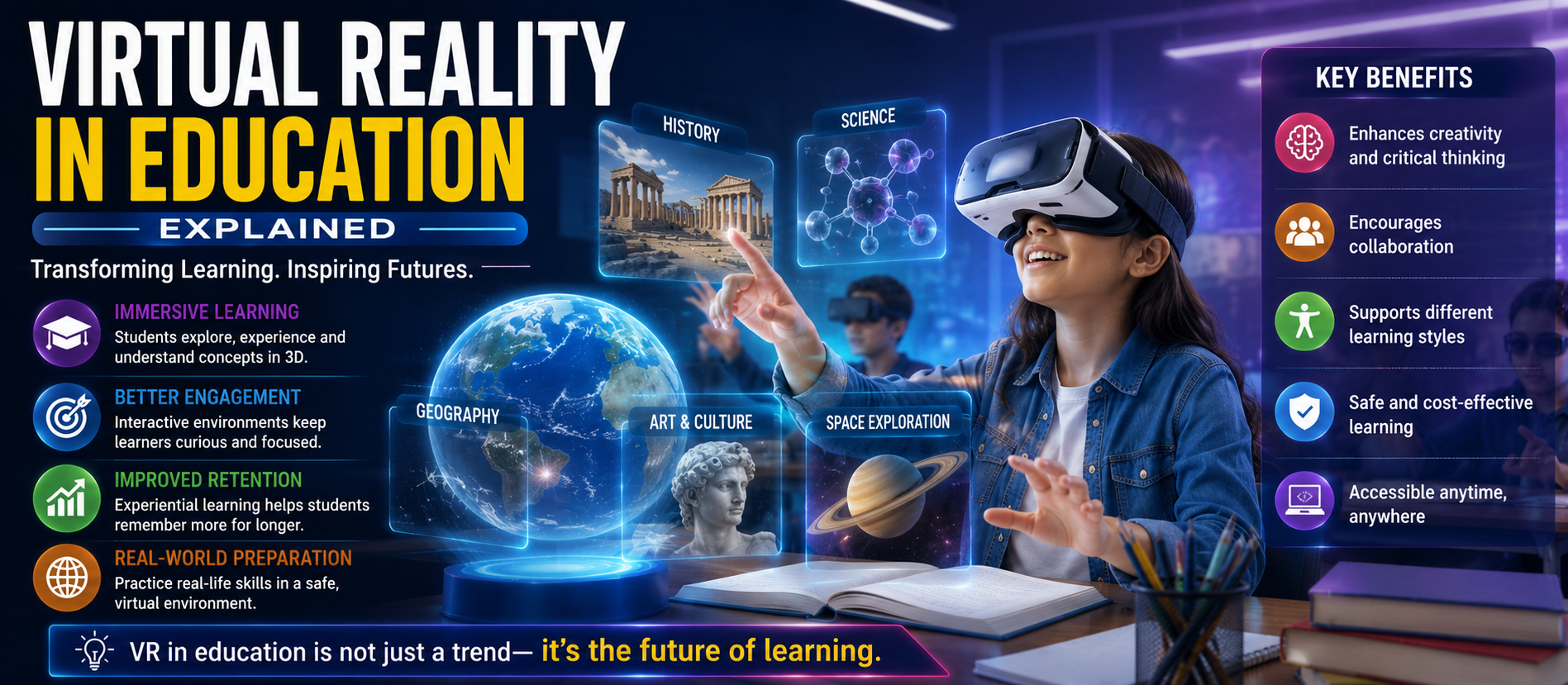
Virtual Reality (VR) is reshaping education by allowing students to experience learning instead of simply reading or listening about it. From virtual science laboratories and historical tours to medical simulations and engineering training, VR provides immersive experiences that improve engagement, understanding, and knowledge retention.
💡 Key Insight
As educational institutions adopt digital technologies, Virtual Reality is becoming an important component of modern teaching. Combined with Artificial Intelligence (AI), Augmented Reality (AR), cloud computing, and adaptive learning platforms, VR has the potential to transform classrooms into highly interactive learning environments.
What Is Virtual Reality?
Virtual Reality is a computer-generated three-dimensional environment that users can explore using VR headsets and motion controllers. Instead of viewing information on a flat screen, learners feel as if they are present inside the virtual environment.
- Immersive 3D experiences
- Interactive simulations
- Virtual laboratories
- Collaborative learning spaces
- Safe practical training
Why VR Matters in Education
Traditional classrooms often rely on lectures, textbooks, and static presentations. VR enables experiential learning where students actively participate in lessons, increasing curiosity, motivation, and long-term understanding.
Benefits of Virtual Reality in Education
- Greater student engagement
- Improved knowledge retention
- Hands-on learning without physical risk
- Access to virtual field trips
- Support for different learning styles
- Higher collaboration and communication
- Realistic skill development
Applications Across Subjects
Science
Students can safely perform chemistry experiments, explore atoms, and study ecosystems in immersive environments.
Medicine
Medical students can practice surgical procedures, anatomy, emergency response, and patient care without risking patient safety.
Engineering
Future engineers can visualize complex machinery, buildings, and manufacturing systems before physical construction begins.
History & Geography
VR allows students to visit ancient civilizations, museums, historical landmarks, and natural wonders from the classroom.
Language Learning
Immersive conversations and cultural simulations help students develop communication skills naturally.
VR and Artificial Intelligence
AI enhances VR by creating adaptive learning experiences, intelligent tutoring systems, personalized feedback, speech recognition, and automated assessment. Together they provide highly individualized education.
Challenges of VR Adoption
- Hardware costs
- Content development expenses
- Teacher training requirements
- Accessibility concerns
- Technical infrastructure
- Potential motion discomfort
Best Practices for Schools
- Start with curriculum-aligned VR lessons.
- Train educators thoroughly.
- Combine VR with traditional teaching.
- Measure learning outcomes.
- Ensure equitable student access.
Future of VR in Education
Future classrooms may combine VR, AI, AR, digital twins, haptic feedback, cloud computing, and learning analytics to create personalized educational experiences. Students could collaborate globally in shared virtual classrooms while receiving real-time AI guidance.
Frequently Asked Questions (AEO Section)
How does Virtual Reality improve education?
VR increases engagement, practical experience, visualization, and knowledge retention through immersive learning.
Is VR suitable for all subjects?
Many subjects including science, medicine, engineering, history, geography, language learning, and vocational training benefit from VR.
What are the disadvantages of VR in education?
High costs, hardware requirements, content availability, teacher training, and accessibility remain key challenges.
Will VR replace teachers?
No. VR is a powerful educational tool that complements teachers by enhancing practical learning and engagement.
SEO, GEO & AI Search Perspective
Educational content should answer common learner questions clearly using structured headings, concise explanations, and trustworthy information. This improves discoverability across search engines and AI-powered search experiences.
Case Studies and Real-World Examples
Universities, schools, and corporate training centers around the world are experimenting with immersive learning. Medical schools use VR to simulate surgeries, engineering departments visualize complex systems, architecture students walk through virtual buildings, and aviation academies provide realistic flight simulations. Such environments allow repeated practice without the cost or risk associated with physical equipment.
Virtual field trips enable learners to explore rainforests, oceans, museums, archaeological sites, and even outer space. Instead of only reading about these places, students interact with objects, observe details, and participate in guided activities that strengthen conceptual understanding.
Skills Developed Through VR Learning
- Critical thinking and decision-making
- Problem-solving in realistic environments
- Collaboration with classmates
- Spatial awareness
- Digital literacy
- Communication and teamwork
- Confidence through repeated practice
Implementation Roadmap
Educational institutions should begin with pilot programs, identify learning objectives, evaluate hardware, train instructors, and gather feedback from students. Successful pilots can then expand gradually while measuring academic outcomes and return on investment.
Responsible implementation also includes privacy protection, accessibility, cybersecurity, and inclusive instructional design.
Case Studies and Real-World Examples
Universities, schools, and corporate training centers around the world are experimenting with immersive learning. Medical schools use VR to simulate surgeries, engineering departments visualize complex systems, architecture students walk through virtual buildings, and aviation academies provide realistic flight simulations. Such environments allow repeated practice without the cost or risk associated with physical equipment.
Virtual field trips enable learners to explore rainforests, oceans, museums, archaeological sites, and even outer space. Instead of only reading about these places, students interact with objects, observe details, and participate in guided activities that strengthen conceptual understanding.
Skills Developed Through VR Learning
- Critical thinking and decision-making
- Problem-solving in realistic environments
- Collaboration with classmates
- Spatial awareness
- Digital literacy
- Communication and teamwork
- Confidence through repeated practice
Implementation Roadmap
Educational institutions should begin with pilot programs, identify learning objectives, evaluate hardware, train instructors, and gather feedback from students. Successful pilots can then expand gradually while measuring academic outcomes and return on investment.
Responsible implementation also includes privacy protection, accessibility, cybersecurity, and inclusive instructional design.
Case Studies and Real-World Examples
Universities, schools, and corporate training centers around the world are experimenting with immersive learning. Medical schools use VR to simulate surgeries, engineering departments visualize complex systems, architecture students walk through virtual buildings, and aviation academies provide realistic flight simulations. Such environments allow repeated practice without the cost or risk associated with physical equipment.
Virtual field trips enable learners to explore rainforests, oceans, museums, archaeological sites, and even outer space. Instead of only reading about these places, students interact with objects, observe details, and participate in guided activities that strengthen conceptual understanding.
Skills Developed Through VR Learning
- Critical thinking and decision-making
- Problem-solving in realistic environments
- Collaboration with classmates
- Spatial awareness
- Digital literacy
- Communication and teamwork
- Confidence through repeated practice
Implementation Roadmap
Educational institutions should begin with pilot programs, identify learning objectives, evaluate hardware, train instructors, and gather feedback from students. Successful pilots can then expand gradually while measuring academic outcomes and return on investment.
Responsible implementation also includes privacy protection, accessibility, cybersecurity, and inclusive instructional design.
Case Studies and Real-World Examples
Universities, schools, and corporate training centers around the world are experimenting with immersive learning. Medical schools use VR to simulate surgeries, engineering departments visualize complex systems, architecture students walk through virtual buildings, and aviation academies provide realistic flight simulations. Such environments allow repeated practice without the cost or risk associated with physical equipment.
Virtual field trips enable learners to explore rainforests, oceans, museums, archaeological sites, and even outer space. Instead of only reading about these places, students interact with objects, observe details, and participate in guided activities that strengthen conceptual understanding.
Skills Developed Through VR Learning
- Critical thinking and decision-making
- Problem-solving in realistic environments
- Collaboration with classmates
- Spatial awareness
- Digital literacy
- Communication and teamwork
- Confidence through repeated practice
Implementation Roadmap
Educational institutions should begin with pilot programs, identify learning objectives, evaluate hardware, train instructors, and gather feedback from students. Successful pilots can then expand gradually while measuring academic outcomes and return on investment.
Responsible implementation also includes privacy protection, accessibility, cybersecurity, and inclusive instructional design.
Case Studies and Real-World Examples
Universities, schools, and corporate training centers around the world are experimenting with immersive learning. Medical schools use VR to simulate surgeries, engineering departments visualize complex systems, architecture students walk through virtual buildings, and aviation academies provide realistic flight simulations. Such environments allow repeated practice without the cost or risk associated with physical equipment.
Virtual field trips enable learners to explore rainforests, oceans, museums, archaeological sites, and even outer space. Instead of only reading about these places, students interact with objects, observe details, and participate in guided activities that strengthen conceptual understanding.
Skills Developed Through VR Learning
- Critical thinking and decision-making
- Problem-solving in realistic environments
- Collaboration with classmates
- Spatial awareness
- Digital literacy
- Communication and teamwork
- Confidence through repeated practice
Implementation Roadmap
Educational institutions should begin with pilot programs, identify learning objectives, evaluate hardware, train instructors, and gather feedback from students. Successful pilots can then expand gradually while measuring academic outcomes and return on investment.
Responsible implementation also includes privacy protection, accessibility, cybersecurity, and inclusive instructional design.
Case Studies and Real-World Examples
Universities, schools, and corporate training centers around the world are experimenting with immersive learning. Medical schools use VR to simulate surgeries, engineering departments visualize complex systems, architecture students walk through virtual buildings, and aviation academies provide realistic flight simulations. Such environments allow repeated practice without the cost or risk associated with physical equipment.
Virtual field trips enable learners to explore rainforests, oceans, museums, archaeological sites, and even outer space. Instead of only reading about these places, students interact with objects, observe details, and participate in guided activities that strengthen conceptual understanding.
Skills Developed Through VR Learning
- Critical thinking and decision-making
- Problem-solving in realistic environments
- Collaboration with classmates
- Spatial awareness
- Digital literacy
- Communication and teamwork
- Confidence through repeated practice
Implementation Roadmap
Educational institutions should begin with pilot programs, identify learning objectives, evaluate hardware, train instructors, and gather feedback from students. Successful pilots can then expand gradually while measuring academic outcomes and return on investment.
Responsible implementation also includes privacy protection, accessibility, cybersecurity, and inclusive instructional design.
Case Studies and Real-World Examples
Universities, schools, and corporate training centers around the world are experimenting with immersive learning. Medical schools use VR to simulate surgeries, engineering departments visualize complex systems, architecture students walk through virtual buildings, and aviation academies provide realistic flight simulations. Such environments allow repeated practice without the cost or risk associated with physical equipment.
Virtual field trips enable learners to explore rainforests, oceans, museums, archaeological sites, and even outer space. Instead of only reading about these places, students interact with objects, observe details, and participate in guided activities that strengthen conceptual understanding.
Skills Developed Through VR Learning
- Critical thinking and decision-making
- Problem-solving in realistic environments
- Collaboration with classmates
- Spatial awareness
- Digital literacy
- Communication and teamwork
- Confidence through repeated practice
Implementation Roadmap
Educational institutions should begin with pilot programs, identify learning objectives, evaluate hardware, train instructors, and gather feedback from students. Successful pilots can then expand gradually while measuring academic outcomes and return on investment.
Responsible implementation also includes privacy protection, accessibility, cybersecurity, and inclusive instructional design.
Case Studies and Real-World Examples
Universities, schools, and corporate training centers around the world are experimenting with immersive learning. Medical schools use VR to simulate surgeries, engineering departments visualize complex systems, architecture students walk through virtual buildings, and aviation academies provide realistic flight simulations. Such environments allow repeated practice without the cost or risk associated with physical equipment.
Virtual field trips enable learners to explore rainforests, oceans, museums, archaeological sites, and even outer space. Instead of only reading about these places, students interact with objects, observe details, and participate in guided activities that strengthen conceptual understanding.
Skills Developed Through VR Learning
- Critical thinking and decision-making
- Problem-solving in realistic environments
- Collaboration with classmates
- Spatial awareness
- Digital literacy
- Communication and teamwork
- Confidence through repeated practice
Implementation Roadmap
Educational institutions should begin with pilot programs, identify learning objectives, evaluate hardware, train instructors, and gather feedback from students. Successful pilots can then expand gradually while measuring academic outcomes and return on investment.
Responsible implementation also includes privacy protection, accessibility, cybersecurity, and inclusive instructional design.
Case Studies and Real-World Examples
Universities, schools, and corporate training centers around the world are experimenting with immersive learning. Medical schools use VR to simulate surgeries, engineering departments visualize complex systems, architecture students walk through virtual buildings, and aviation academies provide realistic flight simulations. Such environments allow repeated practice without the cost or risk associated with physical equipment.
Virtual field trips enable learners to explore rainforests, oceans, museums, archaeological sites, and even outer space. Instead of only reading about these places, students interact with objects, observe details, and participate in guided activities that strengthen conceptual understanding.
Skills Developed Through VR Learning
- Critical thinking and decision-making
- Problem-solving in realistic environments
- Collaboration with classmates
- Spatial awareness
- Digital literacy
- Communication and teamwork
- Confidence through repeated practice
Implementation Roadmap
Educational institutions should begin with pilot programs, identify learning objectives, evaluate hardware, train instructors, and gather feedback from students. Successful pilots can then expand gradually while measuring academic outcomes and return on investment.
Responsible implementation also includes privacy protection, accessibility, cybersecurity, and inclusive instructional design.
Case Studies and Real-World Examples
Universities, schools, and corporate training centers around the world are experimenting with immersive learning. Medical schools use VR to simulate surgeries, engineering departments visualize complex systems, architecture students walk through virtual buildings, and aviation academies provide realistic flight simulations. Such environments allow repeated practice without the cost or risk associated with physical equipment.
Virtual field trips enable learners to explore rainforests, oceans, museums, archaeological sites, and even outer space. Instead of only reading about these places, students interact with objects, observe details, and participate in guided activities that strengthen conceptual understanding.
Skills Developed Through VR Learning
- Critical thinking and decision-making
- Problem-solving in realistic environments
- Collaboration with classmates
- Spatial awareness
- Digital literacy
- Communication and teamwork
- Confidence through repeated practice
Implementation Roadmap
Educational institutions should begin with pilot programs, identify learning objectives, evaluate hardware, train instructors, and gather feedback from students. Successful pilots can then expand gradually while measuring academic outcomes and return on investment.
Responsible implementation also includes privacy protection, accessibility, cybersecurity, and inclusive instructional design.
Case Studies and Real-World Examples
Universities, schools, and corporate training centers around the world are experimenting with immersive learning. Medical schools use VR to simulate surgeries, engineering departments visualize complex systems, architecture students walk through virtual buildings, and aviation academies provide realistic flight simulations. Such environments allow repeated practice without the cost or risk associated with physical equipment.
Virtual field trips enable learners to explore rainforests, oceans, museums, archaeological sites, and even outer space. Instead of only reading about these places, students interact with objects, observe details, and participate in guided activities that strengthen conceptual understanding.
Skills Developed Through VR Learning
- Critical thinking and decision-making
- Problem-solving in realistic environments
- Collaboration with classmates
- Spatial awareness
- Digital literacy
- Communication and teamwork
- Confidence through repeated practice
Implementation Roadmap
Educational institutions should begin with pilot programs, identify learning objectives, evaluate hardware, train instructors, and gather feedback from students. Successful pilots can then expand gradually while measuring academic outcomes and return on investment.
Responsible implementation also includes privacy protection, accessibility, cybersecurity, and inclusive instructional design.
Case Studies and Real-World Examples
Universities, schools, and corporate training centers around the world are experimenting with immersive learning. Medical schools use VR to simulate surgeries, engineering departments visualize complex systems, architecture students walk through virtual buildings, and aviation academies provide realistic flight simulations. Such environments allow repeated practice without the cost or risk associated with physical equipment.
Virtual field trips enable learners to explore rainforests, oceans, museums, archaeological sites, and even outer space. Instead of only reading about these places, students interact with objects, observe details, and participate in guided activities that strengthen conceptual understanding.
Skills Developed Through VR Learning
- Critical thinking and decision-making
- Problem-solving in realistic environments
- Collaboration with classmates
- Spatial awareness
- Digital literacy
- Communication and teamwork
- Confidence through repeated practice
Implementation Roadmap
Educational institutions should begin with pilot programs, identify learning objectives, evaluate hardware, train instructors, and gather feedback from students. Successful pilots can then expand gradually while measuring academic outcomes and return on investment.
Responsible implementation also includes privacy protection, accessibility, cybersecurity, and inclusive instructional design.
Conclusion
Virtual Reality is transforming education by making learning immersive, practical, engaging, and highly interactive. While challenges such as cost and infrastructure remain, continued advances in technology are making VR increasingly accessible to schools, colleges, universities, and professional training institutions.
Students who combine immersive technologies with critical thinking, responsible AI use, and lifelong learning will be well prepared for the future workforce.
For more educational insights, AI innovations, SEO, AEO, GEO, AI Search optimization, and future-focused digital content, visit www.digiifrog.com.
Ready to Grow?
Talk to us about a strategy tailored to your brand — we will help you stand out in search, AI discovery and social.

Comments (0)
Log in to leave a comment.