📋 Quick Summary
In this article:
What Will Education Look Like in the Future?
1. Artificial Intelligence Will Become Part of Everyday Learning
2. Personalized Learning Will Become More Practical
3. Teachers Will Become More Important, Not Less
4. AI Literacy Will Become a Core Educational Skill
5. Critical Thinking Will Become More Valuable
6. Skills-Based Education Will Grow
7. Lifelong Learning Will Become Normal
8. Hybrid and Blended Learning Will Continue
9. Digital Learning Platforms Will Become More Intelligent
10. Learning Analytics Will Support Better Decisions
11. Accessibility and Inclusion Will Become Central
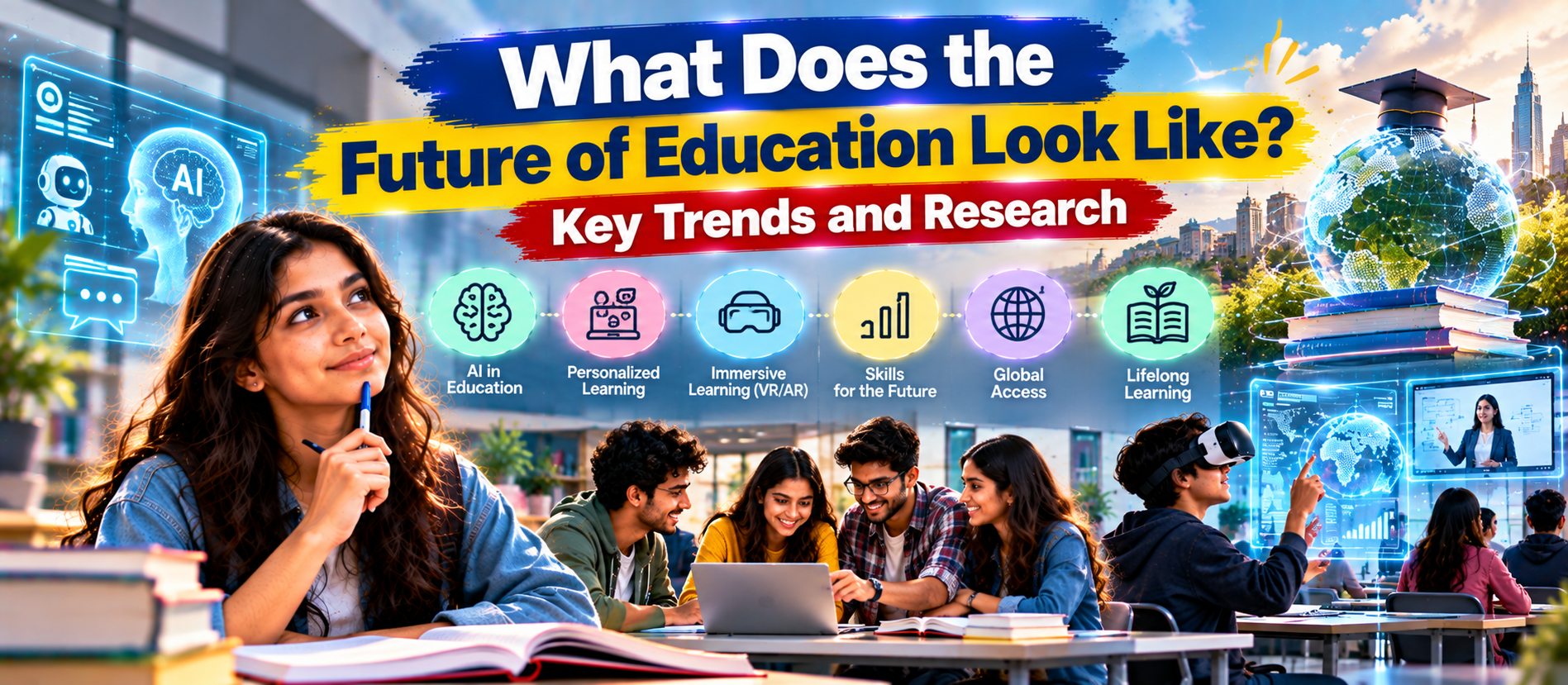
The future of education will not be defined by one technology, one classroom model, or one type of learner. It will be shaped by a combination of artificial intelligence, digital learning, personalized education, changing career needs, flexible learning models, stronger teacher roles, and a growing focus on human skills.
Education is entering a period of major change. Students can already learn through physical classrooms, online courses, virtual classrooms, mobile apps, learning platforms, simulations, and AI-powered tools. Teachers can use digital resources to create learning materials, analyze progress, personalize support, and automate some routine tasks.
But technology alone does not create better education. The central question is how technology can improve learning while protecting human agency, equity, privacy, critical thinking, creativity, and meaningful relationships.
OECD research says education systems need to remain grounded in evidence while preparing for a world that is changing rapidly. The organization also highlights the need to rethink education as AI capabilities advance.
⚠ Watch Out
UNESCO similarly emphasizes a human-centred and rights-based approach to AI in education. Its research points to opportunities for access and personalization, while also warning about inequality, privacy, safety, ethics, and governance.
This article explores the future of education, the most important education trends for the coming years, what current research tells us, and what students, teachers, schools, colleges, and parents can do to prepare.
What Will Education Look Like in the Future?
Future education is likely to be more flexible, personalized, connected, technology-enabled, and skills-focused. However, that does not mean traditional classrooms will disappear.
A more realistic future is a blended ecosystem where students may move between classroom instruction, independent study, digital resources, collaborative projects, practical activities, and AI-supported learning.
💡 Key Insight
The teacher will remain important. In many situations, technology can provide information quickly, but teachers help students interpret information, develop judgment, collaborate, stay motivated, manage uncertainty, and understand social and ethical contexts.
UNESCO's 2026 Smart Education report describes smart education as an integration of pedagogy, governance, and technology rather than simple technology adoption. It also stresses that there is no single pathway for every education system.
1. Artificial Intelligence Will Become Part of Everyday Learning
AI is likely to become one of the strongest forces shaping education. Students can already use AI systems for explanations, practice questions, brainstorming, feedback, translation, coding, summarization, and personalized study support.
Teachers can use AI to draft lesson materials, create differentiated activities, generate question sets, organize information, and support routine administrative work.
However, the future of AI in education should not be measured by how much work AI can complete. A better question is whether students actually learn more deeply.
The OECD's Digital Education Outlook 2026 examines effective uses of generative AI and emphasizes that educational value depends on how GenAI is used. AI can support learning when it is guided by sound teaching principles, while simply outsourcing tasks to AI may improve task performance without producing equivalent learning gains.
This means future classrooms will need AI literacy. Students should learn how AI systems work at a practical level, how to verify outputs, how to recognize limitations, and how to use AI without giving up independent thinking.
2. Personalized Learning Will Become More Practical
Students do not all learn at the same speed or in the same way. Personalized learning aims to respond to differences in prior knowledge, learning pace, interests, strengths, and areas that need support.
Digital platforms can collect learning data and use it to recommend activities, identify gaps, and adjust practice. UNESCO IITE research describes the growing use of learning analytics, adaptive learning platforms, AI-powered tutoring systems, student support systems, and career-building systems for personalization and student success.
Personalization does not mean every student needs a completely different curriculum. It can mean giving students different levels of practice, feedback, examples, resources, or support while maintaining shared learning goals.
3. Teachers Will Become More Important, Not Less
One common prediction about educational technology is that teachers will eventually become unnecessary. Current evidence points to a more complex picture.
Technology can automate certain tasks. It can generate materials, analyze patterns, answer routine questions, and provide instant feedback. But education also involves relationships, motivation, social development, judgment, classroom culture, mentoring, and ethical decisions.
Teachers will increasingly act as learning designers, mentors, facilitators, evaluators, and guides for technology use.
Future-ready teachers will need both subject expertise and digital skills. They will also need to understand when technology adds value and when a human interaction is more effective.
4. AI Literacy Will Become a Core Educational Skill
AI literacy is different from simply knowing how to use an AI chatbot. Students need to understand the strengths and limitations of AI.
Future AI literacy may include:
- Understanding basic AI concepts
- Writing useful prompts
- Checking AI-generated information
- Recognizing bias and missing context
- Protecting personal data
- Understanding copyright and academic integrity
- Knowing when human judgment is required
- Using AI responsibly in academic work
OECD has highlighted the need to reconsider which skills education should prioritize in an AI-influenced world, while UNESCO has developed AI competency frameworks and policy guidance for students and teachers.
5. Critical Thinking Will Become More Valuable
When information is easy to produce, the ability to evaluate information becomes more important.
Students will need to ask:
- Is this information accurate?
- What evidence supports the claim?
- Who created this content?
- What information is missing?
- Could there be another explanation?
- Is the source reliable?
- Was AI involved in producing the content?
Critical thinking will become especially important as students interact with AI-generated text, synthetic media, personalized content, recommendation systems, and large volumes of online information.
UNESCO has repeatedly emphasized human agency, critical thinking, ethics, and responsible technology use as education systems respond to AI.
6. Skills-Based Education Will Grow
Education is increasingly connected to employability and lifelong learning. Students need subject knowledge, but they also need skills that can be applied in changing environments.
The World Economic Forum's Future of Jobs Report 2025 identifies analytical thinking as the leading core skill reported by employers. Resilience, flexibility and agility, leadership, creative thinking, technological literacy, empathy, and curiosity are also among the important core skills. AI and big data are among the fastest-growing technical skills.
This suggests that future education will place more emphasis on:
- Problem-solving
- Analytical thinking
- Creative thinking
- Communication
- Collaboration
- Digital literacy
- AI literacy
- Adaptability
- Leadership
- Lifelong learning
7. Lifelong Learning Will Become Normal
Education will increasingly extend beyond childhood, adolescence, and university. People may need to learn new skills several times throughout their careers.
Technology changes quickly. Jobs change. Some tasks become automated while new roles appear. Professionals therefore need ways to update their skills without leaving work permanently.
Future education may include more short courses, micro-credentials, professional certificates, modular degrees, workplace learning, online programs, and skill-based assessments.
The World Economic Forum projects significant job disruption through 2030 and reports that employers expect a combination of technology skills and human skills to become increasingly important.
8. Hybrid and Blended Learning Will Continue
The future is unlikely to be completely online or completely classroom-based. Blended learning combines different learning environments.
A student may attend a classroom for discussion and practical work, use an online platform for revision, watch a recorded explanation at home, complete a digital assessment, and work with classmates on a shared project.
This flexibility can help students learn at different times and locations. But good blended learning requires thoughtful design. Simply putting classroom worksheets online does not automatically create a strong digital learning experience.
9. Digital Learning Platforms Will Become More Intelligent
Learning management systems and digital learning platforms are moving beyond simple content storage.
Future platforms may increasingly combine:
- Learning analytics
- Adaptive practice
- AI tutoring
- Progress dashboards
- Automated feedback
- Career recommendations
- Digital assessments
- Collaborative tools
- Accessibility features
UNESCO IITE's research on digital learning platforms highlights how analytics and AI can support personalization, student success, and digital learning ecosystems.
10. Learning Analytics Will Support Better Decisions
Learning analytics uses educational data to understand patterns in learning.
Schools and universities can potentially use data to identify students who may need additional support, understand where learners struggle, monitor engagement, and evaluate interventions.
However, data should not become a substitute for professional judgment. A dashboard can show that a student is not completing activities. It cannot automatically explain why.
Future education systems will therefore need both data literacy and strong privacy practices.
11. Accessibility and Inclusion Will Become Central
Technology can create new opportunities for learners with different needs. Features such as captions, screen readers, speech recognition, translation, adjustable interfaces, audio content, and flexible formats can improve access.
But technology can also create inequality. A student without reliable internet, a suitable device, electricity, or digital support may be excluded from opportunities that are available to others.
UNESCO reports that while billions of people use the internet, major gaps in school connectivity remain. It also highlights the risk that AI could widen existing technology divides.
The future of education must therefore focus not only on innovation but also on equitable access.
12. Mobile Learning Will Expand
Smartphones and tablets already allow learners to access educational content almost anywhere. Mobile learning can support language practice, revision, short lessons, flashcards, educational videos, quizzes, and communication.
Future mobile education may become more personalized and context-aware. A learner could receive short practice activities based on previous performance or available study time.
However, mobile learning should not become endless screen consumption. Good educational design needs clear goals, active practice, reflection, and breaks.
13. Microlearning Will Support Busy Learners
Microlearning breaks learning into short, focused units. A lesson might take five, ten, or fifteen minutes instead of an hour.
This approach can be useful for revision and professional learning. It can also fit into small periods of available time.
But short content should not replace deep learning when deep understanding is required. Complex subjects often need extended practice, discussion, projects, and reflection.
The future will likely use both microlearning and deeper learning experiences rather than treating them as competing models.
14. Immersive Learning Will Grow
Virtual reality, augmented reality, simulations, and interactive 3D environments can make certain learning experiences more engaging.
Students may explore historical environments, conduct virtual experiments, examine complex structures, practise technical procedures, or visualize scientific concepts.
Immersive learning will be most valuable where it adds something that ordinary text or video cannot easily provide. The technology should serve the learning objective.
15. Project-Based and Experiential Learning Will Gain Importance
Future education will need to prepare students for situations where there is no single textbook answer.
Project-based learning allows students to research, design, build, test, communicate, and revise. These activities can develop both subject knowledge and transferable skills.
Examples include:
- Building a simple environmental monitoring project
- Creating a business plan
- Designing a community survey
- Developing a digital product
- Investigating a local environmental problem
- Creating a multimedia presentation
- Designing a solution to a practical challenge
These experiences help students connect learning with real-world problems.
16. Assessment Will Need to Change
If students use AI, digital platforms, simulations, and collaborative tools, assessment methods must evolve.
Traditional exams will continue to have value, especially for measuring individual knowledge under controlled conditions. But future education may also rely more on portfolios, projects, presentations, practical tasks, oral explanations, simulations, and authentic assessments.
The key challenge is maintaining academic integrity while assessing what students actually understand.
Assessment may increasingly ask students to explain their reasoning, apply knowledge to unfamiliar situations, defend decisions, and demonstrate work processes rather than simply produce a final answer.
17. Academic Integrity Will Become More Complex
Generative AI creates new questions about authorship and assessment. If a student uses AI to brainstorm, edit, translate, summarize, or generate an entire answer, the educational meaning of the final work can be very different.
Schools and universities will need clear policies that distinguish acceptable support from inappropriate substitution.
Students should also learn responsible AI use rather than simply being told not to use AI. They need practical guidance about disclosure, verification, privacy, attribution, and independent thinking.
OECD's 2026 Digital Education Outlook and UNESCO's AI guidance both point toward the importance of purposeful, responsible, and human-centred AI use.
18. Teacher Professional Development Will Change
Teachers will need ongoing professional learning. It will not be enough to learn how to operate a new software tool.
Teachers may need training in:
- AI literacy
- Digital pedagogy
- Learning analytics
- Online assessment
- Cybersecurity and privacy
- AI-supported lesson design
- Digital accessibility
- Media and information literacy
Professional development should also include opportunities for teachers to share successful practices with one another.
19. Education Will Focus More on Human Skills
It may seem that technology will make technical skills more important than human skills. Current labour-market research suggests the opposite is more nuanced.
The World Economic Forum reports strong demand for both technology skills and human capabilities such as analytical thinking, creative thinking, resilience, leadership, empathy, and curiosity.
Future education therefore needs balance. Students should learn how to use technology and how to work effectively with people.
20. Emotional and Social Learning Will Remain Important
Education is not only about academic performance. Students also need to manage emotions, communicate, collaborate, resolve disagreements, build relationships, and develop confidence.
Technology can support some of these activities, but it cannot replace authentic human relationships.
Future-ready schools should create environments where students can work together, discuss difficult ideas, practise communication, and learn from different perspectives.
21. Cybersecurity and Digital Well-Being Will Become Core Issues
As more learning moves into digital environments, schools will hold more data and students will spend more time connected to devices.
Future education systems will need strong cybersecurity practices, privacy policies, identity protection, safe platform design, and clear rules for responsible digital behaviour.
Digital well-being will also matter. Students need to learn how to manage notifications, screen time, online distractions, misinformation, and unhealthy technology habits.
22. Education Will Become More Connected to Careers
Students increasingly want education that connects clearly with future opportunities.
Schools and universities may therefore expand career exploration, industry projects, internships, entrepreneurship, professional certifications, and skills-based learning.
Career education will also need to change quickly. Students should not only ask, “Which job should I choose?” They should also ask, “Which skills will help me adapt when this job changes?”
23. Sustainability Education Will Grow
Climate change, environmental risks, renewable energy, resource management, and sustainable development will influence education and employment.
Students will need both scientific understanding and the ability to evaluate complex trade-offs.
Schools can connect sustainability with science, economics, technology, geography, business, and community projects rather than teaching it as an isolated topic.
24. Open Educational Resources Will Expand Access
Open educational resources can make learning materials more accessible by allowing educators and learners to use, adapt, and share resources under appropriate open licences.
Open resources can reduce some cost barriers and support teachers who need high-quality materials. Their impact will depend on quality, discoverability, language availability, accessibility, and digital infrastructure.
25. Education Policy Will Become More Important
Technology changes faster than many education systems can adapt. Policies need to address AI use, data protection, teacher training, digital infrastructure, procurement, accessibility, academic integrity, and assessment.
UNESCO's current work stresses that AI policy must consider inclusion and equity, while OECD emphasizes evidence-based approaches to future education.
The future of education therefore depends not only on schools and technology companies. Governments, educators, researchers, families, employers, and students all have roles to play.
What Will Students Need to Learn for the Future?
Students will need a balanced skill set.
Knowledge skills: Reading, writing, mathematics, science, subject knowledge, research.
Thinking skills: Analytical thinking, critical thinking, problem-solving, systems thinking, decision-making.
Technology skills: Digital literacy, AI literacy, data literacy, cybersecurity awareness, responsible technology use.
Human skills: Communication, collaboration, empathy, leadership, creativity, resilience.
Learning skills: Self-directed learning, curiosity, reflection, adaptability, and lifelong learning.
This balanced model is consistent with labour-market research showing that technology skills and human capabilities will increasingly work together.
How Schools Can Prepare for the Future of Education
- Build digital infrastructure: Provide reliable connectivity and appropriate devices.
- Train teachers: Make professional development continuous.
- Create responsible AI policies: Define acceptable and unacceptable uses.
- Teach AI and media literacy: Help students evaluate digital information.
- Use technology for a clear purpose: Start with the learning goal.
- Improve accessibility: Design learning for diverse learners.
- Strengthen critical thinking: Teach students to question and verify.
- Use data responsibly: Protect privacy and avoid purely automated decisions.
- Expand experiential learning: Connect lessons to real problems.
- Measure outcomes: Evaluate whether technology actually improves learning.
How Students Can Prepare for the Future
- Learn how to learn independently.
- Develop strong reading and writing skills.
- Practise critical and analytical thinking.
- Learn basic AI literacy.
- Use AI as a support tool, not a replacement for thinking.
- Build communication and collaboration skills.
- Develop digital and data literacy.
- Work on practical projects.
- Learn continuously instead of depending only on formal degrees.
- Build a portfolio of useful work and skills.
What Parents Should Know About Future Education
Parents do not need to understand every new educational technology. They need to help children develop healthy learning habits.
Encourage children to ask questions, read widely, explain their reasoning, solve problems, use technology responsibly, and learn from mistakes.
Do not measure the future of education only by the number of devices in a classroom. A classroom full of technology can still provide weak learning if students are passive.
The better question is: Are students becoming more capable, curious, independent, thoughtful, and prepared for real life?
What Current Research Tells Us
Several broad conclusions appear across recent international research.
- AI is changing education: OECD and UNESCO both recognize that AI is reshaping teaching, learning, assessment, and education governance.
- Human agency matters: Technology should strengthen learning rather than replace human judgment and relationships.
- Personalization is expanding: AI and learning analytics can support adaptive learning and targeted interventions when implemented responsibly.
- Digital inequality remains a major issue: Connectivity and access gaps can prevent learners from benefiting equally from technology.
- Skills are changing: Employers increasingly need a combination of technological and human capabilities.
- Evidence matters: Education systems need to evaluate whether innovations actually improve learning rather than assuming that new technology is automatically better.
The Biggest Challenge: Technology vs Learning
The future of education should not become a competition to adopt the newest technology.
A school does not become future-ready simply because it has AI tools, tablets, virtual reality, or a new learning platform.
Future-ready education starts with learning goals. Technology comes next.
For every new tool, educators should ask:
- What learning problem does this solve?
- Does it improve understanding?
- Does it help students practise important skills?
- Can teachers use it effectively?
- Is it accessible?
- Is student data protected?
- Could the tool create new risks?
- How will we measure its impact?
These questions help prevent technology from becoming an expensive distraction.
Frequently Asked Questions About the Future of Education
What is the future of education?
The future of education is likely to combine classroom learning with digital tools, AI, personalized learning, flexible learning models, practical projects, and lifelong skill development. Human relationships and teacher guidance will remain important.
Will AI replace teachers?
AI may automate some teaching-related tasks, but it is unlikely to replace the full role of teachers. Teaching includes mentoring, motivation, classroom relationships, judgment, social development, and ethical decision-making.
What are the biggest education trends for 2026 and beyond?
Major trends include AI-supported learning, AI literacy, personalized learning, learning analytics, blended education, digital platforms, skills-based education, lifelong learning, immersive learning, accessibility, and stronger attention to responsible technology use.
What skills will students need in the future?
Students will need strong academic foundations plus analytical thinking, critical thinking, creativity, communication, collaboration, digital literacy, AI literacy, adaptability, resilience, and lifelong learning habits.
Will online learning replace traditional classrooms?
It is more likely that online and classroom learning will coexist. Blended models can combine the flexibility of digital learning with the social and practical strengths of physical classrooms.
Why is critical thinking important in the AI era?
AI can generate convincing information quickly. Students therefore need to evaluate evidence, identify errors, question assumptions, verify sources, and make independent judgments.
How can schools prepare students for AI?
Schools can teach AI literacy, responsible use, verification, privacy, ethics, prompt skills, critical thinking, and practical problem-solving. Students should learn how to work with AI without becoming dependent on it.
What is the role of teachers in future education?
Teachers will increasingly guide learning, design meaningful experiences, mentor students, evaluate progress, support human development, and help learners use technology responsibly.
Conclusion: The Future of Education Should Be Human-Centred
The future of education will be digital, but it should not become less human.
AI, learning analytics, adaptive platforms, immersive technologies, online learning, and digital resources can create powerful opportunities. But technology is only valuable when it improves learning.
The strongest education systems of the future will combine technology with strong teachers, critical thinking, creativity, collaboration, inclusion, ethical decision-making, and lifelong learning.
Students will need to know how to use technology, but they will also need to know when not to use it. They will need information, but they will also need judgment. They will need technical skills, but they will also need empathy, communication, resilience, and curiosity.
Research from OECD, UNESCO, and the World Economic Forum points toward the same broad lesson: the future is not about choosing between humans and technology. It is about building education systems where technology strengthens human capabilities and gives more learners the opportunity to succeed.
Digiifrog focuses on clear digital content and modern education strategies that help organizations communicate useful knowledge in an AI-driven world. Explore more at www.digiifrog.com.
Research References
- OECD — Future of Education and Skills
- OECD — Digital Education Outlook 2026
- UNESCO — AI and Education: Protecting the Rights of Learners
- UNESCO — Artificial Intelligence in Education
- UNESCO IITE — Trends in Digital Learning Platforms
- UNESCO IITE — Smart Education Around the World, 2026
- World Economic Forum — Future of Jobs Report 2025: Skills Outlook
Ready to Grow?
Talk to us about a strategy tailored to your brand — we will help you stand out in search, AI discovery and social.

Comments (0)
Log in to leave a comment.