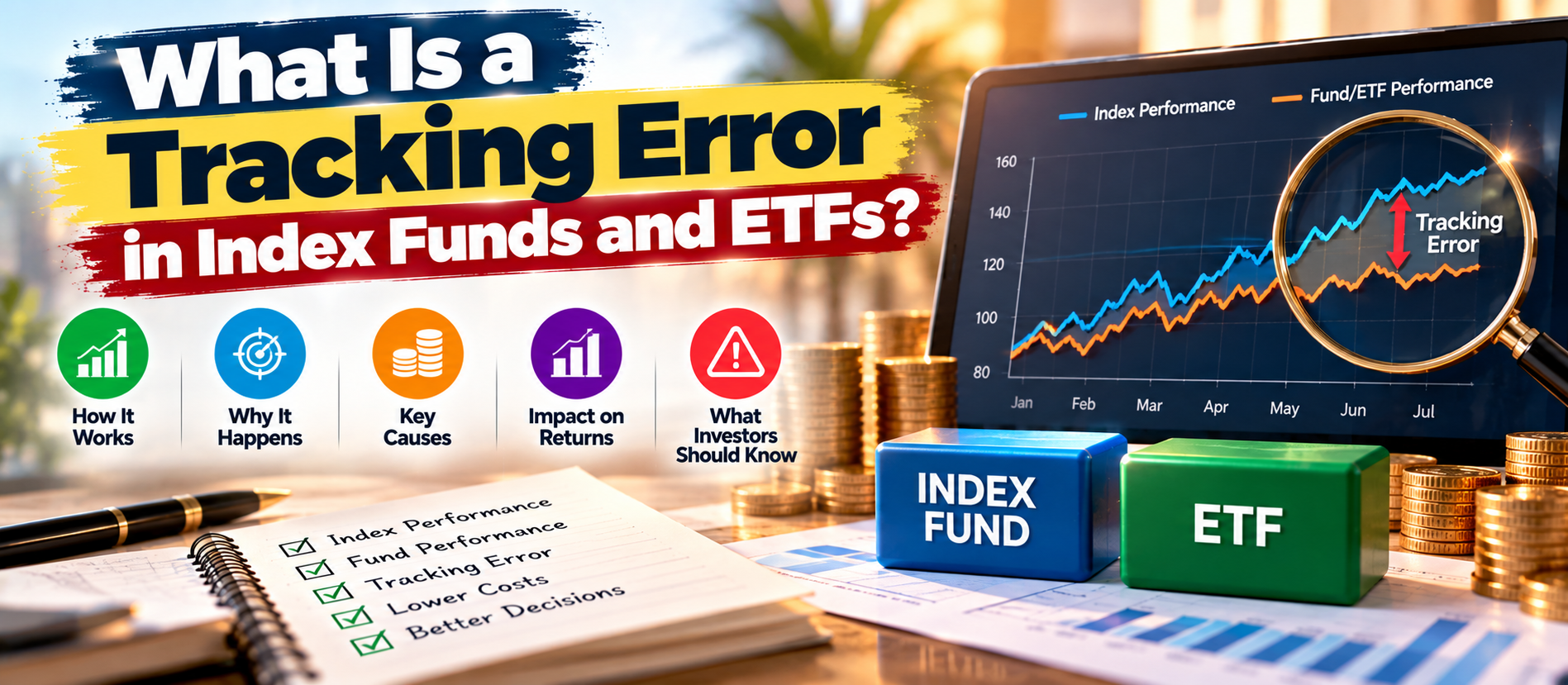
📋 Quick Summary
In this article:
Introduction: Why Tracking Error Matters
Tracking Error vs. Tracking Difference
Example: Low tracking error, but a negative tracking difference
How Is Tracking Error Calculated?
Why Do Index Funds and ETFs Have Tracking Error?
1. Fund expenses
2. Cash holdings
3. Changes in index constituents
4. Trading costs and market liquidity
5. Corporate actions
Digiifrog | Personal Finance & Investing
Introduction: Why Tracking Error Matters
Index funds and exchange-traded funds (ETFs) are designed to follow a market index. An index may represent large companies, a particular sector, government bonds or another defined group of investments. Instead of trying to beat the market through frequent stock selection, a passive fund aims to copy the performance of its chosen benchmark.
But a fund rarely matches its index perfectly. Its returns may be slightly higher or lower. The gap can change from day to day. This is where tracking error becomes useful.
Tracking error helps investors judge how consistently a fund follows its benchmark. It can reveal differences that are not obvious when you look only at a fund’s latest return or expense ratio. Two index funds may follow the same index and charge similar fees, yet their tracking records may differ.
This guide explains tracking error in simple terms. It covers the meaning, calculation, causes, difference from tracking difference, practical examples and ways to compare index funds and ETFs in India.
What Is Tracking Error?
Tracking error is a measure of how much a fund’s returns differ from the returns of its benchmark over time. In standard investment usage, it is calculated as the annualised standard deviation of the differences between the fund’s daily returns and the benchmark’s daily returns over a specified period.
Put simply, it measures how uneven the gap between the fund and the index has been. A lower figure generally means the fund has followed its benchmark more consistently. A higher figure means the return gap has moved around more.
For example, suppose an index fund follows the Nifty 50 Total Returns Index. The fund aims to deliver returns close to that benchmark after accounting for expenses and other factors. If the fund’s daily return differences are small and stable, its tracking error may be low. If those differences move around more, its tracking error may be higher.
Tracking error does not tell you whether the fund has made a profit. It measures relative consistency, not the direction of the market. A fund can have low tracking error while both the fund and its index fall sharply. It can also have low tracking error when both rise strongly.
Tracking Error vs. Tracking Difference
These terms sound similar, but they answer different questions. Investors should understand both before comparing passive funds.
| MeasureWhat it tells youSimple question | ||
| Tracking error | How much the fund’s return gap varies over time | How consistently does the fund follow the benchmark? |
| Tracking difference | The difference between the fund’s return and the benchmark’s return over a period | How far behind or ahead was the fund? |
Tracking error is about the variability of the gap. Tracking difference is about the size and direction of the gap over a period.
Example: Low tracking error, but a negative tracking difference
Imagine an index returns 12% over a year and a fund returns 11.5%. The fund trails the benchmark by 0.5 percentage points. If that gap has been fairly steady from day to day, the fund could still have low tracking error.
Now imagine another fund also returns 11.5%, but its daily performance repeatedly moves ahead of and behind the index. Its tracking difference for the year is still minus 0.5 percentage points, but its tracking error may be higher because the daily gap fluctuated more.
This example shows why one measure cannot replace the other. Tracking error helps assess consistency. Tracking difference helps assess how much return the investor actually missed or gained compared with the benchmark.
How Is Tracking Error Calculated?
The formal method uses a series of daily returns. For each trading day, the fund’s return is compared with the benchmark’s return. The resulting daily gaps are then used to calculate their standard deviation and annualise the result.
In simplified terms:
Daily return gap = Fund’s daily return − Benchmark’s daily return
Tracking error = Annualised standard deviation of the daily return gaps
The exact calculation follows the applicable regulatory and reporting methodology. In India, fund houses disclose tracking error and tracking difference for index funds and ETFs in line with the relevant SEBI requirements. Check the latest disclosures on the asset management company’s website and the Association of Mutual Funds in India (AMFI) website.
A simple illustration
Suppose a benchmark returns 1.00% on a particular day and an index fund returns 0.96%. The daily gap is minus 0.04 percentage points. On another day, the benchmark returns minus 0.50% while the fund returns minus 0.48%. The gap is plus 0.02 percentage points.
These daily gaps are collected over the required period. The more they vary, the higher the standard deviation may be. A single day does not define a fund’s tracking error. Investors should review the published measure over a meaningful period and compare it with funds tracking the same benchmark.
Do not confuse this calculation with simply subtracting one year’s fund return from one year’s index return. That calculation gives a return gap for the period, which is closer to tracking difference.
Why Do Index Funds and ETFs Have Tracking Error?
Passive funds try to copy an index, but several practical factors can stop them from matching it exactly. The main causes include the following.
1. Fund expenses
A fund has operating costs, including its expense ratio. These costs are reflected in the fund’s net asset value (NAV) and can cause its return to fall behind the index. The benchmark itself does not pay the fund’s expenses, so the fund’s net return may be lower.
2. Cash holdings
A fund may keep some money in cash or cash-like instruments to manage inflows, redemptions, expenses or operational needs. If the index rises while part of the fund remains in cash, the fund may not rise by the same amount. The effect can also work differently when the market falls.
3. Changes in index constituents
Index providers periodically add or remove companies and adjust their weights. A fund must trade to reflect these changes. It may not be able to complete every trade at exactly the same time or price used by the index calculation. This can create temporary differences.
4. Trading costs and market liquidity
Buying and selling securities costs money. Some securities may have low trading volume or wide bid-ask spreads. In a fast-moving market, a fund may pay a different price from the price assumed by the index. Trading costs can affect how closely the fund follows its benchmark.
5. Corporate actions
Dividends, rights issues, mergers, stock splits and other corporate actions can affect a fund’s portfolio and the index. Timing differences or operational processing may create temporary gaps. It is important to compare a fund with the correct benchmark version, such as a Total Returns Index when that is the appropriate reference.
6. Sampling instead of holding every security
Some indexes contain many securities or include instruments that are costly or difficult to trade. A fund may use representative sampling rather than holding every constituent in exactly the same weight. This can reduce operational costs, but it can also create differences from the benchmark.
7. Fund inflows and redemptions
When investors add or withdraw large amounts of money, the fund may need to buy or sell securities. The timing and price of these transactions may not match the index’s theoretical movements. Large flows can therefore affect tracking.
8. Dividend timing and reinvestment
When companies pay dividends, the fund receives cash and may reinvest it. The timing of receipt and reinvestment can affect daily performance. This is one reason why comparing a fund with a price-only index instead of a suitable total-return benchmark can give a misleading result.
9. Market disruption and regulatory limits
Trading halts, circuit limits, restrictions, settlement delays or unusual market conditions may prevent a fund from buying or selling securities as planned. Such events can temporarily increase tracking error. A fund may not be able to replicate the index perfectly in every market condition.
Is Lower Tracking Error Always Better?
For a fund whose main purpose is to replicate a particular index, lower tracking error is generally desirable. It suggests that the fund has followed the benchmark more consistently. This can be useful when comparing two funds that track the same index.
However, tracking error should not be the only selection rule. A very low figure does not automatically mean the fund is the best choice. You should also review tracking difference, expense ratio, fund size, operational history, service quality and—especially for ETFs—trading liquidity and the bid-ask spread.
Do not compare tracking error across unrelated benchmarks without context. A fund tracking a broad large-cap index and a fund tracking a narrow sector index have different portfolios and trading conditions. The more useful comparison is between funds that follow the same or a closely comparable benchmark over the same period.
Also, a low tracking error does not mean low market risk. If the benchmark falls 20% and the fund closely follows it, the fund may also fall by a similar amount, after costs and other differences. Tracking error is not a measure of how risky the underlying market is.
Tracking Error in Index Mutual Funds vs. ETFs
Index mutual funds and ETFs can both follow the same benchmark, but the way investors buy and sell them differs.
Index mutual funds
Investors generally buy or redeem units through the fund house or an authorised platform at the applicable NAV. The fund manager handles portfolio trading. Cash flows, operating expenses, index changes and trading costs can all affect tracking. Investors should review the scheme’s disclosed tracking error and tracking difference.
Exchange-traded funds
ETFs trade on an exchange during market hours, so investors buy and sell units at market prices. The ETF’s NAV and its exchange price are related, but they are not always identical. Trading liquidity, market-maker activity and the bid-ask spread can affect the price an investor receives.
💡 Key Insight
There is an important distinction here: tracking error is usually calculated using the fund’s NAV returns against the benchmark, while an ETF investor’s actual result can also be affected by buying or selling ETF units above or below NAV, as well as brokerage and other transaction costs. Therefore, a low tracking error does not guarantee that every ETF trade will be efficient.
For ETFs, review both the fund’s tracking record and the practical trading conditions. Check average trading volume, spread, market depth and whether the exchange price is close to the indicative or published NAV. Avoid assuming that every ETF tracking the same index is equally easy to trade.
How Indian Investors Can Check Tracking Error
Tracking error should be reviewed using current, official information rather than an old comparison article or a social media post. A practical process is:
- Identify the exact benchmark. Check whether the fund follows the Nifty 50, Sensex, a broad-market index, a sector index, a bond index or another benchmark.
- Open the fund house website. Find the latest factsheet, scheme page or tracking disclosures.
- Check AMFI disclosures. Use the current data made available by the industry association for comparison.
- Compare matching periods. Look at figures for the same period, such as one year, where available. Do not compare one fund’s one-year figure with another fund’s three-year figure.
- Review tracking difference too. It helps show how much the fund’s return has differed from the benchmark over the reported period.
- Check the date of the data. Tracking measures can change as markets, fund flows and portfolios change.
- Read the scheme documents. Understand the investment objective, benchmark, expenses and risk factors.
Useful starting points include the SEBI Investor page on tracking error and the NSE explanation of tracking error. Always confirm the latest figures for the individual fund before making a decision.
What Tracking Error Limits Mean in India
SEBI has set disclosure and tracking-related requirements for index funds and ETFs. Regulatory documents have described an annualised tracking-error limit of 2% for many equity and other non-debt passive schemes, subject to the applicable rules and provisions for unavoidable circumstances. The exact requirement may vary by product type and can change as regulations are updated.
Do not treat 2% as a target or a guarantee. It is not a promise that the fund will always remain within a particular return gap, nor does it mean that all funds below that figure are equally good. The current rules, product category and official scheme disclosures should be checked at the time of investment.
Tracking difference is a separate disclosure. A fund may have low tracking error but still consistently trail its benchmark because of expenses. This is why investors should consider both measures instead of focusing only on whether a tracking-error figure is within a regulatory threshold.
How Tracking Error Affects Your Investment Over Time
Tracking error matters because passive investors expect a fund to deliver performance close to its chosen index. A persistent difference can affect the final value of an investment. However, the effect on your actual result depends on the size and direction of the tracking difference, the holding period, expenses, taxes and the price at which you transact.
Consider two funds that follow the same benchmark. Fund A has a lower tracking error, while Fund B has a higher one. This suggests Fund A has followed the benchmark more consistently. But if Fund B has a lower expense ratio and a better long-term tracking difference, it may still deserve consideration. You should examine the complete record rather than selecting a fund based on one statistic.
Small differences can compound over long periods. That does not mean investors should try to predict which fund will have the lowest tracking error next year. Instead, review long-term data, understand why differences occurred and prefer a fund with a transparent, consistent process.
A Practical Checklist for Comparing Index Funds and ETFs
- Benchmark match: Does the fund follow the index you actually want?
- Tracking error: How consistently has the fund followed the benchmark?
- Tracking difference: How far ahead or behind has the fund been over one, three or other disclosed periods?
- Expense ratio: What are the fund’s ongoing costs?
- Fund size and history: Does it have sufficient operating history and assets for your needs?
- Portfolio replication: Does it hold all index constituents or use sampling?
- ETF liquidity: Is trading volume adequate, and is the bid-ask spread reasonable?
- Transaction costs: Include brokerage and other applicable charges when buying or selling an ETF.
- Disclosure quality: Are the latest factsheets and tracking data easy to find?
- Your plan: Does the fund fit your investment horizon, asset allocation and risk tolerance?
Common Mistakes to Avoid
Mistake 1: Confusing tracking error with investment risk
Tracking error measures the variability of the fund’s return gap against its benchmark. It does not measure the full risk of the market or guarantee capital protection.
Mistake 2: Looking only at recent returns
A fund may have performed well recently because its benchmark performed well. That alone does not show that it tracks the benchmark efficiently. Check tracking error and tracking difference alongside returns.
Mistake 3: Comparing different indexes
A small-cap fund and a large-cap fund do not serve the same purpose. Compare funds that track the same benchmark before drawing conclusions about tracking quality.
Mistake 4: Ignoring trading spreads in ETFs
The exchange price can differ from NAV. A wide bid-ask spread can reduce the investor’s return even when the ETF itself has a good tracking record.
Mistake 5: Assuming the lowest figure will remain lowest
Tracking error changes over time. Fund flows, market conditions, index changes and operating factors can affect it. Review recent data, but do not treat one month or one year as a permanent guarantee.
Mistake 6: Treating a regulatory threshold as a quality rating
A limit is a compliance requirement, not a ranking system. A fund can meet a limit and still be less suitable than another fund based on cost, tracking difference or liquidity.
Frequently Asked Questions (FAQs)
What is tracking error in an index fund?
Tracking error measures how much the fund’s returns differ from its benchmark returns from day to day over time. It is commonly expressed as the annualised standard deviation of daily return differences.
Is a lower tracking error better?
Usually, yes, when comparing funds that track the same benchmark. A lower value indicates more consistent benchmark tracking. Still, investors should also check tracking difference, expenses, fund operations and other relevant factors.
What is the difference between tracking error and tracking difference?
Tracking error measures how much the daily return gap varies. Tracking difference measures the return gap between the fund and benchmark over a reported period. One is about variability; the other is about the size and direction of the gap.
Can tracking error be zero?
In theory, a fund whose returns match its benchmark exactly every day would have zero tracking error. In practice, expenses, cash balances, trading costs and operational factors usually make exact replication difficult.
Does low tracking error mean the fund cannot lose money?
No. A fund with low tracking error can fall when its benchmark falls. Tracking error measures how closely the fund follows the index, not whether the index itself will rise or fall.
Where can I find tracking error data in India?
Check the asset management company’s website, the latest scheme factsheet and current AMFI disclosures. SEBI’s investor education resources also explain the concept.
Should I choose an index fund or an ETF based on tracking error alone?
No. Tracking error is only one part of the decision. For ETFs, check trading volume, spreads and transaction costs. For both structures, compare tracking difference, expense ratio, benchmark and your investment needs.
Why can a fund trail its index even when tracking error is low?
Fund expenses and other costs can cause the fund to trail the benchmark steadily. If the gap is fairly consistent, tracking error may remain low even though tracking difference is negative.
Does an ETF’s market price always match its NAV?
No. The market price can trade above or below NAV. Liquidity, supply and demand, spreads and market conditions can affect the price. Check the trading conditions before placing an order.
How often should I review tracking error?
Review it when comparing funds and periodically as part of your investment review. Use current disclosures and avoid making decisions based on a single short-term movement.
Conclusion: Use Tracking Error as One Part of Your Decision
Tracking error is a useful measure for investors who want to understand how closely an index fund or ETF follows its benchmark. A lower figure generally points to more consistent tracking, but it does not tell the whole story.
Combine tracking error with tracking difference, expenses, benchmark suitability and—where relevant—ETF liquidity and trading costs. Compare similar funds using current, official data. Remember that a passive fund still carries the risks of the market it tracks, and no tracking measure guarantees returns.
At Digiifrog, our aim is to make financial concepts clear and practical. Take time to understand the numbers, read the scheme documents and choose investments that fit your goals and risk tolerance.
Editorial disclaimer: This article is for general educational purposes only. It is not personalised investment advice. Regulatory requirements and fund disclosures may change. Verify current information from SEBI, AMFI and the fund house before making investment decisions.
Ready to Grow?
Talk to us about a strategy tailored to your brand — we will help you stand out in search, AI discovery and social.


Comments (0)
Log in to leave a comment.