📋 Quick Summary
In this article:
Why Does Asset Allocation Matter?
1. It helps align investments with your goals
2. It helps manage portfolio risk
3. It can make the investing journey easier to follow
4. It helps balance growth and stability
5. It supports regular portfolio reviews
Understand the Main Asset Classes
Bonds and fixed-income investments
Real estate and property-related investments
Investing is not only about choosing the right stock, mutual fund, or other product. It is also about deciding how your money should be spread across different kinds of investments. This decision is called asset allocation. It can influence how your portfolio behaves during market changes and how well it supports your financial goals.
Imagine two people who invest the same amount of money. One places nearly all of it in shares. The other spreads the money across shares, bonds, and cash-like investments. Their portfolios may react very differently when markets rise, fall, or remain uncertain. Neither portfolio is automatically right for every person. Their suitability depends on their goals, time horizon, financial position, and comfort with risk.
In this guide, Digiifrog explains what asset allocation is, why it matters, which asset classes investors commonly use, and how to think about a suitable mix. You will also learn how diversification and rebalancing work, see an illustrative portfolio example, and review common mistakes to avoid.
What Is Asset Allocation?
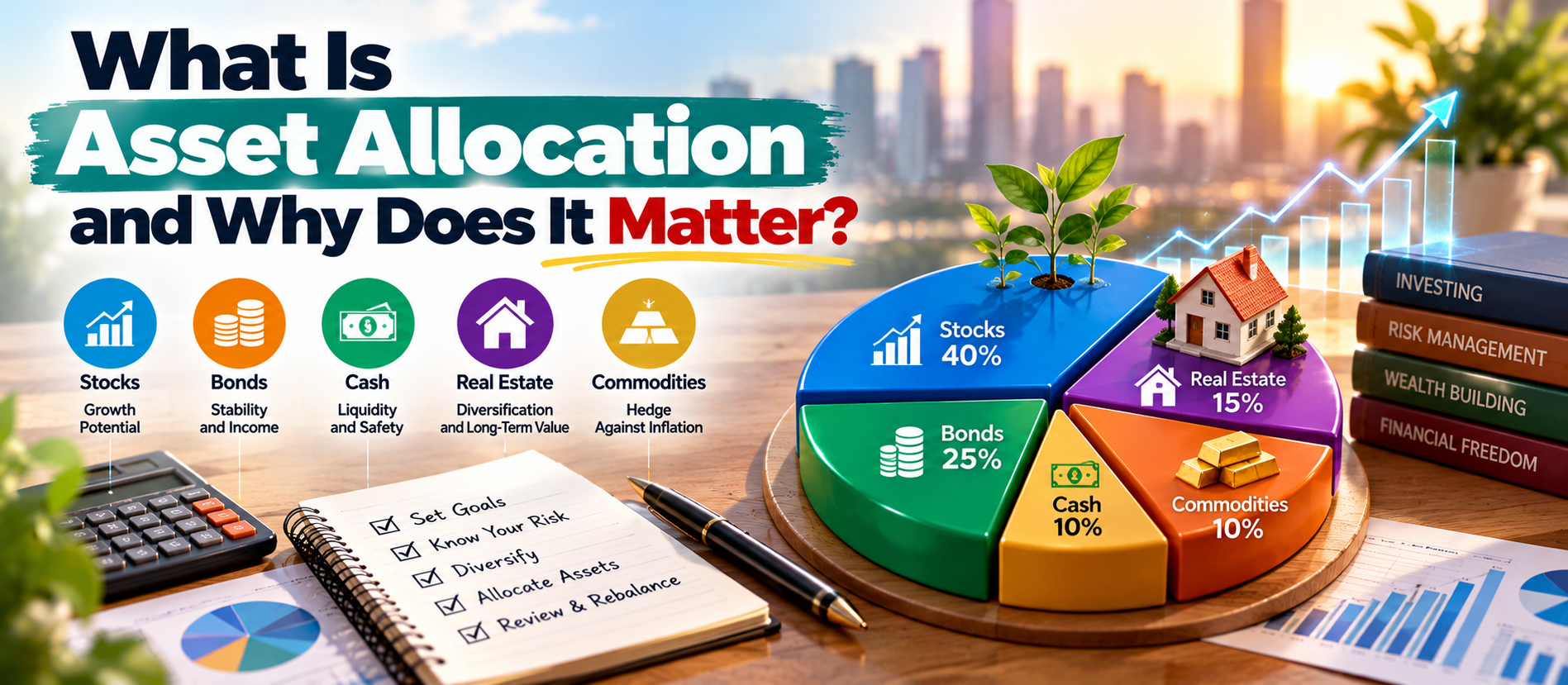
Asset allocation is the process of dividing an investment portfolio among different asset classes. Common asset classes include stocks, bonds, cash or cash equivalents, and sometimes other assets such as real estate or commodities. Each asset class has its own features, potential returns, risks, and behaviour in different market conditions.
For example, an investor might choose to hold 60% of a portfolio in shares, 30% in bonds or fixed-income investments, and 10% in cash-like assets. These percentages are only an illustration. They are not a recommended mix for everyone.
The main purpose of asset allocation is to match the portfolio to a financial goal while taking an appropriate level of risk. An investor saving for a goal many years away may have different needs from someone who expects to use the money next year. A person who can tolerate large short-term changes may also choose a different mix from someone who would struggle to stay invested during a market fall.
Asset allocation is not a guarantee against losses. Markets can decline, and different asset classes can sometimes fall at the same time. A thoughtful allocation is a way to manage risk, not a way to remove it completely.
Why Does Asset Allocation Matter?
Investors often spend a great deal of time deciding which individual investments to buy. But the overall mix of assets can be just as important. Even a portfolio containing well-known investments may not suit a goal if it takes more risk than the investor can handle or does not offer enough growth potential for a long-term target.
1. It helps align investments with your goals
Every investment goal has a purpose and a timeline. Money for a near-term expense may need stability and easy access. Money intended for retirement decades away may have more time to recover from market declines, although it still carries risk. Asset allocation helps connect your investments with the date and purpose for which you need the money.
2. It helps manage portfolio risk
Different asset classes can respond differently to changes in interest rates, inflation, economic growth, and investor confidence. Holding more than one type of asset may reduce dependence on a single source of returns. It cannot prevent every loss, but it can help avoid putting all your investment risk in one place.
3. It can make the investing journey easier to follow
A clear allocation gives you a plan to return to when markets become volatile. Without a plan, an investor may buy more of an asset simply because its price has recently risen or sell in fear after a fall. A suitable strategy can help you make decisions based on your goals rather than short-term emotion.
4. It helps balance growth and stability
Growth-oriented investments may offer higher long-term return potential but can experience large declines. More defensive assets may help reduce volatility or provide liquidity, but they may not grow fast enough to meet every long-term goal. Asset allocation is the process of balancing these needs.
5. It supports regular portfolio reviews
Over time, some investments may grow faster than others. Your original allocation can drift away from its intended percentages. A planned review helps you see whether your portfolio still matches your goals and risk limits.
Understand the Main Asset Classes
Before choosing an allocation, learn what the main asset classes do and what risks they carry. An investment’s label alone does not tell you whether it is safe. Review its underlying holdings, costs, liquidity, and potential for loss.
Stocks or equities
Stocks represent ownership in a company. Investors may earn returns through price increases and, in some cases, dividends. Shares can support long-term growth, but their prices can rise and fall sharply. A company may perform poorly, and broad markets can decline during economic or financial stress.
Owning shares in only one or two companies creates concentration risk. Investors can spread this risk by holding a wider range of companies, industries, and markets, often through diversified mutual funds or exchange-traded funds (ETFs). A fund’s name does not guarantee broad diversification, so check what it actually owns.
Bonds and fixed-income investments
Bonds are debt instruments issued by governments, companies, or other organisations. The issuer generally promises to make interest payments and repay principal according to the terms, but repayment is not risk-free. Bond prices can change when interest rates move. Issuers may also fail to meet their obligations.
Bond funds and other fixed-income investments can provide income and may behave differently from shares in some market conditions. Their risk depends on factors such as credit quality, maturity, interest-rate sensitivity, and currency exposure. Lower-risk does not mean risk-free.
Cash and cash equivalents
Cash, savings deposits, and certain short-term instruments can provide liquidity for near-term needs. They may be useful for emergency reserves or money that must be available soon. However, cash can lose purchasing power when prices rise faster than the interest earned.
Cash-like investments may also have different protections, withdrawal conditions, and risks depending on the product and country. Understand those terms before relying on an account or instrument for an important goal.
Real estate and property-related investments
Real estate can provide rental income or potential price appreciation. Direct property ownership may require substantial capital and can involve maintenance costs, taxes, legal work, and difficulty selling quickly. Property-related funds or listed real estate investments work differently and have their own market risks.
A home you live in may be an important part of your overall financial position, but it is not always equivalent to a liquid investment portfolio. Consider housing costs, debt, and the time needed to sell when planning your asset mix.
Gold and commodities
Gold and other commodities may be used by some investors as a way to diversify their holdings. Their prices can fluctuate, and they do not always move in the opposite direction from shares. Gold does not normally generate interest or dividends, and buying, storing, or selling physical assets can involve costs.
Commodities can be affected by supply, demand, currency movements, global events, and investor sentiment. They should be evaluated as part of a wider plan rather than treated as a guaranteed hedge against every risk.
Asset Allocation vs. Diversification
Asset allocation and diversification are related, but they are not the same thing.
Asset allocation means deciding how much of your portfolio to place in different asset classes. Diversification means spreading investments within and across those categories so that the portfolio is not overly dependent on one holding, company, sector, or source of risk.
For example, an investor may allocate 70% of a portfolio to equities and 30% to bonds. That is an asset allocation decision. But if the equity portion is invested entirely in one company, the portfolio may still be poorly diversified. The investor could have a diversified equity fund instead, while also reviewing how the bond holdings are spread.
Owning several funds does not automatically create diversification. Two funds may hold many of the same companies or focus on the same sector. Check their underlying holdings, geographic exposure, industry concentration, and risk factors. Diversification can reduce some forms of risk, but it cannot guarantee a profit or prevent losses during a broad market decline.
Three Factors That Shape Your Asset Allocation
1. Your investment time horizon
Your time horizon is the amount of time before you expect to use the money. It can be a few months, several years, or decades. The time horizon affects how much short-term volatility you may be able to accept.
Money needed soon generally has less time to recover from a market decline. A long-term retirement goal may allow more time for a portfolio to experience market ups and downs. However, a long time horizon alone does not mean you must take high risk. Your income, financial commitments, and ability to withstand losses also matter.
2. Your risk tolerance and risk capacity
Risk tolerance describes your willingness to accept investment losses and uncertainty. Risk capacity is your financial ability to withstand those losses without putting essential needs at risk. The two are related but different.
You may feel comfortable with market volatility but still have low risk capacity if you need the money for an upcoming expense. Another investor may have enough savings and stable income to handle market declines but feel anxious when portfolio values fall. A suitable plan should consider both the emotional and financial sides of risk.
Do not choose an allocation only because a questionnaire labels you as aggressive or conservative. Use such tools as a starting point. Review the assumptions and make sure the result fits your actual goals and circumstances.
3. Your financial situation and goals
Consider income stability, emergency savings, debt, dependants, insurance, and upcoming expenses. If you have expensive debt or no emergency savings, your first priority may not be building a complex investment portfolio. You may need to strengthen your financial foundation before taking additional investment risk.
Also consider the purpose of each goal. A portfolio for retirement may need a different allocation from one intended to fund education in five years or support a home purchase in two years. You can have more than one portfolio strategy because different goals have different timelines.
How to Build an Asset Allocation Plan Step by Step
Step 1: Write down each financial goal
List what you are investing for, how much you may need, and when you expect to use the money. Be as specific as possible. “Build wealth” is a broad aim. “Save for retirement over the next 25 years” gives you a clearer starting point.
Step 2: Protect near-term needs
Set aside money for essential expenses and emergency needs before placing money needed soon into volatile investments. Avoid using your emergency fund to chase higher returns. The purpose of that reserve is access and resilience, not maximum growth.
Step 3: Assess risk honestly
Think about how you would react if your portfolio fell significantly in value. Would you be able to stay invested, or would you need to sell to cover expenses? Consider your income, debts, dependants, and other assets. A portfolio should be realistic enough that you can follow it during difficult periods.
Step 4: Choose a broad mix of asset classes
Decide what role each asset class will play. Equities may provide long-term growth potential. Bonds may provide income or balance, depending on their characteristics. Cash can support near-term needs. Other assets may play a limited role if they fit your plan and you understand their risks.
There is no universal percentage that suits every investor. A portfolio mix should follow your goals, time horizon, risk tolerance, risk capacity, and local tax and investment rules.
Step 5: Select investments within each category
Once you choose broad percentages, decide how to implement them. You might use individual securities, diversified mutual funds, ETFs, deposits, bonds, or other regulated products available in your location. Compare costs, underlying holdings, liquidity, tax treatment, and risks.
Do not buy a product only because it has recently performed well. Past returns do not guarantee future results. Make sure each investment has a clear role in the overall portfolio.
Step 6: Record your target allocation
Write down your target percentages and the reason behind them. For example, note that the allocation is designed for a particular goal and time horizon, not for outperforming the market every month. A written plan can help you avoid unnecessary changes when markets move.
Step 7: Review and rebalance when needed
Over time, market movements and new contributions can change your portfolio percentages. Set a review schedule or a threshold that tells you when to consider rebalancing. Rebalance only after considering costs, taxes, and whether your goals or circumstances have changed.
An Illustrative Asset Allocation Example
Suppose an investor has ₹10,00,000 set aside for a long-term goal. For learning purposes only, imagine the investor selects a portfolio with 60% equities, 30% bonds or fixed-income investments, and 10% cash-like assets.
| Asset categoryIllustrative allocationAmount on ₹10,00,000 | ||
| Equities | 60% | ₹6,00,000 |
| Bonds or fixed income | 30% | ₹3,00,000 |
| Cash-like assets | 10% | ₹1,00,000 |
| Total100%₹10,00,000 |
This example demonstrates the arithmetic, not a recommended portfolio. It does not account for the investor’s age, income, risk capacity, time horizon, debts, tax position, or other assets. A different person may need a very different mix.
Imagine that equities later rise faster than the other categories. The equity portion may become a larger share of the portfolio than originally intended. That change may increase the portfolio’s exposure to equity-market risk. Rebalancing can bring the mix closer to the target, subject to costs and tax rules.
What Is Portfolio Rebalancing?
Rebalancing means bringing a portfolio back toward its intended asset allocation. It is needed because asset classes rarely grow at the same pace. Without a review, the portfolio may become more aggressive or more conservative than you planned.
There are several common ways to rebalance:
- Sell and buy: Sell some of an asset category that has grown beyond its target and use the proceeds to buy categories that are below target.
- Direct new contributions: Add new money to underweighted categories instead of selling existing holdings.
- Use withdrawals: When appropriate, take withdrawals from categories that are overweight rather than reducing every holding equally.
Rebalancing can involve transaction costs, taxes, and other practical considerations. Before selling investments, check the applicable rules and costs. In some situations, directing new contributions toward underweighted assets may be a simpler option.
Do not confuse rebalancing with trying to predict the market. It is a way to maintain a planned risk level, not a promise to improve returns. Avoid changing your target allocation every time one asset class becomes popular or unpopular.
How Often Should You Review Asset Allocation?
There is no single review schedule that fits every investor. Some people review their portfolio on a set timetable, such as every six or twelve months. Others review when an asset category moves beyond a chosen range. A regular schedule can reduce the temptation to react to daily market news.
Review your allocation sooner if your financial circumstances change significantly. Examples include a major change in income, a new dependant, a home purchase, a change in retirement plans, or a goal moving closer. A review does not always mean you must trade. Sometimes the right decision is to keep the existing plan.
Keep records of your target allocation, actual holdings, costs, and the reasons for any changes. This makes it easier to see whether you are following a deliberate strategy or reacting emotionally to market movements.
Common Asset Allocation Mistakes to Avoid
1. Copying another investor’s portfolio
A portfolio that suits a friend, influencer, or family member may not suit you. Their goals, income, debts, and risk capacity may be different. Build your allocation around your own circumstances.
2. Chasing recent performance
Investors may increase their exposure to assets that have recently risen sharply. This can lead to buying after a strong run and selling after a fall. Keep your focus on your goal and planned risk level rather than recent returns alone.
3. Confusing the number of investments with diversification
Holding many funds or securities does not guarantee a well-diversified portfolio. Several funds may own the same assets. Review what you own, including sector, country, company, credit, and interest-rate exposure.
4. Taking too much risk with short-term money
Money needed soon may not have time to recover after a market decline. Match the investment to the date you need the money, not only to the return you hope to earn.
5. Ignoring fees and taxes
Investment costs reduce the money that remains for you. Taxes can also affect the value of selling or switching investments. Compare the full cost and local tax treatment before making portfolio changes.
6. Rebalancing too often
Frequent changes can create unnecessary costs and make it harder to follow a long-term strategy. Set reasonable review rules and avoid trading simply because prices moved over a short period.
7. Forgetting inflation and cash needs
Cash can offer stability and access, but inflation may reduce its purchasing power over time. At the same time, investing all available money in volatile assets can leave you without funds for emergencies. Balance access needs with long-term growth needs.
Asset Allocation for Beginners: A Simple Checklist
Use this checklist to prepare for your first portfolio review:
- Identify the goal and the date you expect to use the money.
- Keep emergency savings separate from long-term investments.
- Review debts, income stability, and upcoming expenses.
- Assess both your willingness and ability to accept losses.
- Choose a mix of assets that matches the goal and risk level.
- Check the holdings and costs of each investment product.
- Write down your target percentages and review rules.
- Review periodically and rebalance only when appropriate.
- Check tax implications before selling or switching assets.
- Seek qualified advice if the decision is complex or unclear.
Frequently Asked Questions About Asset Allocation
What is asset allocation in simple words?
Asset allocation means deciding how to divide your investments among different types of assets, such as stocks, bonds, and cash. The aim is to match the portfolio to your financial goals, time horizon, and ability to handle risk.
Why is asset allocation important?
It helps you manage how much risk your portfolio takes, balance growth and stability, and keep your investments connected to your goals. It can reduce dependence on one asset class, but it cannot guarantee profits or prevent losses.
What is the difference between asset allocation and diversification?
Asset allocation determines the percentages invested in broad asset classes. Diversification spreads investments within and across those categories. A portfolio can have several asset classes but still be poorly diversified if it depends heavily on a few holdings.
What is a good asset allocation for beginners?
There is no single allocation that is best for all beginners. The right mix depends on the goal, time horizon, risk tolerance, risk capacity, income, debt, and need for access to the money. Treat general examples as educational, not as personalised advice.
Should asset allocation change with age?
It may change as goals and time horizons change. For example, someone approaching a goal may need to reduce exposure to assets that could fall sharply just before the money is required. Age alone should not determine the mix; personal circumstances and the goal also matter.
What is rebalancing in investing?
Rebalancing is the process of bringing a portfolio back toward its target allocation after market movements or contributions change the percentages. It can involve selling overweight assets, buying underweight assets, or directing new contributions to categories that need them.
Can asset allocation prevent investment losses?
No. Asset allocation and diversification can help manage some risks, but investments can still lose value. Different asset classes may fall together during periods of market stress. Understand the risks before investing.
Final Thoughts: Build a Portfolio With a Purpose
Asset allocation is one of the foundations of a considered investment plan. It helps you decide how much of your money belongs in growth-oriented assets, income-producing investments, and more accessible holdings. The right mix depends on what you are trying to achieve and how much risk you can realistically accept.
Start with your goals and time horizon. Review your financial foundation, understand the risks of each asset class, and choose investments that work together rather than compete without a clear purpose. Record your target allocation and review it when your circumstances change.
Do not expect one allocation to deliver the best returns in every market. A sound plan is designed to support your needs over time, not to predict every short-term movement. Consistency, diversification, and thoughtful reviews can help you make more informed decisions.
Explore more personal finance and investing insights at Digiifrog.
Disclaimer: This article is for general educational purposes only. It is not personalised financial, tax, or investment advice. Investments can lose value, and asset allocation does not eliminate risk. Consider your own circumstances and consult a qualified professional when needed.
Ready to Grow?
Talk to us about a strategy tailored to your brand — we will help you stand out in search, AI discovery and social.

Comments (0)
Log in to leave a comment.