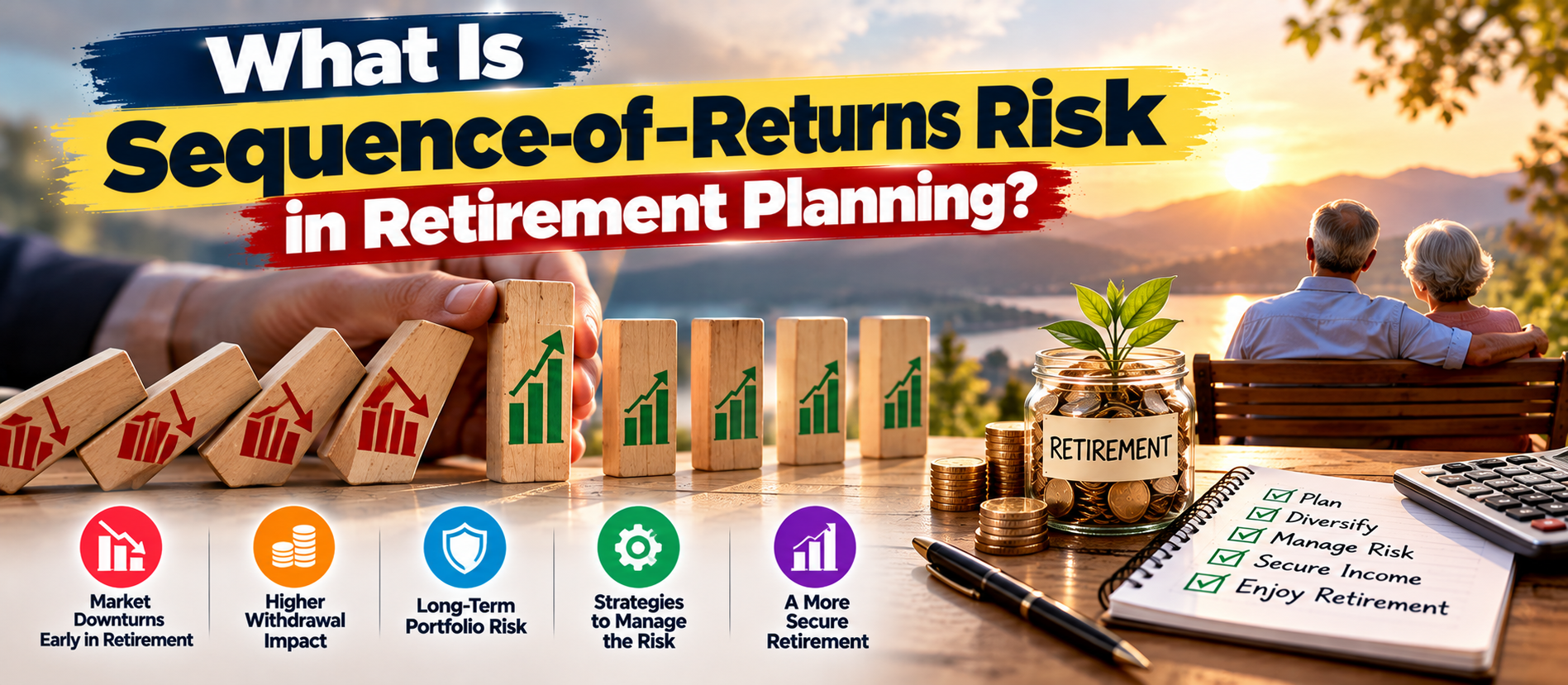
📋 Quick Summary
In this article:
Introduction: Why the Timing of Returns Matters
What Is Sequence-of-Returns Risk?
Why Early Retirement Losses Can Be So Damaging
A Simple Example: Two Retirees, Different Outcomes
Who Is Most Exposed to Sequence Risk?
Sequence Risk Before Retirement: The Fragile Years
How to Reduce Sequence-of-Returns Risk
1. Keep a cash reserve for near-term spending
2. Use a diversified portfolio
3. Plan withdrawals before retirement begins
4. Make withdrawals flexible where possible
5. Separate essential and optional spending
Introduction: Why the Timing of Returns Matters
Retirement planning often focuses on how much money you need and what return your investments might earn. These are important questions, but they do not tell the whole story. The timing of investment returns also matters.
Imagine two people retire with the same amount of money. They hold similar investments and withdraw the same amount each year. Over a long period, their investments may even experience similar average returns. Yet one person may finish retirement with a healthy balance while the other struggles to make the money last.
💡 Key Insight
One reason for this difference is sequence-of-returns risk. It is especially important when you start taking money out of your portfolio. A market fall during the first years of retirement can force you to sell investments at low prices. Those sold units are no longer available to benefit from a future recovery.
This risk affects people who rely on mutual funds, shares, ETFs or other market-linked investments to support retirement spending. It can also matter to people who retire early and expect their savings to last for several decades.
This article explains sequence-of-returns risk in simple language. It includes a numerical illustration, common mistakes and practical steps that Indian investors can consider when planning retirement income.
What Is Sequence-of-Returns Risk?
Sequence-of-returns risk is the risk that the order in which investment gains and losses occur will affect how long your retirement savings last. It matters most when you are withdrawing money from your portfolio on a regular basis.
During your working years, you usually add money to investments. A market decline can be uncomfortable, but regular contributions may allow you to buy more units at lower prices. During retirement, the situation changes. Instead of adding money, you may need to sell investments to pay for food, housing, health care and other costs.
If markets fall while you are making withdrawals, you may need to sell more units to raise the same amount of cash. If markets later recover, the units you sold cannot take part in that recovery. This can permanently reduce the portfolio’s ability to generate future returns.
Sequence risk is not the same as ordinary market volatility. Volatility describes how much investment prices move. Sequence risk focuses on how the timing of those movements interacts with withdrawals and affects the sustainability of retirement income.
It is also not limited to the first day of retirement. The years just before and after retirement are often especially important because your savings may be large, your future contributions may be limited, and you are close to relying on the portfolio for income.
Why Early Retirement Losses Can Be So Damaging
Three forces work together to make early losses dangerous.
- Your portfolio may be at its largest. After decades of saving, a large share of your lifetime wealth may be invested. A percentage loss can therefore remove a substantial amount of money.
- You need cash for living expenses. You may not be able to wait for markets to recover. Bills continue even when investment prices fall.
- Withdrawals reduce the recovery base. Money sold to fund spending is no longer invested. A later recovery applies only to what remains in the portfolio.
For example, a portfolio that falls by 20% needs a 25% gain just to return to its original value, before considering withdrawals or fees. If you also sell investments during the decline, the amount left to recover is smaller.
This is why retirement plans should not rely only on an average annual return. Markets do not deliver a smooth return every year. A plan needs to account for difficult early years as well as more favourable ones.
A Simple Example: Two Retirees, Different Outcomes
Consider two fictional retirees, Asha and Ravi. Each begins retirement with ₹1 crore. Each withdraws ₹6 lakh at the end of every year. To keep the example simple, assume the same three annual returns occur in a different order and ignore taxes, fees and inflation.
| YearAsha’s returnRavi’s return | ||
| 1 | -20% | +30% |
| 2 | +10% | +10% |
| 3 | +30% | -20% |
The sequence of returns is different, even though both retirees experience the same set of returns. Asha faces a major loss in the first year, when her portfolio is still large and withdrawals begin. Ravi experiences the same loss later, after two stronger years.
Under these simplified assumptions, Asha’s balance after the three withdrawals is about ₹91.2 lakh, while Ravi’s is about ₹97.5 lakh. The exact result depends on the timing of each withdrawal and how returns are applied. This example is illustrative, not a forecast or a guarantee of what a real portfolio will do.
The key lesson is that average return alone can hide an important risk. When you are withdrawing money, the order of gains and losses can affect how much capital remains to support future spending.
Who Is Most Exposed to Sequence Risk?
Sequence-of-returns risk can affect many investors, but some situations make it more serious.
- People retiring soon: A market fall shortly before retirement can reduce the amount available to support planned spending.
- New retirees: Early losses combined with withdrawals can create lasting damage to the portfolio.
- Early retirees: A long retirement period means savings may need to support spending for 30 years or more.
- People with high withdrawal needs: Large withdrawals relative to the portfolio leave less room to recover from losses.
- Retirees who depend heavily on market-linked assets: A portfolio concentrated in volatile assets may be more exposed to sharp declines.
- Households with little guaranteed income: If pension or other reliable income does not cover essential costs, the portfolio may need to provide more cash during market downturns.
The risk is not limited to people with small portfolios. A large retirement corpus can still be vulnerable if spending is high, withdrawals are inflexible or investment losses arrive at an unfavourable time.
Sequence Risk Before Retirement: The Fragile Years
The years just before retirement deserve special attention. A major market fall at this stage can reduce your portfolio when you have fewer working years left to rebuild it. You may need to delay retirement, reduce planned spending or save more to reach the same goal.
This period is sometimes called the retirement “fragile decade”—roughly the years around the transition from work to retirement. It is not a precise rule, but it highlights a useful planning idea: the timing of a large loss can matter more when your ability to add new savings is limited.
As retirement approaches, review your asset allocation, expected spending and cash reserves. That does not mean you should automatically sell all equities. Retirement may last decades, and inflation can erode the value of money held only in low-growth assets. Instead, aim for a mix that can support near-term spending while retaining a suitable growth component for later years.
Also consider whether your retirement date can be flexible. Working part-time for an additional year, delaying a large purchase or temporarily reducing discretionary spending may improve the plan if markets perform poorly. These choices are personal and depend on health, family responsibilities and work opportunities.
How to Reduce Sequence-of-Returns Risk
No strategy can guarantee that a retirement portfolio will never run short. However, several planning methods can reduce the pressure to sell long-term investments during a market downturn.
1. Keep a cash reserve for near-term spending
Keep an appropriate amount of money in accessible, lower-volatility assets for expenses you expect in the near future. This can help you avoid selling equities immediately after a market fall.
The right reserve depends on your pension income, spending, asset allocation, other assets and comfort with risk. Some people use a few months of expenses; others prefer a longer buffer. A larger reserve may reduce forced selling, but holding too much cash for many years can weaken long-term growth and purchasing power.
Think of cash as a spending buffer, not a complete investment strategy. Review it periodically and replenish it when conditions and your plan allow.
2. Use a diversified portfolio
A portfolio spread across suitable asset classes may be less dependent on one market. Equities may provide long-term growth but can fall sharply. High-quality fixed-income investments and cash may offer more stability, although they have their own risks, including interest-rate, credit and inflation risk.
Diversification does not guarantee a profit or prevent every loss. Different assets can fall at the same time. The aim is to avoid relying on a single source of return and to build a portfolio that matches your time horizon and spending needs.
3. Plan withdrawals before retirement begins
Estimate how much income you need from investments after accounting for pension income, rental income or other reliable sources. Test different withdrawal amounts under poor-market scenarios. A plan that works only when returns are strong may be too optimistic.
A withdrawal rate is not a guarantee. A rate that may be manageable for one household could be too high for another because of age, inflation, taxes, fees, asset mix and retirement length. Review the plan with cautious assumptions and consider professional advice for complex situations.
4. Make withdrawals flexible where possible
Essential spending is difficult to reduce, but discretionary expenses may be more flexible. You might postpone a major holiday, delay a vehicle upgrade or reduce non-essential spending after a poor market year. This can lower the amount you need to withdraw while your portfolio is under pressure.
Some retirees use rules that link withdrawals to portfolio performance. For example, they may pause an inflation-based increase after a negative year or reduce discretionary withdrawals when the portfolio falls below a chosen level. Any rule should be simple enough to follow and should protect essential needs first.
5. Separate essential and optional spending
Prepare two retirement budgets. The first covers essentials such as food, housing, utilities, basic health care and insurance. The second covers flexible expenses such as travel, hobbies and large discretionary purchases.
Then identify which income sources can cover essential costs. A pension, eligible annuity or other dependable income may help, but each option has trade-offs, fees, tax rules and conditions. Do not commit money to a product without understanding access restrictions and what happens to the funds after death.
6. Consider a bucket approach carefully
Some retirees organise investments into time-based buckets. A near-term bucket may hold money for upcoming expenses. A medium-term bucket may contain assets intended for later spending, while a long-term bucket may remain invested for growth.
This structure can make the plan easier to understand and may reduce the urge to sell growth assets after a fall. However, buckets do not remove investment risk. The overall asset allocation, withdrawal plan and costs still matter. Refill decisions should follow a written plan rather than market predictions.
7. Rebalance with a clear process
Rebalancing brings your portfolio back toward its intended asset allocation. It can involve selling some assets that have grown and buying assets that have fallen. This helps control risk, but selling after a decline may not always be desirable when you also need cash for spending.
Decide in advance how often you will review the portfolio and what conditions will trigger a rebalance. Consider transaction costs and tax consequences. Avoid making large changes based only on fear or a short-term market forecast.
8. Keep working or earning options open, if practical
Part-time work, consulting or occasional income can reduce the amount you need to withdraw during difficult market periods. Even a temporary income source may provide flexibility. This is not possible or desirable for everyone, particularly when health or caregiving needs make work difficult.
If you plan to work after retirement, treat that income as a possible support rather than a guaranteed source unless it is contractually reliable. A plan should still be tested for the possibility that the income stops.
9. Review insurance and unexpected costs
Large medical bills or family emergencies can force withdrawals at the wrong time. Review health insurance, emergency savings and other protection that fits your circumstances. Understand policy exclusions and limits. Insurance can help manage certain risks, but it will not cover every expense.
10. Review your plan regularly
Retirement planning is not a one-time calculation. Review spending, portfolio value, income sources, taxes and asset allocation at least annually, and after major life changes. Use current figures rather than assuming that old return estimates will continue.
What Not to Do During a Market Crash
A market decline can create fear, especially when you rely on investments for monthly income. A written plan can help you avoid decisions that make the damage worse.
- Do not panic-sell the entire portfolio. Selling everything can lock in losses and make it difficult to participate in a recovery. Any change should follow your needs and investment plan, not a headline alone.
- Do not assume markets will recover on your timetable. Recoveries can take different amounts of time. Your cash plan should not depend on a quick rebound.
- Do not keep withdrawals unchanged without review. If your portfolio falls sharply, check whether discretionary spending can be adjusted.
- Do not chase high returns to recover losses quickly. Taking much more risk after a fall can expose you to further losses.
- Do not ignore inflation. Cutting spending may help, but a plan must still consider the rising cost of essential goods and services.
Before making major changes, review your plan with a qualified financial adviser who understands retirement income and your personal circumstances.
Example: A Retirement Income Plan in India
Imagine a couple retires with a financial portfolio of ₹1.5 crore. They also receive some dependable income, but their investments must cover a meaningful share of household expenses. They expect to be retired for 25 to 30 years.
Instead of assuming a smooth annual return, they test several scenarios. One scenario includes a market decline in the first two years. Another assumes weak returns later in retirement. They then create a plan with these features:
- Essential expenses are estimated separately from optional spending.
- Near-term spending is supported by accessible, lower-volatility assets and reliable income sources where available.
- The long-term portfolio remains diversified and is not concentrated in one company or sector.
- Withdrawals are reviewed after major market declines.
- Discretionary spending can be reduced temporarily if the portfolio is under pressure.
- Health costs, inflation and taxes are included in the annual review.
This example does not imply that ₹1.5 crore is enough for every household. The required corpus depends on expenses, other income, age, health, inflation, investment returns and how long the money must last. The lesson is to test the plan under difficult conditions, not only under average-return assumptions.
Sequence Risk and Inflation: Two Risks That Can Work Together
Inflation makes retirement planning harder because the same amount of money buys less over time. If you increase withdrawals every year to keep up with rising prices, the amount leaving your portfolio can grow even when market returns are weak.
Imagine a retiree withdraws ₹6 lakh in the first year and increases that amount annually. If inflation rises, the portfolio must fund larger withdrawals. If poor returns occur at the same time, the combination can put extra pressure on the remaining balance.
That is why a retirement plan should test both market losses and higher living costs. Consider multiple inflation assumptions, and review whether spending increases can be moderated after difficult years. Do not solve sequence risk by holding all assets in cash for decades; inflation can also damage a cash-only strategy.
How to Prepare Before Retirement: A Checklist
- Estimate essential and discretionary retirement expenses.
- List pension, rental, annuity or other dependable income sources, where applicable.
- Calculate how much annual income must come from investments.
- Test the plan against an early market decline and several years of weak returns.
- Decide how much near-term spending to keep in accessible assets.
- Set a diversified asset allocation that reflects your risk tolerance and time horizon.
- Write rules for adjusting discretionary withdrawals after poor returns.
- Review health insurance, emergency reserves and major family obligations.
- Understand the tax and withdrawal rules of each retirement product.
- Schedule a regular review and update the plan when circumstances change.
Frequently Asked Questions (FAQs)
What is sequence-of-returns risk in simple terms?
It is the risk that poor returns early in retirement will hurt your savings more because you are withdrawing money while markets are down. Selling investments at low prices leaves fewer units to recover later.
Why is sequence risk more serious after retirement than during saving?
During saving, you may continue adding money and can buy more units during a downturn. During retirement, you may need to sell units to pay expenses. Those units cannot participate in a later recovery.
Does sequence risk affect only equity investors?
No. It can affect any portfolio where returns vary and regular withdrawals are made. The level and nature of the risk depend on the assets held, their behaviour and the withdrawal plan.
Can diversification eliminate sequence-of-returns risk?
No. Diversification may reduce dependence on a single asset or market, but it cannot guarantee positive returns or prevent losses. A cash reserve and flexible withdrawals may also help manage the risk.
How much cash should I keep in retirement?
There is no universal amount. Consider your essential spending, other income sources, portfolio mix, health needs and comfort with risk. A cash reserve can reduce forced selling, but excessive cash can lose purchasing power to inflation.
Should I stop investing in equity before retirement?
Not automatically. Retirement may last for decades, and some growth assets may help address inflation. The right allocation depends on your circumstances. Review both near-term income needs and long-term growth needs rather than following a single rule.
What is a retirement bucket strategy?
It is a way to organise investments by when the money may be needed. A near-term bucket supports upcoming expenses, while other buckets may be designed for medium- and long-term needs. It can help with planning, but it does not remove market risk.
Can a Systematic Withdrawal Plan (SWP) protect me from sequence risk?
An SWP can automate withdrawals from a mutual fund, but it does not guarantee income or protect the corpus from losses. If the fund falls while withdrawals continue, units may be sold at lower values. Choose withdrawal amounts carefully and review them regularly.
When should I start planning for sequence risk?
Start several years before retirement, when you have time to review your allocation, spending and income options. Continue reviewing the plan throughout retirement because market conditions and personal needs can change.
Where can I learn more about retirement planning in India?
SEBI Investor offers educational resources on retirement planning, diversification, investment risks and financial goals. You can begin with its retirement planning guidance and consider advice from a qualified, regulated professional for your own circumstances.
Conclusion: Plan for the Order of Returns, Not Just the Average
Sequence-of-returns risk is an important part of retirement planning because it shows that timing matters. A market decline in the first years of retirement can have a greater effect on a portfolio than the same decline later, especially when withdrawals continue.
You cannot control the order of market returns. You can, however, prepare for uncertainty. Estimate realistic spending, diversify investments, keep a suitable reserve for near-term needs and make withdrawal rules flexible where possible. Test your plan against poor early returns, inflation and unexpected expenses.
⚠ Watch Out
There is no strategy that guarantees your savings will last forever. A careful plan, regular reviews and professional advice when needed can help you make better decisions and reduce avoidable pressure during difficult markets.
At Digiifrog, our aim is to make financial concepts clear and practical. Use this guide as a starting point, then adapt the ideas to your retirement goals, household needs and risk tolerance.
SEO and Publishing Notes
Editorial disclaimer: This article is for general educational purposes only. It is not personalised investment, legal or tax advice. Investments can lose value, and returns are not guaranteed. Consider your circumstances and consult a qualified financial adviser before making major retirement decisions.
Ready to Grow?
Talk to us about a strategy tailored to your brand — we will help you stand out in search, AI discovery and social.


Comments (0)
Log in to leave a comment.