📋 Quick Summary
In this article:
Why White Collar Crimes Matter
Common Types of White Collar Crimes
Cyber-Enabled Financial Crimes
Who Commits White Collar Crimes?
How White Collar Crimes Are Investigated
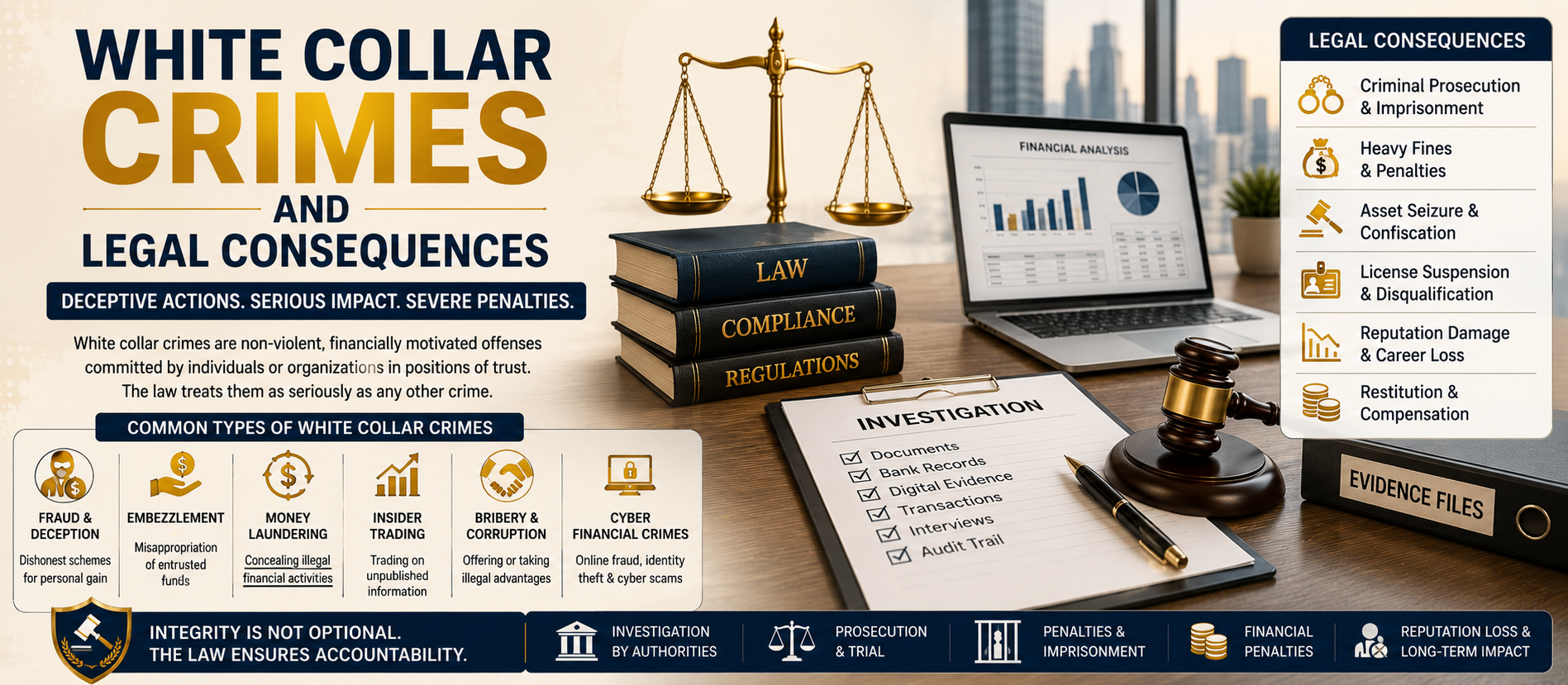
White collar crimes have become one of the most significant legal and financial challenges in the modern business world. Unlike traditional crimes that involve physical violence, white collar crimes are generally committed through deception, fraud, manipulation, abuse of trust, or financial misconduct for personal or corporate gain.
These crimes can affect businesses, governments, investors, employees, consumers, and financial institutions. In today's digital economy, technological advancements, online transactions, global banking systems, and artificial intelligence have created new opportunities for sophisticated financial crimes.
Governments and regulatory agencies worldwide continue strengthening enforcement measures to combat corporate fraud, money laundering, cyber-enabled financial crimes, insider trading, tax evasion, and other forms of economic misconduct.
This comprehensive guide explains white collar crimes, common examples, legal consequences, regulatory investigations, compliance requirements, and strategies organizations can use to reduce legal risks in 2026.
What Are White Collar Crimes?
White collar crimes are non-violent offenses typically committed by individuals, professionals, executives, government officials, or organizations for financial or economic benefit.
The term generally refers to crimes involving:
- Fraud
- Financial deception
- Breach of trust
- Corporate misconduct
- Regulatory violations
- Economic crimes
White collar crimes often involve sophisticated planning, extensive documentation, digital systems, and complex financial transactions.
Why White Collar Crimes Matter
Although these crimes may not involve physical violence, their impact can be enormous.
Consequences often include:
- Financial losses
- Business failures
- Investor harm
- Employment losses
- Market instability
- Consumer damage
- Reputational harm
Large-scale corporate frauds have historically resulted in billions of dollars in losses and long-term economic consequences.
Common Types of White Collar Crimes
Corporate Fraud
Corporate fraud occurs when businesses or executives intentionally misrepresent information for financial gain.
Examples include:
- False accounting records
- Revenue manipulation
- Hidden liabilities
- Misleading investors
- Financial statement fraud
Corporate fraud can severely damage investor confidence and market integrity.
Embezzlement
Embezzlement involves the unlawful appropriation of funds or assets entrusted to an individual.
- Employee theft
- Misuse of company funds
- Unauthorized transfers
- Financial record manipulation
Organizations often discover embezzlement through audits and internal investigations.
Money Laundering
Money laundering involves disguising the origin of illegally obtained funds to make them appear legitimate.
Common laundering stages include:
- Placement
- Layering
- Integration
Anti-money laundering regulations require financial institutions to monitor suspicious activities.
Insider Trading
Insider trading occurs when individuals trade securities based on material non-public information.
- Corporate announcements
- Merger information
- Financial results
- Confidential business data
Financial regulators actively investigate suspected insider trading activities.
Tax Evasion
⚠ Watch Out
Tax evasion involves intentionally avoiding lawful tax obligations.
Examples include:
- Underreporting income
- False deductions
- Hidden assets
- Fraudulent filings
Tax authorities impose significant penalties for intentional violations.
Bribery and Corruption
Bribery involves offering, giving, receiving, or soliciting something of value to influence decisions improperly.
- Government corruption
- Corporate bribery
- Procurement fraud
- Kickback schemes
Anti-corruption laws increasingly apply across international business transactions.
Cyber-Enabled Financial Crimes
Technology has expanded opportunities for financial misconduct.
- Business email compromise
- Online fraud
- Identity theft
- Cryptocurrency scams
- Digital payment fraud
Cybercrime investigations often involve both financial and digital evidence.
Who Commits White Collar Crimes?
White collar crimes may be committed by individuals across various sectors.
- Corporate executives
- Accountants
- Financial professionals
- Government officials
- Employees
- Business owners
- Investment advisors
Access to financial systems and positions of trust often play a role in these offenses.
How White Collar Crimes Are Investigated
Investigations typically involve multiple agencies and specialists.
- Financial regulators
- Law enforcement agencies
- Tax authorities
- Forensic accountants
- Cybercrime units
- Compliance investigators
Investigations may take months or years due to the complexity of financial records and transactions.
Evidence Commonly Used in White Collar Crime Cases
Modern investigations rely heavily on documentary and digital evidence.
- Financial statements
- Bank records
- Email communications
- Transaction histories
- Accounting records
- Internal reports
- Digital logs
Electronic evidence often plays a critical role in establishing intent and misconduct.
Legal Consequences of White Collar Crimes
Penalties vary depending on the offense, jurisdiction, financial impact, and aggravating circumstances.
Possible consequences include:
- Criminal prosecution
- Financial penalties
- Restitution orders
- Asset forfeiture
- Professional license suspension
- Corporate sanctions
- Imprisonment
Large-scale financial crimes often result in severe penalties.
Corporate Liability and Compliance Risks
Organizations themselves may face legal consequences when employees or executives engage in misconduct.
Potential outcomes include:
- Regulatory investigations
- Civil lawsuits
- Reputational damage
- Operational restrictions
- Compliance monitoring
Businesses increasingly invest in compliance programs to reduce risks.
Role of Whistleblowers
Whistleblowers often play a critical role in exposing white collar crimes.
They may report:
- Fraudulent accounting
- Bribery schemes
- Regulatory violations
- Insider misconduct
- Financial irregularities
Many jurisdictions provide legal protections for whistleblowers who report misconduct in good faith.
How Businesses Can Prevent White Collar Crimes
Prevention remains the most effective strategy.
- Strong internal controls
- Regular audits
- Compliance programs
- Employee training
- Fraud monitoring systems
- Whistleblower reporting channels
- Risk assessments
Effective governance significantly reduces exposure to financial crime risks.
Importance of Corporate Compliance Programs
Compliance programs help organizations detect and prevent misconduct.
Core elements often include:
- Written policies
- Ethics training
- Risk management procedures
- Monitoring systems
- Internal investigations
- Reporting mechanisms
Regulators increasingly consider compliance efforts when evaluating enforcement actions.
White Collar Crimes in the Digital Economy
Digital transformation has introduced new legal challenges.
- Cryptocurrency fraud
- AI-assisted scams
- Online investment fraud
- Data manipulation
- Cross-border financial crimes
Law enforcement agencies continue adapting to emerging technologies.
Economic Impact of White Collar Crimes
The financial impact extends beyond individual victims.
- Investor losses
- Business closures
- Reduced market confidence
- Regulatory costs
- Employment disruption
- Economic instability
These offenses often create widespread consequences across industries.
Defenses in White Collar Crime Cases
Individuals accused of financial crimes may present legal defenses depending on the circumstances.
Examples may involve:
- Lack of intent
- Mistaken identity
- Insufficient evidence
- Reliance on professional advice
- Procedural defenses
Specific defenses vary by case and jurisdiction.
SEO, AEO, GEO, and AI Search for Legal Compliance Education
Organizations increasingly rely on digital content to educate employees about compliance risks.
SEO (Search Engine Optimization) helps compliance resources rank in Google and Bing.
AEO (Answer Engine Optimization) improves visibility in direct-answer search experiences.
GEO (Generative Engine Optimization) enhances discoverability in AI-generated responses.
AI Search Optimization ensures compliance content remains visible across modern AI-powered search platforms.
Accessible education helps organizations build stronger compliance cultures.
Frequently Asked Questions
What is a white collar crime?
A white collar crime is a non-violent offense involving fraud, deception, financial misconduct, or abuse of trust for economic gain.
What are common examples of white collar crimes?
Examples include corporate fraud, embezzlement, insider trading, money laundering, tax evasion, and bribery.
Can companies be held liable?
Yes. Organizations may face regulatory penalties, civil liability, and other legal consequences.
How are white collar crimes investigated?
Investigations often involve financial regulators, law enforcement agencies, forensic accountants, and compliance specialists.
Can strong compliance programs reduce risk?
Yes. Effective compliance systems help detect, prevent, and address misconduct before it escalates.
Conclusion
White collar crimes continue evolving alongside technological innovation, global finance, and digital commerce. Although these offenses are typically non-violent, their economic and social consequences can be enormous.
Businesses, professionals, and organizations must remain vigilant by implementing strong compliance programs, conducting regular audits, maintaining ethical standards, and promoting transparency.
Understanding white collar crimes and their legal consequences helps organizations reduce risk, protect stakeholders, and maintain public trust in an increasingly complex business environment.
For more expert insights on legal compliance, business strategy, SEO, AEO, GEO, AI Search, and digital growth, visit Digiifrog.
Digiifrog
Website: www.digiifrog.com
Digital Marketing, SEO, AEO, GEO & AI Search Solutions for Modern Businesses.
Ready to Grow?
Talk to us about a strategy tailored to your brand — we will help you stand out in search, AI discovery and social.


Comments (0)
Log in to leave a comment.