📋 Quick Summary
In this article:
Quick Answer: Why Are B2B SaaS Solutions So Popular?
Why Businesses Are Moving Away from Traditional Software
1. Lower Upfront Technology Costs
2. Faster Deployment
3. Scalability Supports Business Growth
4. Remote and Hybrid Work Made SaaS More Important
5. Automatic Software Updates
6. B2B SaaS Improves Business Collaboration
7. Integration Is a Major SaaS Advantage
8. SaaS Supports Business Automation
9. Artificial Intelligence Is Expanding SaaS Capabilities
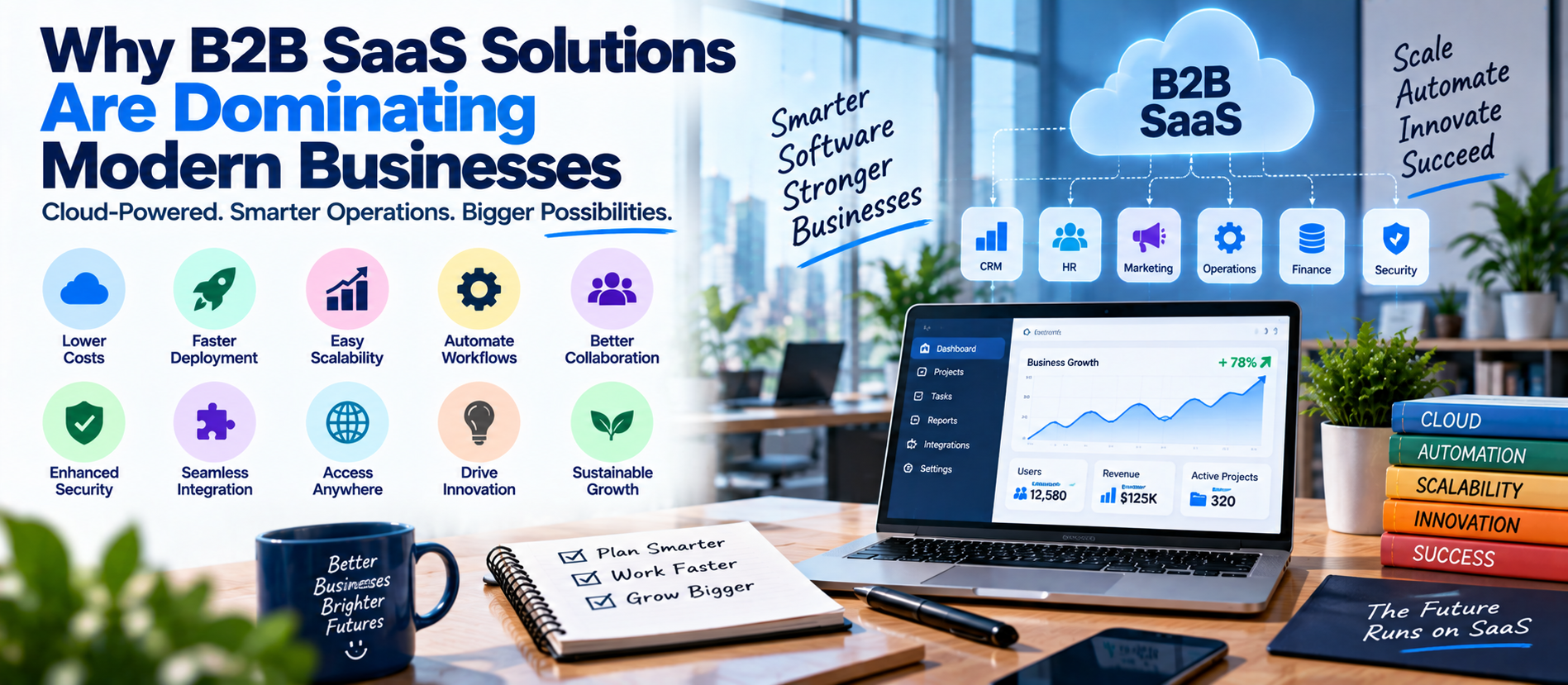
B2B SaaS solutions are dominating modern businesses because they provide flexible, scalable, accessible, and cost-efficient software without the complexity of traditional on-premise systems. From customer relationship management and accounting to marketing automation, cybersecurity, collaboration, and artificial intelligence, SaaS platforms are changing how companies operate.
Businesses no longer need to purchase expensive servers, install complex software on every computer, or wait months for major upgrades. With Software as a Service, organizations can access powerful applications through the internet and pay for services based on subscriptions or usage.
This article explains why B2B SaaS solutions are growing rapidly, how they benefit modern organizations, the challenges businesses should consider, and what the future of the B2B SaaS industry may look like.
Quick Answer: Why Are B2B SaaS Solutions So Popular?
B2B SaaS solutions are popular because they help businesses access software through the cloud without managing complex infrastructure. Companies can deploy tools faster, support remote teams, scale services as they grow, receive automatic updates, and reduce many upfront technology costs.
Modern businesses also need software that connects with other systems, provides real-time data, and supports automation. SaaS platforms are designed to meet many of these needs.
What Is B2B SaaS?
B2B SaaS stands for Business-to-Business Software as a Service.
It refers to cloud-based software products that are sold primarily to businesses rather than individual consumers. Users usually access the software through a web browser, mobile application, or API.
Common categories of B2B SaaS include:
- Customer Relationship Management (CRM).
- Marketing automation.
- Accounting and financial management.
- Human resources and payroll.
- Project management.
- Cybersecurity.
- Cloud storage and collaboration.
- Customer support platforms.
- Business intelligence and analytics.
- Workflow automation.
The SaaS provider manages much of the underlying infrastructure, while customers use the application as an online service.
Why Businesses Are Moving Away from Traditional Software
Traditional business software often required companies to purchase licenses, install applications locally, manage servers, and perform upgrades manually.
This approach can create several challenges:
- High upfront costs.
- Complex installation processes.
- Expensive infrastructure.
- Slow software upgrades.
- Limited remote access.
- Ongoing maintenance requirements.
B2B SaaS offers a different model.
Businesses can usually create an account, configure the platform, add users, and begin using the software much faster. The provider handles many infrastructure and maintenance responsibilities.
1. Lower Upfront Technology Costs
One of the biggest reasons businesses choose SaaS is the reduced need for large upfront investments.
Traditional enterprise software may require:
- Software license purchases.
- Dedicated servers.
- IT infrastructure.
- Installation services.
- Maintenance contracts.
SaaS typically uses subscription-based pricing. This allows many businesses to spread costs over time.
However, lower upfront cost does not always mean lower total cost. Companies should evaluate subscription fees, user growth, additional features, integrations, and long-term usage before selecting a platform.
2. Faster Deployment
Modern businesses move quickly. A company may need a new sales system, communication platform, or automation tool within days rather than months.
SaaS can reduce deployment time because the core infrastructure already exists.
Instead of building and maintaining the technology environment from the beginning, businesses can focus on:
- Account configuration.
- User permissions.
- Data migration.
- Workflow setup.
- Team training.
Faster deployment can help companies respond quickly to changing business needs.
3. Scalability Supports Business Growth
Business needs change over time.
A startup may begin with five employees and later grow to fifty or five hundred. Traditional infrastructure may require major upgrades when the company expands.
Many B2B SaaS platforms allow businesses to add:
- More users.
- Additional storage.
- Advanced features.
- Higher service capacity.
- New integrations.
This flexibility makes SaaS attractive for growing companies.
Businesses should still review pricing structures carefully because rapid growth can increase software spending.
4. Remote and Hybrid Work Made SaaS More Important
Modern teams are no longer always located in one office.
Employees may work:
- From home.
- From different cities.
- From different countries.
- In hybrid office environments.
Cloud-based SaaS tools make it easier for authorized users to access business applications from different locations.
💡 Key Insight
Teams can collaborate on documents, manage projects, communicate with customers, and access important information without depending entirely on office-based servers.
5. Automatic Software Updates
Traditional software updates can be expensive and time-consuming.
IT teams may need to:
- Download new versions.
- Test compatibility.
- Install updates.
- Update multiple devices.
- Resolve technical problems.
SaaS providers can update their platforms centrally.
This means users can often access new features and improvements without manually installing software on every device.
Businesses should still monitor major platform changes and test critical integrations when updates affect important workflows.
6. B2B SaaS Improves Business Collaboration
Modern businesses depend on collaboration between departments.
Sales teams need information from marketing. Customer service teams need access to customer history. Finance teams need accurate operational data.
B2B SaaS platforms can improve collaboration by providing shared access to relevant information.
Examples include:
- Shared project dashboards.
- Centralized customer records.
- Real-time document collaboration.
- Automated notifications.
- Team communication tools.
When information is stored in disconnected systems, employees may waste time searching for data or creating duplicate records.
7. Integration Is a Major SaaS Advantage
Businesses rarely use only one software platform.
A typical company may use separate tools for:
- Sales.
- Marketing.
- Accounting.
- Customer support.
- Human resources.
- Analytics.
Modern SaaS platforms often provide APIs and integrations that allow systems to exchange information.
For example, a lead generated through a marketing platform can automatically move into a CRM. A workflow automation system can trigger notifications when a customer completes a specific action.
Good integration can reduce manual data entry and improve operational efficiency.
8. SaaS Supports Business Automation
Automation is becoming a major priority for modern organizations.
B2B SaaS platforms can automate repetitive tasks such as:
- Lead assignment.
- Email follow-up.
- Invoice reminders.
- Customer notifications.
- Report generation.
- Approval workflows.
- Data synchronization.
Automation does not eliminate the need for employees. Instead, it can reduce repetitive administrative work and allow teams to focus on higher-value activities.
9. Artificial Intelligence Is Expanding SaaS Capabilities
Artificial intelligence is becoming an important part of the B2B SaaS market.
AI-powered SaaS platforms can help businesses with:
- Data analysis.
- Content creation.
- Customer support.
- Sales forecasting.
- Workflow automation.
- Document processing.
- Business recommendations.
AI can make software more useful by helping users analyze large amounts of information and complete tasks faster.
However, businesses should evaluate AI features carefully. Accuracy, privacy, security, data handling, and human oversight are important considerations.
10. Subscription Models Create More Predictable Access
SaaS subscriptions allow businesses to access software based on monthly or annual plans.
This model can help companies plan technology spending, especially when compared with large one-time infrastructure purchases.
Common SaaS pricing models include:
- Per-user pricing.
- Usage-based pricing.
- Tiered pricing.
- Feature-based plans.
- Enterprise agreements.
The best pricing model depends on the company's size, usage patterns, and growth plans.
11. Real-Time Data Helps Businesses Make Better Decisions
Many modern SaaS platforms provide dashboards and reports that update as business activity occurs.
Real-time or near-real-time data can help managers monitor:
- Sales performance.
- Marketing campaigns.
- Customer support activity.
- Project progress.
- Financial performance.
- Operational efficiency.
Better visibility can help businesses respond more quickly to problems and opportunities.
However, more data does not automatically create better decisions. Organizations need clear metrics and reliable data practices.
The Most Important Benefits of B2B SaaS Solutions
Accessibility
Authorized users can access cloud-based applications from different locations and devices.
Scalability
Businesses can often increase or reduce service capacity based on their needs.
Speed
SaaS can reduce deployment time compared with many traditional software environments.
Automatic Updates
Providers can manage many updates and improvements centrally.
Integration
APIs and connected applications can help businesses create more efficient workflows.
Automation
SaaS platforms can automate repetitive tasks across sales, marketing, finance, operations, and customer support.
Popular Types of B2B SaaS Solutions
CRM Software
CRM platforms help businesses manage customer and prospect relationships.
Marketing Automation Software
These tools support campaigns, lead nurturing, audience segmentation, and performance tracking.
Project Management Software
Teams use project platforms to organize tasks, deadlines, resources, and collaboration.
Accounting and Finance Software
Cloud-based finance platforms can help manage invoices, expenses, reporting, and business records.
Human Resources Software
HR SaaS platforms can support employee records, recruitment, payroll, and workforce management.
Cybersecurity SaaS
Cloud-delivered security tools can support identity management, threat monitoring, email protection, and other security needs.
Challenges Businesses Should Consider Before Choosing SaaS
B2B SaaS provides many advantages, but it is not risk-free.
Data Security
Businesses should understand how a provider protects customer and business information.
Compliance Requirements
Companies operating in regulated industries may need to evaluate data location, retention, access controls, and compliance capabilities.
Vendor Dependence
Moving important business processes to one provider can create dependence on that vendor.
Integration Complexity
Connecting multiple SaaS platforms can create technical challenges if systems are poorly designed.
Subscription Costs
Multiple subscriptions can become expensive. Businesses should regularly review software usage and eliminate unused licenses.
How to Choose the Right B2B SaaS Solution
Step 1: Define the Business Problem
Do not select software simply because it is popular. Start with the problem you need to solve.
Step 2: Identify Essential Features
Create a list of features that are necessary for your business.
Step 3: Review Security
Understand authentication, access controls, encryption, monitoring, and provider security practices.
Step 4: Check Integration Options
Confirm whether the software can connect with your existing business systems.
Step 5: Understand Total Cost
Consider subscription costs, additional users, integrations, training, migration, and future growth.
Step 6: Test the User Experience
Software adoption depends on whether employees can use the platform effectively.
Step 7: Review Vendor Reliability
Consider support quality, service history, product development, and long-term business stability.
Why Small Businesses Are Also Adopting SaaS
B2B SaaS is not only for large enterprises.
Small businesses can access tools that previously required major technology investments.
A small company can now use cloud platforms for:
- Customer management.
- Online accounting.
- Email marketing.
- Project collaboration.
- Business automation.
- Customer support.
This can help smaller companies compete more effectively without building large internal IT systems.
The Role of SaaS in Digital Transformation
Digital transformation is not simply about purchasing new technology. It is about improving how a business operates and delivers value.
SaaS supports digital transformation by helping companies:
- Move processes online.
- Improve collaboration.
- Automate repetitive work.
- Centralize business data.
- Use analytics for decision-making.
- Connect teams and systems.
The best SaaS strategy supports clear business goals instead of adding unnecessary software.
Common B2B SaaS Mistakes to Avoid
- Buying software without defining a business problem.
- Using too many disconnected applications.
- Ignoring employee training.
- Failing to review security requirements.
- Keeping unused subscriptions active.
- Overlooking integration costs.
- Moving critical data without a migration plan.
A successful SaaS strategy requires governance, planning, and regular software reviews.
The Future of B2B SaaS
The B2B SaaS industry will continue to evolve as businesses demand smarter and more connected software.
Important trends may include:
- AI-powered business applications.
- Autonomous workflow automation.
- Industry-specific SaaS platforms.
- Stronger cybersecurity features.
- Better API ecosystems.
- Usage-based pricing models.
- More personalized software experiences.
AI agents may also become a larger part of SaaS platforms. Instead of simply providing dashboards, future software may actively help users complete multi-step business tasks.
The companies that succeed will need to balance automation with security, transparency, reliability, and human control.
SEO, AEO, GEO, and AI Search Optimization for B2B SaaS
Technology content should be structured clearly so users, search engines, answer engines, and AI systems can understand the subject.
For SEO, relevant keywords can include B2B SaaS solutions, business SaaS software, cloud-based business software, and Software as a Service for businesses.
For AEO, provide direct answers to important questions:
- What is B2B SaaS?
- Why are businesses adopting SaaS?
- What are the benefits of cloud-based business software?
For GEO and AI Search optimization, content should use clear definitions, logical headings, concise explanations, and practical examples. AI search systems benefit from content that clearly connects a business problem with a solution and expected outcome.
Frequently Asked Questions
What is a B2B SaaS solution?
A B2B SaaS solution is cloud-based software designed primarily for businesses. Companies access the application online and usually pay through a subscription or usage-based model.
Why is SaaS becoming popular among businesses?
SaaS offers accessibility, faster deployment, scalability, automatic updates, integration capabilities, and reduced need for businesses to manage their own infrastructure.
Is B2B SaaS suitable for small businesses?
Yes. Many SaaS platforms offer plans for small businesses and allow companies to access advanced software without major upfront infrastructure investments.
What is the biggest risk of using SaaS?
Important risks include data security, compliance requirements, vendor dependence, integration complexity, and uncontrolled subscription costs.
How does AI affect B2B SaaS?
AI is adding capabilities such as automation, predictive analysis, intelligent recommendations, customer support, and content generation to many SaaS platforms.
Conclusion
B2B SaaS solutions are dominating modern businesses because they offer a flexible way to access powerful software without managing complex infrastructure.
Companies can deploy applications faster, support remote teams, automate workflows, integrate business systems, and scale technology as their needs change.
However, SaaS adoption should be strategic. Businesses need to evaluate security, compliance, integration requirements, total costs, and vendor reliability.
The future of B2B SaaS will be shaped by artificial intelligence, automation, connected data, and more specialized business solutions. Organizations that choose software based on real business needs will be in a stronger position to benefit from this transformation.
For more insights into B2B SaaS, artificial intelligence, business technology, automation, SEO, AEO, GEO, and AI Search optimization, visit www.digiifrog.com.
Important Note
SaaS features, pricing models, security standards, AI capabilities, and regulations can change over time. Businesses should review current provider documentation, contracts, security practices, compliance requirements, and technical specifications before selecting or implementing a SaaS platform.
Ready to Grow?
Talk to us about a strategy tailored to your brand — we will help you stand out in search, AI discovery and social.


Comments (0)
Log in to leave a comment.