📋 Quick Summary
In this article:
Quick Answer: Why Are Businesses Spending More on Cybersecurity?
1. Cyberattacks Can Create Major Financial Losses
2. AI Is Changing Both Cyber Defense and Cyber Risk
3. AI Security and Governance Are Becoming Business Requirements
4. Businesses Depend More on Digital Systems
5. Ransomware and Extortion Threats Create Operational Pressure
6. Customer Trust Has Become a Valuable Business Asset
7. Regulations and Contract Requirements Are Increasing
8. Cloud Adoption Requires Shared Security Responsibility
9. Third-Party and Supply-Chain Risks Are Growing
10. Remote and Hybrid Work Expand the Attack Surface
11. Identity Has Become a Critical Security Control
Cybersecurity has become a major business priority. In the past, many companies treated it mainly as an IT responsibility. Security teams protected networks, installed software updates, managed passwords, and responded to technical incidents.
That view has changed.
Today, a cyber incident can interrupt operations, expose customer information, create financial losses, damage a company's reputation, and affect relationships with partners. The growing use of cloud platforms, connected software, remote work, artificial intelligence, and digital supply chains has expanded the number of systems that businesses must protect.
This is why more organizations are increasing their cybersecurity investment.
The World Economic Forum's Global Cybersecurity Outlook 2026 describes cybersecurity as a strategic economic concern rather than only a technical issue. Its findings also show that AI, geopolitical volatility, and supply-chain complexity are reshaping cyber risk.
This guide explains why businesses are investing more in cybersecurity, what is driving this change, and how companies can build a practical cybersecurity strategy.
Digiifrog creates clear, structured, and search-friendly content for businesses, technology brands, and digital growth strategies.
Quick Answer: Why Are Businesses Spending More on Cybersecurity?
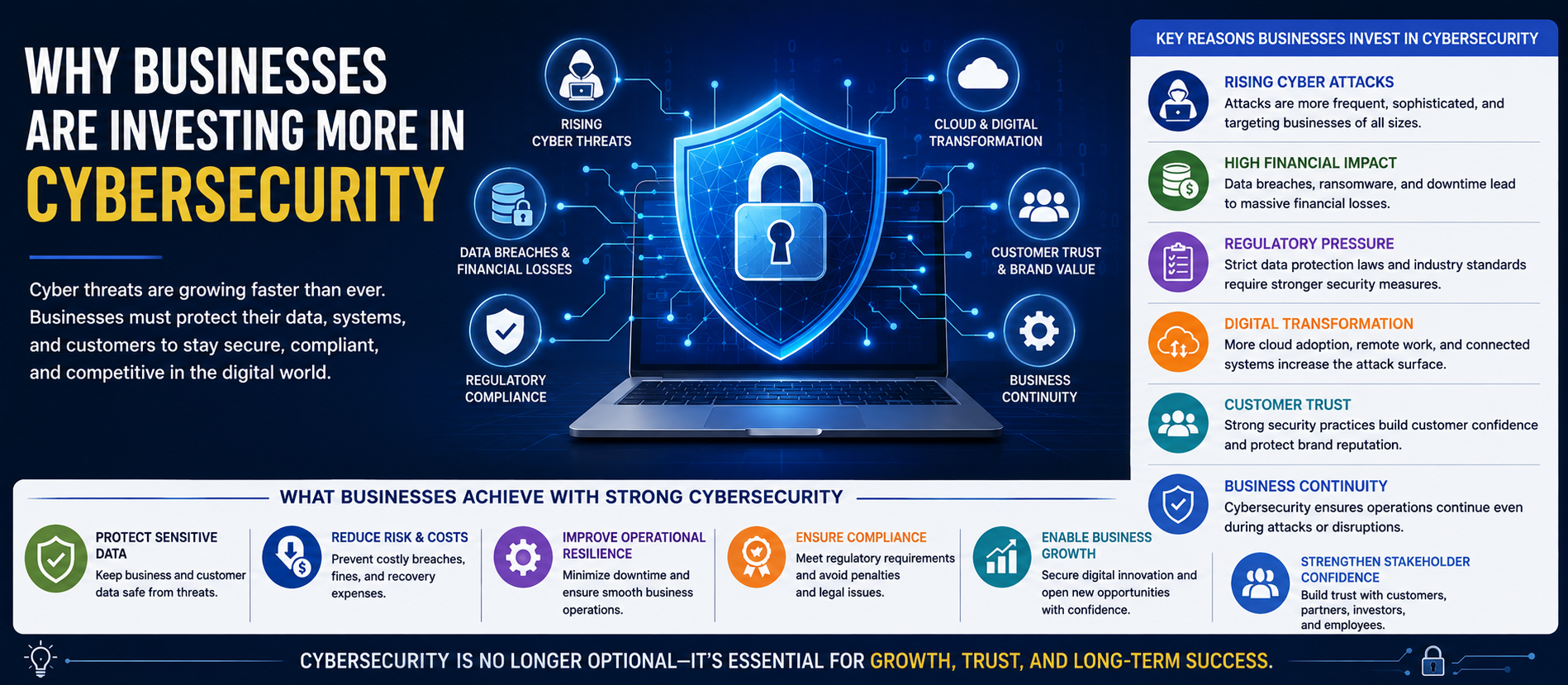
Businesses are investing more in cybersecurity because cyber threats are becoming more complex, digital operations depend on more connected systems, AI is creating new security risks, data breaches can be expensive, customers expect stronger protection, and business leaders increasingly view cyber resilience as a core part of risk management.
Cybersecurity spending is therefore moving from a defensive technology cost toward an investment in business continuity, trust, resilience, and long-term growth.
1. Cyberattacks Can Create Major Financial Losses
The financial impact of a cyber incident can extend far beyond the immediate technical response.
A serious incident may involve investigation costs, legal expenses, recovery work, lost productivity, customer notifications, business interruption, and lost business.
IBM's 2026 Cost of a Data Breach research reports a global average breach cost of US$4.99 million, with detection, escalation, and lost business contributing to the increase. The report also highlights the growing role of AI-driven attacks.
Costs vary by industry, country, organization size, and incident type. However, the main business lesson is clear: preventing and containing incidents can be less costly than recovering from a major disruption.
2. AI Is Changing Both Cyber Defense and Cyber Risk
Artificial intelligence is one of the biggest reasons cybersecurity strategies are changing.
AI can help security teams analyze large volumes of data, detect unusual activity, prioritize alerts, and support faster incident response. At the same time, attackers can use AI to make phishing, impersonation, social engineering, malware, and other attacks faster or more convincing.
The World Economic Forum reported that 94% of respondents in its 2026 survey viewed AI as the most significant driver of cybersecurity change in the year ahead. The report also found growing attention to AI security assessments.
Businesses therefore need to invest in two related areas:
- Using AI to improve cyber defense.
- Securing the AI systems and tools used by the organization.
3. AI Security and Governance Are Becoming Business Requirements
Many organizations are adopting AI quickly. Security and governance do not always develop at the same speed.
This creates risks involving:
- Unauthorized AI tools.
- Uncontrolled data sharing.
- Weak access controls.
- Sensitive information in prompts.
- Model and application vulnerabilities.
- AI-generated fraud and impersonation.
In India, IBM's 2025 data breach research found that many organizations were still developing AI governance and access controls. This illustrates a wider business challenge: innovation can create new value, but it can also create new attack surfaces when security is added too late.
4. Businesses Depend More on Digital Systems
Modern businesses rely on digital infrastructure for daily operations.
Important systems may include:
- Cloud applications.
- Customer relationship platforms.
- Financial systems.
- Communication tools.
- Supply-chain software.
- Remote access systems.
- Connected devices.
- AI services.
When these systems are unavailable, the business may not be able to operate normally.
This makes cybersecurity closely connected to business continuity. The question is no longer only, “Can we stop every attack?” A more practical question is, “How quickly can we detect, contain, and recover from an incident?”
5. Ransomware and Extortion Threats Create Operational Pressure
Ransomware and other forms of cyber extortion can disrupt access to systems and data. Even when an organization has backups, recovery can take time and require extensive technical work.
Businesses therefore invest in multiple layers of protection, including:
- Backup and recovery systems.
- Network segmentation.
- Endpoint protection.
- Identity controls.
- Security monitoring.
- Incident response planning.
- Employee awareness training.
The goal is to reduce the likelihood and impact of a successful attack rather than relying on one security product.
6. Customer Trust Has Become a Valuable Business Asset
Customers share information with businesses because they expect it to be handled responsibly.
A security incident can weaken that trust.
💡 Key Insight
This is especially important for businesses that handle financial information, personal data, health information, intellectual property, or other sensitive records.
Strong cybersecurity practices can support customer confidence by showing that the organization takes privacy, access control, and incident response seriously.
Cybersecurity can therefore become part of the overall customer experience and brand reputation.
7. Regulations and Contract Requirements Are Increasing
Businesses operate under different legal, regulatory, and contractual requirements depending on their industry and location.
Customers and business partners may also require suppliers to demonstrate specific security controls.
Common expectations can include:
- Access management.
- Data protection.
- Security assessments.
- Incident reporting procedures.
- Vendor risk reviews.
- Employee security training.
- Documented security policies.
Compliance should not be the only reason to invest in cybersecurity. A company can meet a checklist and still face real risk. The stronger approach is to connect compliance requirements with practical risk reduction.
8. Cloud Adoption Requires Shared Security Responsibility
Cloud services can provide flexibility and scalability, but moving a workload to the cloud does not remove the need for security management.
Businesses must understand which responsibilities belong to the cloud provider and which remain with the customer.
Important areas may include:
- User access.
- Configuration.
- Data protection.
- Application security.
- Monitoring.
- Identity management.
Misconfigured cloud resources, excessive permissions, and weak identity controls can create serious risks.
9. Third-Party and Supply-Chain Risks Are Growing
Businesses rarely operate alone. They depend on software providers, cloud services, contractors, payment platforms, logistics partners, and other third parties.
A security weakness in one connected organization can affect many others.
This is why vendor and supply-chain security reviews are becoming more important.
Businesses increasingly ask suppliers:
- What security controls are in place?
- What data can you access?
- How do you manage subcontractors?
- How quickly will you report a serious incident?
- What happens to our data when the contract ends?
Cybersecurity investment must therefore extend beyond the company's own network.
10. Remote and Hybrid Work Expand the Attack Surface
Employees may access business systems from homes, shared workspaces, mobile devices, and different networks.
This can improve flexibility, but it also creates additional security challenges.
Businesses may invest in:
- Multi-factor authentication.
- Device management.
- Secure remote access.
- Identity-based security.
- Endpoint monitoring.
- Security awareness training.
The focus is shifting from protecting only a physical office network toward protecting users, devices, identities, applications, and data wherever they are used.
11. Identity Has Become a Critical Security Control
Many attacks begin with compromised credentials or weak access controls.
A strong identity strategy can help reduce this risk by ensuring that users receive only the access they need and that sensitive actions require additional verification.
Common practices include:
- Multi-factor authentication.
- Role-based access.
- Least-privilege access.
- Regular access reviews.
- Privileged account protection.
- Fast removal of unused accounts.
Identity security is particularly important as businesses connect more cloud applications and AI-powered tools.
12. Cyber Resilience Is Replacing the Idea of Perfect Prevention
No organization can guarantee that it will never face a cyber incident.
Cyber resilience focuses on the ability to prepare for, withstand, respond to, and recover from a disruption.
A resilient business should understand:
- Which systems are most critical.
- Which data must be protected.
- How an incident will be detected.
- Who makes key decisions.
- How customers and partners will be informed.
- How operations can be restored.
The World Economic Forum's 2026 outlook emphasizes resilience as a strategic priority as organizations face AI-driven threats, geopolitical volatility, and supply-chain vulnerabilities.
13. Cybersecurity Is Now a Board-Level Issue
Cyber incidents can affect revenue, operations, legal exposure, reputation, and strategic plans.
For this reason, cybersecurity discussions increasingly involve senior executives and boards.
Leadership teams should understand cyber risk in business terms.
Useful questions include:
- What are our most important digital assets?
- What would happen if a critical system stopped working?
- Which cyber risks could create the largest business impact?
- How quickly could we recover?
- Do we have appropriate cyber insurance and response plans?
- Are our third parties creating major exposure?
This does not require every executive to become a technical expert. It requires cybersecurity to be connected with business risk and decision-making.
14. Cyber Insurance and Risk Management Are Evolving
Cyber insurance can be one part of a broader risk strategy. However, insurance does not prevent attacks or automatically restore operations.
Insurers and organizations may evaluate controls such as:
- Multi-factor authentication.
- Backup practices.
- Endpoint protection.
- Incident response planning.
- Security monitoring.
Businesses should understand policy terms, exclusions, coverage limits, and notification requirements. Cybersecurity investment and insurance should work together rather than being treated as alternatives.
15. Security Talent and Managed Security Services Are Important
Cybersecurity requires specialized skills, and many organizations cannot build a large internal security team.
Some businesses therefore use managed security service providers for functions such as monitoring, threat detection, incident response, and vulnerability management.
Outsourcing security can provide access to expertise, but accountability remains with the business. Companies should define responsibilities, service levels, access controls, and reporting requirements clearly.
16. Businesses Are Using AI to Improve Security Operations
AI can help security teams process large amounts of information and reduce repetitive work.
Potential uses include:
- Phishing detection.
- Anomaly detection.
- User behavior analysis.
- Alert prioritization.
- Log analysis.
- Incident response support.
The World Economic Forum's 2026 research reported substantial use of AI for cybersecurity while also identifying skills, oversight, and uncertainty as barriers.
This shows why AI security should remain human-led. Automation can accelerate analysis, but important decisions may still require context, investigation, and accountability.
17. Security Spending Is Increasing Because the Cost of Doing Nothing Is Clearer
Cybersecurity budgets are often compared with the visible cost of tools and personnel. The cost of weak security is less visible until an incident occurs.
Businesses are now more likely to consider the potential impact of:
- Operational downtime.
- Lost revenue.
- Customer churn.
- Legal and recovery expenses.
- Regulatory consequences.
- Reputation damage.
PwC's 2026 Global Digital Trust Insights found that many organizations expected cyber budgets to increase, with AI, cloud security, network security, and data protection among major investment priorities.
18. Cybersecurity Supports Business Growth and Digital Innovation
Security is sometimes viewed as an obstacle to innovation. In reality, strong security can make innovation easier.
A business is more likely to adopt cloud services, AI tools, digital customer experiences, and connected systems confidently when it has appropriate governance and protection.
Cybersecurity can therefore support growth by helping the organization:
- Protect customer data.
- Adopt new technology more safely.
- Meet enterprise customer requirements.
- Improve operational resilience.
- Build digital trust.
Cybersecurity Investment Areas Businesses Should Prioritize
| Investment Area Why It Matters Example Focus | ||
| Identity security | Protects user and privileged access | MFA and least privilege |
| Endpoint security | Protects laptops and devices | Monitoring and threat detection |
| Cloud security | Reduces risks in cloud environments | Configuration and access controls |
| Data protection | Protects sensitive information | Encryption and access management |
| AI security | Manages new AI-related risks | Governance and secure deployment |
| Incident response | Improves recovery capability | Response plans and exercises |
| Third-party security | Reduces supply-chain exposure | Vendor assessments |
| Employee awareness | Reduces human-targeted risk | Phishing and security training |
How Businesses Can Build a Practical Cybersecurity Strategy
- Identify critical assets. Understand which systems and information are most important.
- Assess the biggest risks. Focus on realistic threats and business impact.
- Strengthen identity controls. Use MFA, least privilege, and regular access reviews.
- Protect data. Apply appropriate encryption, access controls, and backup processes.
- Secure cloud and AI environments. Review configurations, permissions, and governance.
- Prepare for incidents. Create and test an incident response and recovery plan.
- Review third parties. Understand supplier access and security responsibilities.
- Train employees. Make security awareness continuous rather than a one-time event.
- Measure and improve. Review controls regularly as threats and systems change.
SEO, AEO, GEO, and AI Search Optimization for Cybersecurity Businesses
Cybersecurity buyers increasingly use search engines, answer engines, and AI tools to research risks and solutions.
Useful questions include:
- Why is cybersecurity important for small businesses?
- What cybersecurity services does a business need?
- How can companies protect themselves from ransomware?
- What is AI security?
- How can a business improve cyber resilience?
Cybersecurity companies can improve visibility by publishing clear and accurate answers.
SEO helps content appear in traditional search.
AEO focuses on direct answers to common questions.
GEO helps generative systems understand topics, expertise, and context.
AI Search Optimization benefits from clear structure, accurate information, useful examples, expert content, and consistent business information.
Common Cybersecurity Investment Mistakes to Avoid
Buying Tools Without a Clear Strategy
More security products do not automatically create better protection. Businesses should understand how tools work together.
Ignoring Identity Security
Strong authentication and access management are foundational controls.
Treating Security as Only an IT Problem
Cyber risk can affect the entire business and requires leadership support.
Adding AI Without Governance
AI systems should have clear rules for data access, permissions, monitoring, and accountability.
Ignoring Third-Party Risk
Suppliers and connected services can create exposure that must be managed.
Creating a Plan but Never Testing It
Incident response and recovery plans should be practiced and updated.
Frequently Asked Questions
Why are companies investing more in cybersecurity?
Companies are increasing cybersecurity investment because cyber threats can cause financial losses, operational disruption, data exposure, and loss of customer trust. AI, cloud adoption, and connected supply chains are also creating new risks.
What is the biggest cybersecurity trend in 2026?
AI is one of the biggest drivers of cybersecurity change. It is improving threat detection and response while also enabling new forms of cyberattack and fraud.
Is cybersecurity important for small businesses?
Yes. Small businesses can also face phishing, ransomware, credential theft, and other threats. The right strategy should match the company's size, systems, data, and risk level.
How much should a business spend on cybersecurity?
There is no universal amount. Spending should be based on business risk, regulatory obligations, the value of critical assets, and the potential impact of disruption.
Can AI improve cybersecurity?
Yes. AI can support threat detection, alert analysis, phishing detection, anomaly identification, and response. It should be used with appropriate governance and human oversight.
What is cyber resilience?
Cyber resilience is the ability to prepare for, withstand, respond to, and recover from cyber incidents while maintaining important business operations.
Conclusion
Businesses are investing more in cybersecurity because the digital environment has become more important and more exposed.
AI is changing both attack and defense. Cloud systems and third-party services create larger digital ecosystems. Data breaches and business interruptions can create significant costs. Customers and partners expect stronger protection. Leadership teams increasingly understand that cyber risk can affect the entire organization.
The best cybersecurity strategy is not simply about buying more tools. It is about understanding risk, protecting critical assets, managing identity and access, securing cloud and AI systems, preparing for incidents, reviewing suppliers, and building the ability to recover.
In 2026, cybersecurity is an investment in resilience, customer trust, and the ability to operate confidently in a digital economy.
Disclaimer: This article is for general educational and informational purposes only. Cybersecurity requirements, laws, regulations, and appropriate controls vary by organization and jurisdiction. Businesses should consult qualified cybersecurity, legal, and compliance professionals for advice based on their specific circumstances.
Digiifrog
Website: www.digiifrog.com
Ready to Grow?
Talk to us about a strategy tailored to your brand — we will help you stand out in search, AI discovery and social.
Comments (0)
Log in to leave a comment.