📋 Quick Summary
In this article:
Why Email Marketing Still Matters for Businesses
What Makes a Good Email Marketing Strategy?
Strategy 1: Build a Permission-Based Email List
Strategy 2: Segment Your Audience
Strategy 3: Create a Strong Welcome Series
Email 1: Welcome
Email 2: Helpful Resource
Email 3: Brand Introduction
Email 4: Best Content
Email 5: Relevant Offer
Strategy 4: Personalize Emails With Useful Context
Strategy 5: Send Valuable Content, Not Only Promotions
Email remains one of the most useful channels for building direct relationships with customers. Social platforms can help businesses reach new audiences, and search engines can help people discover a brand. Email gives a business something different: a direct communication channel with people who have chosen to receive messages.
But having an email list is not enough.
Businesses need a clear strategy. They need useful content, relevant offers, good timing, strong subject lines, effective calls to action, and a reliable way to measure results.
The best email marketing strategies are also simple. They focus on the customer rather than sending as many emails as possible.
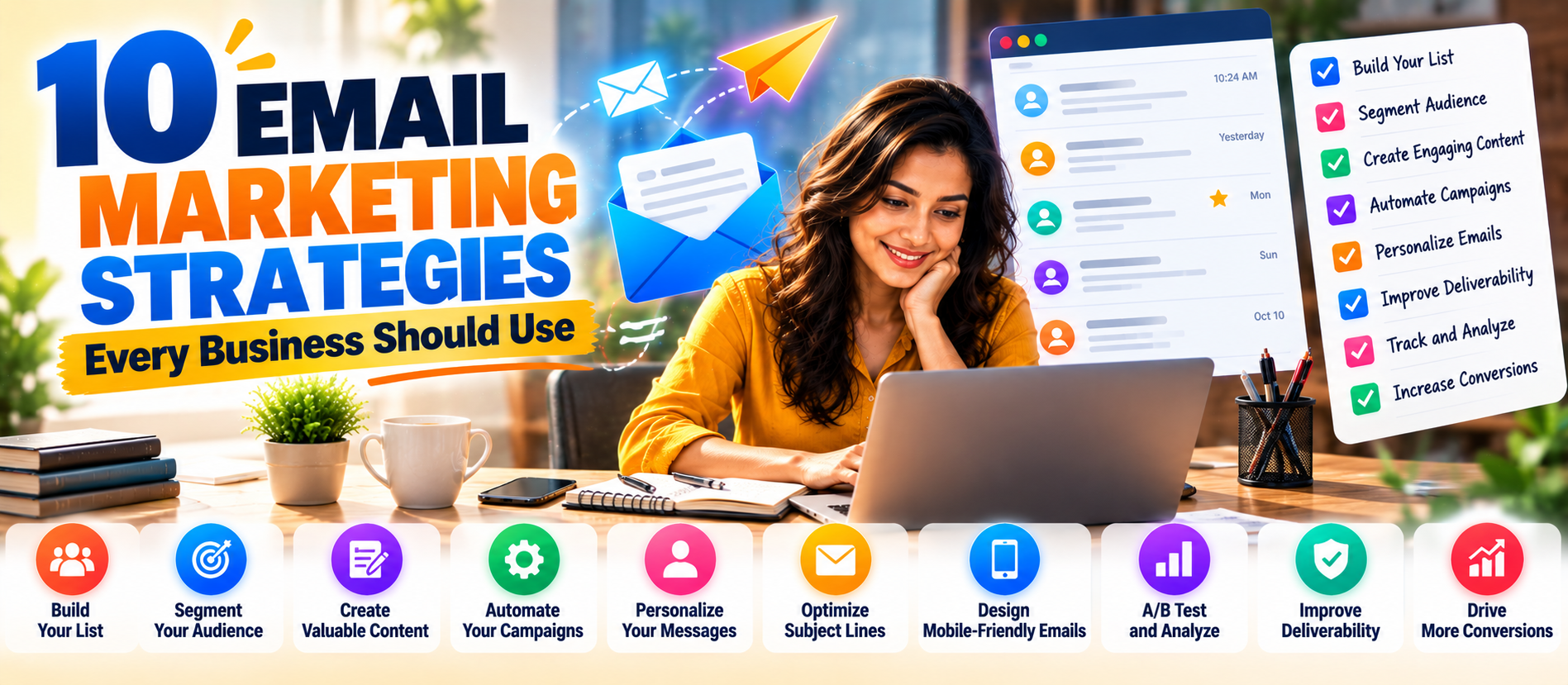
This guide explains 10 practical strategies that businesses can use to build stronger email campaigns. It covers list building, segmentation, personalization, automation, content, subject lines, conversion optimization, testing, analytics, retention, and the connection between email marketing and SEO, AEO, GEO, and AI Search.
Why Email Marketing Still Matters for Businesses
Email can support almost every stage of the customer journey.
A business can use email to:
- Welcome new subscribers
- Educate prospects
- Share useful content
- Promote products and services
- Nurture leads
- Recover abandoned purchases where appropriate
- Onboard new customers
- Share product updates
- Collect feedback
- Encourage repeat purchases
- Build customer loyalty
Email is especially useful because a campaign can be measured. Businesses can monitor delivery, opens where reliable and applicable, clicks, conversions, unsubscribes, revenue, and other outcomes depending on the email platform and tracking setup.
However, privacy changes and technical developments have made some traditional email metrics less reliable. For that reason, businesses should focus more on meaningful actions such as clicks, conversions, replies, purchases, and revenue rather than relying on one metric.
What Makes a Good Email Marketing Strategy?
A strong strategy connects five elements:
- Audience: Who should receive the message?
- Purpose: Why are you sending it?
- Value: Why should the recipient care?
- Action: What should the recipient do next?
- Measurement: How will you know whether it worked?
If these five elements are clear, campaign planning becomes much easier.
Strategy 1: Build a Permission-Based Email List
The foundation of email marketing is a quality email list.
Do not treat email addresses as ordinary marketing data. People should understand what they are signing up for and how their information will be used. Businesses should also follow applicable privacy, consent, and email marketing laws in the markets where they operate.
A good list-building process focuses on relevance rather than volume.
Useful ways to attract subscribers include:
- Website signup forms
- Newsletter subscriptions
- Useful downloadable guides
- Checklists
- Free tools or calculators
- Webinars
- Product updates
- Special offers
- Consultation requests
- Event registrations
The offer should match the audience.
For example, a digital marketing company could offer a website SEO checklist. A software company could offer a product guide. An ecommerce business could offer useful buying information or a relevant incentive.
A smaller list of engaged subscribers can be more valuable than a large list filled with people who never interact with the brand.
Strategy 2: Segment Your Audience
Not every subscriber needs the same email.
Segmentation allows businesses to group contacts based on useful characteristics or behavior.
Possible segments include:
- New subscribers
- Existing customers
- Potential customers
- Repeat customers
- High-value customers
- Inactive subscribers
- Product interests
- Geographic location
- Industry
- Purchase history
- Website behavior
- Content interests
Segmentation can make messages more relevant.
Imagine an online store selling clothing, home products, and electronics. A subscriber who frequently views electronics does not necessarily need every clothing promotion.
Sending relevant content can improve the customer experience and reduce unnecessary messages.
Strategy 3: Create a Strong Welcome Series
The first few messages after signup can shape the subscriber's expectations.
A welcome email should explain what the subscriber can expect.
A simple welcome sequence could include:
Email 1: Welcome
Thank the subscriber and explain what they will receive.
Email 2: Helpful Resource
Give the subscriber something useful related to the reason they signed up.
Email 3: Brand Introduction
Explain who the business serves and what problem it solves.
Email 4: Best Content
Share useful articles, videos, guides, or resources.
Email 5: Relevant Offer
Introduce a product, service, consultation, or other next step when appropriate.
The sequence should feel helpful rather than aggressive.
Strategy 4: Personalize Emails With Useful Context
Personalization is more than adding a person's first name to the subject line.
Useful personalization can consider:
- Customer interests
- Previous purchases
- Location
- Industry
- Content preferences
- Stage in the buying journey
- Recent website activity
For example, a B2B company could send different content to a startup founder and a marketing manager at a large organization.
The message can still promote the same service, but the examples and pain points can be different.
Personalization should always have a purpose. Adding personal information simply because the software allows it can feel uncomfortable or irrelevant.
Strategy 5: Send Valuable Content, Not Only Promotions
One of the most common email marketing mistakes is turning every email into a sales pitch.
People may subscribe because they want useful information. If every message asks them to buy something, engagement can decline.
Use a healthy mix of content.
Examples include:
- Educational articles
- Industry insights
- How-to guides
- Case studies
- Customer stories
- Research findings
- Practical tips
- Product education
- Company news
- Relevant promotions
A simple rule is to ask before every campaign:
“What useful reason does the subscriber have to read this?”
If the answer is unclear, improve the message before sending it.
Strategy 6: Write Better Subject Lines
The subject line is often the first part of an email people see.
It should be clear and relevant.
Useful subject line approaches include:
- Ask a clear question
- Highlight a specific benefit
- Explain what the email contains
- Create curiosity without misleading the reader
- Use a timely reason to open
- Keep the wording concise
Examples:
- 5 Ways to Improve Your Website Conversion Rate
- Your Guide to Better Local SEO
- What Changed in Your Monthly Report?
- New Resources for Small Business Owners
- Before You Launch Your Next Google Ads Campaign
Avoid deceptive clickbait.
The subject line should accurately represent the email.
Strategy 7: Use Clear Calls to Action
Every email should have a clear purpose.
The reader should understand what to do next.
Examples include:
- Read the guide
- Book a consultation
- View the product
- Download the checklist
- Register for the webinar
- Request a quote
- Start a free trial
- Contact the team
Do not hide the main action inside a long paragraph.
Use clear button or link text.
For example, “Download the SEO Checklist” is more specific than “Click Here.”
The call to action should match the reader's stage.
A new subscriber may need education. A returning customer may be ready for a product offer.
Strategy 8: Automate the Right Customer Journeys
Email automation can save time and create more consistent communication.
Automation does not mean sending more emails. It means sending the right message based on a defined trigger or workflow.
Common automation examples include:
- Welcome sequences
- Lead nurturing
- Customer onboarding
- Purchase confirmations
- Product education
- Abandoned cart reminders where appropriate
- Review requests
- Renewal reminders
- Re-engagement campaigns
- Post-purchase follow-up
Automation is most useful when the journey is clear.
For example, a lead who downloads a guide about PPC advertising may receive a sequence explaining PPC strategy, campaign measurement, landing pages, and common mistakes. A relevant service offer can then appear after the educational sequence.
This is more useful than sending unrelated promotional emails.
Strategy 9: Optimize Emails for Mobile Readers
Many people read email on mobile devices.
That means your email should be easy to scan on a smaller screen.
Use:
- Short paragraphs
- Readable font sizes
- Clear headings
- Strong contrast
- Responsive layouts
- Buttons that are easy to tap
- Optimized images
- Limited visual clutter
Do not make the reader zoom in to understand the message.
Before sending an important campaign, preview it across common screen sizes and email clients supported by your audience.
Strategy 10: Test, Measure, and Improve
Email marketing should be treated as an ongoing process.
Do not assume the first version of a campaign is the best version.
Test meaningful variables such as:
- Subject lines
- Calls to action
- Email structure
- Offers
- Content length
- Send timing
- Audience segments
- Images
💡 Key Insight
Change one important variable at a time when practical. This makes the results easier to interpret.
Testing should have a reason. Do not test random details simply because a testing feature exists.
Email Marketing Metrics Every Business Should Monitor
Metrics help turn email marketing into a measurable business activity.
| Metric What It Tells You | |
| Delivery Rate | How successfully emails reached recipient mail systems. |
| Open Rate | A directional measure of email viewing, but it can be affected by privacy and technical changes. |
| Click-Through Rate | How often recipients clicked links or calls to action. |
| Conversion Rate | How often recipients completed the desired action. |
| Unsubscribe Rate | How frequently recipients opted out. |
| Bounce Rate | How frequently messages could not be delivered. |
| Revenue or Lead Value | Business value generated from campaigns when properly tracked. |
Do not optimize for opens alone. A campaign can have a strong open rate and still produce few sales or leads.
The business goal should determine the primary KPI.
How to Build an Email Content Calendar
A content calendar can prevent random email activity.
A simple monthly calendar might include:
- Week 1: Educational article
- Week 1: Product or service tip
- Week 2: Customer story
- Week 2: Industry insight
- Week 3: Useful checklist or guide
- Week 3: Product education
- Week 4: Special offer
- Week 4: Monthly roundup
The exact frequency should depend on audience expectations and business needs.
Quality and relevance are more important than sending emails simply to meet a quota.
Email Marketing for Lead Generation
Email is useful for nurturing leads that are not ready to buy immediately.
For example, a website visitor may download a guide but not contact the business.
A lead-nurturing sequence can gradually provide:
- Useful educational information
- Common problem explanations
- Practical solutions
- Case studies
- Service comparisons
- A relevant consultation or offer
This creates a longer customer journey.
The goal is not to force a sale. The goal is to help the prospect make an informed decision.
Email Marketing for E-commerce
E-commerce businesses can use email across the customer lifecycle.
Useful campaigns include:
- New product announcements
- Product recommendations
- Back-in-stock alerts
- Educational product content
- Seasonal campaigns
- Post-purchase education
- Review requests
- Loyalty campaigns
- Re-engagement campaigns
Product recommendations should be relevant. Sending the same product to every customer wastes the opportunity created by personalization.
Email Marketing for B2B Companies
B2B sales cycles can be longer.
That makes lead nurturing especially useful.
B2B emails can include:
- Industry reports
- Research
- Case studies
- Product guides
- Webinars
- Implementation advice
- Expert articles
- Customer success stories
Do not make every B2B email sound like a sales brochure.
Decision-makers often need information before they are ready to speak with sales.
Email Personalization Without Being Intrusive
Personalization should improve relevance.
It should not make subscribers feel monitored.
Use information that has a clear business purpose and appropriate permission.
For example, if a subscriber selects “SEO” as a content interest, sending SEO resources is useful personalization.
Showing a highly specific behavioral detail that the customer did not expect can create discomfort.
Always consider the customer's perspective.
Email Deliverability Matters
A perfect email cannot generate results if it does not reach the inbox.
Businesses should pay attention to email deliverability and sender reputation.
Good practices include:
- Use permission-based lists
- Remove invalid addresses
- Monitor bounces
- Provide a clear unsubscribe option
- Use appropriate authentication
- Send relevant content
- Avoid misleading subject lines
- Monitor spam complaints
Email authentication standards such as SPF, DKIM, and DMARC can help establish legitimate sending practices. Businesses should follow the requirements of their email service provider and the mailbox providers relevant to their audience.
How Email Marketing Supports SEO
Email does not directly replace SEO.
But the two channels can support each other.
A newsletter can send readers to useful website content. Strong content can attract direct traffic, shares, links, and repeat visitors. Email performance can also reveal which topics generate interest.
For example, if an email about “Local SEO for Small Businesses” receives strong clicks, that may indicate that the topic deserves deeper website content.
Email can therefore become part of the broader content research process.
Email Marketing and AEO
Answer Engine Optimization focuses on making useful answers easy to understand and discover.
Email can support this process indirectly.
Customer questions from email replies can become:
- FAQ pages
- Blog articles
- Service page sections
- Short videos
- Social media posts
- Knowledge base articles
Your email inbox can therefore become a source of content ideas.
Email Marketing and GEO
For local businesses, email can help strengthen relationships within a geographic market.
Local newsletters can include:
- Local events
- Location-specific offers
- Community updates
- Local customer stories
- Area-specific service information
Keep location claims accurate. Do not create artificial local content simply to insert city names.
Email Marketing and AI Search
AI Search is changing how people research products and services.
Email still has an important role because it can drive people back to original content published on a business website.
A useful workflow is:
Customer question → Email insight → Website content → Search visibility → Social distribution → Lead or customer action
This creates a connected content system.
Businesses should focus on publishing clear, original, trustworthy information on their websites. Email can then help distribute that information to an existing audience.
How AI Can Improve Email Marketing
AI can support email marketing in several ways.
- Generate subject line ideas
- Suggest content angles
- Summarize customer feedback
- Create first drafts
- Adapt messages for different segments
- Analyze campaign patterns
- Repurpose long-form content
- Generate testing variations
Human review remains important.
AI-generated emails can contain incorrect information, generic language, unsuitable claims, or a tone that does not match the brand.
Use AI to improve the workflow, not to remove responsibility.
Email Marketing Automation Workflow Example
A simple service-business automation could look like this:
- Visitor downloads a guide.
- Subscriber receives a welcome email.
- Subscriber receives a helpful educational article.
- Subscriber receives a case study.
- Subscriber receives a practical checklist.
- Subscriber receives an invitation for a consultation.
- Engaged leads are passed to the sales process.
Subscribers who do not engage can receive a different sequence or a re-engagement message.
This approach avoids sending the same campaign to everyone.
Common Email Marketing Mistakes
- Buying email lists
- Sending too many promotional emails
- Ignoring segmentation
- Using misleading subject lines
- Writing long blocks of text
- Using unclear calls to action
- Ignoring mobile readers
- Not testing important campaigns
- Measuring only open rates
- Ignoring unsubscribes and complaints
- Sending irrelevant content
- Failing to maintain the list
- Using AI content without review
- Ignoring privacy and consent requirements
A Simple 30-Day Email Marketing Plan
Week 1: Prepare
- Define your audience.
- Review your email list.
- Define three to five content themes.
- Choose your primary conversion goal.
- Check your signup and unsubscribe processes.
Week 2: Build
- Create a welcome email.
- Write two educational emails.
- Prepare one product or service email.
- Create one customer story or case study.
Week 3: Automate
- Build a welcome sequence.
- Create a lead-nurturing workflow.
- Set appropriate triggers.
- Test every link and form.
Week 4: Measure
- Review clicks.
- Review conversions.
- Review unsubscribes.
- Identify the strongest topics.
- Improve the next month's calendar.
How Digiifrog Can Help With Email Marketing
Digiifrog helps businesses connect email marketing with broader digital marketing goals.
Email can work alongside:
- Content marketing
- SEO
- AI Search optimization
- AEO
- GEO
- Social media marketing
- Google Ads
- Meta advertising
- Website development
- Lead generation
- Conversion optimization
- Branding
The goal is to build a connected customer journey.
A person may discover a business through search, read an article, subscribe to an email list, receive educational content, visit a service page, and eventually become a customer.
Digiifrog can help businesses plan this journey with content, email, paid advertising, SEO, website optimization, and AI-focused digital strategies.
Frequently Asked Questions
What are the most important email marketing strategies?
Important strategies include building a permission-based list, segmenting subscribers, creating welcome and nurture sequences, personalizing useful content, writing clear subject lines, using strong calls to action, automating appropriate journeys, optimizing for mobile, and measuring meaningful results.
How often should a business send marketing emails?
There is no universal frequency. It depends on audience expectations, content quality, business type, and the purpose of the emails. A sustainable schedule is better than sending frequent messages that provide little value.
Is email marketing good for small businesses?
Yes. Email can help small businesses build relationships, nurture leads, promote services, encourage repeat purchases, and distribute useful content. A focused list and simple automation can be enough to start.
What is email segmentation?
Email segmentation means dividing subscribers into groups based on relevant information or behavior. This allows businesses to send more relevant messages instead of treating every subscriber the same way.
What is email automation?
Email automation uses defined triggers or workflows to send messages based on subscriber actions or lifecycle stages. Examples include welcome emails, onboarding, lead nurturing, purchase follow-up, and re-engagement.
Should businesses use AI for email marketing?
AI can help with ideas, drafts, personalization, analysis, and content repurposing. Businesses should review AI-generated content for accuracy, brand voice, privacy, and suitability before sending it.
What email marketing metric matters most?
It depends on the goal. For a lead-generation campaign, qualified leads and conversions may matter more than opens. For ecommerce, purchases and revenue may be more important. Use metrics that connect email activity to business outcomes.
How can email marketing support SEO?
Email can distribute website content and reveal which topics interest subscribers. This can help businesses identify content opportunities and drive engaged visitors to useful pages.
Final Thoughts
Email marketing works best when it is treated as a relationship channel rather than a broadcast tool.
Build your list carefully. Understand your audience. Segment where useful. Send valuable information. Personalize with purpose. Automate customer journeys. Make emails easy to read. Test important campaigns. Measure conversions and business value.
Most importantly, respect the subscriber.
Every email is an opportunity to build trust or reduce it.
When email marketing is connected with content marketing, SEO, social media, paid advertising, AEO, GEO, and AI Search strategies, it becomes part of a wider digital growth system.
The goal is not to send more emails. The goal is to send better emails to the right people at the right stage with a clear reason to care.
Official Resources
- Google Workspace: Email sender guidelines
- Gmail: Email sender guidelines
- FTC: CAN-SPAM Act Compliance Guide
- UK ICO: Direct Marketing Guidance
Brand: Digiifrog | www.digiifrog.com
Ready to Grow?
Talk to us about a strategy tailored to your brand — we will help you stand out in search, AI discovery and social.


Comments (0)
Log in to leave a comment.