
📋 Quick Summary
In this article:
What Are Digital Marketing Services?
Why Businesses Need Digital Marketing
1. Search Engine Optimization (SEO)
On-Page SEO
Off-Page SEO
2. Local SEO Services
3. Content Marketing Services
4. Google Ads and PPC Advertising
5. Social Media Marketing
6. Facebook and Meta Advertising
Introduction
Growing a business online takes more than having a website. Your business needs to be visible, useful, trusted, and easy to find. Customers may discover your brand through Google, Bing, social media, online ads, email, local search, or AI-powered search tools.
This is where digital marketing services can help. A strong digital marketing strategy connects different channels and turns them into a measurable growth system. The goal is simple: attract the right audience, build trust, generate leads, increase sales, and keep customers coming back.
For small businesses, startups, professional services, eCommerce brands, and growing companies, the right marketing mix can make online growth more predictable. However, not every business needs every service. The best approach depends on your audience, goals, budget, industry, and sales process.
This guide explains the major digital marketing services that can support online growth. It also covers SEO, AEO, GEO, AI Search Optimization, paid advertising, content marketing, social media, email marketing, conversion optimization, analytics, and local marketing.
What Are Digital Marketing Services?
Digital marketing services are professional marketing activities that help a business attract and convert customers through digital channels. These services can include search engine optimization, paid advertising, content creation, social media marketing, email campaigns, website optimization, analytics, and marketing automation.
Digital marketing is not one single activity. It is a group of connected strategies. SEO can bring organic traffic. Content can educate visitors. Paid advertising can create faster visibility. Social media can build relationships. Email can nurture leads. Conversion optimization can turn more visitors into customers.
The strongest strategy connects these activities instead of treating them as separate campaigns.
Why Businesses Need Digital Marketing
Customers spend a large part of their buying journey online. They search for products, compare services, read reviews, watch videos, visit websites, and ask questions before making decisions.
- Reach customers beyond your local area.
- Build brand awareness and credibility.
- Generate targeted website traffic.
- Capture qualified leads.
- Increase online and offline sales.
- Measure campaign performance.
- Improve customer relationships.
- Reduce wasted marketing spend.
- Build long-term organic visibility.
1. Search Engine Optimization (SEO)
SEO services help a website become easier for search engines and users to understand. The goal is to improve relevant organic visibility and attract people who are already searching for information, products, or services.
Technical SEO
Technical SEO focuses on crawling, indexing, site architecture, page speed, mobile usability, redirects, canonical URLs, XML sitemaps, robots.txt, security, and structured data.
On-Page SEO
On-page SEO improves individual pages. It includes titles, headings, keywords, content structure, internal links, images, URLs, meta descriptions, and search intent.
Off-Page SEO
Off-page SEO focuses on signals outside the website. Quality backlinks, digital PR, brand mentions, citations, and relevant online references can support authority and visibility.
SEO is usually a long-term strategy. Results depend on competition, website quality, content depth, technical health, authority, and search demand.
2. Local SEO Services
💡 Key Insight
Local SEO is important for businesses that serve specific cities, towns, regions, or service areas. Restaurants, clinics, agencies, contractors, retailers, consultants, and local service providers can use local SEO to improve visibility when nearby customers search for relevant services.
A local SEO strategy can include Google Business Profile optimization, local keyword research, business citations, location pages, review management, local content, map visibility, and consistent business information.
Local SEO should also provide useful information such as services, opening hours, service areas, contact details, photos, reviews, and frequently asked questions.
3. Content Marketing Services
Content marketing helps a business answer customer questions and demonstrate expertise. Good content is useful before a customer is ready to buy.
Common content formats include:
- Blog articles
- Ultimate guides
- How-to articles
- Case studies
- Product guides
- Service pages
- FAQs
- Videos
- Infographics
- White papers
- eBooks
- Social media content
Strong content should have a clear purpose. It should answer a real question, use simple language, provide useful details, and guide readers toward an appropriate next step.
4. Google Ads and PPC Advertising
Google Ads services can help businesses reach people who are actively searching for products or services. PPC campaigns can be useful when a company needs targeted traffic and measurable results.
Effective PPC management involves keyword research, campaign structure, ad copy, audience targeting, landing pages, bidding, conversion tracking, negative keywords, budget management, and performance testing.
Paid advertising should not be judged only by clicks. Businesses should also monitor leads, sales, conversion rates, cost per lead, customer acquisition cost, revenue, and return on ad spend.
5. Social Media Marketing
Social media marketing helps businesses build visibility and relationships on platforms where their audiences spend time. The right platform depends on the target audience and business model.
- Content planning
- Community engagement
- Short-form video
- Educational posts
- Customer stories
- Social advertising
- Lead generation campaigns
- Performance reporting
Consistency matters. Businesses should focus on useful content instead of posting only promotional messages.
6. Facebook and Meta Advertising
Meta advertising can help businesses reach defined audiences through Facebook and Instagram. Campaigns may support awareness, traffic, engagement, lead generation, app promotion, or sales.
Successful campaigns need clear objectives, strong creative assets, relevant landing pages, accurate conversion tracking, and continuous testing. Different audiences may respond to different messages, formats, offers, and calls to action.
7. Email Marketing
Email marketing helps businesses communicate directly with subscribers and customers. It can support lead nurturing, customer retention, product education, promotions, onboarding, and repeat purchases.
Useful email campaigns include welcome sequences, educational newsletters, abandoned-cart messages, product updates, promotional campaigns, and re-engagement emails.
Important email metrics include delivery rate, open rate, click-through rate, conversion rate, unsubscribe rate, bounce rate, and revenue generated.
8. Conversion Rate Optimization (CRO)
Getting traffic is only part of marketing. A website also needs to turn visitors into leads or customers. Conversion Rate Optimization focuses on improving that process.
CRO can involve better headlines, clearer calls to action, shorter forms, stronger trust signals, improved page layouts, faster websites, better product information, testimonials, FAQs, and landing page testing.
A small improvement in conversion rate can have a meaningful impact when a website already receives substantial traffic.
9. Lead Generation Services
Lead generation focuses on attracting potential customers and collecting their contact information or other useful business signals.
Lead generation campaigns can use landing pages, forms, downloadable resources, webinars, search ads, social media ads, organic search, email, and content marketing.
Businesses should measure lead quality, not just lead quantity. A smaller number of qualified leads may create more revenue than a large number of poorly matched inquiries.
10. Marketing Automation
Marketing automation reduces repetitive manual work. It can help businesses send the right message based on customer actions.
Examples include automated welcome emails, lead scoring, follow-up messages, abandoned-cart reminders, customer onboarding, appointment reminders, and sales notifications.
⚠ Watch Out
Automation works best when the customer journey is clearly mapped. Businesses should avoid sending too many messages or creating complicated workflows without a clear purpose.
11. Analytics and Marketing Reporting
Analytics helps businesses understand what is working. Without measurement, marketing decisions often become guesswork.
- Website traffic
- Organic traffic
- Engaged sessions
- Conversion rate
- Cost per lead
- Customer acquisition cost
- Return on investment
- Return on ad spend
- Customer lifetime value
- Revenue by marketing channel
Reports should focus on business outcomes. A dashboard with hundreds of numbers is not automatically useful. The best reports make important trends easy to understand.
12. AEO: Answer Engine Optimization
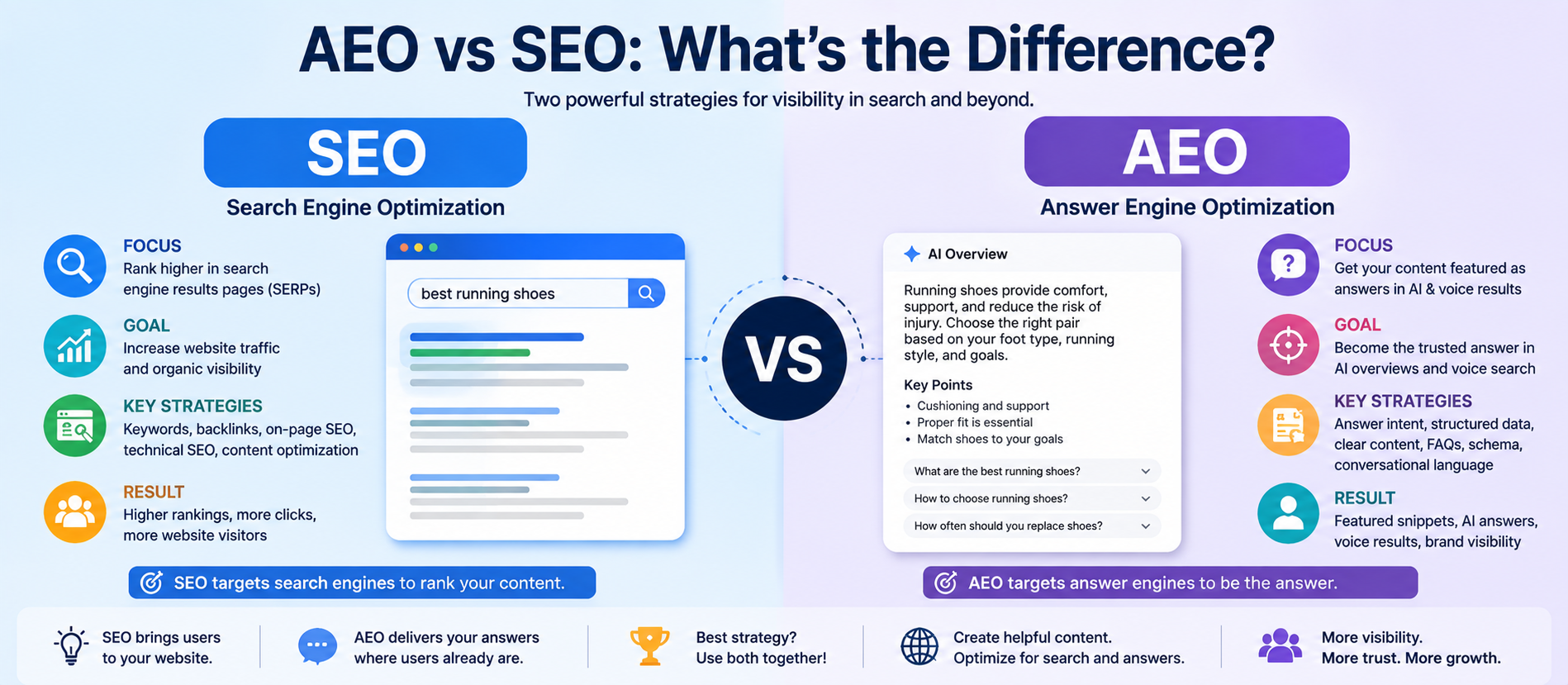
Answer Engine Optimization (AEO) focuses on creating content that provides clear answers to user questions. This approach is useful for conversational search, featured-answer experiences, voice queries, and AI-assisted discovery.
AEO-friendly content often uses clear questions and direct answers. Helpful FAQs, concise definitions, structured headings, lists, tables, and well-organized supporting information can make content easier to understand.
For example, a page about SEO services can answer questions such as “What is SEO?”, “How long does SEO take?”, “What does an SEO agency do?”, and “How much does SEO cost?” The answers should be factual, useful, and easy to scan.
13. GEO: Generative Engine Optimization
Generative Engine Optimization (GEO) focuses on improving the usefulness and discoverability of brand content in generative search experiences.
GEO is closely connected to content quality, authority, relevance, entities, clear information architecture, and factual accuracy. Businesses should create content that provides complete answers instead of writing only for individual keywords.
Useful GEO practices include building topical authority, demonstrating expertise, using descriptive headings, supporting claims with credible sources, maintaining accurate business information, and creating original insights.
14. AI Search Optimization
AI-powered search is changing how people discover information. Users may receive summarized answers instead of a traditional list of links. Businesses should therefore make their websites easy for both people and machines to understand.
AI Search Optimization can include clear page structure, useful answers, semantic relevance, structured data, strong internal linking, original research, author information, trustworthy sources, and consistent brand information.
The goal is not to create content only for an AI system. The goal is to create genuinely useful information that can be understood, referenced, and trusted.
15. Website Design and Development
A marketing campaign can struggle if the website provides a poor user experience. Website design and development should support marketing goals.
A business website should be mobile-friendly, fast, accessible, secure, easy to navigate, and clear about its products or services. Important pages should have strong calls to action.
Technical performance also matters. Slow pages can frustrate users and reduce the effectiveness of paid and organic campaigns.
16. Online Reputation Management
Trust has a direct effect on buying decisions. Online reputation management helps businesses monitor and improve how their brand appears online.
Businesses can encourage genuine customer reviews, respond professionally to feedback, maintain accurate business profiles, and publish helpful information that demonstrates expertise.
Reputation management should be transparent. Businesses should not create fake reviews or misleading claims.
17. How to Choose the Right Digital Marketing Services
There is no single marketing package that works for every business. Start with your business objective.
If You Need More Organic Traffic
Focus on SEO, content marketing, technical SEO, and local SEO when relevant.
If You Need Faster Traffic
Consider PPC advertising and paid social campaigns with proper conversion tracking.
If You Need More Leads
Combine SEO or advertising with landing pages, lead magnets, forms, CRM processes, and lead nurturing.
If You Need Better Brand Awareness
Use content marketing, social media, video, digital PR, and consistent brand messaging.
If You Want AI Search Visibility
Improve content quality, topical authority, structured information, AEO, GEO, technical SEO, and entity clarity.
18. A Practical Digital Marketing Growth Plan
Stage 1: Research
Identify your target audience, competitors, customer questions, keywords, existing traffic sources, and business goals.
Stage 2: Build
Improve the website, create important service pages, develop useful content, establish analytics, and prepare conversion paths.
Stage 3: Promote
Use SEO, content marketing, social media, email, and paid advertising based on your goals and available resources.
Stage 4: Measure and Improve
Review performance regularly. Keep what works. Improve weak areas. Test new ideas carefully. Reallocate budget based on measurable results.
Common Digital Marketing Mistakes
- Trying every marketing channel at once.
- Ignoring customer search intent.
- Creating content without a clear audience.
- Focusing only on traffic instead of conversions.
- Running paid ads without conversion tracking.
- Ignoring mobile users.
- Using complicated language in marketing content.
- Publishing low-value AI-generated content without review.
- Ignoring local search opportunities.
- Failing to measure return on investment.
Why Simple Content Performs Better
Marketing content should be easy to understand. Short sentences help readers find important information quickly. Clear headings make long articles easier to scan. Direct answers can also improve the usefulness of content for search engines and AI systems.
Instead of writing complex sentences, explain one idea at a time. Use active language. Avoid unnecessary jargon. Define technical terms when they are needed. Add examples when a concept may be difficult to understand.
This approach improves readability for customers and makes information easier for search systems to process.
How Digiifrog Can Help
Digiifrog provides digital marketing solutions designed around measurable business goals. Services can include SEO, technical SEO, local SEO, content marketing, Google Ads, Facebook and Meta advertising, social media marketing, email marketing, branding, lead generation, conversion optimization, analytics, AEO, GEO, and AI Search Optimization.
Our approach starts with understanding the business. We then identify the right audience, channels, content opportunities, and conversion paths. The strategy is measured and improved over time.
Frequently Asked Questions
What are the most important digital marketing services?
The right services depend on your goals. Common services include SEO, content marketing, PPC advertising, social media marketing, email marketing, local SEO, conversion optimization, analytics, and AI Search Optimization.
Which digital marketing service is best for a small business?
There is no universal answer. A small business should select services based on its audience, location, competition, budget, and business goals. Local businesses often benefit from local SEO, while companies targeting broader markets may need SEO, content, paid advertising, or a combination.
How long does digital marketing take to work?
The timeline varies by channel. Paid advertising can produce traffic quickly, while SEO and content marketing usually require consistent work over a longer period. Results also depend on competition, website quality, budget, and execution.
Can digital marketing increase sales?
Yes. Digital marketing can support sales by attracting relevant visitors, generating leads, improving conversion rates, nurturing prospects, and retaining customers. Results depend on the offer, audience, website, sales process, and marketing execution.
What is the difference between SEO and PPC?
SEO focuses on improving organic search visibility. PPC uses paid advertising placements to reach selected audiences. Many businesses use both because they can serve different stages of the customer journey.
Why are AEO and GEO important?
AEO helps content provide direct answers to user questions. GEO focuses on visibility and usefulness in generative search experiences. Both reflect the growing importance of conversational and AI-assisted discovery.
How can a business measure digital marketing success?
Track business-focused metrics such as qualified leads, conversion rate, customer acquisition cost, revenue, return on investment, and customer lifetime value. Channel-specific metrics should support these larger business goals.
Final Thoughts
The best digital marketing services to grow your business online are the services that match your customers, goals, and resources. There is no need to use every channel at the same time.
Start with a clear objective. Build a strong website. Understand your audience. Create useful content. Improve search visibility. Use paid advertising when it makes sense. Build relationships through social media and email. Track conversions. Then improve the strategy using real data.
As search continues to evolve, businesses should also prepare for AEO, GEO, and AI-powered discovery. Clear, useful, trustworthy content will remain valuable across changing digital platforms.
Digiifrog helps businesses build measurable digital marketing strategies that connect visibility with real business outcomes.
Website: www.digiifrog.com
Suggested Internal Links
- Digital Marketing Services
- SEO Services
- Local SEO Services
- Google Ads Management
- Social Media Marketing
- Content Marketing Services
- AI Search Optimization
- GEO and AEO Services
- Lead Generation Services
Readability focus: This article uses short paragraphs, direct sentences, descriptive headings, lists, clear definitions, and question-based sections to make the content easier for readers, search engines, answer engines, and AI-powered search systems to understand.
Ready to Grow?
Talk to us about a strategy tailored to your brand — we will help you stand out in search, AI discovery and social.
Comments (0)
Log in to leave a comment.