📋 Quick Summary
In this article:
The Evolution of Modern Investing
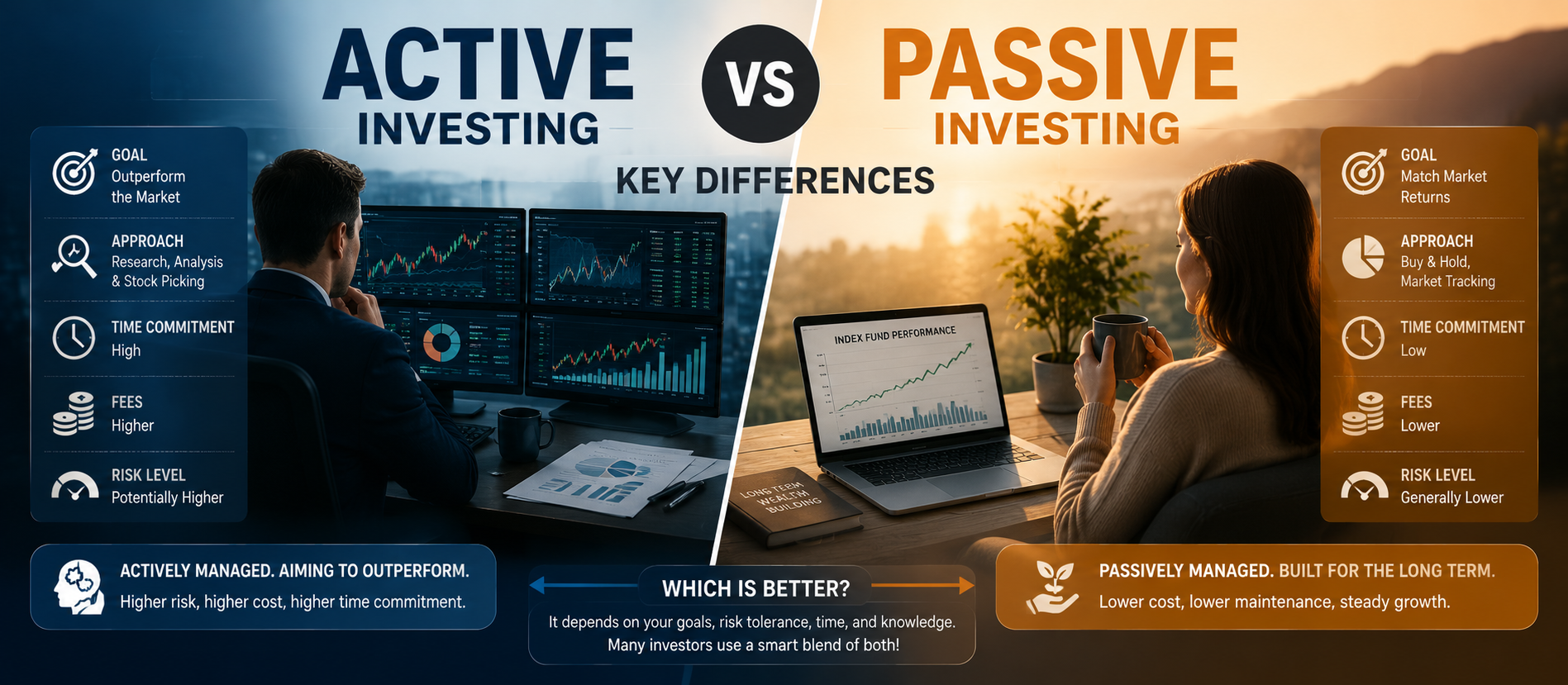
Key Difference 1: Investment Objective
Key Difference 2: Portfolio Management Style
Key Difference 3: Cost Structure
Key Difference 4: Risk Characteristics
Understanding the differences between active and passive investing is essential for making informed financial decisions. Some investors prefer actively managed portfolios that seek to outperform the market, while others favor passive strategies designed to track market performance with lower costs and less intervention.
This comprehensive guide from Digiifrog explores active vs passive investing, examines their key differences, advantages, disadvantages, and helps investors determine which approach may best align with their financial goals and risk tolerance.
What Is Active Investing?
Active investing is an investment strategy where portfolio managers, financial advisors, or individual investors make ongoing decisions about buying and selling assets in an effort to outperform a specific market benchmark.
Active investors analyze:
- Company financial statements
- Economic conditions
- Industry trends
- Market opportunities
- Valuation metrics
- Technical indicators
The goal is to identify investments that can generate returns exceeding broader market performance.
What Is Passive Investing?
Passive investing is a strategy focused on tracking the performance of a market index rather than attempting to outperform it.
Passive investors typically invest in:
- Index funds
- Exchange-Traded Funds (ETFs)
- Broad market portfolios
- Market-tracking mutual funds
The objective is to achieve market returns while minimizing costs, turnover, and management intervention.
The Evolution of Modern Investing
Historically, active investing dominated the financial industry. Investors relied on professional fund managers to identify opportunities and manage portfolios.
Over time, academic research and market performance data demonstrated that many actively managed funds struggled to consistently outperform market indexes after accounting for fees.
This led to the growing popularity of passive investing and index-based strategies.
Key Difference 1: Investment Objective
Active Investing
The primary objective is to outperform a benchmark index and generate excess returns.
Passive Investing
The goal is to replicate market performance as closely as possible.
This fundamental difference shapes every aspect of portfolio management.
Key Difference 2: Portfolio Management Style
Active investing requires continuous monitoring, research, and decision-making.
Portfolio managers actively:
- Select securities
- Adjust allocations
- Respond to market changes
- Manage risk exposures
Passive investing involves minimal intervention and follows predefined index methodologies.
Key Difference 3: Cost Structure
Costs are among the most significant distinctions between active and passive investing.
Active Investing Costs
- Higher management fees
- Research expenses
- Trading costs
- Advisory fees
Passive Investing Costs
- Lower expense ratios
- Reduced trading costs
- Minimal management expenses
Lower costs can significantly improve long-term investment returns.
Key Difference 4: Risk Characteristics
Both strategies involve risks, but the sources differ.
Active Investing Risks
- Manager underperformance
- Incorrect investment decisions
- Market timing mistakes
- Concentration risk
Passive Investing Risks
- Market-wide declines
- Index concentration risks
- Limited downside protection
Neither approach eliminates investment risk entirely.
Key Difference 5: Performance Expectations
Active investors seek superior performance through research and skill.
Passive investors accept market returns as a realistic and efficient outcome.
Research suggests that consistently outperforming markets over long periods can be challenging for many active managers.
Advantages of Active Investing
Potential for Outperformance
Skilled managers may identify opportunities that outperform benchmarks.
Flexibility
Active portfolios can adapt to changing market conditions.
Risk Management
Managers may reduce exposure during periods of heightened risk.
Specialized Strategies
Active investing can target specific sectors, themes, or opportunities.
Disadvantages of Active Investing
- Higher fees
- Greater complexity
- Potential underperformance
- Tax inefficiency due to frequent trading
- Manager dependency
Higher costs can significantly reduce net returns over time.
Advantages of Passive Investing
Low Costs
Reduced fees leave more investment returns in investors' hands.
Diversification
Broad market indexes often provide extensive diversification.
Simplicity
Passive strategies require less ongoing management and decision-making.
Tax Efficiency
Lower turnover generally results in fewer taxable events.
Transparency
Investors clearly understand what assets their portfolios contain.
Disadvantages of Passive Investing
- No attempt to outperform markets
- Full participation in market downturns
- Limited flexibility
- Potential index concentration risks
Passive investors accept both the strengths and weaknesses of market performance.
Active Investing Strategies
Common active approaches include:
- Growth investing
- Value investing
- Sector rotation
- Momentum investing
- Market timing
- Fundamental analysis
These strategies rely on research and active decision-making.
Passive Investing Strategies
Popular passive strategies include:
- Index fund investing
- ETF investing
- Buy-and-hold investing
- Target-date funds
- Broad market diversification
These approaches focus on long-term participation in market growth.
Which Strategy Is Better for Beginners?
Many financial experts recommend passive investing for beginners because of its simplicity, diversification, and lower costs.
⚠ Watch Out
Passive strategies help new investors avoid common mistakes such as excessive trading and emotional decision-making.
However, some individuals may prefer active investing if they possess significant market knowledge and enjoy investment research.
Combining Active and Passive Investing
Many investors adopt a hybrid approach that combines both strategies.
Examples include:
- Passive core portfolio with active satellite investments
- Index funds supplemented by specialized active funds
- Long-term passive investments combined with tactical opportunities
This approach can balance diversification, cost efficiency, and potential outperformance.
The Role of Technology in Investing
Technology continues transforming investment management.
Modern innovations include:
- Robo-advisors
- AI-driven portfolio analysis
- Automated rebalancing
- Low-cost trading platforms
- Real-time financial data
Technology has increased access to both active and passive investment solutions.
Behavioral Factors in Investing
Investor psychology often influences outcomes.
Common behavioral challenges include:
- Emotional trading
- Market timing mistakes
- Overconfidence
- Fear during market declines
- Greed during bull markets
Passive investing may help reduce some behavioral risks by encouraging long-term discipline.
SEO, AEO, GEO, and AI Search Opportunities
SEO (Search Engine Optimization)
Create educational content comparing investment strategies, portfolio management techniques, and wealth-building approaches.
AEO (Answer Engine Optimization)
Use structured FAQs, concise explanations, and comparison-based content to improve answer engine visibility.
GEO (Generative Engine Optimization)
Provide balanced, detailed, and trustworthy information that AI systems can confidently reference.
AI Search Optimization
Focus on expertise, transparency, and comprehensive financial education to improve visibility across AI-powered search platforms.
Frequently Asked Questions (FAQ)
What is the main difference between active and passive investing?
Active investing seeks to outperform the market, while passive investing aims to track market performance.
Is passive investing safer than active investing?
Passive investing generally offers broader diversification and lower costs, but both strategies involve market risks.
Why are passive funds cheaper?
Passive funds require less research, trading activity, and portfolio management.
Can active investing outperform passive investing?
Some active managers outperform benchmarks, but consistent long-term outperformance can be difficult to achieve.
Can investors combine both approaches?
Yes. Many investors use a combination of active and passive strategies to balance costs, diversification, and potential returns.
Conclusion
Active vs Passive Investing: Key Differences is an important consideration for anyone building an investment portfolio. Active investing offers flexibility and the potential for outperformance, while passive investing provides simplicity, diversification, lower costs, and long-term efficiency.
The best choice depends on individual financial goals, investment knowledge, risk tolerance, and time commitment. Many successful investors combine both approaches to create balanced portfolios that support long-term wealth creation and financial security.
Digiifrog
Website: www.digiifrog.com
Ready to Grow?
Talk to us about a strategy tailored to your brand — we will help you stand out in search, AI discovery and social.


Comments (0)
Log in to leave a comment.