📋 Quick Summary
In this article:
Who Needs to Pay Advance Tax in India?
1. Business owners and traders
2. Freelancers and consultants
3. Salaried employees with additional income
4. Landlords and property owners
5. Investors with taxable gains or investment income
6. Companies, firms, and other taxable entities
Who Is Generally Exempt From Advance Tax?
Advance Tax Due Dates for Tax Year 2026–27
Special Due Date for Eligible Presumptive-Taxation Taxpayers
Income tax is not always paid only after the financial year ends. Many taxpayers must pay tax during the same year in which they earn income. This system is called advance tax. It allows eligible taxpayers to spread tax payments across the year instead of paying the full amount at return-filing time.
Advance tax may apply to business owners, freelancers, consultants, professionals, landlords, investors, and salaried employees who have additional taxable income. It becomes especially relevant when tax deducted at source (TDS) does not cover the full tax liability.
In simple terms, advance tax is tax paid during the year based on estimated income. The estimate should include income from all relevant sources, eligible deductions or adjustments, and tax already deducted or collected. You should review the estimate during the year because income and tax liability can change.
This guide focuses on the rules relevant to Tax Year 2026–27 in India. Tax laws and procedures can change, so verify the latest requirements on the official Income Tax Department portal before paying.
What Is Advance Tax?
Advance tax is a system under which eligible taxpayers pay income tax in instalments during the tax year in which the income is earned. It is often described as a “pay as you earn” system.
For example, a consultant may earn fees throughout the year. A landlord may receive rent, and an investor may realise taxable capital gains. If tax due on these earnings is not fully covered by TDS or other eligible credits, the taxpayer may need to pay advance tax.
Advance tax differs from self-assessment tax. Advance tax is paid during the year based on estimated income. Self-assessment tax is generally the remaining amount paid after the year ends, when the taxpayer prepares the return and calculates the final tax due.
Who Needs to Pay Advance Tax in India?
As a general rule, advance tax is payable when the estimated tax payable for the relevant year is ₹10,000 or more, after considering relevant tax credits and adjustments. This threshold refers to estimated tax payable, not gross income.
1. Business owners and traders
People who earn taxable profits from a business may need to pay advance tax. This can include sole proprietors and other eligible taxpayers whose income is not fully covered by TDS. Business profits can change during the year, so regular estimates are useful.
2. Freelancers and consultants
Freelancers, designers, developers, writers, marketing consultants, and other independent professionals may receive payments from multiple clients. TDS may be deducted from some invoices, but it may not cover the full tax liability. Estimate annual receipts and eligible expenses, then calculate whether advance tax is due.
3. Salaried employees with additional income
For many employees, the employer deducts tax from salary. However, salary TDS may not cover tax on other income. Interest from fixed deposits, rental income, taxable capital gains, freelance earnings, or other taxable receipts can increase the final liability.
If the estimated tax after eligible credits reaches the advance-tax threshold, an employee may need to pay the shortfall through instalments. Telling the employer about other income may help with salary-TDS planning, but you should still check your total tax position.
4. Landlords and property owners
Rental income may create a tax liability that is not fully covered by TDS. Property owners should include expected rent and relevant deductions when estimating tax. The calculation depends on the applicable rules and the facts of the property and taxpayer.
5. Investors with taxable gains or investment income
Taxable gains from shares, mutual funds, property, or other assets can change your tax liability. Interest from deposits and other investments can also matter. If you realise a significant gain, review your estimate instead of waiting until return filing.
6. Companies, firms, and other taxable entities
Advance-tax obligations can also apply to companies, firms, and other taxpayers when the relevant threshold and legal conditions are met. The calculation may involve additional provisions based on the entity and its income.
Who Is Generally Exempt From Advance Tax?
A key exception applies to a resident senior citizen aged 60 years or more who has no income chargeable under the head “Profits and gains of business or profession.” Such an individual is generally not liable to pay advance tax under the applicable provision.
This is not a blanket exemption for everyone aged 60 or above. A senior citizen with business or professional income may need to pay advance tax if the other conditions are met.
A person whose estimated tax liability is fully covered by eligible TDS or other tax credits may have no additional advance-tax amount to pay. The correct approach is to estimate total tax, subtract eligible credits, and check the remaining liability against the threshold and applicable rules.
Advance Tax Due Dates for Tax Year 2026–27
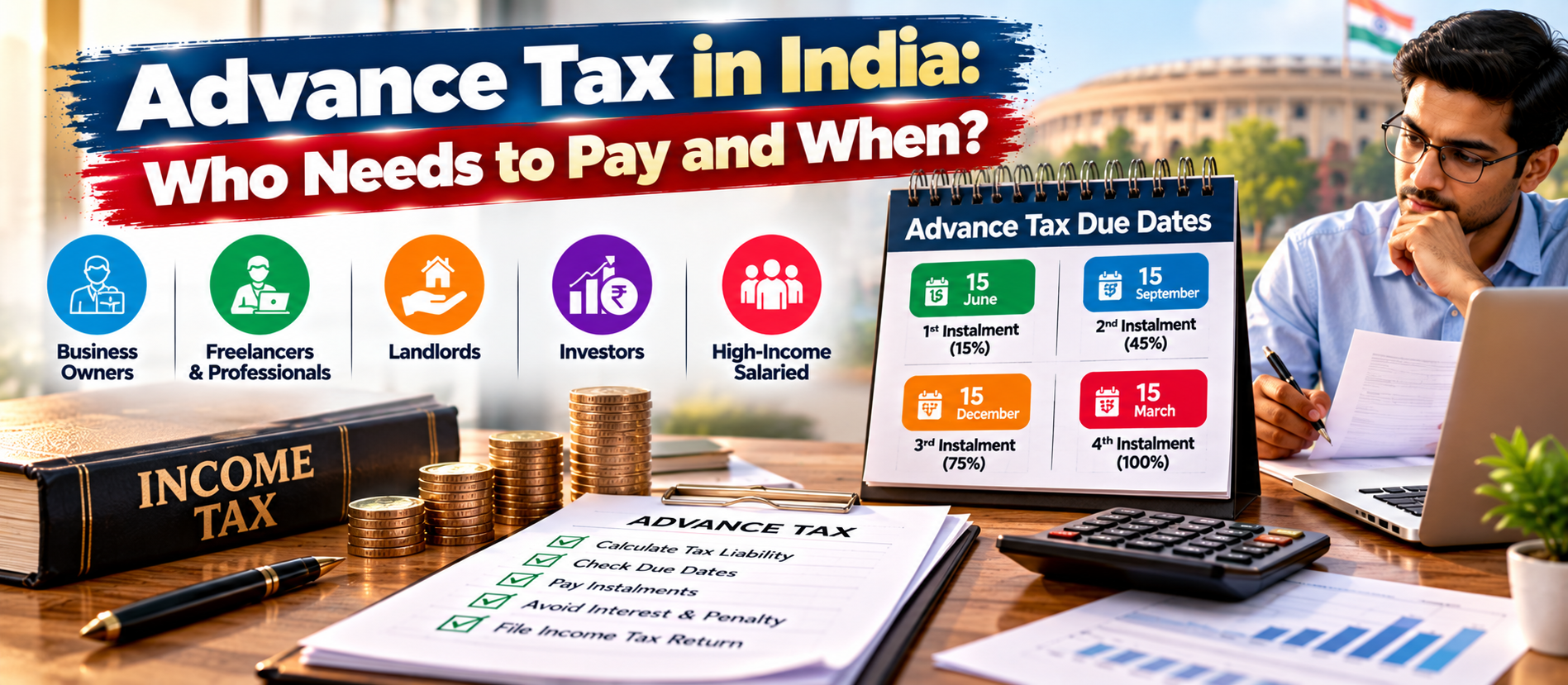
Most taxpayers pay advance tax in four instalments. The percentages below are cumulative targets. Each percentage is the total advance tax that should have been paid by that date, not an additional percentage on top of earlier instalments.
| Due dateCumulative targetWhat it means | ||
| On or before 15 June 2026 | At least 15% | Pay the first instalment based on your estimate. |
| On or before 15 September 2026 | At least 45% | Bring total advance tax paid to at least 45%. |
| On or before 15 December 2026 | At least 75% | Bring the cumulative amount to at least 75%. |
| On or before 15 March 2027 | 100% | Pay the full estimated advance-tax liability. |
These are the general instalment dates and targets published by the Income Tax Department for Tax Year 2026–27. The Income-tax Act, 2025 applies to income earned in this tax year. Check current official guidance if a due date falls on a bank holiday or if a special rule applies to your taxpayer category.
Read the Income Tax Department’s official tax-payment guidance.
Special Due Date for Eligible Presumptive-Taxation Taxpayers
Eligible taxpayers using the presumptive taxation schemes specified by law generally pay the full advance-tax amount in one instalment on or before 15 March of the relevant tax year. For Tax Year 2026–27, that date is 15 March 2027.
This special schedule does not mean every small business or freelancer automatically qualifies. Eligibility depends on the scheme, the nature of the activity, turnover or receipt limits, and other legal conditions. Confirm eligibility under the Income-tax Act, 2025 and the current Income Tax Department guidance.
Tax paid on or before 31 March is generally treated as advance tax for that tax year under the applicable rules. However, paying near the end of March may not remove interest consequences for an earlier shortfall. Do not ignore the earlier instalment dates.
How to Calculate Advance Tax
The basic method is to estimate taxable income for the full year, calculate tax under the applicable rules, and subtract eligible tax credits. The remaining amount is your estimated advance-tax liability.
- Estimate total income. Include salary, business or professional profit, rent, interest, taxable capital gains, and other taxable income.
- Estimate eligible deductions and adjustments. Apply only deductions, exemptions, reliefs, or allowances available under the rules that apply to you.
- Calculate tax. Use the applicable tax regime and rates for the relevant tax year. Include surcharge and cess where relevant.
- Subtract tax credits. Account for expected TDS, tax collected at source (TCS), and other eligible credits.
- Check the threshold. If estimated tax payable after relevant credits is ₹10,000 or more, review your advance-tax obligation.
- Plan the instalments. Follow the applicable schedule and subtract earlier payments when working out the amount still due.
Tax calculations can be more complex when income varies, capital gains arise late in the year, or several sources of income are involved. Keep records of your assumptions. If you are uncertain, ask a qualified tax professional to review the estimate.
Advance Tax Calculation Example
Suppose a taxpayer’s estimated tax liability for Tax Year 2026–27, after relevant credits, is ₹1,00,000. This example explains the instalment percentages only. It does not calculate tax on any particular income.
| Due dateCumulative targetTotal paid by dateIllustrative payment at that stage | |||
| 15 June | 15% | ₹15,000 | ₹15,000 |
| 15 September | 45% | ₹45,000 | ₹30,000 more |
| 15 December | 75% | ₹75,000 | ₹30,000 more |
| 15 March | 100% | ₹1,00,000 | ₹25,000 more |
In practice, subtract advance tax already paid when working out each instalment. If your estimate changes, recalculate the remaining liability. For example, a capital gain realised later in the year may increase the amount needed in a later instalment.
What If Your Income Changes During the Year?
Advance tax is based on estimated income, so the estimate can change. A freelancer may win a large contract. A business may earn more or less profit than expected. An investor may sell an asset and realise a taxable gain. A landlord may begin receiving rent partway through the year.
Review income and tax credits before each instalment date. If expected tax increases, update the estimate and pay the required cumulative amount by the relevant deadline. If income falls, recalculate using reasonable assumptions and the applicable law.
Do not simply repeat last year’s payment amounts. Your current income, tax regime, deductions, credits, and tax rates may differ. Keep a record of significant changes in your estimate.
How to Pay Advance Tax Online
Use the official Income Tax Department e-filing portal. The portal’s labels and workflow may change, so follow the instructions currently displayed.
- Open the official Income Tax Department e-filing portal.
- Go to the tax-payment or e-Pay Tax service.
- Enter the required taxpayer details and select the applicable tax year and advance-tax payment category.
- Review the payment details carefully.
- Select an available payment method and complete the transaction through the authorised payment flow.
- Save the challan receipt, transaction reference, and payment confirmation.
- Later, check that the payment appears correctly in your tax records.
Use only the official portal or an authorised channel. Verify the tax year and payment category before paying. A payment posted against the wrong year or category may need correction and can delay reconciliation.
Advance Tax vs. TDS vs. Self-Assessment Tax
| TypeWhen it is paid or deductedPurpose | ||
| Advance tax | During the tax year, based on estimated liability | Pay tax in instalments while income is earned. |
| TDS | Deducted by a payer when legal conditions apply | Collect tax at the source of specified payments. |
| Self-assessment tax | Usually after the tax year ends, while preparing the return | Pay the remaining amount due after calculating final liability and credits. |
These mechanisms work together. TDS does not always cover the full liability, and paying advance tax does not remove the need to file a return when filing is required. When preparing your return, reconcile the payments with official tax records.
What Happens If You Do Not Pay on Time?
Failure to pay enough advance tax by the relevant dates can lead to interest under the applicable law. For Tax Year 2026–27, the Income-tax Act, 2025 contains the relevant rules for that tax year, including provisions for failure to pay sufficient advance tax and for deferment or short payment of instalments.
The amount of interest depends on the facts, the amount paid, the dates, and the statutory calculation. Do not assume that paying the full amount near the end of the year will remove interest for earlier shortfalls.
If you discover a missed instalment, update your estimate and pay the outstanding amount as soon as possible. Keep the payment proof and seek advice if the shortfall is significant or your circumstances are complex. Check the official guidance for the current provisions and their application.
Review the official tax-payment FAQs.
Common Advance-Tax Mistakes to Avoid
- Counting only salary: Include other taxable income, such as interest, rent, business profit, and capital gains.
- Ignoring TDS already deducted: Subtract eligible credits, but verify them against official records.
- Confusing cumulative percentages: The 45% September target includes the June instalment; it is not another 45% on top.
- Using last year’s estimate without review: Current income and tax rules may be different.
- Waiting until March: Earlier instalments have separate deadlines and may affect interest.
- Choosing the wrong tax year or payment category: Check details before submitting payment.
- Assuming every senior citizen is exempt: The exception depends on residency and the absence of business or professional income.
- Assuming every small business qualifies for presumptive taxation: Check eligibility before relying on the special due date.
- Failing to keep records: Save estimates, challans, TDS details, and supporting documents.
Advance-Tax Planning Checklist
- Update your income estimate for the full tax year.
- Include income from salary, interest, rent, business, and capital gains.
- Review eligible deductions, reliefs, and tax credits.
- Check TDS and TCS records for amounts already paid.
- Calculate estimated tax and confirm whether advance tax is due.
- Check the cumulative percentage required by the next deadline.
- Pay through the official portal and save the receipt.
- Review the estimate again if income changes significantly.
- Reconcile payments when preparing your income tax return.
Frequently Asked Questions
1. What is the minimum tax liability for advance tax in India?
As a general rule, advance tax applies when estimated tax payable for the year is ₹10,000 or more after relevant credits and adjustments. Special rules and exemptions can apply.
2. What are the advance-tax due dates for Tax Year 2026–27?
For most taxpayers, the cumulative targets are 15% by 15 June 2026, 45% by 15 September 2026, 75% by 15 December 2026, and 100% by 15 March 2027. Eligible presumptive-taxation taxpayers generally pay the full amount by 15 March, subject to the rules.
3. Do salaried employees need to pay advance tax?
They may need to if tax on additional income is not fully covered by salary TDS and the remaining estimated liability meets the threshold. Additional income can include rent, deposit interest, freelance income, or taxable capital gains.
4. Are senior citizens exempt from advance tax?
A resident senior citizen aged 60 or above who has no income chargeable under business or profession is generally exempt. Senior citizens with business or professional income should check the applicable rules.
5. Can freelancers and consultants pay advance tax?
Yes. Freelancers and consultants may need to pay advance tax when estimated tax liability reaches the threshold after eligible credits. They should estimate annual income and expenses and update the calculation during the year.
6. What if my income rises after December?
Update your estimate and calculate the amount required to meet the applicable cumulative target. Pay by the relevant deadline and review whether interest applies to an earlier shortfall.
7. Is advance tax the same as TDS?
No. TDS is deducted by a payer when required. Advance tax is paid by the taxpayer during the year based on estimated tax liability. Both can count toward the final calculation when properly credited.
8. Where can I pay advance tax online?
Use the official Income Tax Department e-filing portal and follow its current payment instructions. Verify the tax year, payment category, and taxpayer details, and save the challan after payment.
Conclusion
Advance tax helps taxpayers pay income tax during the year rather than leaving the full amount until return filing. It can apply to business owners, professionals, freelancers, landlords, investors, and salaried people with additional taxable income. The general threshold is ₹10,000 of estimated tax payable, subject to applicable credits and exceptions.
For most taxpayers, the cumulative targets are 15% by 15 June, 45% by 15 September, 75% by 15 December, and 100% by 15 March. Eligible presumptive-taxation taxpayers generally follow a special schedule and pay the full amount by 15 March.
Estimate income carefully, subtract eligible tax credits, review the calculation before each deadline, and keep proof of payment. If you have multiple income sources or complex circumstances, seek professional advice and confirm current rules through the official Income Tax Department website.
At Digiifrog, we aim to make tax and personal-finance topics easier to understand through clear, practical information.
Disclaimer
This article is for general educational purposes only and is not tax, legal, or financial advice. Tax rules, forms, due dates, and procedures may change. Examples are illustrative and do not calculate any reader’s actual liability. Verify current provisions on the official Income Tax Department website and consult a qualified tax professional for advice based on your circumstances.
Official Resources
- Income Tax Department: Official E-Filing Portal
- Income Tax Department: Tax Payments and Advance-Tax FAQs
- Income-tax Act, 2025: Official Text
- Digiifrog
Ready to Grow?
Talk to us about a strategy tailored to your brand — we will help you stand out in search, AI discovery and social.

Comments (0)
Log in to leave a comment.