📋 Quick Summary
In this article:
Why AI Bias Is Difficult to Solve
1. Biased or Incomplete Training Data
2. Historical Bias
3. Sampling Bias
4. Labeling and Annotation Bias
5. Feature and Proxy Bias
6. Model and Objective Choices
7. Feedback Loops
8. Deployment Context
9. Generative AI and Large Language Models
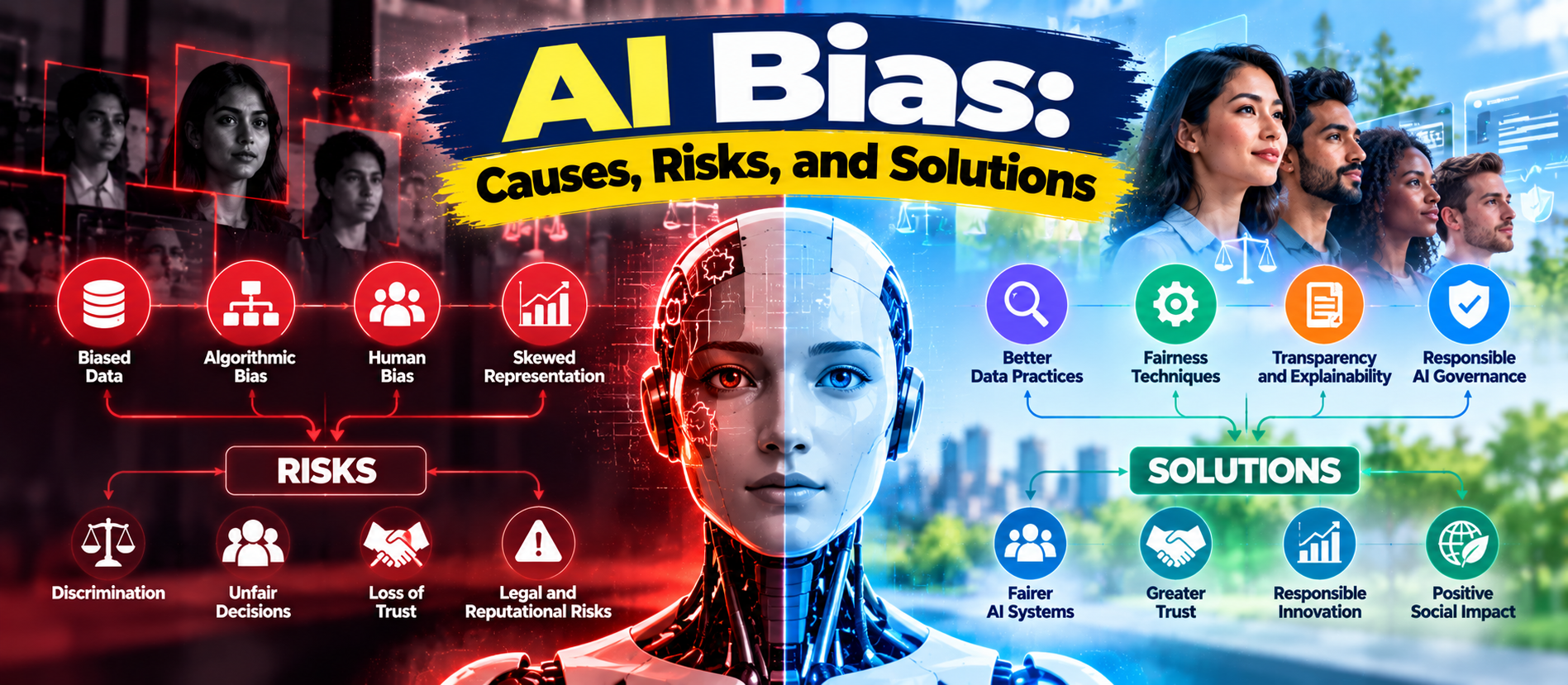
Artificial intelligence can process huge amounts of information, identify patterns, and support decisions at a speed that humans cannot match. But AI systems are not automatically neutral. They can reproduce patterns from historical data, reflect design choices, or behave differently across groups. This is known as AI bias.
AI bias matters because AI is increasingly used in hiring, lending, healthcare, education, customer service, fraud detection, advertising, search, and many other areas. A biased system can produce unfair outcomes even when nobody intentionally designed it to discriminate.
For businesses, the goal should not be to assume that bias can be removed completely. A better approach is to identify where harmful bias can appear, measure it in the right context, reduce avoidable harm, and maintain human oversight. NIST's AI Risk Management Framework treats fairness and harmful bias management as part of trustworthy AI and recommends considering trustworthiness throughout design, development, deployment, use, and evaluation.
What Is AI Bias?
AI bias is a systematic pattern in an AI system that can produce unfair, unequal, or otherwise harmful outcomes for particular people or groups. Bias can affect predictions, classifications, recommendations, generated content, rankings, or automated decisions.
Bias does not always come from a single faulty algorithm. AI systems are socio-technical systems. Their behavior can be shaped by data, people, organizations, software, deployment settings, and the environment in which outputs are used.
For example, imagine a hiring model trained mainly on historical hiring decisions from an organization where one demographic group was heavily represented in senior roles. The model may learn patterns associated with those historical decisions. If those patterns are used as a proxy for future success, the system may disadvantage qualified applicants from other groups.
The important lesson is simple: an automated decision can still contain human and historical bias.
Why AI Bias Is Difficult to Solve
AI bias is not a single technical defect. It can enter at many stages of the AI lifecycle. A system may use a balanced dataset but still create unequal outcomes because of its features, objective function, thresholds, user behavior, or deployment context.
Fairness also has different meanings. A business may care about equal access, equal error rates, equal treatment, or equal outcomes. These goals can sometimes conflict. That means organizations must define what fairness means for the specific use case instead of relying on one universal metric.
NIST describes AI as socio-technical and notes that trustworthy AI involves multiple characteristics, including validity and reliability, safety, security, accountability, transparency, explainability, privacy, and fairness with harmful bias managed.
Major Causes of AI Bias
1. Biased or Incomplete Training Data
Machine learning systems learn from data. If the data does not represent the population affected by the system, performance may vary across groups.
Problems can include underrepresentation, missing records, historical discrimination, measurement errors, outdated information, and labels that reflect subjective human decisions.
For example, a speech recognition system trained on limited accents may perform less accurately for speakers whose voices are poorly represented in the training data.
2. Historical Bias
Historical data can contain real-world inequalities. A model can learn those patterns without understanding their social causes.
If a company historically promoted certain profiles more often, a model trained on promotion records may treat those profiles as signals of future leadership potential. The model can therefore reproduce the past instead of identifying the qualities the organization actually wants.
3. Sampling Bias
Sampling bias occurs when the data used for training or evaluation does not adequately represent the people, conditions, or environments where the system will operate.
A model can appear accurate in testing while performing poorly for a smaller subgroup that was not sufficiently represented.
4. Labeling and Annotation Bias
Many AI datasets depend on people to label examples. Human annotators may disagree or apply different standards.
Labels can also reflect cultural assumptions or organizational policies. When these labels become training targets, those assumptions can become part of the model.
5. Feature and Proxy Bias
A system may not directly use a sensitive attribute but may use another variable that acts as a proxy.
Location, language, purchasing patterns, education history, device information, or other variables can sometimes correlate with demographic characteristics. Removing one sensitive field does not automatically make a model fair.
6. Model and Objective Choices
Developers decide what the model should optimize. A system optimized mainly for overall accuracy may perform very well for the largest group while producing worse error rates for smaller groups.
Thresholds and ranking rules can also change outcomes. Bias can therefore appear even when the underlying dataset looks reasonable.
7. Feedback Loops
AI systems can influence the data they later learn from. This creates a feedback loop.
For example, a recommendation system may repeatedly show certain content to a user. The user's subsequent behavior becomes new data. That data can reinforce the original recommendation pattern.
8. Deployment Context
A model can behave differently after deployment because real users, workflows, incentives, and environments differ from the original testing conditions.
A model that works well in one country, language, industry, or customer segment may not produce the same results elsewhere.
9. Generative AI and Large Language Models
Generative AI introduces additional bias risks. Large language models learn statistical patterns from very large datasets. Those datasets can contain stereotypes, unequal representation, harmful language, and conflicting cultural assumptions.
Bias may appear in generated text, images, recommendations, summaries, classifications, or answers. It may also change depending on the prompt and context.
NIST's Generative AI Profile recommends evaluating fairness and bias using use-case-appropriate benchmarks, subgroup testing, field testing, and red-teaming.
Examples of AI Bias in the Real World
Hiring and Recruitment
An AI recruiting system may rank applicants using patterns from historical hiring data. If historical decisions contained unequal treatment, the system may reproduce those patterns.
Bias can also enter through job descriptions, resume screening, interview scoring, or automated candidate recommendations.
Credit and Financial Services
AI can support credit risk assessment and fraud detection. If data or proxy variables create unequal error rates, some customers may face additional friction or adverse outcomes.
Healthcare
Healthcare AI can support diagnosis, risk prediction, and resource allocation. Differences in data quality or representation can affect performance across patient groups.
High-impact applications require careful validation because errors can have serious consequences.
Education
AI tools can recommend learning resources, estimate student performance, or help identify students who may need additional support. If the underlying data reflects unequal access or historical differences, automated recommendations may reinforce those patterns.
Advertising and Recommendations
AI systems decide which advertisements, products, jobs, videos, or information users see. Even without explicit discriminatory rules, optimization can produce uneven exposure across groups.
Generative AI Outputs
A chatbot or image generator may associate occupations, leadership roles, family structures, or other concepts with stereotyped representations. Such patterns can affect user trust and can become more serious when generated content is used in business decisions.
Risks Created by AI Bias
1. Discrimination and Unequal Treatment
The most direct risk is unfair treatment. A biased system can affect who receives an opportunity, service, recommendation, or benefit.
2. Financial Loss
Biased decisions can lead to rejected applications, lost customers, inefficient targeting, increased manual reviews, or costly remediation.
3. Legal and Regulatory Exposure
Organizations may face legal or regulatory obligations depending on the AI use case, sector, jurisdiction, and affected rights. AI governance should therefore include legal review for high-impact applications.
4. Reputational Damage
Customers and employees may lose trust when an AI system produces unfair outcomes. Public criticism can grow quickly when an automated decision affects a sensitive area.
5. Poor Business Decisions
Bias is not only an ethics issue. It can reduce model quality. If a model performs poorly for important customer groups, the business receives weaker predictions and less useful automation.
6. Loss of Customer Trust
People expect organizations to explain important automated decisions. When users cannot understand or challenge an outcome, trust can decline.
7. Amplification of Existing Inequality
AI can operate at scale. A small bias in an automated process can affect thousands or millions of interactions. This is why AI bias deserves attention before deployment, not only after a problem becomes public.
How to Detect AI Bias
Bias detection should be a continuous process. One test is rarely enough.
Define the Affected Groups
Start by identifying who could be affected by the system. Depending on the use case, this may involve demographic groups, geographic groups, language groups, customer segments, or other relevant populations.
Measure Performance by Subgroup
Do not rely only on overall accuracy. Compare relevant metrics across groups. Depending on the application, useful measures can include false-positive rates, false-negative rates, precision, recall, error rates, calibration, and service quality.
Test Edge Cases
Evaluate situations where data is limited, unusual, incomplete, or ambiguous. Edge-case testing can reveal weaknesses hidden by average performance.
Use Counterfactual Testing
Where appropriate, change one relevant attribute while keeping other information constant. If the output changes unexpectedly, the test may reveal a potential fairness problem.
Conduct Red-Team Testing
Independent testers can deliberately search for harmful patterns and unexpected behavior. NIST's recent AI evaluation work highlights model testing, red teaming, and user testing as complementary ways to assess AI systems.
Practical Solutions to Reduce AI Bias
1. Improve Data Quality
Review datasets for missing values, representation gaps, outdated records, inconsistent labels, and historical distortions. Document where the data came from and what populations it represents.
2. Build Diverse Evaluation Sets
Evaluation data should reflect the real conditions in which the system will operate. Include relevant subgroups and realistic use cases.
3. Use Fairness Metrics That Match the Context
There is no single fairness metric that works for every AI system. Choose measures based on the harm being managed and the decision being supported.
4. Add Human Oversight
Human review is especially important for high-impact decisions. People should have enough information and authority to question, override, or escalate an AI output.
5. Improve Explainability
Users and affected people need meaningful information about how an AI system is being used, its limitations, and where appropriate, the factors that influenced an output.
6. Document AI Systems
Maintain documentation for datasets, model versions, evaluation results, intended use, known limitations, risks, and changes after deployment.
7. Monitor After Deployment
AI systems can drift. User populations change. Data changes. Business processes change. Monitor outcomes over time and repeat fairness assessments when the model, data, or use case changes.
8. Establish AI Governance
Assign clear ownership. Define approval processes for high-risk AI use cases. Create escalation paths for suspected harmful outcomes.
9. Test Before Scaling
Do not move directly from a successful demo to organization-wide deployment. Start with controlled pilots. Measure outcomes. Review unexpected behavior. Then expand carefully.
10. Give People a Way to Challenge Outcomes
When an AI system affects a person, organizations should consider whether that person can request clarification, correction, or human review. A challenge process can reveal problems that automated monitoring misses.
AI Bias and Generative AI Search
AI bias also matters in AI-powered search and answer systems. Generative systems may summarize information, recommend sources, classify content, or answer questions based on patterns learned from data and retrieval systems.
💡 Key Insight
For businesses, this creates a new content and visibility challenge. Clear, factual, well-structured information is easier for AI systems to interpret. Organizations should avoid unsupported claims and make important facts easy to verify.
From an AI Search and GEO perspective, trustworthy content should use clear headings, direct answers, definitions, evidence, context, and transparent authorship. This does not guarantee a particular ranking or recommendation, but it improves the clarity and usefulness of information for both people and machine systems.
A Practical AI Bias Management Framework for Businesses
Step 1: Identify
List the AI systems used by the organization. Record their purpose, users, data sources, outputs, and affected stakeholders.
Step 2: Map the Risk
Identify where bias could enter. Review data collection, labeling, modeling, deployment, user interaction, and downstream decisions.
Step 3: Measure
Define measurable tests. Compare relevant outcomes across groups and document limitations.
Step 4: Review
Bring technical teams together with domain experts, legal or compliance specialists, and people who understand the affected users.
Step 5: Mitigate
Improve data, adjust model design, change thresholds, add safeguards, introduce human review, or redesign the workflow when necessary.
Step 6: Monitor
Continue testing after deployment. Track complaints, performance differences, drift, and new use cases.
Step 7: Govern
Keep clear records of decisions, approvals, incidents, corrective actions, and model changes.
AI Bias Prevention Checklist
- Define the intended use of every AI system.
- Identify people and groups affected by the system.
- Review training and evaluation data for representation gaps.
- Document data sources and known limitations.
- Test model performance across relevant subgroups.
- Check for proxy variables and unintended correlations.
- Use fairness metrics that match the business and social context.
- Test edge cases and counterfactual scenarios.
- Conduct independent red-team or adversarial testing where appropriate.
- Keep humans involved in high-impact decisions.
- Document model versions and evaluation results.
- Monitor performance after deployment.
- Create a process for users to challenge or report harmful outcomes.
- Review AI systems whenever data, models, vendors, or use cases change.
- Train employees on responsible AI use.
What Businesses Should Do in 2026
AI governance is becoming more practical. Organizations should move beyond broad statements about responsible AI and build repeatable processes.
Start with an inventory of AI systems. Identify high-impact use cases. Define risk levels. Test important systems before deployment. Monitor them after release. Keep evidence of decisions and evaluations.
Current NIST guidance continues to emphasize structured AI risk management, while its 2026 evaluation work highlights the value of combining model testing, red teaming, and user testing. These approaches support a more complete view of how an AI system behaves in real-world conditions.
Organizations should also remember that fairness is not only a model problem. It is a business process problem. A technically strong model can still create harm if it is used for the wrong purpose, given excessive authority, or deployed without meaningful human oversight.
Why Responsible AI Is a Business Advantage
Managing AI bias can improve more than compliance. Better data can improve model performance. Better documentation can speed up troubleshooting. Human oversight can reduce costly errors. Clear governance can make AI adoption easier because teams understand who is responsible for decisions.
Trust also matters. Customers, employees, and partners are more likely to use AI systems when they understand how those systems are governed and how problems can be addressed.
Conclusion
AI bias is not simply a problem with algorithms. It can begin with data, historical decisions, labels, product design, model objectives, deployment choices, or human behavior.
The solution is not to stop using AI. The solution is to use AI more carefully.
Businesses should identify possible sources of bias, measure outcomes across relevant groups, test systems before and after deployment, document limitations, maintain human oversight, and create clear governance processes.
Trustworthy AI is built through continuous work. When organizations treat fairness and bias management as part of the complete AI lifecycle, they can make AI systems more reliable, transparent, and useful.
Digiifrog helps businesses understand and apply modern digital and AI strategies. Learn more at www.digiifrog.com.
Frequently Asked Questions About AI Bias
What is AI bias?
AI bias is a systematic pattern in an AI system that can produce unfair, unequal, or harmful outcomes for particular people or groups.
What causes AI bias?
Common causes include biased training data, incomplete samples, historical bias, labeling choices, proxy variables, model objectives, feedback loops, and differences between testing and real-world deployment.
Can AI bias be completely removed?
Not always. Bias can have many technical and social causes, and different fairness goals can conflict. The practical goal is to identify harmful bias, reduce avoidable harm, and continuously monitor the system.
How can businesses detect AI bias?
Businesses can compare performance across relevant groups, test edge cases, use counterfactual tests, conduct red-team exercises, review complaints, and perform ongoing evaluations after deployment.
Why is human oversight important in AI?
Human oversight provides a way to question, correct, or override AI outputs, especially when the system affects important decisions or people may experience significant harm.
Does generative AI have bias?
Yes. Generative AI can reproduce patterns and stereotypes present in training data and can produce different outputs depending on prompts and context. Testing should reflect the intended use.
What is responsible AI governance?
Responsible AI governance is the set of policies, roles, controls, documentation, evaluations, monitoring processes, and accountability mechanisms used to manage AI risks throughout the system lifecycle.
Why is AI bias important for businesses?
AI bias can create unfair outcomes, reduce model quality, increase operational and legal risk, damage trust, and produce poor business decisions.
Ready to Grow?
Talk to us about a strategy tailored to your brand — we will help you stand out in search, AI discovery and social.
Comments (0)
Log in to leave a comment.