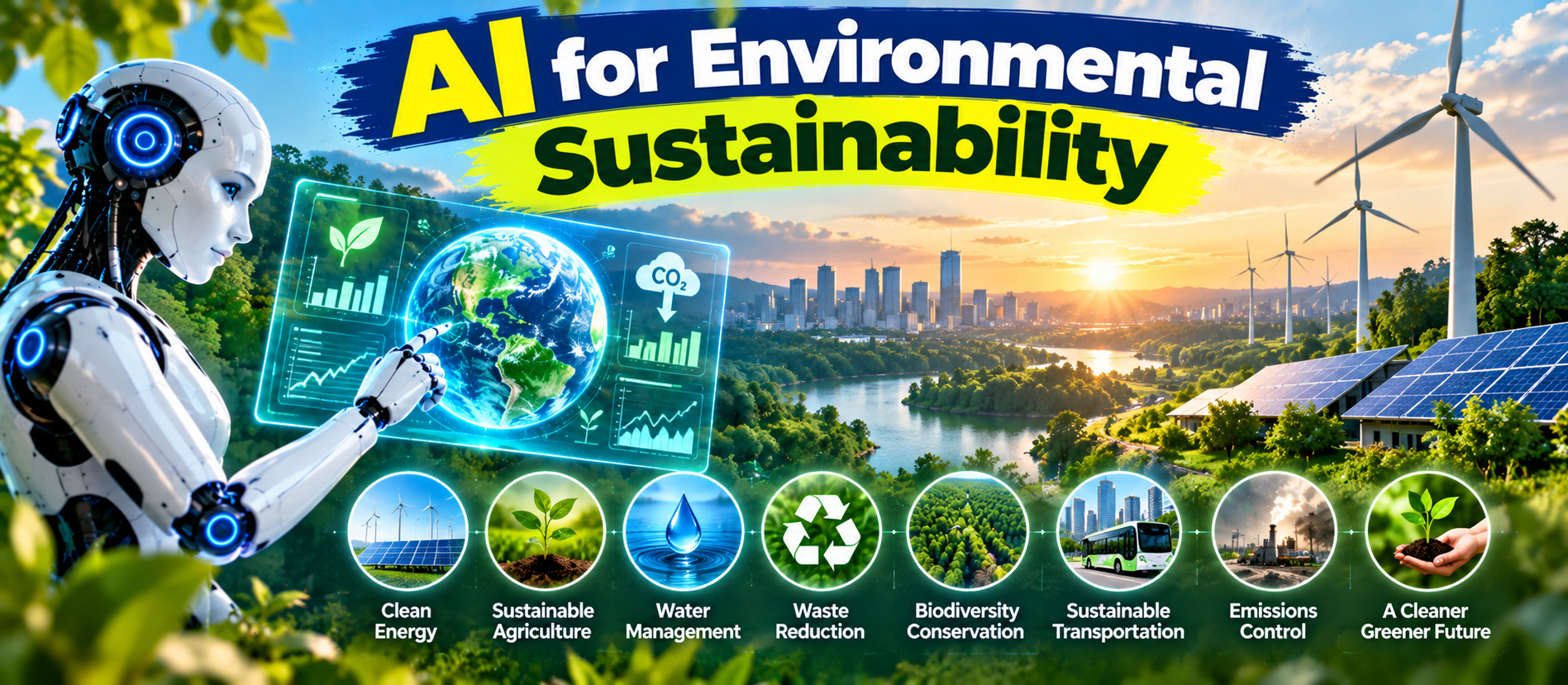
📋 Quick Summary
In this article:
What Is AI for Environmental Sustainability?
Why AI Matters for Sustainability
1. AI for Renewable Energy
2. AI for Energy Efficiency
3. AI for Climate and Weather Forecasting
4. AI for Forest Monitoring
5. AI for Biodiversity Conservation
6. AI for Pollution Detection
7. AI for Methane Emissions
8. AI for Sustainable Agriculture
9. AI for Water Management
Introduction
Environmental sustainability is one of the biggest challenges facing businesses, governments, communities, and individuals. Climate change, pollution, biodiversity loss, water stress, waste, and resource consumption are connected problems. They also generate huge amounts of data.
Satellites capture images of land and oceans. Sensors measure air and water quality. Smart meters record energy use. Weather stations collect atmospheric information. Supply chains create operational data. Farms generate information about soil, crops, irrigation, and weather.
Artificial intelligence can help turn this data into useful decisions. AI can identify patterns, detect changes, forecast events, optimize systems, and automate selected tasks. The OECD notes that AI can support real-time environmental monitoring, pollution and weather forecasting, climate modelling, and smart energy management.
But AI is not automatically sustainable. AI systems require computing resources, electricity, hardware, cooling, and data infrastructure. The International Energy Agency says AI has the potential to improve energy systems and reduce emissions, while growing data-center electricity demand creates its own environmental challenge.
The right question is therefore not simply, “Can AI help the environment?” A better question is: Where can AI create measurable environmental benefits that are larger than the resources and impacts required to build and operate the AI system?
What Is AI for Environmental Sustainability?
AI for environmental sustainability means using artificial intelligence to understand, protect, optimize, and restore natural and built environments.
It can include machine learning, computer vision, forecasting models, optimization systems, generative AI, intelligent agents, and other AI techniques.
Common goals include:
- Reducing energy consumption
- Increasing renewable energy efficiency
- Reducing greenhouse gas emissions
- Detecting pollution
- Monitoring forests and biodiversity
- Improving water management
- Reducing food waste
- Improving agricultural productivity
- Optimizing transport
- Reducing industrial waste
- Improving disaster preparedness
- Supporting environmental policy and compliance
Why AI Matters for Sustainability
Many environmental systems are complex. Conditions can change quickly. Human teams cannot manually inspect every satellite image, sensor reading, weather signal, supply-chain record, or energy transaction.
AI can process large datasets at high speed. It can also find relationships that are difficult to detect manually.
For example, an AI system may combine weather forecasts, electricity demand, renewable generation, and grid conditions to improve energy planning. A computer-vision system may examine satellite images to identify changes in forests or wetlands. A predictive model may estimate when industrial equipment is likely to fail.
The value comes from better decisions. AI itself is not the environmental solution. It is a tool that can improve the way environmental systems are monitored and managed.
1. AI for Renewable Energy
Renewable energy sources such as solar and wind are variable. Their output changes with weather and time. AI can help forecast generation and match supply with demand.
Possible applications include:
- Solar power forecasting
- Wind power forecasting
- Demand forecasting
- Grid balancing
- Battery optimization
- Predictive maintenance
- Energy trading support
- Renewable asset performance monitoring
Better forecasting can reduce uncertainty. It can also help operators plan storage and other flexible resources.
The IEA identifies AI-led optimization as an important opportunity for the energy sector, while noting that adoption depends on data, digital infrastructure, skills, security, and other enabling conditions.
2. AI for Energy Efficiency
Energy efficiency is often one of the fastest ways to reduce environmental impact. AI can help organizations understand where energy is being wasted.
Buildings can use AI to optimize heating, ventilation, and air conditioning. Factories can use models to adjust processes. Data centers can use intelligent controls to manage cooling and computing loads.
The IEA reports that AI-based building management can reduce energy use in HVAC systems, while industrial and transport optimization can also produce efficiency gains.
These applications are important because they focus on existing infrastructure. A small efficiency improvement repeated across thousands of buildings or machines can create a large aggregate effect.
3. AI for Climate and Weather Forecasting
Climate and weather data are essential for adaptation. AI can help analyze large atmospheric datasets and improve forecasting workflows.
Potential applications include:
- Extreme weather prediction
- Flood risk analysis
- Cyclone forecasting
- Drought monitoring
- Heatwave alerts
- Wildfire risk assessment
- Sea-level monitoring
- Climate scenario analysis
India is already applying AI and advanced forecasting tools to climate and disaster resilience. A Government of India briefing in February 2026 described AI-supported weather forecasting, climate-risk management, sea-level monitoring, and cyclone forecasting as part of India's climate-action efforts.
Better forecasting can support earlier decisions. It can help communities prepare, protect infrastructure, and allocate emergency resources.
4. AI for Forest Monitoring
Forests are important carbon sinks and biodiversity habitats. Monitoring them at large scale is difficult.
AI can analyze satellite and aerial imagery to identify:
- Deforestation
- Forest degradation
- Illegal land clearing
- Fire damage
- Vegetation changes
- Tree-cover loss
Computer vision can compare images from different dates. This can help environmental agencies identify areas that need investigation.
AI does not replace field verification. Instead, it can help prioritize where human teams should look first.
5. AI for Biodiversity Conservation
Biodiversity monitoring can generate huge datasets. Cameras, acoustic sensors, satellites, environmental DNA, and field observations can all contribute information.
AI can help classify images, identify species from sounds, detect changes in habitats, and process large ecological datasets.
Possible applications include:
- Wildlife identification
- Animal population monitoring
- Acoustic biodiversity monitoring
- Habitat mapping
- Invasive species detection
- Protected-area monitoring
- Poaching-risk analysis
The broader digital sustainability community also identifies AI and data analytics as tools for biodiversity monitoring and environmental observation.
6. AI for Pollution Detection
Pollution can be difficult to monitor continuously. AI can combine sensor data, satellite imagery, weather information, and industrial records to identify pollution patterns.
Applications include:
- Air-quality forecasting
- Water-quality monitoring
- Industrial emissions detection
- Oil-spill detection
- Illegal dumping detection
- Urban pollution mapping
UNEP highlights AI applications that can map environmental damage and detect methane emissions. Its International Methane Emissions Observatory, for example, uses AI to analyze satellite data and help identify methane emissions.
7. AI for Methane Emissions
Methane is a powerful greenhouse gas. Finding leaks quickly can help reduce emissions.
AI can analyze satellite observations and other data sources to detect possible methane emissions. Systems can then help prioritize inspections and repairs.
This is a strong example of how AI can connect data analysis with physical action. The model is useful only when its findings lead to verification and mitigation.
8. AI for Sustainable Agriculture
Agriculture depends on weather, soil, water, crop health, pests, and market conditions. AI can combine these signals to support farmers.
Potential applications include:
- Precision irrigation
- Crop disease detection
- Yield forecasting
- Soil monitoring
- Pest detection
- Fertilizer optimization
- Weather-based farm planning
- Satellite crop monitoring
Precision agriculture can reduce unnecessary use of water, fertilizer, pesticides, and fuel. The environmental benefit depends on the quality of the recommendations and whether users actually change their practices.
9. AI for Water Management
Water systems face pressure from climate change, population growth, pollution, and inefficient infrastructure.
AI can support:
- Water demand forecasting
- Leak detection
- Reservoir management
- Irrigation planning
- Flood prediction
- Water-quality monitoring
- Groundwater analysis
Smart water systems can use sensor data to detect unusual patterns. A sudden pressure change may indicate a leak. AI can help identify such anomalies faster.
10. AI for Waste Management
Waste management involves collection, sorting, recycling, transportation, and disposal. AI can improve several parts of the process.
Computer vision can identify materials on recycling lines. Route optimization can reduce unnecessary vehicle travel. Predictive systems can estimate collection demand.
AI can also support circular-economy models by helping businesses understand material flows and identify opportunities to reuse or recover resources.
11. AI for Smart Buildings
Buildings consume energy for cooling, heating, lighting, ventilation, computing, and equipment.
AI-enabled building management can adjust systems based on occupancy, weather, energy prices, and building conditions.
Possible benefits include:
- Lower electricity use
- Better thermal comfort
- Reduced peak demand
- Predictive equipment maintenance
- Improved indoor-air management
Automation should still include safeguards. A system that aggressively reduces energy use but creates unsafe or uncomfortable conditions is not a successful sustainability solution.
12. AI for Sustainable Transportation
Transportation produces emissions through vehicle operation, fuel use, congestion, and infrastructure demand.
AI can support more efficient transportation through route optimization, traffic prediction, fleet management, predictive maintenance, and demand forecasting.
The IEA cites transport optimization as one area where AI could reduce energy use and emissions. It also warns that rebound effects can reduce or reverse some benefits.
For example, autonomous or highly convenient transport could increase total travel in some scenarios. Sustainability depends on the complete system, not just the efficiency of one vehicle.
13. AI for Sustainable Supply Chains
Supply chains are complex networks. They include suppliers, factories, warehouses, transportation, inventory, and customers.
AI can optimize inventory and logistics. It can also help companies identify unusual energy use, material waste, delivery inefficiencies, or supply risks.
Potential applications include:
- Demand forecasting
- Inventory optimization
- Route planning
- Supplier risk analysis
- Material tracking
- Warehouse optimization
- Carbon-data analysis
14. AI for Industrial Sustainability
Industrial facilities use energy and materials at large scale. Even small improvements can matter when applied continuously.
AI can optimize manufacturing processes, predict equipment failures, improve quality control, and reduce scrap.
Predictive maintenance can also extend equipment life. Instead of replacing machinery on a fixed schedule, companies can use condition data to determine when maintenance is needed.
The result can be less downtime, fewer unnecessary replacements, and better resource utilization.
15. AI for Carbon Accounting
Organizations need reliable emissions data to manage climate goals. Carbon accounting can involve large datasets across offices, factories, vehicles, suppliers, energy systems, and purchased goods.
AI can help classify records, detect anomalies, estimate missing information, and automate parts of reporting workflows.
However, automated estimates should not be treated as unquestionable facts. Businesses need transparent methodologies, source data, validation, and audit controls.
16. AI for Climate Risk Management
Climate risk affects physical assets, supply chains, insurance, agriculture, infrastructure, and communities.
AI can combine climate projections with asset and operational data to identify potential risks.
For example, a company may analyze flood exposure across warehouses. An insurer may model weather-related risks. A city may identify neighborhoods that face higher heat or flood exposure.
These systems can support planning, but uncertainty must be communicated clearly. A model is a decision-support tool, not a perfect prediction of the future.
17. AI for Disaster Response
During disasters, information changes rapidly. AI can help process satellite images, social-media signals, sensor data, weather information, and emergency reports.
Possible applications include:
- Damage assessment
- Flood mapping
- Wildfire detection
- Emergency route planning
- Resource allocation
- Infrastructure assessment
Human emergency teams remain essential. AI outputs should be verified before high-impact decisions are made.
18. AI and Circular Economy
A circular economy aims to reduce waste and keep materials in productive use for longer.
AI can support circular models by improving product design, material identification, predictive maintenance, repair decisions, and recycling.
For example, computer vision can help sorting facilities identify different materials. Predictive models can identify when equipment needs repair rather than replacement.
19. The Environmental Footprint of AI
AI can help sustainability, but AI itself has an environmental footprint.
UNEP recommends looking at the full AI lifecycle. This includes the resources and impacts associated with hardware, data centers, energy, water, materials, transport, and end-of-life waste.
ISO/IEC TR 20226:2025 provides a framework for considering environmental sustainability aspects of AI systems across their lifecycle, including workload, resource and asset utilization, carbon impact, pollution, waste, transportation, and location.
This lifecycle view is important. Measuring only the electricity used during model inference can miss impacts from hardware manufacturing, construction, supply chains, and electronic waste.
20. AI Data Centers and Energy Demand
Data centers are the physical foundation of modern AI. They require electricity for computing and cooling.
The IEA reported in April 2026 that global data-centre electricity demand grew by 17% in 2025, while electricity consumption from AI-focused data centers grew by 50%. The IEA also notes that energy efficiency per AI task is improving rapidly, but more energy-intensive uses such as video generation, reasoning, and agentic tasks can increase total demand.
This creates an important sustainability challenge. Improving efficiency per task does not automatically reduce total resource use if the number and intensity of AI tasks grow faster.
21. AI Water Use and Hardware Impacts
AI infrastructure can also affect water and material resources. Data centers may use water for cooling, while hardware manufacturing depends on minerals, energy, chemicals, and complex global supply chains.
AI sustainability therefore requires more than purchasing renewable electricity. Companies should consider cooling systems, hardware utilization, equipment lifetimes, recycling, location, and resource efficiency.
Recent research and reviews have highlighted concerns about energy use, greenhouse gas emissions, grid pressure, and freshwater resources associated with AI infrastructure.
22. Green AI: Making AI Itself More Sustainable
Green AI means designing and operating AI systems with environmental efficiency in mind.
Practical strategies include:
- Use smaller models when they are sufficient.
- Optimize inference workloads.
- Cache repeated results when appropriate.
- Reduce unnecessary model calls.
- Use efficient hardware.
- Improve server utilization.
- Choose lower-carbon electricity where feasible.
- Extend hardware lifetimes where practical.
- Measure energy and resource use.
- Use lifecycle assessment.
A larger model is not automatically a better sustainability choice. The right model is the one that delivers the required result with an appropriate resource cost.
23. Measuring the Environmental Impact of AI
Organizations should measure both benefits and costs.
| Area Possible Metric | |
| Energy | Electricity use per workload |
| Carbon | CO2e associated with AI operations |
| Water | Water consumption or water-use intensity |
| Hardware | Equipment utilization and lifetime |
| Waste | Electronic waste and recycling rate |
| Efficiency | Energy or emissions per useful task |
| Environmental benefit | Energy, water, waste or emissions avoided |
| Business impact | Cost savings or productivity gains |
The ISO/IEC sustainability guidance for AI specifically identifies environmental aspects and potential metrics across the AI lifecycle.
24. AI Sustainability Needs a Net-Impact Approach
A useful sustainability assessment should compare the environmental cost of an AI system with the environmental benefit it enables.
For example, an AI system may consume electricity but reduce industrial energy consumption by optimizing production. Another system may require computing resources but help detect methane leaks.
The calculation should consider the complete system.
Net environmental impact = environmental costs of AI − measurable environmental benefits enabled by AI.
This is not a single universal formula. Different projects require different boundaries and assumptions. But the principle is useful: measure outcomes rather than assuming that “AI” is automatically green.
25. Avoiding Rebound Effects
Efficiency improvements can sometimes increase total consumption.
If a process becomes cheaper or faster, people may use it more. This is known as a rebound effect.
The IEA specifically warns that rebound effects can reduce some potential emissions benefits from AI.
For example, more efficient transport could encourage more travel. More efficient computing could encourage heavier AI use.
Sustainability strategies should therefore measure total resource use, not only efficiency per unit.
26. AI for Environmental Compliance
Environmental regulations generate reporting and monitoring requirements. AI can help organizations process large amounts of operational data and identify possible compliance issues.
Applications may include:
- Emissions monitoring
- Waste documentation
- Water-quality records
- Environmental reporting
- Satellite-based monitoring
- Anomaly detection
AI can make compliance workflows faster, but legal responsibility should remain with appropriate human decision-makers.
27. AI and Sustainable Cities
Cities combine transportation, buildings, water, waste, energy, and public infrastructure. AI can help coordinate these systems.
Smart-city applications include:
- Traffic optimization
- Public transport planning
- Street-light optimization
- Waste collection
- Water-leak detection
- Air-quality monitoring
- Building energy management
The biggest gains may come from connecting systems rather than optimizing one component in isolation.
28. AI for Sustainable Business Operations
Businesses can use AI to reduce environmental impact in everyday operations.
Examples include:
- Optimizing delivery routes
- Reducing unnecessary business travel
- Forecasting inventory
- Reducing food waste
- Monitoring facility energy use
- Improving equipment maintenance
- Automating environmental reporting
Businesses should start with measurable problems. A small pilot with a clear baseline is often more useful than a large AI project with no environmental metric.
29. Challenges of Using AI for Sustainability
Data Quality
AI depends on data. Poor, incomplete, biased, or inconsistent environmental data can produce unreliable results.
Infrastructure
Remote locations may lack sensors, connectivity, computing resources, or skilled personnel.
Cost
Advanced systems can be expensive to build and maintain.
Transparency
Environmental decisions may require explanations that some complex models cannot provide easily.
False Positives and False Negatives
A monitoring system can miss a real environmental event or flag something incorrectly. Human review remains important.
Privacy
Environmental monitoring can sometimes involve people, vehicles, properties, or sensitive locations. Data governance is essential.
Greenwashing
Organizations may promote AI as a sustainability solution without measuring actual environmental outcomes. Claims should be supported by evidence.
30. A Practical Framework for Sustainable AI Projects
- Define the environmental problem. Start with a measurable problem.
- Create a baseline. Measure current energy, emissions, waste, water, or resource use.
- Check whether AI is necessary. A simpler solution may be more efficient.
- Select the smallest suitable model. Match model capability to the task.
- Estimate AI lifecycle impacts. Include infrastructure and hardware where practical.
- Define success metrics. Measure environmental outcomes, not only model accuracy.
- Pilot the system. Test it in a controlled setting.
- Validate results. Compare AI recommendations with trusted measurements.
- Monitor rebound effects. Check whether efficiency changes total demand.
- Scale only when the evidence supports it.
31. Future of AI for Environmental Sustainability
The future is likely to involve tighter integration between AI, sensors, satellites, energy systems, robotics, and environmental data.
AI agents may eventually coordinate complex sustainability workflows. For example, an agent could monitor energy demand, check weather forecasts, compare renewable generation, identify anomalies, and recommend actions to an operator.
Digital twins may also become more useful. A digital representation of a building, factory, grid, or city can be combined with AI to test possible changes before implementing them in the physical world.
Scientific discovery is another important area. AI may help researchers explore new materials, energy technologies, climate processes, and environmental interventions. These benefits are harder to forecast, but their potential is significant.
AI for Environmental Sustainability: Key Applications at a Glance
| Area AI Application Potential Sustainability Benefit | ||
| Energy | Forecasting and optimization | Lower waste and better renewable integration |
| Buildings | Smart HVAC control | Lower energy use |
| Agriculture | Precision irrigation | Better water and input efficiency |
| Forests | Satellite image analysis | Faster deforestation detection |
| Biodiversity | Species and habitat monitoring | Better conservation data |
| Water | Leak and demand prediction | Reduced water loss |
| Waste | Computer-vision sorting | Improved recycling |
| Transport | Route optimization | Lower fuel and energy use |
| Industry | Process optimization | Lower energy and material waste |
| Climate | Risk and weather modelling | Better adaptation and preparedness |
AI and Environmental Sustainability: SEO, AEO, GEO and AI Search Perspective
Environmental technology is also becoming an important information topic. Businesses, researchers, journalists, investors, and policymakers increasingly use AI-powered search systems to find information.
Organizations publishing sustainability content should make their information easy to understand and verify.
Use direct answers. Define technical terms. Add evidence. Explain methodology. Use descriptive headings. Include useful tables and FAQs. Keep statistics tied to dates and sources.
This approach supports traditional SEO and also improves the chance that AI systems can accurately interpret and summarize the content.
❓ Frequently Asked Questions
How can AI help environmental sustainability?▾
AI can analyze environmental data, forecast conditions, optimize energy and resource use, monitor ecosystems, detect pollution, support agriculture, improve transportation, and assist climate-risk planning.
Can AI reduce carbon emissions?▾
AI can contribute to emissions reductions when it improves energy efficiency, renewable integration, transport efficiency, industrial processes, or environmental monitoring. The IEA estimates that widespread adoption of existing AI applications could enable substantial emissions reductions, while also stressing that adoption barriers and rebound effects matter. citeturn0search1turn0search6
Is AI itself environmentally friendly?▾
Not automatically. AI requires electricity, hardware, data centres, cooling, and other resources. UNEP recommends assessing the full AI lifecycle rather than focusing on one stage.
How does AI help renewable energy?▾
AI can improve renewable generation forecasting, demand forecasting, grid management, battery optimization, and predictive maintenance.
How can AI help biodiversity?▾
AI can analyze wildlife images, acoustic recordings, satellite data, and habitat information to support species identification and ecosystem monitoring.
Can AI help farmers become more sustainable?▾
Yes. AI can support precision irrigation, crop monitoring, disease detection, yield forecasting, and input optimization.
What is Green AI?▾
Green AI refers to designing and operating AI systems with attention to energy, carbon, water, hardware, waste, and other environmental impacts.
How can businesses measure AI sustainability?▾
Businesses can measure energy use, carbon impact, water use, hardware lifecycle, waste, and the environmental benefits enabled by the AI system.
Can AI solve climate change?▾
No single technology can solve climate change. AI can support mitigation, adaptation, monitoring, and scientific research, but it must be combined with policy, infrastructure, investment, behavioral change, and other technologies.
AI Sustainability Checklist for Businesses
- Identify one measurable environmental problem.
- Create a baseline before deploying AI.
- Compare AI with simpler alternatives.
- Choose an appropriately sized model.
- Measure energy and resource use.
- Review data quality and governance.
- Check privacy and security risks.
- Measure actual environmental outcomes.
- Watch for rebound effects.
- Document assumptions and limitations.
- Review results regularly.
- Scale only after evidence supports the business case.
Conclusion
AI can become an important tool for environmental sustainability. It can help organizations understand complex systems, forecast risks, optimize resources, detect pollution, monitor ecosystems, improve energy efficiency, and support climate adaptation.
But the sustainability story has two sides. AI can reduce environmental impacts in one system while increasing energy, water, hardware, or waste impacts in another. The IEA describes AI as a potential tool for emissions reduction, but not a silver bullet.
The most responsible approach is therefore outcome-focused. Measure what the AI system consumes. Measure what it improves. Compare the two. Include lifecycle impacts. Watch for rebound effects. Keep humans accountable for high-impact decisions.
When AI is connected to reliable environmental data, efficient infrastructure, strong governance, and measurable goals, it can support a more informed and resource-efficient economy.
Digiifrog helps businesses understand AI, automation, digital transformation, SEO, and modern technology strategies. Learn more at www.digiifrog.com.
Ready to Grow?
Talk to us about a strategy tailored to your brand — we will help you stand out in search, AI discovery and social.

Comments (0)
Log in to leave a comment.