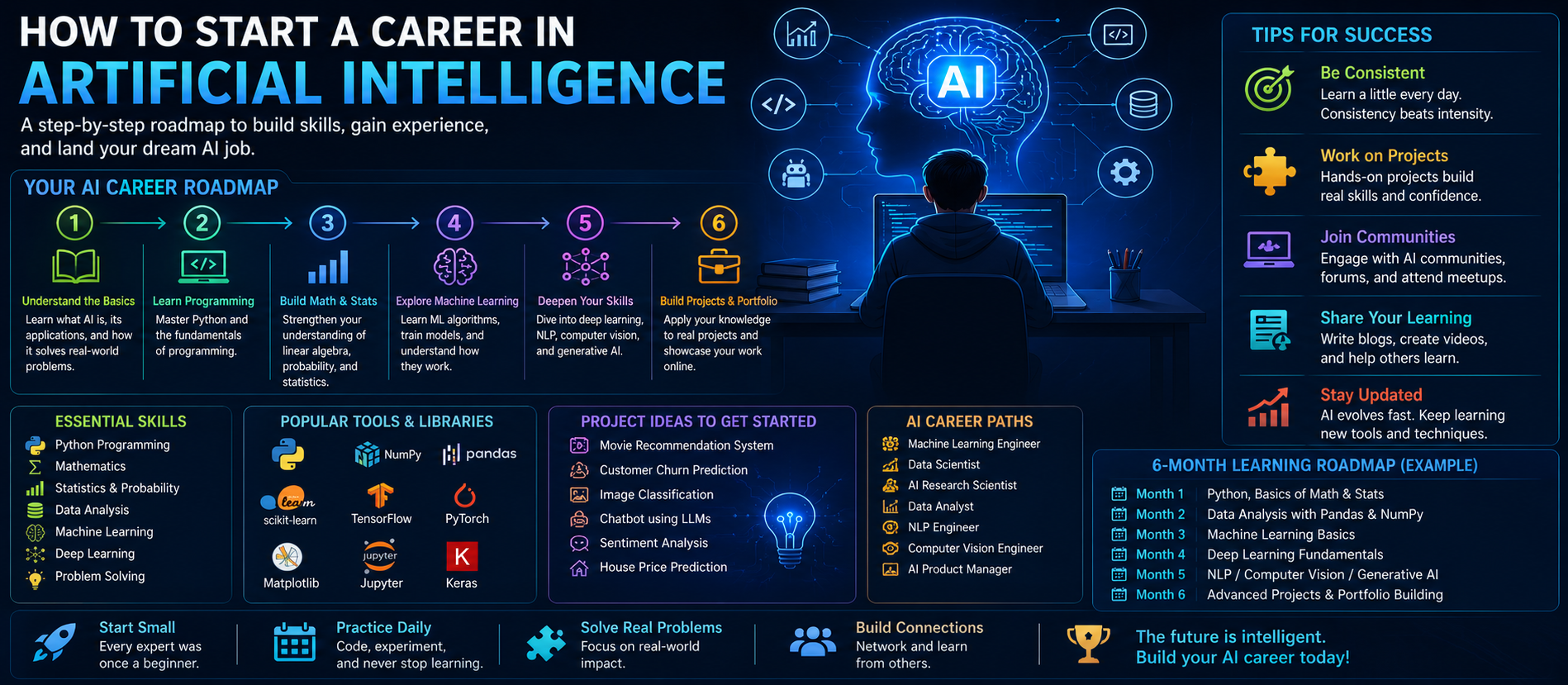
📋 Quick Summary
In this article:
What Does an AI Career Actually Mean?
Step 1: Understand the Fundamentals of AI
Step 2: Learn Python and Basic Programming
Step 3: Build Your Mathematics and Statistics Foundation
Step 4: Learn Data Analysis
Step 5: Learn Machine Learning
Start with Supervised Learning
Step 6: Explore Generative AI and Large Language Models
Step 7: Learn Responsible and Trustworthy AI
Step 8: Build Real AI Projects
💡 Key Insight
How to start a career in artificial intelligence is one of the most important questions for students, developers, data professionals, marketers, and career changers today. AI is no longer limited to research laboratories. Organizations are using machine learning, generative AI, computer vision, automation, data analytics, and AI agents across healthcare, finance, manufacturing, education, cybersecurity, marketing, and many other industries.
The good news is that there is no single path into an AI career. You do not need to become a mathematician or train a giant language model to work with artificial intelligence. Different roles require different combinations of programming, mathematics, data skills, domain knowledge, communication, product thinking, and responsible AI practices.
The World Economic Forum's Future of Jobs Report 2025 identifies AI and big data among the fastest-growing skill areas, while also emphasizing the continued importance of analytical thinking, creativity, resilience, flexibility, collaboration, and lifelong learning.
This guide provides a practical roadmap for building an AI career step by step.
What Does an AI Career Actually Mean?
An AI career can involve much more than building machine learning models. The field includes technical, analytical, operational, research, product, creative, and business-focused roles.
- AI Engineer: Builds and deploys AI-powered applications and systems.
- Machine Learning Engineer: Develops, trains, evaluates, and maintains machine learning models.
- Data Scientist: Uses data, statistics, and machine learning to generate insights and predictions.
- Data Analyst: Works with data to answer business questions and support decisions.
- AI Researcher: Investigates new algorithms, models, methods, and AI capabilities.
- AI Product Manager: Connects customer needs, business strategy, technical teams, and AI capabilities.
- AI Automation Specialist: Designs workflows that connect AI models with business processes and software tools.
- AI Solutions Architect: Designs technical systems that integrate models, data, infrastructure, and applications.
- Responsible AI or AI Governance Specialist: Focuses on risk, safety, evaluation, transparency, and governance.
Before choosing courses or tools, decide which type of problem you want to solve. Your target role should influence what you learn.
Step 1: Understand the Fundamentals of AI
Start by learning the basic concepts. You should understand the difference between artificial intelligence, machine learning, deep learning, generative AI, and automation.
- Artificial Intelligence: A broad field focused on systems that perform tasks associated with intelligence.
- Machine Learning: A branch of AI where systems learn patterns from data.
- Deep Learning: Machine learning based on multi-layer neural networks.
- Generative AI: AI systems that generate content such as text, images, audio, code, or video.
- AI Agents: Systems designed to pursue goals by using models, tools, data, and workflows.
Do not rush into advanced frameworks before understanding these foundations. A clear conceptual base will make future learning easier.
Step 2: Learn Python and Basic Programming
Python is one of the most useful languages for AI, machine learning, automation, and data work. A beginner should learn:
- Variables and data types.
- Conditions and loops.
- Functions and modules.
- Lists, dictionaries, and other data structures.
- Reading and writing files.
- Error handling.
- Basic object-oriented programming.
- Working with APIs.
You do not need to master every advanced programming concept before building projects. Learn the basics, then use programming to solve increasingly realistic problems.
Step 3: Build Your Mathematics and Statistics Foundation
The amount of mathematics you need depends on your career goal. An AI product manager may need a conceptual understanding, while an ML researcher may require advanced mathematics.
For many practical AI and machine learning roles, focus on:
- Basic algebra.
- Functions and graphs.
- Probability.
- Descriptive statistics.
- Distributions and sampling.
- Hypothesis testing.
- Vectors and matrices.
- Basic calculus concepts.
Do not let mathematics become a barrier that stops you from building. Learn theory alongside practical projects so that concepts have context.
Step 4: Learn Data Analysis
AI systems depend heavily on data. Before training models, learn how to inspect, clean, transform, and visualize data.
Useful skills include:
- Working with spreadsheets and CSV files.
- SQL and databases.
- Data cleaning and preprocessing.
- Exploratory data analysis.
- Data visualization.
- Feature selection and engineering.
- Understanding missing and biased data.
A strong AI professional should ask important questions about data: Where did it come from? Is it accurate? Is it representative? Are there privacy or licensing issues? What limitations could affect the model?
Step 5: Learn Machine Learning
Once you understand Python and data basics, begin learning machine learning concepts and workflows.
Start with Supervised Learning
Learn regression and classification. Examples include predicting house prices, identifying fraudulent transactions, or classifying customer feedback.
Learn Unsupervised Learning
Explore clustering and dimensionality reduction to identify patterns without predefined labels.
Understand Model Evaluation
Accuracy alone is not always enough. Learn concepts such as precision, recall, F1 score, mean absolute error, overfitting, underfitting, validation, and test datasets.
The goal is not merely to make a model run. You should understand whether its output is reliable and useful.
Step 6: Explore Generative AI and Large Language Models
Generative AI has created new career opportunities in application development, workflow automation, AI product development, retrieval systems, evaluation, and AI operations.
Important areas include:
- Prompt design and structured prompting.
- Working with model APIs.
- Retrieval-augmented generation.
- Embeddings and semantic search.
- Vector databases and knowledge retrieval.
- Tool calling and AI agents.
- Evaluation and testing.
- Security and prompt-injection awareness.
- Cost, latency, and reliability management.
Use generative AI as a development tool, but do not depend on it blindly. Review outputs, test assumptions, and understand the underlying workflow.
Step 7: Learn Responsible and Trustworthy AI
Responsible AI is becoming an important professional skill. AI systems can create risks involving privacy, bias, security, inaccurate outputs, misuse, and unexpected consequences.
The U.S. National Institute of Standards and Technology's AI Risk Management Framework is designed to help organizations incorporate trustworthiness into the design, development, use, and evaluation of AI systems. Its core functions are commonly described as Govern, Map, Measure, and Manage.
Even beginners should learn to ask:
- What could go wrong?
- How should model performance be measured?
- Could the system create unfair outcomes?
- Does it expose sensitive information?
- Who is responsible when the AI fails?
- How can humans review or override important decisions?
Step 8: Build Real AI Projects
Projects are one of the best ways to demonstrate your skills. Start small and gradually increase complexity.
Beginner Project Ideas
- House-price prediction model.
- Customer review sentiment analyzer.
- Spam or phishing-message classifier.
- Sales forecasting dashboard.
- Personalized recommendation prototype.
Intermediate Project Ideas
- Document question-answering application.
- AI customer-support assistant with knowledge retrieval.
- Image classification system.
- Predictive maintenance model.
- Demand forecasting application.
Advanced Project Ideas
- Multi-step AI agent workflow.
- Production-ready RAG application with evaluation.
- AI-powered analytics platform.
- Machine learning deployment and monitoring pipeline.
- Domain-specific AI assistant with security and access controls.
For every project, explain the problem, data, approach, evaluation method, limitations, and possible improvements.
Step 9: Create a Strong AI Portfolio
Your portfolio should demonstrate what you can actually build. A good portfolio can include:
- Source code repositories.
- Project documentation.
- Live demos where appropriate.
- Technical case studies.
- Architecture diagrams.
- Short videos explaining your projects.
- Evaluation results and lessons learned.
Quality matters more than quantity. Three well-documented projects that solve real problems can be more valuable than dozens of incomplete tutorials.
Step 10: Choose a Specialization
After building foundations, consider specializing. Popular directions include:
- Machine Learning: Predictive models and data-driven systems.
- Generative AI: Language models, multimodal systems, and AI applications.
- Computer Vision: Image and video analysis.
- Natural Language Processing: Language understanding and generation.
- AI Agents and Automation: Goal-driven workflows and tool-connected systems.
- MLOps and AI Infrastructure: Deployment, monitoring, scaling, and reliability.
- AI Governance and Safety: Risk management, evaluation, policy, and compliance.
You do not need to specialize permanently. Technology changes quickly, so your ability to learn and adapt is often as important as your first specialization.
Step 11: Learn Deployment and MLOps Basics
A model that works only inside a notebook is not always enough for professional work. Learn how AI systems move from experimentation into real applications.
Important concepts include:
- APIs and backend services.
- Cloud fundamentals.
- Containers and deployment basics.
- Version control with Git.
- Model and application monitoring.
- Logging and observability.
- Testing and evaluation.
- Data and model versioning.
This knowledge can help you bridge the gap between machine learning experimentation and real-world AI systems.
Step 12: Develop Human Skills Alongside Technical Skills
Technical ability alone is not enough. The World Economic Forum emphasizes that AI and big data skills are growing in importance alongside analytical thinking, creativity, resilience, flexibility, leadership, and collaboration.
Practice explaining technical ideas clearly. Learn how to understand business problems, communicate uncertainty, collaborate with non-technical stakeholders, and present evidence for your decisions.
How to Get Your First AI Job
Your first role may not have the exact title “AI Engineer.” Entry points can include:
- Junior Data Analyst.
- Python Developer.
- Data Science Intern.
- Machine Learning Intern.
- Software Engineer working with AI features.
- AI Automation Specialist.
- Technical Support or Solutions roles for AI products.
- Research Assistant.
Apply for roles where your existing strengths overlap with AI. For example, a marketer can build AI marketing automation projects, a finance professional can create forecasting models, and a web developer can build AI-powered applications.
A Practical 6-Month AI Career Roadmap
Month 1: Foundations
Learn AI concepts, Python basics, Git, and introductory data analysis.
Month 2: Data and Statistics
Practice data cleaning, visualization, SQL, probability, and basic statistics.
Month 3: Machine Learning
Build regression and classification projects and learn model evaluation.
Month 4: Generative AI
Explore APIs, prompt design, embeddings, retrieval, and AI application development.
Month 5: Portfolio Development
Build two or three polished projects and document your architecture, testing, and results.
Month 6: Career Preparation
Improve your résumé, project portfolio, professional profile, interview skills, and job applications.
This schedule is flexible. Some learners will progress faster, while others may need more time. Consistency is more valuable than rushing.
Common Mistakes to Avoid
- Trying to learn every AI tool at once.
- Collecting certificates without building projects.
- Ignoring programming and data fundamentals.
- Copying code without understanding it.
- Using model outputs without evaluation.
- Ignoring privacy, security, and responsible AI.
- Building projects with no clear problem statement.
- Waiting until you feel “fully ready” before applying for opportunities.
SEO, AEO, GEO, and AI Search Opportunities in an AI Career
AI careers are not limited to engineering. Businesses increasingly need professionals who understand how AI intersects with content, search, automation, customer experience, and digital strategy.
Skills in SEO, AEO, GEO, and AI Search optimization can complement technical AI knowledge. Professionals who understand both AI technology and real business use cases may be well positioned to create useful applications, workflows, and content strategies.
Frequently Asked Questions
Do I need a degree to start an AI career?
Not always. A degree can be valuable, especially for research-heavy roles, but many practical AI careers can also be developed through strong technical skills, projects, experience, and a credible portfolio.
How long does it take to learn AI?
A beginner can learn the foundations and build basic projects within months, but AI is a broad field and continuous learning is necessary. The timeline depends on your background and target role.
Is Python necessary for an AI career?
Python is highly useful for many AI, machine learning, data, and automation roles, although some AI-related careers focus more on product, design, governance, or business strategy.
What should I learn first for machine learning?
Start with Python, data analysis, basic statistics, and core machine learning concepts before moving into more advanced deep learning or generative AI systems.
Can beginners get jobs in generative AI?
Yes, particularly in application development, AI integration, automation, data, testing, evaluation, and product-related roles. Strong projects and an understanding of real-world limitations are important.
Conclusion
Starting a career in artificial intelligence is a process of building skills, solving problems, and continuously learning. Begin with foundations such as AI concepts, programming, data, and statistics. Then move into machine learning, generative AI, deployment, and responsible AI.
Do not try to master every topic before starting. Build projects, document what you learn, identify a specialization, and look for opportunities where your existing experience can combine with AI.
The strongest AI professionals are likely to combine technical capability with analytical thinking, domain expertise, communication, creativity, and responsible decision-making.
For businesses and professionals exploring AI, automation, SEO, AEO, GEO, and AI Search optimization, Digiifrog provides digital strategy and technology-focused solutions. Visit www.digiifrog.com.
Quick Answer: How Can I Start a Career in Artificial Intelligence?
Start by learning AI fundamentals, Python, data analysis, basic mathematics and statistics, and machine learning. Build practical projects, create a portfolio, explore a specialization such as generative AI or AI automation, learn responsible AI practices, and apply for entry-level roles where your existing skills overlap with AI.
Important Note
AI tools, job requirements, and skill demands evolve rapidly. Use this roadmap as a foundation and regularly update your knowledge, portfolio, and technical skills based on the role and industry you want to enter.
Ready to Grow?
Talk to us about a strategy tailored to your brand — we will help you stand out in search, AI discovery and social.

Comments (0)
Log in to leave a comment.