📋 Quick Summary
In this article:
Why AI Matters in Drug Discovery
Benefits for Pharmaceutical Companies
SEO + AEO + GEO Optimization
How is AI used in drug discovery?
Can AI replace pharmaceutical researchers?
Meta Title: AI in Drug Discovery and Pharmaceutical Research – Complete Guide
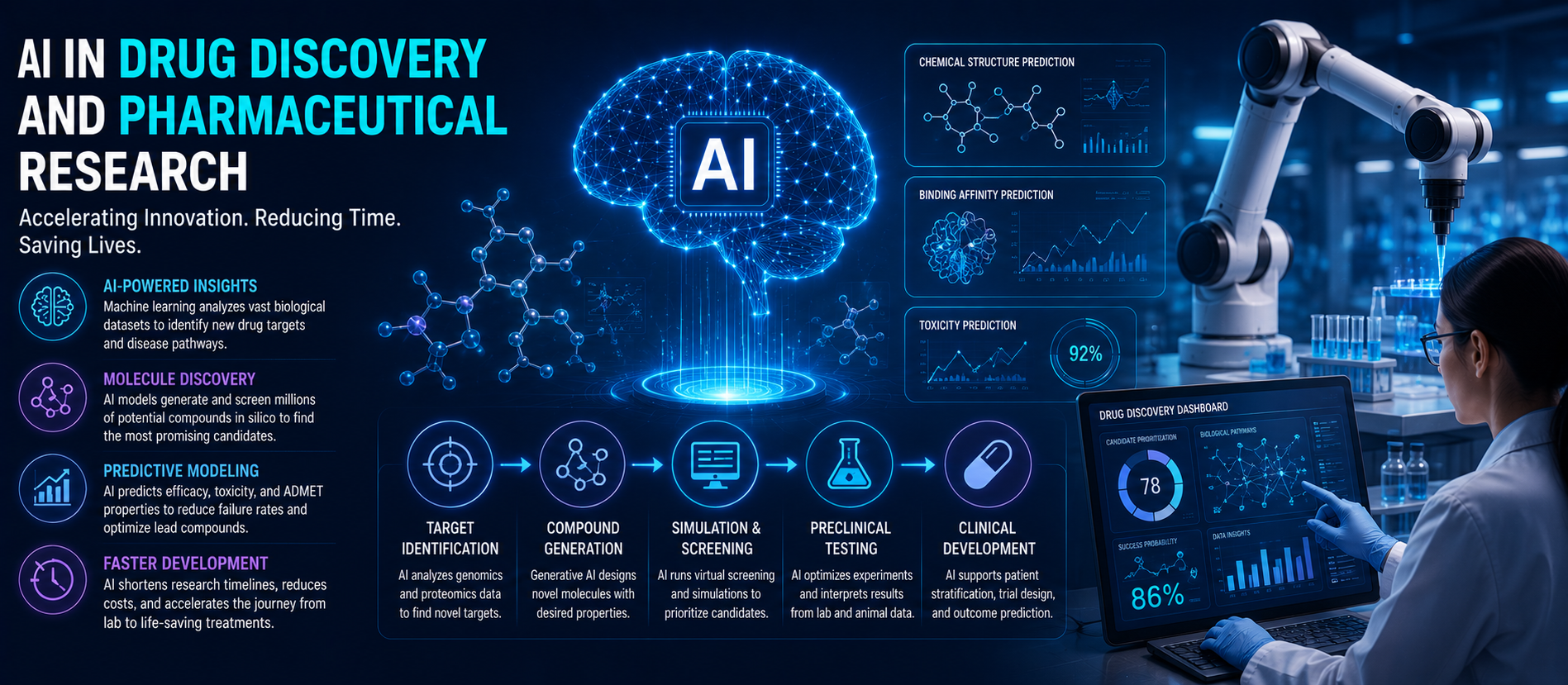
Artificial Intelligence (AI) is reshaping the pharmaceutical industry by accelerating drug discovery, improving clinical research, reducing development costs, and supporting precision medicine. AI-powered platforms can analyze massive biomedical datasets, identify promising drug candidates, predict molecular interactions, and optimize clinical trial design. As healthcare becomes increasingly data-driven, AI is helping researchers bring safer and more effective treatments to patients faster.
Why AI Matters in Drug Discovery
- Faster identification of drug candidates
- Protein structure and molecular analysis
- Clinical trial optimization
- Drug repurposing opportunities
- Predictive toxicity assessment
- Personalized medicine
Key AI Applications
Drug Candidate Discovery
Machine learning analyzes biological and chemical datasets to identify compounds with high therapeutic potential.
Molecular Modeling
AI predicts protein structures, molecular binding, and chemical interactions to reduce laboratory testing time.
Clinical Trials
AI assists with patient recruitment, trial design, monitoring, and data analysis to improve efficiency.
Drug Repurposing
AI identifies existing medicines that may be effective for new diseases, reducing development timelines.
Precision Medicine
AI helps tailor treatments using genetic, clinical, and lifestyle information to improve patient outcomes.
Benefits for Pharmaceutical Companies
- Reduced research costs
- Faster development timelines
- Improved decision-making
- Higher research productivity
- Better patient outcomes
- Enhanced innovation
SEO + AEO + GEO Optimization
Use semantic HTML headings, structured FAQ sections, descriptive metadata, entity-rich keywords, schema-ready formatting, and conversational content to improve visibility across Google Search, Bing, AI assistants, and generative search platforms.
Frequently Asked Questions
How is AI used in drug discovery?
AI analyzes biomedical data, predicts molecular interactions, supports clinical trials, and identifies promising drug candidates.
Can AI replace pharmaceutical researchers?
No. AI enhances research by accelerating analysis and hypothesis generation, while scientists remain essential for experimentation, validation, and regulatory compliance.
Conclusion
AI in drug discovery and pharmaceutical research is accelerating medical innovation by combining computational intelligence with scientific expertise. Organizations that adopt AI responsibly can improve research efficiency, reduce costs, and help deliver new therapies to patients more quickly.
About Digiifrog
Digiifrog (www.digiifrog.com) publishes expert resources on Artificial Intelligence, Digital Marketing, SEO, AEO, GEO, AI Search Optimization, healthcare technology, and business innovation.
Target Keywords: AI in drug discovery, pharmaceutical AI, AI clinical trials, precision medicine, molecular AI, SEO, AEO, GEO, AI Search.
Template note: Expand this WordPress-ready HTML template into a complete 2,000–2,500+ word article with case studies, implementation strategies, comparisons, statistics, and advanced FAQs.
Ready to Grow?
Talk to us about a strategy tailored to your brand — we will help you stand out in search, AI discovery and social.
Comments (0)
Log in to leave a comment.