📋 Quick Summary
In this article:
What Are the Most Important AI Trends for the Future?
1. Agentic AI Will Move From Experiments to Workflows
2. Multimodal AI Will Become the Default
3. AI Reasoning and Verification Will Become More Important
4. Smaller and Specialized AI Models Will Grow
5. AI Will Move Closer to Devices
6. Physical AI and Robotics Will Expand
7. AI-Native Businesses Will Redesign Workflows
8. Human-AI Collaboration Will Matter More Than Replacement
9. Personalization and AI Memory Will Expand
10. AI Governance Will Become a Core Business Function
11. AI Security Will Become More Specialized
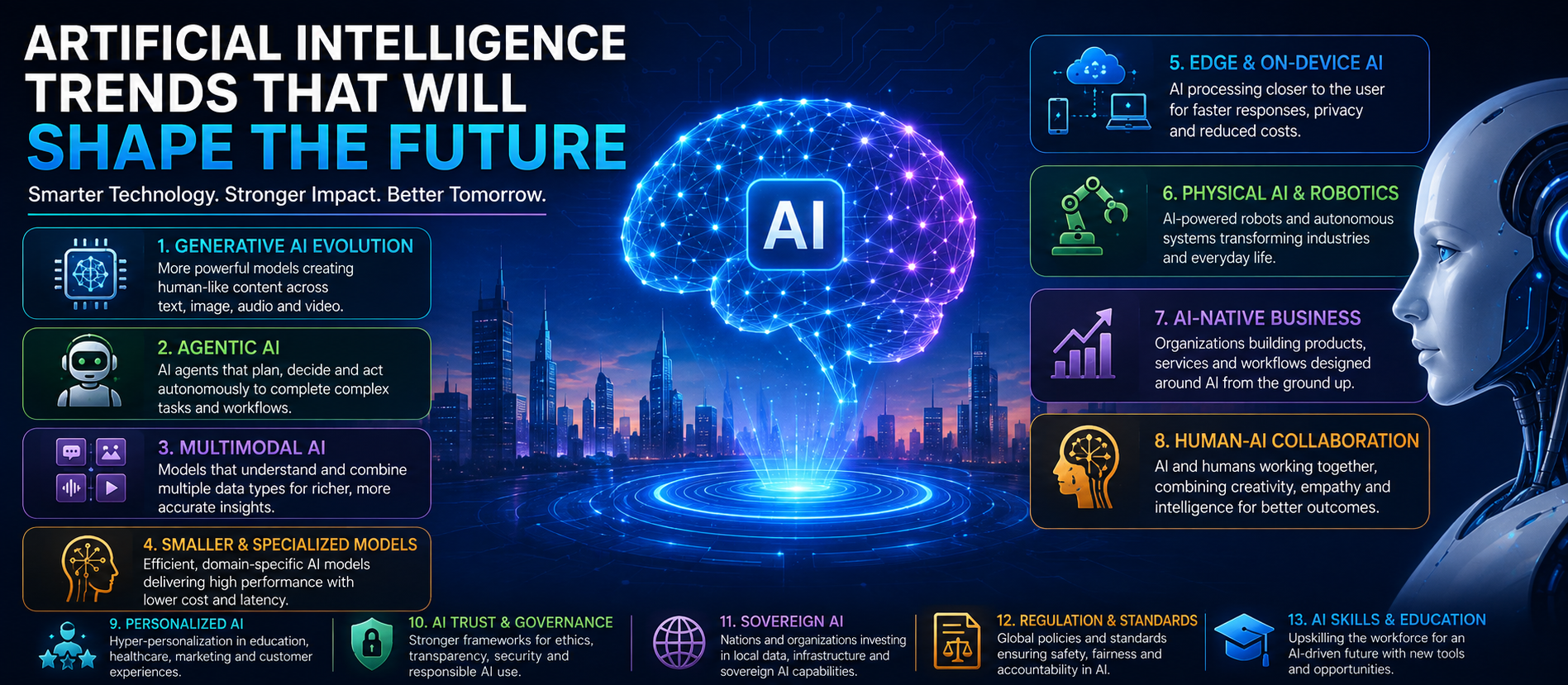
Artificial Intelligence (AI) trends that will shape the future are moving beyond chatbots and simple content generation. AI is becoming more capable of reasoning, using tools, understanding multiple data types, operating across software, and supporting decisions in business, healthcare, education, science, manufacturing, and everyday life.
In 2026, a major shift is the move from AI that responds to prompts toward AI systems that can complete multi-step workflows. Google Cloud describes this as an “agent leap,” while the World Economic Forum highlights the need for authorization, monitoring, and governance as AI agents gain more autonomy. citeturn0search0turn0search10
💡 Key Insight
At the same time, successful AI adoption requires more than powerful models. Data quality, infrastructure, security, skills, governance, cost control, and measurable business outcomes are becoming equally important. citeturn0search3
This WordPress-ready HTML article is prepared for Digiifrog (www.digiifrog.com) with SEO, AEO, GEO, and AI Search optimization.
What Are the Most Important AI Trends for the Future?
The major trends include agentic AI, multimodal intelligence, AI reasoning, smaller and specialized models, physical AI and robotics, AI-native business processes, personalized AI, AI security and governance, sovereign AI infrastructure, and AI skills. These trends are interconnected and will influence how organizations build products, manage employees, and deliver services.
1. Agentic AI Will Move From Experiments to Workflows
Traditional generative AI usually waits for a user instruction and produces an answer. Agentic AI is designed to plan tasks, use tools, interact with software, maintain context, and complete multiple steps toward a goal.
This can turn AI from a writing assistant into a digital worker handling customer service, research, software development, document processing, scheduling, and security operations. Google Cloud's 2026 research identifies the shift from one-off prompts to complex workflow orchestration as a defining business trend. citeturn0search0
The major challenge will be controlling what agents are authorized to do through permissions, monitoring, approval gates, and audit trails.
2. Multimodal AI Will Become the Default
AI systems increasingly work with text, images, audio, video, documents, and structured data rather than text alone. Multimodal AI can combine these information types to create richer analysis.
For example, an AI system could read an invoice, understand an email, check a database, analyze an image, and produce a structured recommendation. This can support business operations, education, research, and other fields when appropriate safeguards are used.
3. AI Reasoning and Verification Will Become More Important
The future of AI is not only about fluent answers. Systems increasingly need to reason through complex tasks, use external tools, check intermediate results, and recognize uncertainty.
Businesses will ask not only “Can the model answer?” but also “Can we verify the answer?” This will increase demand for evaluation datasets, human review, retrieval systems, automated checks, and domain-specific validation.
4. Smaller and Specialized AI Models Will Grow
Large frontier models will remain important, but smaller models can offer advantages in cost, speed, privacy, latency, and deployment flexibility. Organizations may increasingly use different models for different tasks instead of relying on one general-purpose system.
Specialized models can be optimized for coding, customer support, document extraction, cybersecurity, finance, manufacturing, or healthcare. Model diversity can also reduce dependency on a single provider.
5. AI Will Move Closer to Devices
More AI processing is likely to happen on phones, computers, vehicles, industrial equipment, cameras, and other edge devices. On-device AI can reduce latency and may offer privacy and connectivity benefits because some processing can happen locally.
Edge AI will be especially important where real-time response matters, including robotics, manufacturing, automotive systems, security monitoring, and consumer devices.
6. Physical AI and Robotics Will Expand
AI is increasingly moving from digital environments into the physical world. Robots, autonomous machines, industrial systems, drones, and intelligent vehicles can combine perception, reasoning, planning, and action.
Deloitte's 2026 enterprise AI research reports growing physical-AI adoption and expects usage to expand further. citeturn0search3
The opportunity is not simply making robots more intelligent; it is creating systems that can operate safely around people, equipment, and unpredictable environments.
7. AI-Native Businesses Will Redesign Workflows
Many companies initially add AI to existing processes. The next stage is redesigning the process around AI capabilities. Instead of adding an assistant to a manual workflow, businesses may create an AI-native workflow in which agents, software, databases, and employees work together from the beginning.
This can change customer service, sales, marketing, finance, software development, operations, and internal knowledge management.
8. Human-AI Collaboration Will Matter More Than Replacement
The future workplace is likely to combine human expertise and AI systems. People provide judgment, context, accountability, creativity, and strategy, while AI handles repetitive analysis, drafting, search, classification, and workflow execution.
Deloitte reports that AI skills gaps remain a major barrier to integration, showing that AI adoption requires training and organizational change as well as technology. citeturn0search3
9. Personalization and AI Memory Will Expand
AI systems are becoming better at using preferences, previous interactions, organizational knowledge, and long-term context. Personalization can make AI more useful because the system does not need to rediscover the same background every time.
Memory also creates privacy and security questions. Organizations need rules about what an AI system may remember, how long information is retained, who can access it, and how users can correct or delete information.
10. AI Governance Will Become a Core Business Function
As AI becomes more autonomous, governance needs practical controls for data, model selection, access, testing, monitoring, human oversight, incident response, and accountability.
The World Economic Forum notes that agentic AI creates new governance and security challenges because agents can act across interconnected systems. citeturn0search2
AI governance will increasingly become part of product development, cybersecurity, legal review, procurement, and enterprise risk management.
11. AI Security Will Become More Specialized
AI introduces security risks of its own, including prompt injection, data leakage, malicious tool use, insecure agents, model manipulation, unauthorized access, and AI supply-chain attacks.
Agentic systems make these issues more important because models connected to tools can create real-world effects. New approaches are emerging around agent authorization, runtime controls, monitoring, and incident reporting. citeturn0search4turn0search10
12. Sovereign AI and Data Control Will Grow
Sovereign AI broadly refers to AI capabilities operated under a country's or organization's own laws, infrastructure, data controls, and strategic requirements. Governments and enterprises are increasingly considering where models run, where data is stored, which providers control infrastructure, and how dependent they are on external technology.
Deloitte identifies sovereign AI as an emerging strategic consideration involving infrastructure, capability, and legal jurisdiction. citeturn0search3
14. AI Regulation and Standards Will Continue to Evolve
AI governance is developing across jurisdictions through legislation, standards, risk frameworks, transparency requirements, and sector-specific rules. The global regulatory environment is not uniform, so companies operating internationally need to monitor multiple jurisdictions.
The ITU identifies agent governance, standards, infrastructure, and risk management as major themes in AI governance. citeturn0search1turn0search7
How Businesses Can Prepare for the AI Future
- Identify business processes where AI can create measurable value.
- Start with clear use cases instead of adopting AI without a goal.
- Build strong data governance and security controls.
- Define human approval requirements for high-impact actions.
- Evaluate AI systems before and after deployment.
- Monitor agent permissions and tool access.
- Train employees in AI literacy and responsible use.
- Track costs, productivity, quality, and business outcomes.
- Monitor changing regulations and standards.
- Continuously improve AI workflows using real-world results.
SEO, AEO, GEO and AI Search Optimization
SEO content about future AI trends should target searches such as “artificial intelligence trends,” “future of AI,” “AI trends 2026,” “future AI technology,” “AI agents,” “multimodal AI,” and “AI business trends.”
AEO should directly answer questions such as “What are the biggest AI trends?”, “Will AI agents replace traditional automation?”, and “How will AI change businesses in the future?”
GEO and AI Search optimization can be strengthened with current research, clear definitions, structured headings, concise answers, practical examples, authoritative references, FAQs, and topic-specific terminology.
Frequently Asked Questions About Future AI Trends
What is the biggest AI trend for the future?
One of the biggest trends is the move toward agentic AI systems that can plan, use tools, and complete multi-step workflows with greater autonomy. Governance and authorization become increasingly important as these systems expand. citeturn0search0turn0search10
Will AI agents replace traditional automation?
AI agents are likely to complement and extend traditional automation rather than replace every deterministic workflow. Traditional automation remains useful for predictable processes, while agents can handle tasks requiring interpretation, planning, and adaptation.
What is multimodal AI?
Multimodal AI can work with multiple information types, such as text, images, audio, video, and structured data, allowing systems to combine information from different sources.
Why is AI governance becoming important?
More capable and autonomous AI systems can affect data, software, decisions, and real-world operations. Governance helps define acceptable use, permissions, monitoring, accountability, security, and human oversight. citeturn0search2turn0search10
Conclusion
The future of artificial intelligence will be shaped by a transition from simple AI tools to intelligent systems that can understand context, reason, use tools, collaborate with people, and act across digital and physical environments.
Agentic AI, multimodal systems, physical AI, smaller models, AI-native workflows, personalization, sovereign infrastructure, AI governance, security, and workforce skills are likely to become central themes of the next stage of AI adoption. Current research shows that organizations are moving toward more autonomous AI while governance, infrastructure, talent, and measurable business value remain critical challenges. citeturn0search0turn0search3turn0search10
The organizations most likely to benefit will be those that connect AI to real business problems, build trustworthy data and security foundations, train people, measure outcomes, and design appropriate human oversight.
For businesses seeking modern websites, AI content, automation, SEO, AEO, GEO, and AI Search optimization, Digiifrog can help. Visit www.digiifrog.com.
Quick Answer: What AI Trends Will Shape the Future?
The AI trends most likely to shape the future include agentic AI, multimodal intelligence, advanced reasoning, smaller specialized models, on-device AI, physical AI and robotics, AI-native business workflows, personalization and memory, AI security and governance, sovereign AI infrastructure, efficient AI computing, evolving regulation, stronger AI evaluation, and widespread AI skills.
Important Note
This article is educational content and describes rapidly evolving technology trends. Specific AI capabilities, regulations, products, costs, and adoption rates can change quickly. Organizations should verify current technical and legal requirements before making major AI deployment decisions.
Ready to Grow?
Talk to us about a strategy tailored to your brand — we will help you stand out in search, AI discovery and social.

Comments (0)
Log in to leave a comment.