📋 Quick Summary
In this article:
What Are AI-Powered Learning Platforms?
How Do AI-Powered Learning Platforms Work?
AI Tutors and Virtual Learning Assistants
Natural Language Processing in Education
AI for Schools and Educational Institutions
Artificial intelligence is changing the way people learn. Students no longer have to depend only on traditional classrooms, printed books, and fixed learning schedules. Modern technology can now help learners receive personalized lessons, instant feedback, adaptive practice, and intelligent study support.
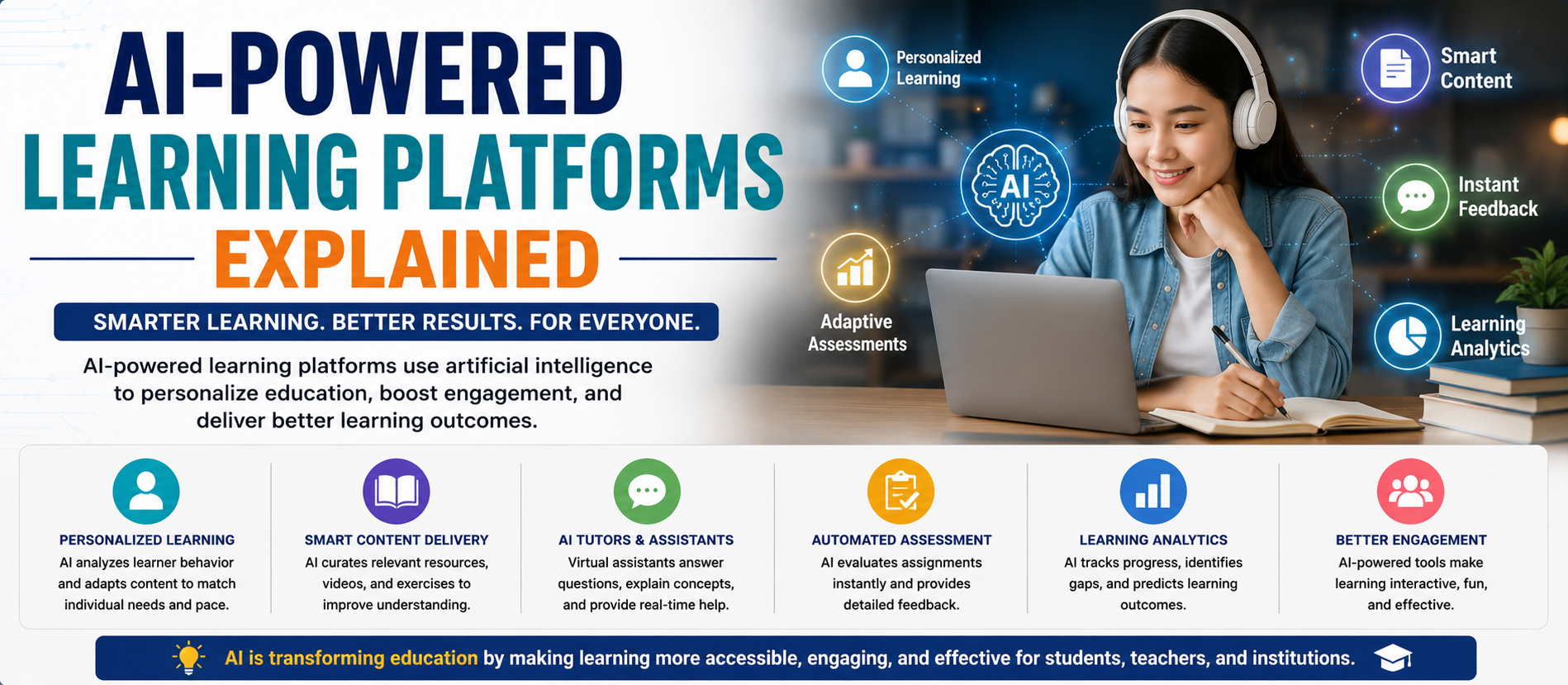
AI-powered learning platforms use artificial intelligence to improve the learning experience. These platforms can analyze learner behavior, identify strengths and weaknesses, recommend useful content, and adjust lessons based on individual progress.
AI does not simply replace teachers. In many cases, it acts as a support system that helps teachers and learners work more effectively. It can automate repetitive tasks, provide personalized recommendations, and make educational resources more accessible.
This guide explains AI-powered learning platforms in simple language. You will learn how they work, what features they offer, their benefits and limitations, and how they may shape the future of education.
What Are AI-Powered Learning Platforms?
AI-powered learning platforms are educational systems that use artificial intelligence to support teaching and learning.
These platforms may use technologies such as:
- Machine learning.
- Natural language processing.
- Predictive analytics.
- Generative AI.
- Speech recognition.
- Recommendation systems.
The main purpose is to make learning more personalized, efficient, and interactive.
For example, an AI learning platform may notice that a student is struggling with algebra. Instead of giving the student the same content repeatedly, the system may recommend easier explanations, additional practice questions, videos, or step-by-step lessons.
How Do AI-Powered Learning Platforms Work?
AI learning systems usually collect and analyze information about the learning process.
This information may include:
- Lessons completed.
- Quiz scores.
- Time spent on activities.
- Topics answered incorrectly.
- Learning preferences.
- Previous performance.
The system uses this information to identify patterns and provide recommendations.
A simplified process looks like this:
- The learner uses the platform.
- The system records relevant learning activity.
- AI analyzes patterns and performance.
- The platform identifies possible strengths or learning gaps.
- The system recommends suitable next steps.
The exact technology and level of personalization vary between platforms.
Personalized Learning With AI
One of the biggest advantages of AI in education is personalization.
Traditional classrooms often teach many students using the same lesson plan. However, every student learns differently. Some people understand concepts quickly, while others need more practice and explanation.
AI can help create a more flexible learning path.
For example, one learner may receive:
- Advanced practice questions.
- Faster lesson progression.
- More challenging projects.
Another learner may receive:
- Simple explanations.
- Additional examples.
- Extra practice exercises.
- Review recommendations.
This approach is often called adaptive learning.
Adaptive Learning Explained
Adaptive learning means that educational content changes based on the learner's needs and performance.
If a student answers several questions correctly, the system may increase the difficulty level. If the student struggles, the platform may provide additional support.
Adaptive learning can help prevent two common problems:
- Learning material that is too easy.
- Learning material that is too difficult.
The goal is to provide an appropriate level of challenge.
AI Tutors and Virtual Learning Assistants
AI-powered tutors are becoming more common in digital education.
A virtual learning assistant may help students:
- Understand difficult concepts.
- Answer basic questions.
- Create study plans.
- Generate practice exercises.
- Review important topics.
Generative AI can also explain the same topic in different ways. For example, a learner might ask for:
- A simple explanation.
- A detailed explanation.
- A real-world example.
- A step-by-step explanation.
This flexibility can make learning more accessible.
Instant Feedback
Traditional grading can take time. AI-powered systems can provide immediate feedback for many types of learning activities.
For example, after completing a quiz, a learner may immediately see:
- Which answers were correct.
- Which answers were incorrect.
- Why an answer may be incorrect.
- What topic should be reviewed next.
Fast feedback can help learners correct mistakes before they become long-term misunderstandings.
AI and Automated Assessment
AI can support automated assessment in some educational situations.
It may help evaluate:
- Multiple-choice questions.
- Basic written responses.
- Programming exercises.
- Language pronunciation.
- Interactive activities.
However, automated assessment is not perfect. Complex writing, creative work, and subjective assignments may require human judgment.
Teachers should understand how automated systems make recommendations and review important decisions carefully.
Natural Language Processing in Education
Natural language processing, often called NLP, helps computers understand and process human language.
In learning platforms, NLP can support:
- Chat-based learning assistants.
- Language learning tools.
- Essay feedback.
- Question answering.
- Text summarization.
This technology allows learners to interact with educational systems using more natural language.
AI for Language Learning
AI is especially useful for language education.
AI-powered language platforms may help learners with:
- Pronunciation practice.
- Vocabulary building.
- Grammar correction.
- Conversation practice.
- Personalized exercises.
Speech recognition can analyze pronunciation and provide feedback. AI conversation tools can also give learners opportunities to practice communication.
AI for Students
Students can use AI-powered learning platforms to create a more organized learning experience.
Possible benefits include:
- Personalized learning paths.
- Flexible study schedules.
- Instant feedback.
- Additional practice materials.
- Study reminders.
- Progress tracking.
Students should still develop independent thinking and critical reasoning. AI should support learning rather than replace the learning process.
AI for Teachers
Teachers can use AI tools to reduce repetitive administrative work and gain insights into student progress.
AI may help teachers:
- Identify students who may need additional support.
- Create practice materials.
- Analyze class performance.
- Organize learning resources.
- Provide faster feedback.
Teachers remain important because education involves human judgment, communication, empathy, mentorship, and context.
AI for Schools and Educational Institutions
Educational institutions can use AI to improve learning systems and administrative processes.
Possible applications include:
- Student support systems.
- Personalized learning.
- Academic analytics.
- Automated administrative tasks.
- Course recommendations.
Institutions should also develop responsible AI policies that address privacy, fairness, security, and academic integrity.
Key Features of AI-Powered Learning Platforms
1. Personalized Recommendations
The system recommends lessons, resources, and activities based on learning progress.
2. Adaptive Content
The difficulty and type of learning material may change based on performance.
3. Intelligent Tutoring
AI assistants can provide explanations and learning support.
4. Automated Feedback
Learners can receive faster feedback on many activities.
5. Progress Analytics
Dashboards can show completed lessons, performance trends, and learning gaps.
6. Interactive Learning
AI can support quizzes, simulations, conversations, and other interactive experiences.
Benefits of AI-Powered Learning Platforms
Personalized Education
AI can help provide a learning experience that is more suitable for individual needs.
Flexible Learning
Students can often learn at their own pace and schedule.
Faster Feedback
Immediate feedback can help learners identify mistakes quickly.
Better Progress Tracking
Students and teachers can use data to understand learning progress.
Greater Accessibility
AI tools may support learners through translation, text-to-speech, speech recognition, and alternative learning formats.
More Engaging Learning
Interactive systems can make education more engaging for some learners.
Challenges of AI in Education
AI-powered learning platforms also have limitations and risks.
Accuracy Problems
AI systems can produce incorrect information. Generative AI may sometimes create false or misleading answers.
Learners should verify important information using reliable sources.
Data Privacy
Learning platforms may collect information about students and their activities.
Organizations should understand:
- What data is collected.
- Why it is collected.
- How long it is stored.
- Who can access it.
- How it is protected.
Bias and Fairness
AI systems can reflect bias present in data or design decisions.
Educational institutions should monitor AI systems and avoid relying on automated decisions without appropriate human review.
Overdependence on Technology
Students may become too dependent on AI tools if they use them to complete work without understanding the subject.
AI should support learning, not replace critical thinking.
Digital Access
Not every learner has equal access to reliable devices or high-speed internet.
Technology-based education should consider accessibility and the digital divide.
How AI Changes the Role of Teachers
AI is unlikely to remove the need for teachers. Instead, it may change how teachers spend their time.
Teachers may spend less time on repetitive administrative tasks and more time on:
- Mentoring students.
- Providing personal guidance.
- Supporting critical thinking.
- Managing classroom discussions.
- Evaluating complex work.
Human teachers provide emotional understanding and real-world experience that technology cannot fully replace.
AI and Academic Integrity
Generative AI has created new questions about academic integrity.
Students may use AI tools to:
- Generate written content.
- Solve problems.
- Create computer code.
- Summarize research.
Educational institutions need clear rules about acceptable and unacceptable use.
Students should understand when AI is allowed, when it must be disclosed, and when independent work is required.
How to Choose an AI-Powered Learning Platform
Before choosing a platform, consider your learning needs.
Ask these questions:
- What subject do I want to learn?
- Does the platform offer personalized learning?
- How does it protect user data?
- Does it provide reliable educational content?
- Can I track my progress?
- Does it fit my budget?
Do not choose a platform only because it uses the word "AI." Focus on whether the platform provides useful learning outcomes.
Tips for Using AI Learning Platforms Effectively
Set Clear Learning Goals
Know what you want to achieve before using the platform.
Verify Important Information
AI-generated answers can be incorrect. Check important facts.
Ask Specific Questions
Clear questions often produce more useful answers.
Practice Without AI Assistance
Test your own understanding regularly.
Use AI as a Learning Partner
Ask AI to explain concepts, provide examples, or create practice questions instead of simply asking it to complete all the work.
AI-Powered Learning for Professional Development
AI learning platforms are not only for school students.
Professionals use online learning to develop skills in:
- Digital marketing.
- Programming.
- Business.
- Design.
- Data analysis.
- Artificial intelligence.
Personalized learning systems can recommend skills based on career goals and current knowledge.
Corporate Learning and AI
Businesses can use AI-powered learning systems for employee training.
AI may help organizations:
- Recommend relevant training.
- Track learning progress.
- Identify skill gaps.
- Create personalized learning paths.
This can help companies build more flexible learning and development programs.
AI and Learning Analytics
Learning analytics involves studying educational data to understand learning behavior and outcomes.
AI can identify patterns that may help educators understand:
- Which topics are difficult.
- Where learners stop engaging.
- Which resources are effective.
- Who may need additional support.
Analytics should be used responsibly and should not replace human judgment.
The Future of AI-Powered Education
The future of education may become more personalized and interactive.
Possible developments include:
- More advanced AI tutors.
- Real-time personalized lessons.
- AI-powered simulations.
- Virtual learning environments.
- Better accessibility tools.
- Improved learning analytics.
However, the future of education should not be based only on technology. Human teachers, ethical standards, privacy protection, and equal access will remain important.
AI, SEO, AEO, GEO and Modern Education Content
People now discover educational information through traditional search engines, AI assistants, answer engines, and generative search experiences.
SEO, or Search Engine Optimization, helps useful content become easier to discover through search results. AEO, or Answer Engine Optimization, focuses on providing clear and direct answers to common questions. GEO, or Generative Engine Optimization, focuses on creating well-structured content that generative AI systems can understand and use effectively.
Educational content should use clear headings, direct explanations, accurate information, examples, and easy-to-read language. This improves readability for people and can also help modern AI-powered search systems understand the topic.
Digiifrog focuses on modern digital strategies, including SEO, AEO, GEO, and AI Search optimization. Businesses, educators, and digital publishers can benefit from clear, structured, helpful content designed for the changing search environment.
Frequently Asked Questions
What is an AI-powered learning platform?
An AI-powered learning platform uses artificial intelligence to support education. It may provide personalized recommendations, adaptive lessons, feedback, analytics, or AI tutoring.
How does AI personalize learning?
AI can analyze learning activity and performance to recommend lessons, practice exercises, or resources that match a learner's needs.
Can AI replace teachers?
AI can support teachers, but human teachers remain important for mentorship, judgment, communication, emotional support, and complex educational decisions.
Are AI learning platforms accurate?
AI systems can make mistakes. Important information should be verified using reliable sources.
Is student data safe on AI learning platforms?
Data protection depends on the platform's policies and security practices. Users and institutions should review privacy and data management practices before using a platform.
How can students use AI responsibly?
Students can use AI for explanations, practice, brainstorming, and learning support while continuing to think independently and following academic integrity rules.
Conclusion
AI-powered learning platforms are changing education by making learning more personalized, flexible, and interactive.
AI can recommend suitable lessons, provide instant feedback, identify learning gaps, and support students with intelligent tutoring. Teachers and educational institutions can also use AI to improve learning analytics and reduce repetitive work.
💡 Key Insight
However, AI is not perfect. Accuracy, privacy, bias, accessibility, and academic integrity remain important challenges.
The best approach is to use AI as a powerful learning tool while maintaining human judgment and critical thinking. When used responsibly, AI-powered learning platforms can help students, professionals, teachers, and organizations create better learning experiences.
Digiifrog
Website: www.digiifrog.com
Digital Growth Through SEO, AEO, GEO & AI Search Optimization.
Ready to Grow?
Talk to us about a strategy tailored to your brand — we will help you stand out in search, AI discovery and social.

Comments (0)
Log in to leave a comment.